

Types of Financial Statements for South African Businesses 2025
Financial statements are like the lifeblood of any South African business. A recent study shows that many small enterprises in South Africa still underutilise critical financial documents despite their potential. Most would expect red tape and paperwork to be the main reason for these reports. The real surprise is that these statements can open doors to smarter strategy, tax savings, and even unlock investor trust.
Table of Contents
- Understanding Key Types Of Financial Statements
- Benefits For Small And Medium South African Businesses
- Using Financial Statements For Tax And Cipc Compliance
- Choosing Cloud-Based Tools For Easy Financial Reporting
Quick Summary
| Takeaway | Explanation |
|---|---|
| Understand Key Financial Statements | Income statements, balance sheets, and cash flow statements are essential for assessing financial health. |
| Leverage Statements for Strategic Decisions | Use financial statements to monitor performance and control costs for better decision-making. |
| Ensure Compliance with SARS and CIPC | Accurate financial records are necessary to meet tax and statutory regulation requirements. |
| Utilize Cloud Accounting Tools | Cloud solutions enhance accuracy, efficiency, and collaboration in financial reporting. |
| Build Trust with Accurate Records | Maintaining meticulous financial statements fosters confidence with stakeholders and investors. |
Understanding Key Types of Financial Statements
Financial statements are critical documents that provide a comprehensive overview of a business’s financial health and performance. For South African businesses, understanding these key financial documents is essential for strategic decision-making, regulatory compliance, and attracting potential investors.
The South African Companies Act mandates specific financial reporting requirements, making it crucial for businesses to prepare accurate and transparent financial statements. Let’s explore the primary types of financial statements that every South African business should understand.
Income Statement: Revealing Business Performance
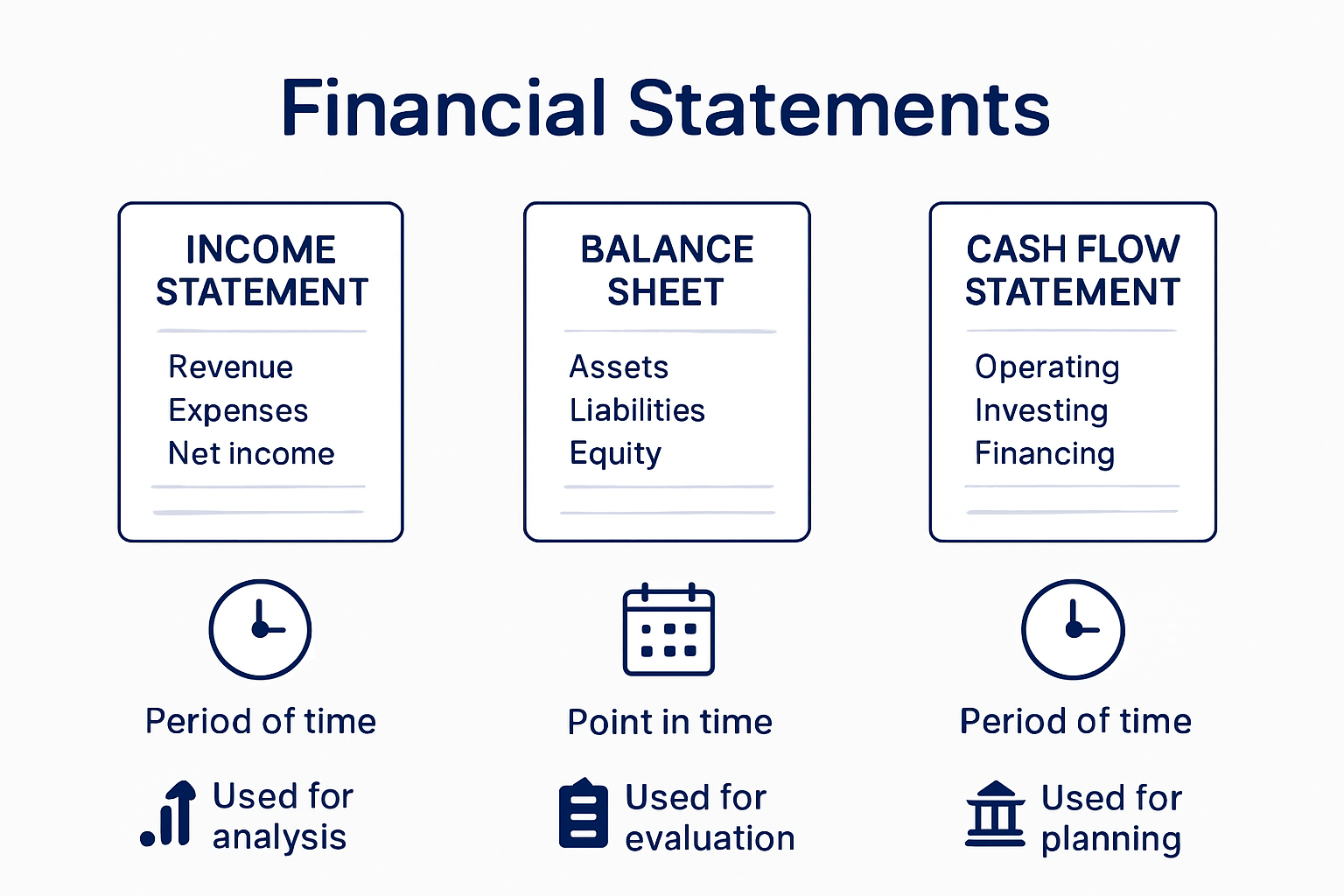
The income statement, also known as the profit and loss statement, provides a detailed account of a company’s revenues, expenses, and profitability over a specific period. According to the Companies and Intellectual Property Commission (CIPC), this document is fundamental in assessing a business’s financial performance.
Key components of an income statement include:
- Revenue: Total income generated from sales and other business activities
- Expenses: Costs incurred in running the business
- Net Profit/Loss: The final financial result after subtracting expenses from revenue
For South African businesses, the income statement helps track financial progress, identify potential areas of improvement, and make informed strategic decisions. Tax accountants and financial advisors frequently use this document to understand a company’s financial trajectory and potential tax implications.
Balance Sheet: Snapshot of Financial Position
A balance sheet provides a comprehensive view of a company’s financial position at a specific point in time. The South African Qualifications Authority (SAQA) emphasizes the importance of this document in understanding a business’s assets, liabilities, and shareholders’ equity.
The balance sheet comprises three primary sections:
- Assets: What the company owns (cash, inventory, equipment)
- Liabilities: What the company owes to external parties
- Shareholders’ Equity: The net worth of the business
Businesses can learn more about interpreting financial statements to gain deeper insights into their financial health and make strategic decisions.
Cash Flow Statement: Tracking Financial Liquidity
The cash flow statement is crucial for understanding how cash moves in and out of a business. It breaks down cash transactions into three main categories: operating, investing, and financing activities. This statement helps businesses assess their ability to generate cash, meet financial obligations, and fund future growth.
For South African businesses, particularly small and medium enterprises, the cash flow statement provides critical insights into financial liquidity and sustainable operations. It helps management understand when and how cash is being generated and spent, enabling more effective financial planning and resource allocation.
Understanding these financial statements is not just a regulatory requirement but a strategic tool for business success. By maintaining accurate and transparent financial records, South African businesses can build trust with stakeholders, make informed decisions, and position themselves for sustainable growth in an increasingly competitive market.
To help clarify the distinctions, here is a summary table comparing the three key types of financial statements discussed above:
| Statement Type | Main Focus | Key Components | Insights Provided |
|---|---|---|---|
| Income Statement | Performance over time | Revenue, Expenses, Net Profit/Loss | Profitability and operational success |
| Balance Sheet | Financial position at a point | Assets, Liabilities, Shareholders’ Equity | Solvency, financial stability |
| Cash Flow Statement | Cash movement over a period | Operating, Investing & Financing Activities | Liquidity, cash management |
Benefits for Small and Medium South African Businesses
Financial statements are more than just regulatory documents for small and medium enterprises (SMEs) in South Africa. They are powerful strategic tools that can transform business management, financial planning, and growth potential. Research from the South African Journal of Economic and Management Sciences reveals that many small enterprises often underutilize these critical financial documents.
Strategic Decision-Making and Financial Clarity
For South African SMEs, comprehensive financial statements provide unparalleled insights into business performance. By maintaining detailed income statements, balance sheets, and cash flow statements, businesses can make data-driven decisions that directly impact their bottom line.
Key strategic benefits include:
- Performance Tracking: Identifying profitable revenue streams
- Cost Management: Pinpointing unnecessary expenses
- Financial Forecasting: Predicting future financial scenarios
The South African Qualifications Authority (SAQA) emphasizes that financial literacy is crucial for small business owners to effectively interpret these documents and drive strategic growth.
Investor and Stakeholder Confidence
Accurate financial statements are fundamental in building credibility with potential investors, banks, and other stakeholders. According to Find an Accountant, the South African Companies Act mandates transparent financial reporting, which can significantly enhance a business’s reputation.
Businesses that maintain precise financial records demonstrate:
- Professionalism: Commitment to financial transparency
- Risk Management: Clear understanding of financial health
- Growth Potential: Ability to secure funding and investments
For those looking to optimize their tax strategy, explore our comprehensive small business tax planning guide to maximize financial efficiency.
Compliance and Financial Health
Comprehensive financial statements are not just recommended but legally required for South African businesses. They serve as critical tools for:
- Accurate tax reporting
- SARS compliance
- Identifying potential financial risks
- Supporting long-term business sustainability
By maintaining meticulous financial records, SMEs can avoid potential legal complications, minimize tax liabilities, and create a solid foundation for sustainable growth. Financial statements transform from being mere compliance documents to strategic assets that drive business success in the competitive South African market.
Using Financial Statements for Tax and CIPC Compliance
For South African businesses, financial statements are not just internal management tools but critical documents for ensuring compliance with regulatory bodies like SARS and the Companies and Intellectual Property Commission (CIPC). Navigating the complex landscape of tax reporting and corporate regulations requires meticulous financial documentation and strategic preparation.
SARS Tax Reporting Requirements
The South African Revenue Service (SARS) relies heavily on comprehensive financial statements to assess a company’s tax obligations. According to the SARS Tax Compliance Status Guide, businesses must submit accurate income statements and balance sheets that transparently reflect their financial activities.
Key tax reporting considerations include:
- Income Declaration: Precise reporting of all revenue streams
- Expense Verification: Detailed documentation of business expenditures
- Tax Deduction Substantiation: Supporting evidence for claimed tax benefits
Businesses that maintain well-structured financial statements can significantly streamline their tax filing process, reduce audit risks, and potentially minimize tax liabilities. Learn more about preparing comprehensive annual financial statements to ensure smooth tax compliance.
CIPC Compliance and Statutory Reporting
The Companies and Intellectual Property Commission mandates specific financial reporting standards for registered businesses. The CIPC Annual Return Guidelines outline the requirements for submitting financial statements that demonstrate a company’s financial health and operational transparency.
Companies must prepare:
- Annual Financial Statements: Comprehensive overview of financial performance
- Annual Returns: Detailed documentation of company status and financial activities
- Statutory Financial Reports: Compliance documents for regulatory review
Professional financial statements not only satisfy legal requirements but also provide stakeholders with confidence in the business’s financial management and governance.
Minimizing Compliance Risks
Proper financial statement preparation is crucial for mitigating potential compliance risks. Inaccurate or incomplete documentation can lead to significant penalties, legal complications, and reputational damage.
Strategies for effective compliance include:
- Regular financial record maintenance
- Engaging professional accounting services
- Staying updated on regulatory changes
- Implementing robust internal financial controls
By treating financial statements as strategic assets rather than mere administrative requirements, South African businesses can transform compliance from a challenging obligation into an opportunity for financial optimization and stakeholder trust.
Ultimately, well-prepared financial statements serve as a powerful communication tool, demonstrating a company’s commitment to transparency, financial discipline, and professional governance in the complex South African business environment.
Choosing Cloud-Based Tools for Easy Financial Reporting
Cloud-based financial reporting tools have revolutionized how South African businesses manage their financial documentation, offering unprecedented flexibility, accuracy, and efficiency. Research by Okon and colleagues highlights the transformative potential of cloud computing in enhancing financial reporting quality for businesses across various sectors.
Here is a table summarising the key features and security considerations to evaluate when choosing a cloud accounting solution in South Africa:
| Feature/Consideration | Description |
|---|---|
| Real-Time Financial Tracking | Instant access to up-to-date financial data |
| Automated Reporting | Minimises manual entries, speeds up report generation |
| Secure Data Storage | Protects sensitive company financial information |
| Multi-User Collaboration | Allows team members to work together easily |
| Data Encryption | Safeguards data through encryption standards |
| SARS Compatibility | Ensures tool aligns with SA tax regulations |
| CIPC Reporting Standards | Meets statutory financial reporting obligations |
| Multi-Factor Authentication | Adds extra security against unauthorised access |
Key Features of Cloud Accounting Solutions
Modern cloud-based financial reporting tools provide South African businesses with comprehensive features that streamline financial management. These platforms go beyond traditional accounting software by offering real-time data synchronization, automatic updates, and seamless integration with existing business systems.
Critical features include:
- Real-Time Financial Tracking: Instant access to financial data
- Automated Reporting: Reduced manual data entry
- Secure Data Storage: Enhanced protection of sensitive financial information
- Multi-User Collaboration: Simplified team access and communication
Explore the comprehensive benefits of cloud accounting for small business growth to understand how these tools can transform your financial management approach.
Security and Compliance Considerations
Cloud-based financial reporting tools for South African businesses must address critical security and regulatory compliance requirements. A study by Bina Nusantara University emphasizes the importance of developing robust cloud-based accounting information systems that meet specific business needs.
Key security and compliance aspects to consider:
- Data Encryption: Protecting financial information
- SARS Compatibility: Ensuring alignment with South African tax regulations
- CIPC Reporting Standards: Meeting statutory reporting requirements
- Multi-Factor Authentication: Preventing unauthorized access
Selecting the Right Cloud Accounting Tool
Choosing an appropriate cloud-based financial reporting tool requires careful consideration of your business’s unique needs. Businesses should evaluate solutions based on:
- Scalability
- User-friendly interface
- Integration capabilities
- Cost-effectiveness
- Customer support
For South African businesses, the ideal cloud accounting solution should offer:
- Rand currency support
- Local tax compliance features
- SARS and CIPC reporting templates
- Multilingual support
- Localized customer service

By leveraging cloud-based financial reporting tools, South African businesses can transform their financial management approach. These solutions offer more than just technological convenience they provide strategic insights, enhance operational efficiency, and support sustainable business growth in an increasingly digital marketplace.
As technology continues to evolve, cloud accounting solutions will play an increasingly critical role in helping businesses make informed financial decisions, maintain regulatory compliance, and compete effectively in the dynamic South African business landscape.
Frequently Asked Questions
What are the key financial statements that South African businesses should know?
The key financial statements for South African businesses are the income statement, balance sheet, and cash flow statement. These documents provide essential insights into a company’s financial health and performance.
How can financial statements benefit small and medium enterprises in South Africa?
Financial statements enable small and medium enterprises to track performance, make informed strategic decisions, build investor and stakeholder confidence, and ensure compliance with tax and regulatory requirements.
What are the tax reporting requirements for financial statements in South Africa?
South African businesses must ensure their financial statements accurately reflect their income and expenses to comply with the South African Revenue Service (SARS) reporting requirements. This includes proper documentation of all revenue streams and business expenditures.
Why should South African businesses consider using cloud-based financial reporting tools?
Cloud-based financial reporting tools offer advantages such as real-time financial tracking, automated reporting, secure data storage, and enhanced collaboration among team members, making financial management more efficient and streamlined.
Unlock the Power of Financial Statements for Your Business
Many business owners in South Africa feel overwhelmed when faced with income statements, balance sheets, and the demands of compliance. If you are unsure how to turn your financial data into smart decisions or worry about missing key SARS and CIPC requirements, you are not alone. This article has shown that accurate financial statements help you make bold moves, win investor trust, and keep your business compliant.
Ready Accounting specialises in taking the guesswork out of financial reporting. With expert cloud accounting solutions, we help you prepare reliable statements, organise your books, and stay ahead of regulatory changes. Stop worrying about errors and missed deadlines. Experience our tailored accounting services for guidance that suits the South African business landscape. Not sure where to begin? See how we simplify annual financial statement preparation and discover why hundreds of business owners trust us to streamline their compliance journey. Take control of your financial future today. Get in touch with Ready Accounting now and turn your financial records into your business advantage.
Recommended
- Annual Financial Statements in South Africa: What Business Owners Need to Know for 2025 – Ready Accounting
- What Is Financial Reporting? Guide for South African Businesses 2025 – Ready Accounting
- How to Prepare Financial Statements for South African Businesses in 2025 – Ready Accounting
- How to Read Financial Statements: Easy Guide for 2025 – Ready Accounting