

Execution Framework: Read a Balance Sheet for SA Business Owners 2025
Balance sheets sound like something only accountants get excited about, right? Surprisingly, over 80 percent of South African small business owners admit they don’t fully understand what’s on their own balance sheet. And missing those numbers can mean missing out on growth, locked-up cash, or hidden risks. Knowing how to decode these documents could be the difference between watching your business stall and finding fresh opportunities nobody else sees.
Table of Contents
- Understanding the Basics of a Balance Sheet
- Key Sections: Assets, Liabilities, Equity Explained
- How Balance Sheets Impact Tax and Reporting
- Tips for Cloud Accounting and Company Compliance
Quick Summary
| Takeaway | Explanation |
|---|---|
| Understand balance sheet components | Familiarize yourself with assets, liabilities, and equity to gauge financial health. |
| Know the importance of the balance sheet equation | Remember: Assets = Liabilities + Shareholders’ Equity, essential for financial accuracy. |
| Assess liquidity ratios regularly | Monitor the ability to convert assets to cash to meet short-term obligations effectively. |
| Maintain detailed tax records | Accurate balance sheets help ensure compliance with SARS regulations and avoid penalties. |
| Leverage cloud accounting technologies | Use cloud solutions for real-time tracking and enhanced security in financial management. |
Understanding the Basics of a Balance Sheet
For south african business owners, understanding a balance sheet is crucial for financial management and strategic decision making. A balance sheet provides a snapshot of a company’s financial position at a specific point in time, revealing what the business owns, owes, and the total value invested by shareholders.
The Three Core Components of a Balance Sheet
Every balance sheet is structured around three fundamental components that work together to paint a complete financial picture. According to Harvard Business School Online, these components are essential for comprehending a company’s financial health.
Assets: These represent everything your business owns that has economic value. In the south african business context, assets include cash, inventory, equipment, property, and accounts receivable. Current assets are those that can be converted to cash within a year, while non current assets are long term investments like property or expensive machinery.
Liabilities: These are the financial obligations your business owes to external parties. Liabilities include bank loans, outstanding invoices, tax payments to SARS, employee salaries, and other financial commitments. They are typically categorized into current liabilities (due within one year) and long term liabilities (due after one year).
Shareholders’ Equity: This represents the total investment in the business by owners and shareholders. It includes initial capital contributions, retained earnings, and additional investments. For small businesses in south africa, this might represent the owner’s personal investment or accumulated profits over time.
The Balance Sheet Equation
The fundamental accounting equation that governs balance sheets is straightforward: Assets = Liabilities + Shareholders’ Equity. This equation must always balance, providing a quick way to verify the accuracy of financial records. The U.S. Securities and Exchange Commission emphasizes that this balance is critical for understanding a company’s financial stability.
For south african entrepreneurs, reading a balance sheet goes beyond mere numbers. It’s about understanding the financial story behind those figures. A healthy balance sheet typically shows more assets than liabilities, indicating strong financial positioning. Conversely, consistently high liabilities compared to assets might signal potential financial challenges.
When examining your balance sheet, pay attention to liquidity ratios. These indicate how quickly your assets can be converted to cash to meet short term obligations. For small businesses navigating the complex south african economic landscape, maintaining strong liquidity is crucial.
If you want to dive deeper into financial statement analysis, check out our comprehensive guide on financial reporting that will help you interpret these critical financial documents with confidence.
Remember, while balance sheets might seem complex, they are powerful tools for understanding your business’s financial health. Regular review and analysis can provide insights that drive smarter business decisions and support long term growth strategies.
Key Sections: Assets, Liabilities, Equity Explained
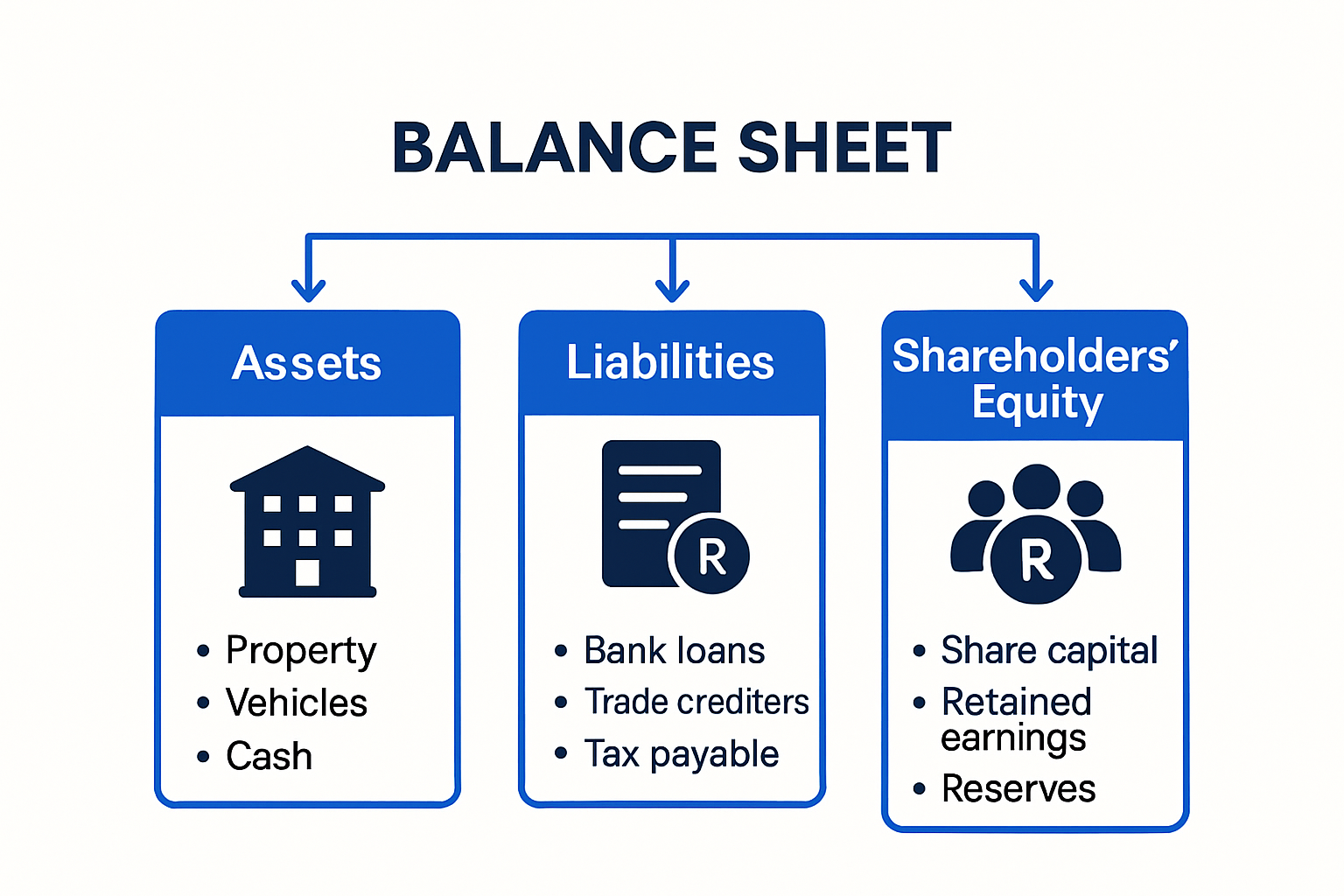
Understanding the specific components of a balance sheet is critical for south african business owners seeking financial clarity and strategic insights. According to CFA Institute, each section plays a unique role in depicting a company’s financial landscape.
Breaking Down Assets: What Your Business Owns
Assets represent the economic resources your business controls that are expected to generate future value. In the south african business context, assets are typically categorized into two primary groups: current and non current assets.
Current Assets: These are short term resources that can be converted into cash within one year. For south african businesses, current assets might include:
- Cash and cash equivalents
- Accounts receivable
- Inventory
- Short term investments
- Prepaid expenses
Non Current Assets: These are long term investments that provide value beyond one year. Examples include:
- Property and equipment
- Land and buildings
- Long term investments
- Intellectual property
- Machinery and vehicles
Here is a table summarising the typical current and non current assets found on a South African business balance sheet:
| Asset Category | Examples | Conversion to Cash Timeframe |
|---|---|---|
| Current Assets | Cash, Accounts receivable, Inventory, Short-term investments, Prepaid expenses | Within 1 year |
| Non Current Assets | Property, Land, Equipment, Intellectual property, Machinery, Vehicles | Beyond 1 year |
Understanding Liabilities: Financial Obligations
Liabilities represent the financial debts and obligations your business owes to external parties. Harvard Business School Online highlights the importance of understanding these financial commitments.
Current Liabilities: Short term financial obligations due within one year, such as:
- Accounts payable
- Short term loans
- Tax payments to SARS
- Wages payable
- Accrued expenses
Non Current Liabilities: Long term financial commitments extending beyond one year, including:
- Long term bank loans
- Lease obligations
- Deferred tax liabilities
- Pension fund commitments
- Bonds payable
Shareholders’ Equity: Ownership and Investment
Shareholders’ equity represents the residual interest in the company’s assets after subtracting liabilities. For south african business owners, this section reflects the total investment and accumulated profits.
Components of Shareholders’ Equity:
- Paid in capital
- Retained earnings
- Additional paid in capital
- Treasury stock
Understanding these balance sheet sections helps business owners assess financial health, make informed decisions, and communicate effectively with investors and financial institutions.
Explore our comprehensive financial reporting guide to gain deeper insights into interpreting financial statements and driving business growth.
Remember, a balance sheet is more than just numbers. It tells the story of your business’s financial journey, revealing strengths, potential risks, and opportunities for strategic investment and expansion.
How Balance Sheets Impact Tax and Reporting
Balance sheets play a critical role in south african business tax reporting and financial compliance. Understanding how these financial documents interact with tax regulations is essential for maintaining accurate records and avoiding potential penalties from SARS.
Below is a table outlining different balance sheet components and their common tax considerations for South African businesses:
| Balance Sheet Component | Tax Considerations |
|---|---|
| Depreciable Assets | Depreciation reduces taxable income |
| Inventory | Valuation affects cost of goods sold and taxable income |
| Investments | Capital gains tax may apply |
| Intangible Assets | Special tax treatment; may affect tax deductions |
| Loan Liabilities | Interest expenses may be deductible |
| Provisions/Accruals | Specific tax rules for timing of deductions |
| Pension Obligations | Contributions can provide tax benefits |
Tax Reporting and Balance Sheet Accuracy
Every south african business must recognize that balance sheets are not just internal financial tools but crucial documents for tax reporting. The International Monetary Fund emphasizes the importance of comprehensive financial reporting in managing fiscal responsibilities.
Key tax reporting considerations include:
- Accurate valuation of assets and liabilities
- Proper classification of income and expenses
- Tracking depreciable assets and their tax implications
- Documenting capital gains and losses
- Maintaining records for potential SARS audits
Tax Implications of Balance Sheet Components
Different balance sheet components have unique tax implications for south african businesses. Accounting Insights highlights how strategic financial reporting can optimize tax positions.
Asset Reporting:
- Depreciation calculations impact taxable income
- Inventory valuation affects cost of goods sold
- Investment assets may trigger capital gains tax
- Intangible assets require specific tax treatment
Liability Considerations:
- Interest expenses on loans may be tax deductible
- Provisions and accruals have specific tax rules
- Pension fund contributions can offer tax benefits
- Long term debt impacts overall tax calculations
SARS Compliance and Financial Transparency
South african businesses must maintain meticulous balance sheets to ensure SARS compliance. This involves:
- Keeping detailed financial records
- Accurately reporting all income streams
- Documenting business expenses
- Preparing annual financial statements
- Ensuring transparency in financial reporting
Learn more about financial reporting requirements to stay ahead of regulatory changes and optimize your tax strategy.
Proper balance sheet management goes beyond mere number crunching. It represents a strategic approach to financial planning that can help south african businesses minimize tax liabilities, maintain regulatory compliance, and make informed financial decisions.
Remember, while balance sheets might seem complex, they are powerful tools for understanding your business’s financial obligations and opportunities. Regular review and professional guidance can help navigate the intricate landscape of tax reporting and financial management.
Tips for Cloud Accounting and Company Compliance
In the rapidly evolving south african business landscape, cloud accounting has become an essential strategy for maintaining accurate financial records and ensuring regulatory compliance. The U.S. Chamber of Commerce highlights the critical role of modern accounting tools in streamlining financial management for businesses of all sizes.
Leveraging Cloud Accounting Technologies
Cloud accounting platforms offer south african businesses unprecedented opportunities to transform financial management. These digital solutions provide real time financial tracking, enhanced security, and seamless integration of critical business data.
Key Benefits of Cloud Accounting:
- Instant access to financial data from anywhere
- Automatic data backup and protection
- Scalable solutions for growing businesses
- Reduced risk of human error
- Simplified collaboration with accountants and financial advisors
Discover the transformative power of cloud accounting solutions to revolutionize your financial management approach.
Ensuring Regulatory Compliance
Navigating south african financial regulations requires meticulous attention to detail. According to Accounting.com, successful compliance involves implementing robust internal control systems and maintaining accurate, transparent financial records.
Critical compliance considerations include:
- Regular reconciliation of financial statements
- Maintaining detailed transaction records
- Adhering to SARS reporting requirements
- Implementing strong cybersecurity measures
- Conducting periodic internal audits
Managing Financial Spreadsheets and Controls
Research from academic studies emphasizes the importance of controlling financial spreadsheets to mitigate risks and ensure regulatory compliance. South african businesses should focus on:
Best Practices for Spreadsheet Management:
- Implement automated control mechanisms
- Restrict spreadsheet access to authorized personnel
- Use version control and tracking systems
- Regularly validate and audit spreadsheet data
- Integrate spreadsheets with cloud accounting platforms
By adopting cloud accounting technologies and maintaining rigorous compliance standards, south african businesses can create a robust financial management ecosystem that supports growth, transparency, and strategic decision making.
Remember, effective financial management is not just about tracking numbers. It is about creating a comprehensive system that provides insights, protects your business, and enables informed strategic choices. Invest in the right tools, stay informed about regulatory changes, and prioritize financial transparency.

Frequently Asked Questions
What are the three main components of a balance sheet?
The three main components of a balance sheet are Assets, Liabilities, and Shareholders’ Equity. These components provide a snapshot of what a business owns, owes, and the value invested by shareholders.
How do I understand the balance sheet equation?
The fundamental balance sheet equation is Assets = Liabilities + Shareholders’ Equity. This equation must always balance, ensuring that the business’s financial position is accurately reported.
Why is it important to assess liquidity ratios?
Assessing liquidity ratios is crucial for understanding a business’s ability to convert its assets into cash to meet short-term obligations effectively. Strong liquidity ratios indicate financial health and stability.
How do balance sheets impact tax compliance in South Africa?
Balance sheets are vital for tax compliance as they help ensure accurate valuation of assets and liabilities. Maintaining proper records can help businesses avoid penalties and ensure compliance with SARS regulations.
Ready to Turn Your Balance Sheet Insights Into Real Business Growth?
If reading your balance sheet leaves you feeling uncertain or worried about missed opportunities, you are not alone. Many South African business owners struggle with numbers on the page that seem disconnected from practical decisions. This article highlights just how easy it is for cash flow gaps, hidden liabilities, or SARS reporting mistakes to sneak up on you. Reliable help can make all the difference between guessing and knowing your next smart move. Our team at Ready Accounting specialises in helping business owners decode their financial statements and avoid those costly surprises. We use modern tools like cloud accounting and real-time reporting so you get clarity, confidence, and more time to focus on growing your business.
Do not let confusing financial documents hold your business back. Take control today with professional guidance tailored to South Africa’s unique regulatory and tax environment. Visit Ready Accounting now to discover the benefits of personalised financial consulting or Book your free consultation and set your business on the right path. The sooner you act, the sooner your numbers can start working for you.
Recommended
- How to Read Financial Statements: Easy Guide for 2025 – Ready Accounting
- Annual Financial Statements in South Africa: What Business Owners Need to Know for 2025 – Ready Accounting
- Financial Statement Basics: A Guide for Business Owners – Ready Accounting
- How to Prepare Financial Statements for South African Businesses in 2025 – Ready Accounting