

Forensic Analysis of the Business Budgeting Process
Most companies know they need a budget. It feels like basic business knowledge but so many businesses miss the real magic behind it. More than 60 percent of small businesses admit they have no formal budget at all. You would think this means they are saving time or hassle but the actual shock is how much opportunity they are losing with every month that slips by. Those numbers tell a story and if you look closer you will see why the budgeting process is more than a box-ticking routine. It could be the difference between just scraping by and building a stable, growing business.
Table of Contents
- What Is The Business Budgeting Process And Its Purpose?
- Why The Business Budgeting Process Is Crucial For Success
- Key Components Of The Business Budgeting Process Explained
- How The Business Budgeting Process Works In Practice
- Real-World Applications Of The Business Budgeting Process
Quick Summary
| Takeaway | Explanation |
|---|---|
| Establish a Comprehensive Budget | Develop a detailed financial blueprint to manage revenues and expenses. |
| Involve Stakeholders in Budgeting | Collaboration ensures diverse insights and aligns departmental goals with budget objectives. |
| Monitor Financial Performance Regularly | Continuous tracking helps identify discrepancies and keeps spending on track. |
| Align Budgets with Strategic Goals | Ensure financial plans support the overall mission and objectives of the organization. |
| Implement Risk Management Strategies | Identify potential financial vulnerabilities and create buffers against uncertainties. |
What is the Business Budgeting Process and Its Purpose?
The business budgeting process represents a critical financial planning framework that enables organizations to map out their financial trajectory, allocate resources strategically, and make informed operational decisions. At its core, budgeting transforms financial uncertainty into a structured roadmap for fiscal management.
Understanding Budget Fundamentals
A budget serves as a comprehensive financial blueprint that details an organization’s anticipated revenues, projected expenses, and potential capital investments over a specific period. According to Harvard Business School Online, budgeting is crucial for setting short and long-term goals while tracking financial performance with precision.
Key characteristics of an effective business budget include:
- Providing clear financial visibility
- Enabling strategic resource allocation
- Supporting data-driven decision making
- Creating accountability across departments
Strategic Purpose of Business Budgeting
The budgeting process goes beyond mere number tracking. It represents a strategic management tool that aligns financial resources with organizational objectives. Businesses use budgets to:
- Forecast potential financial scenarios
- Identify potential financial risks
- Establish performance benchmarks
- Communicate financial expectations internally
By understanding key accounting terms, businesses can develop more nuanced and effective budgeting strategies. Successful budgeting requires a holistic approach that considers both historical financial data and future growth projections, transforming financial planning from a static document into a dynamic management instrument.
Ultimately, the business budgeting process is not just about controlling expenses but about creating a strategic framework that empowers organizations to navigate financial complexities with confidence and clarity.
Why the Business Budgeting Process is Crucial for Success
The business budgeting process transcends traditional financial planning, serving as a strategic compass that guides organizations through complex economic landscapes. By transforming financial data into actionable insights, budgeting becomes a powerful mechanism for sustainable growth and operational excellence.
Financial Predictability and Risk Management
According to Harvard Business School Online, budgeting is fundamental for creating financial predictability and managing organizational risks. The process enables businesses to anticipate potential financial challenges, allocate resources strategically, and develop contingency plans that protect against economic uncertainties.
Key risk management benefits include:
- Identifying potential financial vulnerabilities
- Creating financial buffer strategies
- Monitoring cash flow consistency
- Preventing unexpected financial shortfalls
Strategic Decision Making and Performance Alignment
Budgeting serves as a critical tool for aligning organizational objectives with financial capabilities. By establishing clear financial targets and performance metrics, businesses can create a unified vision that motivates teams and drives strategic initiatives. Avoiding common bookkeeping mistakes becomes easier when budgets provide a structured framework for financial tracking and accountability.
Strategic alignment advantages encompass:
- Translating organizational goals into financial targets
- Creating measurable performance indicators
- Facilitating cross-departmental communication
- Enabling data-driven resource allocation
Ultimately, the business budgeting process is more than a financial exercise it is a dynamic strategic tool that empowers organizations to navigate complexity, mitigate risks, and unlock sustainable growth potential.
Below is a table comparing how budgeting supports financial predictability versus how it aids strategic decision making, highlighting the distinct roles these two aspects play in business success.
| Budgeting Aspect | Main Focus | Key Benefits |
|---|---|---|
| Financial Predictability | Managing cash flow and risks | Anticipates challenges, ensures financial stability |
| Strategic Decision Making | Aligning budgets with business strategy | Supports goal setting, guides resource allocation |
Key Components of the Business Budgeting Process Explained
The business budgeting process comprises intricate financial elements that transform raw financial data into a strategic roadmap for organizational success. Understanding these key components enables businesses to develop comprehensive and effective financial planning strategies.
To help clarify the core parts of the business budgeting process, here is a table outlining its main components and what each involves in practice.
| Budgeting Component | Description |
|---|---|
| Revenue Projection | Estimating income by analysing historical data and market conditions |
| Expense Categorisation | Systematically tracking and grouping all business expenditures |
| Financial Monitoring | Regularly reviewing actual results against the planned budget |
| Strategic Resource Allocation | Allocating funds to align with organisational objectives |
| Risk Management | Identifying financial risks and creating contingency plans |
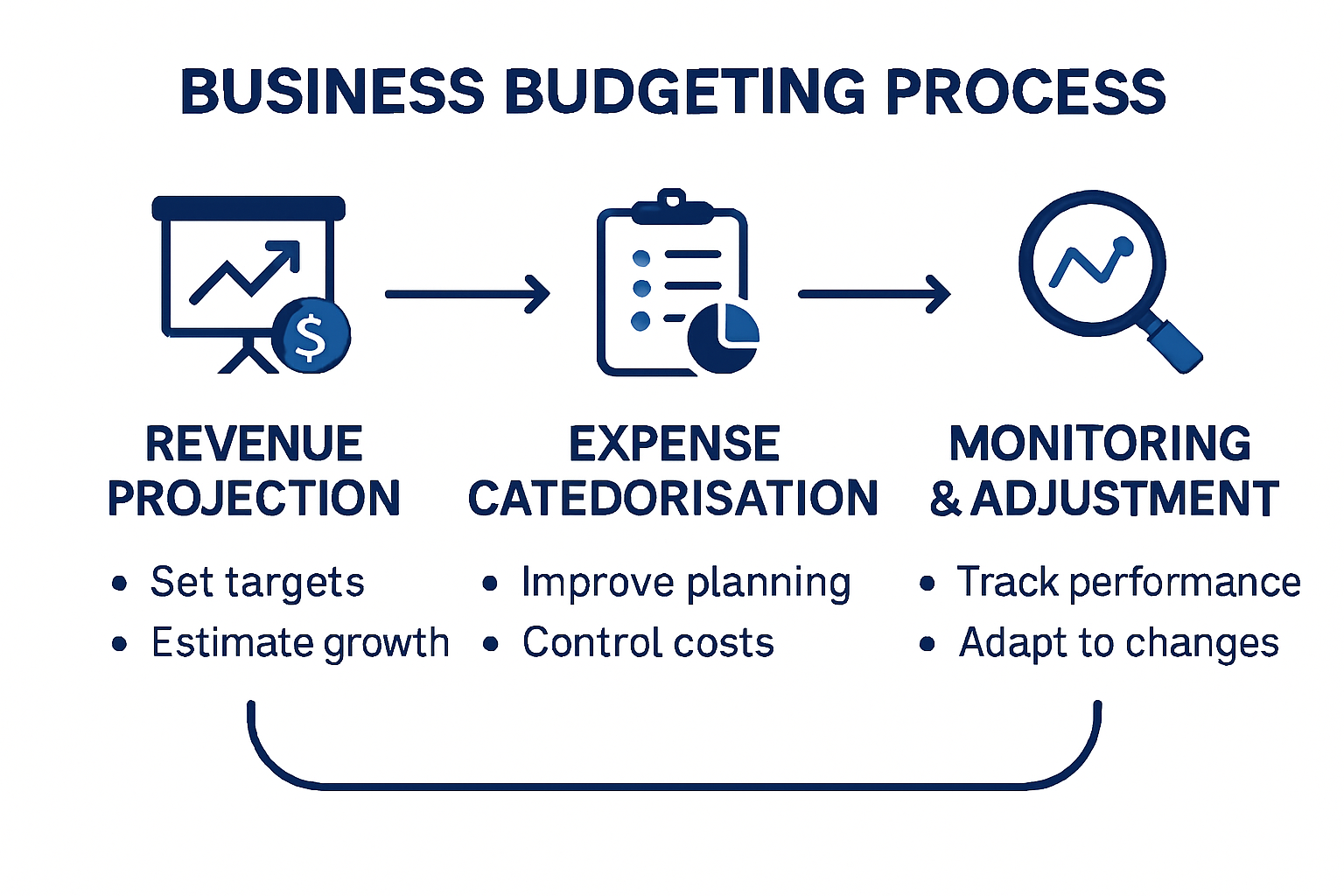
Revenue Projection and Income Estimation
According to Harvard Business School Online, revenue projection represents the foundational step in budgeting. This critical component involves analyzing historical financial performance, market trends, and potential growth opportunities to create realistic income estimates.
Key considerations for revenue projection include:
- Analyzing previous financial periods
- Evaluating market conditions and economic trends
- Considering potential new revenue streams
- Accounting for seasonal fluctuations
Expense Categorization and Management
Expense management involves systematically tracking and categorizing organizational expenditures. By understanding key accounting terms, businesses can develop more nuanced expense management strategies that provide granular insights into financial spending patterns.
Expense categories typically include:
- Fixed operational costs
- Variable expenses
- Capital expenditures
- Discretionary spending
Successful expense management requires a comprehensive approach that balances cost control with strategic investment, ensuring that financial resources are allocated efficiently and aligned with organizational objectives.

Ultimately, the business budgeting process is a dynamic framework that requires continuous refinement, adaptability, and strategic thinking to navigate complex financial landscapes and drive sustainable organizational growth.
How the Business Budgeting Process Works in Practice
The practical implementation of business budgeting transforms theoretical financial planning into a dynamic, actionable strategy that guides organizational decision making. This process involves systematic collaboration, data analysis, and strategic alignment across different business functions.
Collaborative Budget Development
According to Harvard Business School Online, effective budget development requires a collaborative approach that involves stakeholders from multiple organizational levels. This inclusive method ensures comprehensive financial insights and creates organizational buy-in for budgetary goals.
Key collaborative elements include:
- Establishing a cross-functional budget committee
- Gathering input from department heads
- Aligning individual departmental budgets
- Creating transparent communication channels
Implementing Budget Monitoring Mechanisms
Budget implementation goes beyond initial planning, requiring robust monitoring and adjustment strategies. Understanding financial statement basics becomes crucial in tracking financial performance and identifying potential variances.
Essential monitoring practices involve:
- Regular financial performance reviews
- Variance analysis between projected and actual figures
- Quarterly budget reassessment
- Implementing corrective actions
Ultimately, successful budget implementation demands flexibility, continuous learning, and a strategic approach that transforms financial planning from a static document into a dynamic management tool that drives organizational growth and sustainability.
Real-World Applications of the Business Budgeting Process
Business budgeting transcends theoretical frameworks, manifesting as a powerful strategic tool that enables organizations to translate financial planning into tangible operational success. Real-world applications demonstrate how systematic budgeting drives organizational performance across diverse business contexts.
Strategic Investment and Resource Allocation
According to Harvard Business School Online, effective budgeting enables businesses to make data-driven investment decisions. By creating comprehensive financial roadmaps, organizations can strategically allocate resources, prioritize critical initiatives, and minimize financial risks.
Key strategic investment considerations include:
- Identifying high-potential growth opportunities
- Balancing short-term operational needs with long-term strategic goals
- Evaluating return on investment for proposed projects
- Creating financial contingency plans
Operational Performance and Financial Optimization
Budgeting serves as a critical mechanism for operational performance management. Learn how automation improves cash flow to understand how technological integration can enhance budgeting precision and efficiency.
Practical performance optimization strategies involve:
- Establishing clear financial performance metrics
- Implementing regular performance tracking mechanisms
- Creating accountability frameworks across departments
- Developing adaptive financial management approaches
Ultimately, real-world budgeting transforms financial planning from a static document into a dynamic strategic instrument that empowers businesses to navigate complex economic landscapes with confidence and precision.
Take Control of Your Business Budgeting Journey with Ready Accounting
Mastering the budgeting process can feel overwhelming for business owners facing unpredictable cash flow, fast-growing costs, or confusing financial statements. This article has explained how budgeting brings clarity and confidence by aligning your finances with your business goals. But turning these budgeting strategies into workable action steps is often easier said than done, especially if you lack the right systems or support.
Ready Accounting is dedicated to transforming your budgeting headaches into a streamlined plan. Our expertise in cloud accounting and automation tackles problems like inaccurate revenue forecasting, missed expense categories, and poor financial visibility. Explore our resources to get your numbers right, every time. Learn how automation improves cash flow and see why so many South African businesses trust us for their bookkeeping cleanup and financial statement basics.

Ready to ditch budgeting stress and unlock real business growth? Visit Ready Accounting to book your free consultation today. Let us help you build a financial roadmap that puts you back in control and moves your business forward. Get started now before another financial period slips by.
Frequently Asked Questions
What is the purpose of the business budgeting process?
The business budgeting process serves as a strategic financial planning framework that helps organizations map out their financial trajectory, allocate resources effectively, and make informed operational decisions.
How does budgeting support financial predictability?
Budgeting creates financial predictability by allowing businesses to anticipate potential challenges, monitor cash flow consistency, and develop contingency plans to protect against economic uncertainties.
What are the key components of the business budgeting process?
Key components include revenue projection, expense categorization, and financial monitoring. These elements help businesses create realistic income estimates, systematically track spending, and adjust budgets as needed.
How can businesses implement effective budget monitoring mechanisms?
Businesses can implement effective budget monitoring by conducting regular financial performance reviews, performing variance analysis between projected and actual figures, and reassessing budgets quarterly to ensure alignment with organizational goals.