

Aggressive Optimization Standards in Financial Management for South African Businesses
Managing money shapes every decision a business makes in South Africa. Cash flow can make or break a company and some reports show that over 60 percent of business failures here are blamed on poor financial planning. Yet many owners still think a solid financial strategy is just about tracking spreadsheets and meeting tax deadlines. That barely scratches the surface. The smartest businesses now treat financial management as a living system that grows and adapts, putting them miles ahead of the competition.
Table of Contents
- Key Principles For Effective Financial Management
- Implementing Cloud-Based Accounting Solutions
- Tax And Payroll Compliance For South African Firms
- Streamlining Financial Reporting And Bookkeeping
Quick Summary
| Takeaway | Explanation |
|---|---|
| Embrace Dynamic Budgeting | Regularly update financial plans to adapt to market changes and optimize resource allocation. |
| Prioritize Cash Flow Management | Maintain transparency and rigor in tracking money flow to ensure operational stability and prepare for unexpected expenses. |
| Implement Cloud Solutions for Efficiency | Utilize cloud-based accounting for flexibility and real-time insights, significantly reducing traditional accounting costs. |
| Ensure Tax and Payroll Compliance | Stay updated with SARS obligations and invest in automated systems to avoid penalties and ensure accurate submissions. |
| Streamline Financial Reporting Processes | Adopt advanced technologies for accurate financial documentation and strategic insights that enhance business decision-making. |
Key Principles for Effective Financial Management
Financial management represents the strategic backbone of sustainable business success in South Africa. For entrepreneurs and business owners navigating the complex economic landscape, understanding and implementing robust financial management principles is not just recommended – it’s essential for survival and growth.
Strategic Budgeting and Financial Planning
Effective financial management begins with comprehensive strategic budgeting. According to The Southern African Journal of Entrepreneurship and Small Business Management, successful SMEs prioritize creating detailed financial roadmaps that anticipate potential challenges and opportunities. This involves developing realistic revenue projections, identifying potential cost-reduction strategies, and maintaining flexibility to adapt to changing market conditions.
Business owners must approach budgeting as a dynamic process. This means regularly reviewing and adjusting financial plans, tracking key performance indicators, and being prepared to make data-driven decisions. The goal is not just creating a static document but developing a living financial strategy that guides business growth.
Cash Flow Management and Financial Transparency
Cash flow management stands as a critical principle in financial management. The South African National Treasury’s Public Finance Management Act (PFMA) emphasizes the importance of transparent and efficient resource utilization. For businesses, this translates to maintaining a clear understanding of money entering and leaving the organization.
Key strategies include implementing rigorous invoicing processes, negotiating favorable payment terms with suppliers, maintaining adequate cash reserves, and developing contingency plans for potential financial disruptions. Businesses should aim to create a buffer that allows them to manage unexpected expenses without compromising operational stability.
Risk Management and Compliance
Risk management represents the third crucial principle of effective financial management. This involves identifying potential financial risks, developing mitigation strategies, and ensuring compliance with relevant regulatory requirements. South African businesses must stay updated on tax regulations, maintain accurate financial records, and implement robust internal control systems.
Companies should consider investing in professional accounting services that provide comprehensive financial guidance, helping them navigate complex financial landscapes while maintaining compliance and minimizing potential risks.
By embracing these key principles – strategic budgeting, cash flow management, and comprehensive risk management – South African businesses can build a solid financial foundation. The journey to financial excellence requires continuous learning, adaptability, and a commitment to maintaining transparent and efficient financial practices.
Implementing Cloud-Based Accounting Solutions
Cloud-based accounting solutions have revolutionized financial management for South African businesses, offering unprecedented flexibility, efficiency, and real-time insights into financial performance. As technology continues to transform business operations, understanding and implementing these digital solutions becomes crucial for competitive advantage.
Security and Data Protection Considerations
Implementing cloud-based accounting solutions requires a strategic approach to data security. According to research published on arXiv, businesses must prioritize robust security measures to protect sensitive financial information. This involves implementing comprehensive data encryption protocols, establishing multi-factor authentication, and ensuring compliance with local and international data protection regulations.
Key security strategies include regular system audits, maintaining up-to-date software versions, and training staff on cybersecurity best practices. South African businesses should work with cloud accounting providers that offer advanced security features and demonstrate a commitment to protecting client data.
Integration and Scalability
Cloud-based accounting solutions offer remarkable integration capabilities that streamline financial management processes. Learn more about cloud accounting benefits for small business growth to understand how these technologies can transform financial operations. The ability to connect with other business systems such as inventory management, payroll, and customer relationship management platforms creates a holistic approach to business financial tracking.
Scalability represents another significant advantage of cloud accounting solutions. Businesses can easily adjust their accounting infrastructure as they grow, adding or removing features without significant hardware investments. This flexibility allows companies to adapt quickly to changing business environments and financial requirements.
Cost-Effective Financial Management
According to Google Cloud’s Cloud Architecture Center, effective cloud-based financial management involves strategic billing and access control. Businesses can optimize costs by using single billing accounts, implementing precise identity and access management, and regularly analyzing financial data to identify potential savings.
Cloud accounting solutions eliminate many traditional accounting expenses, such as hardware maintenance, software upgrades, and extensive IT infrastructure. Small to medium enterprises can access advanced financial tools previously available only to large corporations, leveling the playing field and enabling more sophisticated financial management.
By embracing cloud-based accounting solutions, South African businesses can achieve greater financial transparency, improve decision-making processes, and create more agile and responsive financial management systems. The key lies in selecting the right solution, implementing robust security measures, and continuously adapting to technological advancements.
Tax and Payroll Compliance for South African Firms
Navigating the complex landscape of tax and payroll compliance is crucial for South African businesses seeking sustainable financial management. Understanding and implementing robust compliance strategies can help companies avoid penalties, maintain financial integrity, and contribute effectively to the national economic framework.
Understanding SARS Tax Obligations
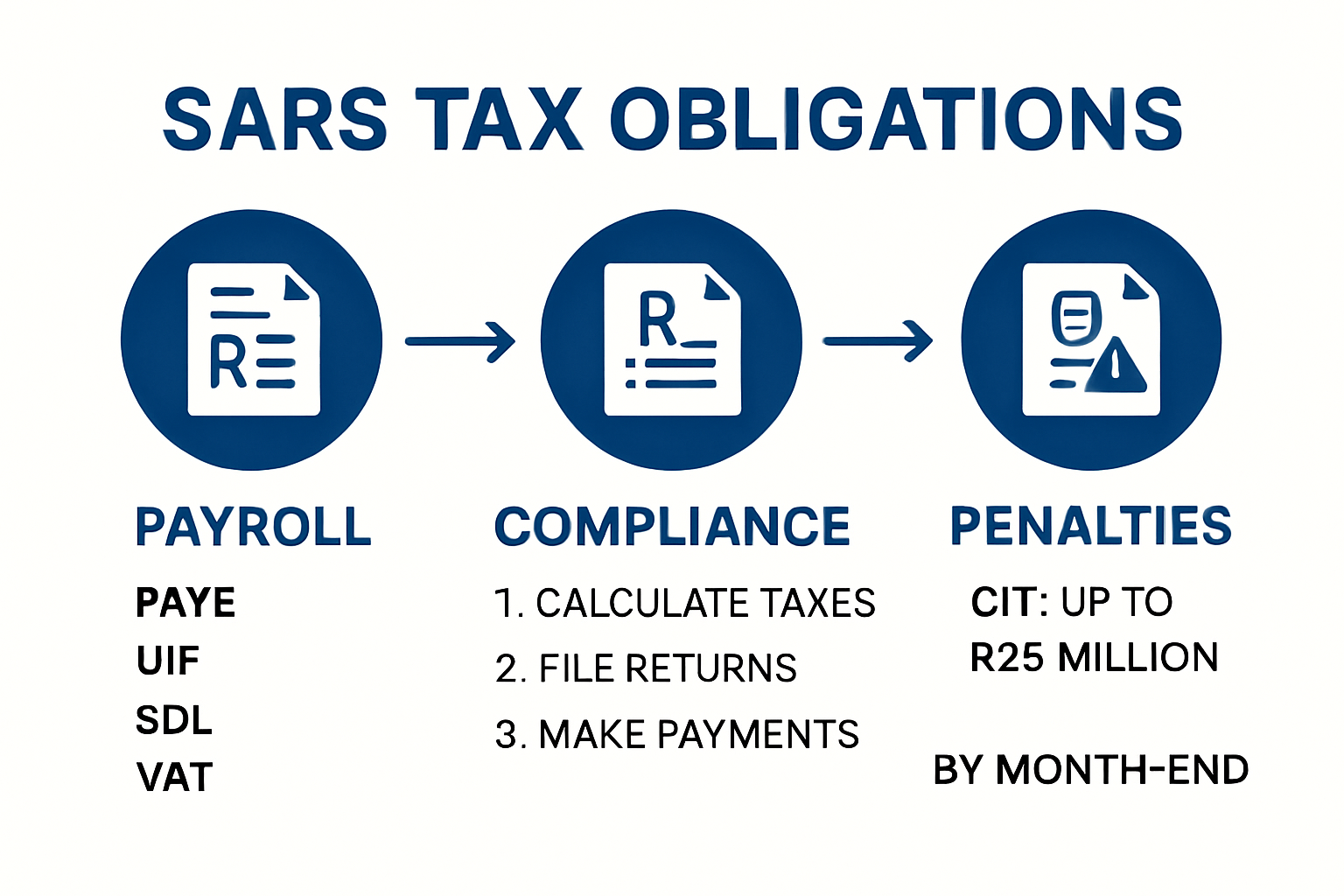
The South African Revenue Service (SARS) provides comprehensive guidelines for business tax compliance. Payroll tax regulations represent a critical component of financial management that requires meticulous attention. According to SARS official resources, businesses must manage multiple tax obligations including corporate income tax, Value Added Tax (VAT), Pay As You Earn (PAYE), Unemployment Insurance Fund (UIF), and Skills Development Levy (SDL).
Companies must maintain accurate records, submit timely returns, and ensure precise calculations across these various tax categories. This involves implementing robust accounting systems that can track and report financial transactions with high levels of accuracy and transparency.
To help clarify the various statutory tax and payroll obligations for South African businesses, the following table summarises the types of taxes and the key compliance requirements outlined in this section:
| Tax/Payroll Type | Key Requirements | Responsible Authority |
|---|---|---|
| Corporate Income Tax | Maintain records, submit timely returns | SARS (South African Revenue Service) |
| VAT | Accurate calculations, regular submissions | SARS |
| PAYE | Precise payroll deductions, report EMP501 returns | SARS |
| UIF | Register employees, accurate monthly contributions | SARS/Department of Labour |
| SDL | Calculate and submit payments on qualifying salaries | SARS |
Payroll Management and Compliance Strategies
Effective payroll management goes beyond simple salary processing. How to streamline payroll management becomes critical for maintaining regulatory compliance. SARS emphasizes the importance of accurate EMP501 return submissions, warning that late or inaccurate submissions can result in significant financial penalties and negatively impact employee tax records.
Key strategies for payroll compliance include implementing automated payroll systems, maintaining detailed employee records, ensuring accurate tax calculations, and staying updated with current legislative requirements. Businesses should invest in continuous staff training and robust technological solutions that can adapt to changing regulatory landscapes.
Risk Mitigation and Proactive Compliance
Risk mitigation in tax and payroll compliance requires a proactive approach. This means regular internal audits, staying informed about legislative changes, and developing comprehensive compliance protocols. South African firms must create systematic processes that allow for quick identification and correction of potential compliance issues.
Companies should consider engaging professional accounting services that specialize in tax compliance and can provide expert guidance through complex regulatory environments. These professionals can help businesses develop tailored strategies that minimize tax liabilities while ensuring full legal compliance.
By adopting a strategic and disciplined approach to tax and payroll compliance, South African businesses can transform regulatory requirements from potential challenges into opportunities for financial optimization and organizational efficiency. The key lies in understanding the nuanced regulatory landscape, investing in appropriate technological solutions, and maintaining a commitment to transparency and accuracy.
Streamlining Financial Reporting and Bookkeeping
Streamlining financial reporting and bookkeeping represents a critical strategy for South African businesses seeking operational efficiency and strategic financial management. In an increasingly complex business environment, companies must adopt sophisticated approaches that ensure accuracy, compliance, and strategic insight.
Advanced Technological Integration
Modern financial reporting demands more than traditional manual processes. Explore the latest in accounting automation to understand how technological solutions can transform financial management. According to research from arxiv.org, integrating machine learning with advanced accounting practices can significantly enhance transparency and scalability in financial reporting.
Businesses should focus on implementing automated systems that reduce human error, provide real-time financial insights, and enable more strategic decision-making. This involves adopting cloud-based accounting platforms, implementing advanced data analytics tools, and creating integrated financial reporting systems that can quickly generate comprehensive financial snapshots.
Risk Management in Financial Documentation
Effective financial reporting goes beyond mere number-crunching. Financial statement basics highlight the critical nature of accurate documentation. Research from arxiv.org emphasizes the significant risks associated with uncontrolled financial spreadsheets, including potential errors and fraud.
Key strategies for mitigating these risks include:
For businesses looking to strengthen their financial reporting and reduce risk, the following table details essential risk mitigation strategies in financial documentation highlighted in the article:
| Strategy | Description |
|---|---|
| Formal Documentation Policies | Establish clear rules and procedures for all financial records |
| Robust Internal Control Mechanisms | Implement systems to prevent error and fraud |
| Regular Audits | Periodically review reporting processes for accuracy |
| Automated Verification Tools | Use technology to verify and validate financial data |
| Staff Training on Reporting Standards | Ongoing training to ensure compliance and reduce mistakes |
- Implementing formal policies for financial documentation
- Creating robust internal control mechanisms
- Regularly auditing financial reporting processes
- Utilizing automated verification tools
- Ensuring comprehensive staff training on financial reporting standards
Compliance and Strategic Reporting
According to research on financial reporting controls, businesses must develop sophisticated approaches to financial documentation that go beyond mere compliance. This involves creating a holistic approach to financial reporting that provides strategic insights while maintaining rigorous accuracy and regulatory compliance.
South African businesses should focus on developing financial reporting systems that:
- Provide real-time financial insights
- Ensure complete regulatory compliance
- Support strategic decision-making
- Minimize potential risks and errors
- Offer scalable and adaptable reporting mechanisms
By embracing these advanced approaches to financial reporting and bookkeeping, South African businesses can transform financial management from a compliance requirement into a strategic advantage. The key lies in leveraging technology, implementing robust control mechanisms, and maintaining a forward-thinking approach to financial documentation and analysis.

Frequently Asked Questions
What are the key principles of effective financial management for businesses in South Africa?
Effective financial management involves strategic budgeting, cash flow management, and risk management. These principles ensure businesses can navigate the complex economic landscape successfully.
How can cloud-based accounting solutions improve financial management for South African businesses?
Cloud-based accounting solutions provide flexibility, real-time insights, and cost-effectiveness. They streamline financial processes and enhance data security compared to traditional accounting methods.
What are the compliance requirements for tax and payroll management in South Africa?
South African businesses must comply with various tax obligations, including corporate income tax, VAT, PAYE, UIF, and SDL. Accurate record-keeping and timely submissions are essential to avoid penalties.
How can South African businesses streamline financial reporting and bookkeeping?
Businesses can streamline financial reporting by implementing automated systems, utilizing advanced data analytics, and maintaining strict documentation policies to reduce errors and improve compliance.
Take Your Financial Management from Reactive to Proactive with Ready Accounting
If your South African business struggles with unpredictable cash flow, complicated compliance, or the headache of manual reporting, you are not alone. The article highlighted how many businesses face hidden challenges from poor budgeting and outdated bookkeeping. You want strategic control, cloud-driven solutions, and up-to-date compliance without feeling overwhelmed. Now you can achieve that clarity and confidence.
Ready Accounting specialises in transforming these exact pain points into strengths. Our team offers expert cloud accounting solutions and hands-on payroll management support so you always have the real-time data and compliance certainty you need. Secure your financial future now. Visit Ready Accounting to book your personalised consultation and get South Africa’s top accounting technology working for your business today.
Recommended
- How to Manage Business Growth in South Africa: 2025 Guide – Ready Accounting
- Types of Financial Statements for South African Businesses 2025 – Ready Accounting
- What Is Management Accounting? Guide for South African Businesses 2025 – Ready Accounting
- How to Read Financial Statements: Easy Guide for 2025 – Ready Accounting