

Forensic Analysis of Sustainable Business Practices for Success
Sustainable business practices are reshaping how companies work, with more South African businesses recognising the power of balancing profits, people, and the planet. But while many might think sustainability is all about buying eco-friendly products or using less paper, there’s a lot more going on behind the scenes. The real change is in their bottom line, with companies implementing sustainable strategies often seeing reduced operational costs and stronger financial outcomes than those that do not.
Table of Contents
- What Are Sustainable Business Practices?
- The Importance of Sustainable Business Practices
- How Sustainable Business Practices Impact Financial Performance
- Key Concepts in Implementing Sustainable Business Practices
- Real-World Examples of Successful Sustainable Business Practices
Quick Summary
| Takeaway | Explanation |
|---|---|
| Sustainability enhances business resilience | Integrating sustainable practices makes companies more adaptable to regulatory and market changes. |
| Holistic value creation is essential | Businesses must focus on environmental, social, and economic impacts beyond just profit. |
| Cost reductions are a direct benefit | Embracing sustainable practices can lead to lower operational costs and increased efficiency. |
| Investor interest is shifting towards ESG | Investors are increasingly considering environmental, social, and governance factors in their decisions. |
| Strategic integration of sustainability is crucial | Companies should align sustainability goals with overall business strategies for effective implementation. |
What Are Sustainable Business Practices?
Sustainable business practices represent a comprehensive approach to conducting business operations that balance economic success with environmental responsibility and social impact. At their core, these practices recognize that long-term business success depends not just on financial performance, but on creating positive value for society and minimizing negative environmental consequences.
Defining Sustainable Business Strategies
Sustainable business practices go beyond traditional profit-driven models by integrating environmental, social, and governance (ESG) considerations into core business strategies. According to the Global Green Growth Institute, these practices involve several key elements:
- Implementing resource-efficient technologies
- Developing transparent reporting mechanisms
- Engaging meaningfully with local and global communities
- Contributing to broader sustainable development goals
Businesses adopting these practices aim to create holistic value that extends far beyond immediate financial returns. This means considering the broader ecosystem in which a company operates and understanding its interconnected responsibilities.
Key Components of Sustainable Business Models
A robust sustainable business model typically encompasses three primary dimensions:
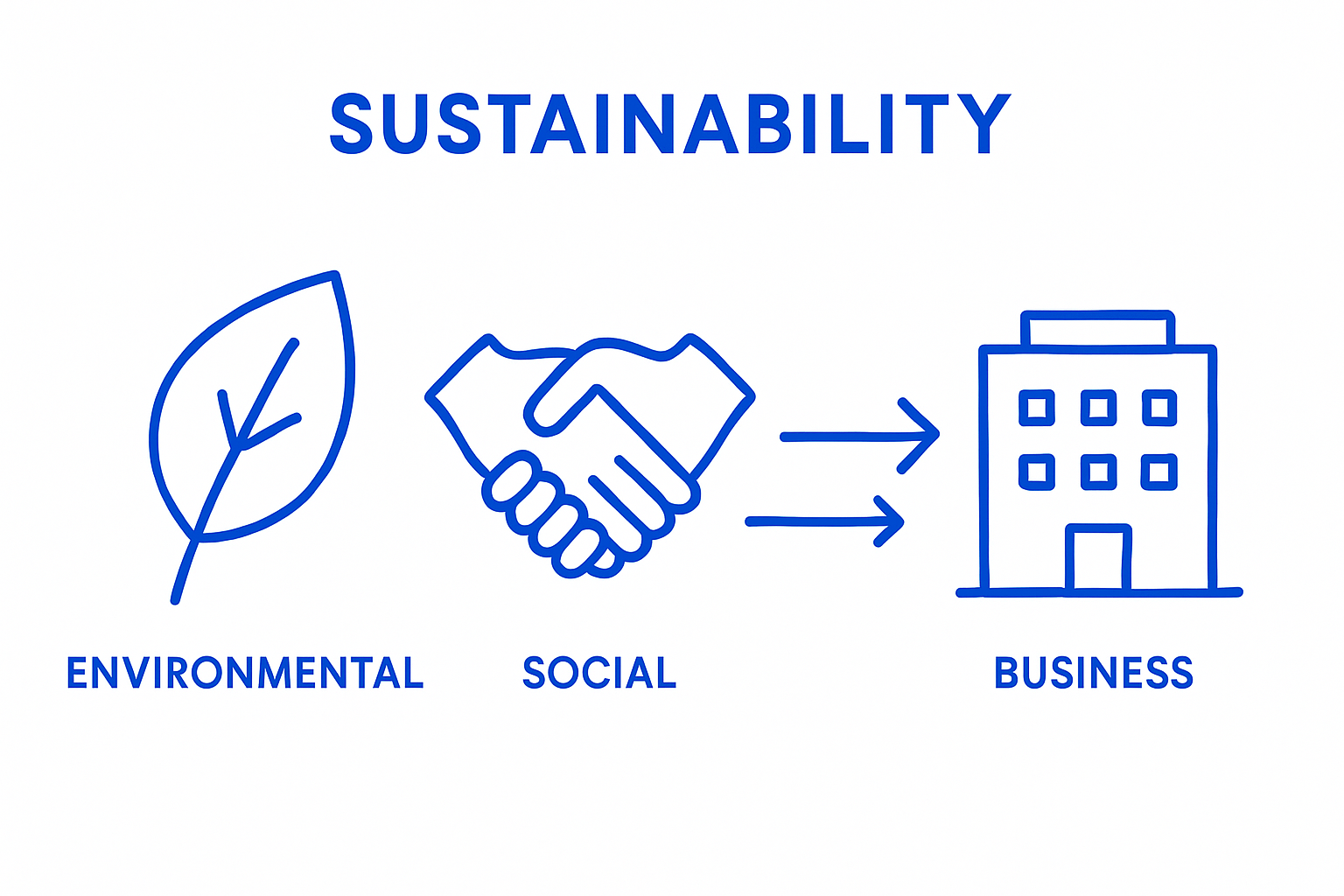
- Environmental Sustainability: Reducing carbon footprint, minimizing waste, using renewable resources, and implementing eco-friendly production processes
- Social Responsibility: Ensuring ethical labor practices, supporting local communities, promoting diversity and inclusion, and maintaining transparent supply chains
- Economic Viability: Generating sustainable profits while investing in long-term strategies that create value for shareholders, employees, and broader societal networks
By integrating these dimensions, businesses can create resilient models that adapt to changing global conditions while maintaining a commitment to responsible growth.
The following table summarises the key components of a sustainable business model, highlighting their main focus areas and intended impact.
| Component | Main Focus | Intended Impact |
|---|---|---|
| Environmental Sustainability | Reducing carbon footprint, minimising waste, using renewables | Lower environmental impact, long-term resource use |
| Social Responsibility | Ethical labour, community support, diversity and inclusion | Stronger social licence, improved community relations |
| Economic Viability | Sustainable profits, long-term strategies, value for stakeholders | Financial resilience, stakeholder confidence |
Our guide on managing business growth offers additional insights into strategic business development with sustainability in mind.
The Importance of Sustainable Business Practices
Sustainable business practices have transitioned from being optional corporate strategies to becoming essential survival mechanisms in today’s rapidly changing global economic landscape. These practices represent a critical approach to business management that simultaneously addresses economic performance, environmental stewardship, and social responsibility.
Economic and Strategic Benefits
Companies implementing sustainable practices gain significant competitive advantages. According to South Africa’s Department of Forestry, Fisheries and the Environment, businesses that prioritize sustainable strategies are better positioned to attract investment, reduce operational risks, and create long-term value. These organizations demonstrate resilience by:
- Anticipating regulatory changes
- Reducing resource consumption costs
- Enhancing brand reputation
- Attracting environmentally conscious consumers and investors
Financial performance is no longer solely about short-term profits but about creating sustainable growth models that can withstand complex global challenges.
Social and Environmental Accountability
Sustainable business practices fundamentally transform how companies interact with their broader ecosystem. By integrating social responsibility into core business strategies, organizations can:
- Improve community relationships
- Support local economic development
- Promote ethical labor practices
- Contribute to broader societal well-being
Environmentally, these practices help businesses reduce their carbon footprint, minimize waste, and contribute to national sustainability goals. Our comprehensive financial reporting guide can help you understand how sustainable practices integrate with financial management.
Ultimately, sustainable business practices are not just a moral imperative but a strategic necessity in an interconnected, resource-constrained world. Businesses that embrace these principles position themselves as forward-thinking, responsible entities capable of generating value across economic, social, and environmental dimensions.
How Sustainable Business Practices Impact Financial Performance
Sustainable business practices have emerged as a powerful strategy for driving financial performance, challenging traditional assumptions that environmental and social considerations are secondary to economic goals. By integrating sustainability into core business operations, companies can unlock significant financial opportunities and create long-term value.
Direct Financial Benefits
Companies that embrace sustainable practices experience measurable financial advantages. According to research from the South African Journal of Economic and Management Sciences, businesses implementing comprehensive Environmental, Social, and Governance (ESG) strategies demonstrate enhanced financial outcomes through:
- Reduced operational costs
- Increased operational efficiency
- Lower risk of regulatory penalties
- Enhanced investor confidence
Cost reduction becomes particularly significant when businesses systematically analyze and minimize resource consumption, waste generation, and energy inefficiencies.
Investor and Market Perception
Sustainable business practices directly influence market valuation and investor attractiveness. Modern investors increasingly consider ESG performance as a critical metric for assessing a company’s long-term viability. Organizations that transparently demonstrate their commitment to sustainability often experience:
- Higher stock market valuations
- Increased access to investment capital
- Stronger brand reputation
- Improved risk management
Our financial statement guide can help you understand how sustainability metrics integrate into comprehensive financial reporting.
Ultimately, sustainable business practices represent a strategic approach to financial management that recognizes the interconnected nature of economic, environmental, and social performance. By viewing sustainability as a core business strategy rather than a peripheral concern, companies can create more resilient, adaptable, and financially robust organizations.
This table provides a comparison of the direct financial benefits and investor perception advantages experienced by businesses that implement sustainable business practices.
| Benefit Area | Description | Examples from the Article |
|---|---|---|
| Direct Financial Benefits | Measurable cost savings and efficiency gains | Reduced operational costs, increased efficiency |
| Risk Management | Lowered likelihood of regulatory penalties and non-compliance costs | Lower risk of regulatory penalties |
| Investor Perception | Enhanced attractiveness to investors and increased market confidence | Enhanced investor confidence, higher market valuations |
| Long-Term Value Creation | Building resilience and stable profits over time | Sustainable growth models, improved risk management |
Key Concepts in Implementing Sustainable Business Practices
Implementing sustainable business practices requires a comprehensive and strategic approach that transforms organizational culture, operational processes, and strategic decision making. These practices are not merely about adopting isolated environmental initiatives, but about creating a holistic framework that integrates sustainability into every aspect of business management.
Strategic Integration and Governance
Successful implementation of sustainable business practices demands robust governance structures and strategic commitment. According to the National Framework for Sustainable Development, organizations must develop comprehensive strategies that:
- Align sustainability goals with overall business objectives
- Create clear accountability mechanisms
- Establish measurable sustainability targets
- Develop transparent reporting systems
Organizational leadership plays a critical role in driving this transformation, ensuring sustainability becomes a core component of corporate strategy rather than a peripheral initiative.
Practical Implementation Frameworks
Businesses seeking to embed sustainable practices must focus on multidimensional approaches that address environmental, social, and economic dimensions. Key implementation strategies include:
- Conducting comprehensive sustainability audits
- Developing employee training and engagement programs
- Investing in resource-efficient technologies
- Creating cross-functional sustainability teams
- Establishing clear performance metrics
Our business growth guide provides additional insights into integrating sustainable strategies within broader organizational development frameworks.
Ultimately, implementing sustainable business practices is a continuous journey of learning, adaptation, and strategic evolution. Organizations must remain flexible, committed, and willing to challenge existing operational paradigms to create meaningful, long-lasting sustainable transformation.
Real-World Examples of Successful Sustainable Business Practices
Sustainable business practices transcend theoretical concepts, finding tangible expression through innovative companies that demonstrate how environmental and social responsibility can drive meaningful organizational transformation. These real-world examples illustrate the practical implementation of comprehensive sustainability strategies across diverse industry sectors.
Corporate Sustainability Champions
South African businesses are increasingly recognizing the strategic value of sustainable practices. According to research investigating management practices, companies that integrate robust sustainability frameworks experience significant operational advantages. Notable examples include:
- Merchants BPO Academy’s youth skills development program
- WWF South Africa’s corporate partnership initiatives
- Corporate health and safety management strategies
- Integrated project management systems prioritizing resource efficiency
Strategic sustainability involves more than environmental considerations, encompassing comprehensive approaches to social development, skills transfer, and organizational resilience.
Innovative Implementation Strategies
Successful sustainable business practices demonstrate how organizations can create shared value by aligning business objectives with broader societal needs. Key implementation approaches include:
- Developing comprehensive skills training programs
- Investing in technology that reduces environmental impact
- Creating cross-functional teams dedicated to sustainability
- Establishing clear metrics for social and environmental performance
Our business budgeting guide can help you understand how financial planning intersects with sustainable business strategies.
These real-world examples underscore a fundamental shift in business thinking. Sustainability is no longer a peripheral concern but a core strategic imperative that drives innovation, attracts talent, and creates long-term organizational value.

Make Sustainable Business Practices Work for You
Are you struggling to turn your commitment to sustainable business practices into real financial results? As highlighted in “Understanding Sustainable Business Practices for Success,” modern South African businesses face the challenge of integrating environmental, social, and governance goals into daily operations without breaking the bank or losing strategic focus. For many owners, the real pain is knowing where to begin, how to measure impact, and feeling uncertain about the financial side of going green. Balancing compliance, brand reputation, and profitability is not easy on your own.

Ready Accounting is here to help you bridge that gap. Our team has the expertise to connect your sustainability goals with practical financial strategies that drive lasting value. We offer tailored services like bookkeeping cleanup, financial statement preparation, and business growth support so you can keep your focus on accountable, responsible growth. Let us take the stress out of sustainable financial management. Visit Ready Accounting now to book your consultation and take the first step towards a more resilient, future-proof business.
Frequently Asked Questions
What are sustainable business practices?
Sustainable business practices involve conducting operations that balance economic success with environmental responsibility and social impact, focusing on long-term value creation and minimizing negative consequences.
How can sustainable business practices improve financial performance?
By integrating sustainability, businesses can reduce operational costs, enhance efficiency, and attract environmentally conscious investors, ultimately leading to improved financial outcomes and resilience.
What are the key components of a sustainable business model?
A sustainable business model typically includes environmental sustainability (reducing carbon footprint), social responsibility (ethical practices and community support), and economic viability (generating long-term profits).
How can companies implement sustainable business practices effectively?
Effective implementation requires a strategic approach, which includes setting measurable sustainability targets, developing accountability structures, conducting audits, and fostering employee engagement in sustainability initiatives.