

Understanding the Cost of Accounting Services in 2025

Accounting services are changing fast in South Africa and prices are climbing as more tasks get automated and moved online. Some business owners worry about costs spiralling out of control but here is the thing that catches most people by surprise. Businesses that switch to cloud-based accounting can cut IT infrastructure expenses by up to 30 percent and lower labour costs by as much as 45 percent. So the real savings are hiding where you least expect them and you might actually pay less for smarter services.
Table of Contents
- Key Factors That Influence Accounting Costs
- Comparing Traditional And Cloud-Based Accounting Services
- Tax, Payroll And Bookkeeping Fees In South Africa
- Tips To Lower Your Accounting Service Expenses
Quick Summary
| Takeaway | Explanation |
|---|---|
| Business Size and Complexity Impact Costs | Smaller businesses with fewer transactions tend to incur lower accounting costs, while larger enterprises with complex operations face higher fees due to increased service demands and compliance requirements. |
| Cloud-Based Solutions Reduce Expenses | Migrating to cloud accounting can lower IT infrastructure costs, enhance accessibility, and improve collaboration, making it a cost-effective choice compared to traditional accounting methods. |
| Proactive Management Minimizes Unexpected Costs | Implementing regular financial record reviews and robust internal controls helps prevent errors, reducing the need for costly corrective accounting services and ensuring efficient financial management. |
| Use Strategic Outsourcing for Savings | Outsourcing non-core accounting functions allows businesses access to specialization at lower costs, enabling better service selection and potentially lowering overall expenses. |
| Recognize Accounting Services as Strategic Investments | By viewing accounting costs as essential investments rather than mere expenses, businesses can leverage professional services for tax optimization, risk mitigation, and enhanced operational efficiency. |
Key Factors That Influence Accounting Costs
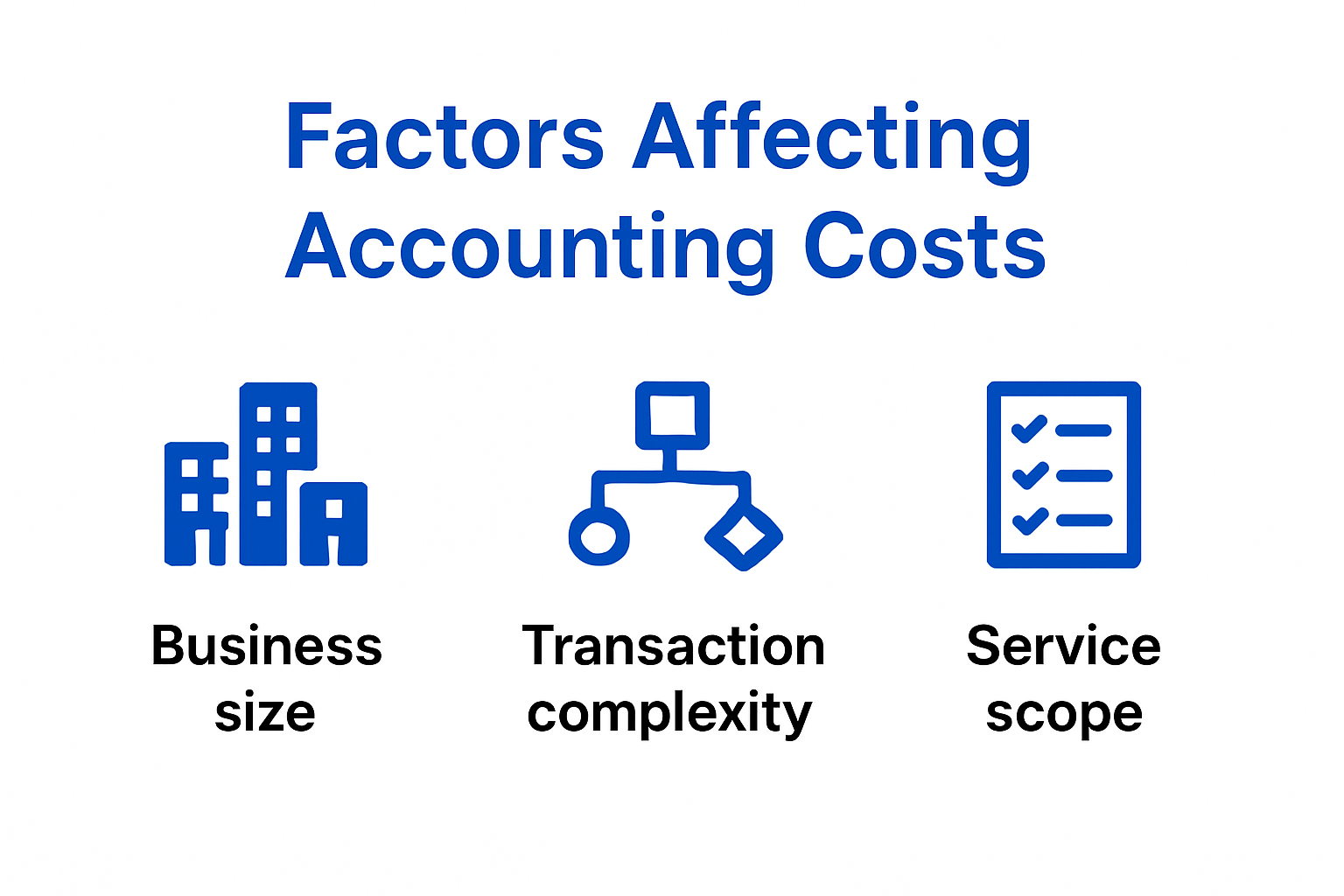
Understanding the cost of accounting services requires a comprehensive look at multiple interconnected variables that shape pricing structures in 2025. Business owners seeking financial management solutions need to recognize that accounting costs are not a one-size-fits-all proposition, but rather a nuanced calculation based on several critical factors.
Business Size and Complexity
The scale and intricacy of your business operations play a fundamental role in determining accounting service costs. Smaller enterprises with straightforward financial transactions will naturally incur lower expenses compared to larger organizations with complex financial landscapes. For instance, a small sole proprietorship might require minimal monthly bookkeeping, while a medium-sized company with multiple revenue streams, international transactions, and intricate tax considerations will demand more comprehensive and consequently more expensive accounting support.
Accounting complexity increases with factors such as:
- Number of financial transactions per month
- Diversity of revenue sources
- Payroll management requirements
- Regulatory compliance needs
Service Scope and Technology Integration
The range of services and technological sophistication significantly impact accounting costs. Modern accounting firms like Ready Accounting leverage cloud-based solutions and automation technologies that can actually reduce long-term expenses. According to Deloitte’s Technology Trends Report, businesses investing in integrated accounting technologies can reduce administrative costs by up to 40%.
Advanced services that influence pricing include:
- Cloud accounting platforms
- Real-time financial reporting
- Automated VAT and tax compliance
- Advanced data analytics
Frequency and Depth of Professional Engagement
The level of professional involvement directly correlates with accounting service costs. Some businesses require monthly reconciliation and basic reporting, while others need comprehensive financial strategy, tax planning, and ongoing advisory services. A small startup might engage an accountant quarterly, whereas a growing enterprise might require weekly or even daily financial consultations.
Key engagement levels impacting cost include:
- Monthly bookkeeping
- Quarterly financial reviews
- Annual tax preparation
- Strategic financial consulting
Understanding these factors helps business owners make informed decisions about their accounting investment. While costs might seem substantial, professional accounting services ultimately provide significant value through financial optimization, risk management, and strategic insights.
For businesses in South Africa, partnering with a cloud accounting expert can transform accounting from a mere compliance necessity to a strategic business advantage.
Comparing Traditional and Cloud-Based Accounting Services
The accounting services landscape has dramatically transformed in recent years, with cloud-based solutions revolutionizing how businesses manage their financial processes. Understanding the distinctions between traditional and cloud-based accounting services is crucial for making informed financial management decisions in 2025.
Cost and Infrastructure Considerations
Traditional accounting services typically involve significant upfront investments in hardware, software licenses, and on-site infrastructure. Businesses had to purchase expensive accounting software, maintain dedicated computer systems, and invest in regular updates and maintenance. In contrast, cloud-based accounting services offer a more flexible and cost-effective approach.
Cloud accounting solutions dramatically reduce initial capital expenditure. According to Gartner’s Cloud Technology Research, businesses can reduce IT infrastructure costs by up to 30% by migrating to cloud-based accounting platforms. These solutions operate on a subscription model, allowing businesses to scale their services according to their specific needs without massive upfront investments.

Accessibility and Collaboration
Traditional accounting methods were characterized by limited accessibility. Financial data was typically confined to specific office computers, making remote work and real-time collaboration challenging. Cloud-based accounting services have transformed this paradigm by providing seamless, secure access from anywhere with an internet connection.
Key accessibility advantages include:
- Real-time financial data updates
- Multi-user collaboration
- Secure remote access
- Instant financial reporting
Modern businesses require financial solutions that support flexible work environments. Research from McKinsey indicates that companies with robust cloud-based systems experience 20% higher productivity and more efficient team collaboration.
Security and Compliance
Security concerns often make businesses hesitant to transition to cloud-based systems. However, contemporary cloud accounting platforms offer advanced security features that often surpass traditional on-premise solutions. These platforms implement robust encryption, multi-factor authentication, and continuous security updates.
For South African businesses, cloud accounting platforms ensure compliance with local regulations like SARS requirements and POPIA (Protection of Personal Information Act). Automated compliance features reduce the risk of human error and provide comprehensive audit trails.
Choosing between traditional and cloud-based accounting services is no longer just a technological decision but a strategic business choice. While traditional methods served businesses effectively in the past, cloud-based solutions offer unprecedented flexibility, cost-effectiveness, and technological integration.
Businesses looking to optimize their financial management should carefully evaluate their specific needs and consider exploring modern cloud accounting technologies that can provide competitive advantages in an increasingly digital business landscape.
Here is a comparison table highlighting the key differences between traditional and cloud-based accounting services as discussed above:
| Feature/Aspect | Traditional Accounting | Cloud-Based Accounting |
|---|---|---|
| Upfront Costs | High (hardware, licenses, maintenance) | Low (subscription-based, scale as needed) |
| IT Infrastructure Costs | Significant | Up to 30% lower |
| Accessibility | Limited to office computers | Accessible from anywhere, real-time updates |
| Collaboration | Challenging | Easy multi-user collaboration |
| Security & Compliance | Manual, may lack regular updates | Automated updates, advanced security, POPIA/SARS |
| Scalability | Hardware-dependent, slow to scale | Instantly adjustable, pay for what you use |
| Productivity Impact | Limited by physical access | 20% higher with robust cloud systems |
Tax, Payroll and Bookkeeping Fees in South Africa
Navigating the financial landscape of accounting services in South Africa requires a nuanced understanding of specific pricing structures for tax, payroll, and bookkeeping. Business owners must recognize that these services are not just administrative tasks but critical components of financial management that directly impact operational efficiency and regulatory compliance.
Typical Fee Structures for Small to Medium Enterprises
Accounting service fees in South Africa vary significantly based on business size, complexity, and specific requirements. For small businesses, monthly bookkeeping services typically range from R1,500 to R5,000, depending on the number of monthly transactions and complexity of financial records. According to SAICA (South African Institute of Chartered Accountants), micro-enterprises can expect more affordable rates, while medium-sized businesses with intricate financial structures may incur higher costs.
Payroll management solutions represent a significant component of accounting expenses. Statistics South Africa reports that businesses spend approximately 3-5% of their total revenue on payroll processing and management. This includes critical services such as:
- Monthly salary calculations
- PAYE and UIF submissions
- Compliance with labour regulations
- Tax reporting and documentation
Specialized Services and Compliance Costs
Tax-related services in South Africa involve complex compliance requirements that directly impact pricing. SARS mandates precise reporting and documentation, which means businesses must invest in comprehensive tax preparation services. Specialized tax consulting can range from R2,000 to R15,000 per month, depending on the complexity of the business structure and industry-specific tax considerations.
Key factors influencing tax and accounting service costs include:
- Business turnover
- Number of employees
- Complexity of financial transactions
- Industry-specific regulatory requirements
Annual Financial Statement and Reporting Expenses
Preparing annual financial statements is a critical yet often underestimated expense for South African businesses. Small businesses might spend between R5,000 to R20,000 for comprehensive financial statement preparation, while larger enterprises could see costs escalating to R50,000 or more. The South African Revenue Service (SARS) requires meticulous documentation, making professional accounting services not just a convenience but a necessity.
Businesses should view these expenses as strategic investments rather than mere costs. Professional accounting services provide crucial benefits including:
- Accurate financial reporting
- Risk mitigation
- Tax optimization
- Regulatory compliance
Understanding these fee structures helps business owners budget effectively and choose accounting services that provide the best value. While costs might seem substantial, professional accounting support can save businesses significant money through expert tax planning, error prevention, and strategic financial guidance.
For South African entrepreneurs seeking detailed insights, exploring comprehensive payroll tax guidance can provide additional clarity on managing these critical financial services.
Below is a summary table outlining the typical ranges of accounting service fees for South African small to large businesses, as described above:
| Service Type | Typical Fee Range (per month/year) | Notes on Variation |
|---|---|---|
| Monthly Bookkeeping | R1,500 – R5,000 / month | Depends on number of transactions and complexity |
| Payroll Management | 3-5% of total revenue / month | Includes salary calculations, PAYE/UIF, compliance |
| Specialized Tax Consulting | R2,000 – R15,000 / month | Varies by business structure and compliance needs |
| Annual Financial Statement Prep | R5,000 – R20,000 (small) / R50,000+ (large) | Size and reporting detail influence cost |
Tips to Lower Your Accounting Service Expenses
Managing accounting service expenses requires strategic thinking and proactive financial management. South African businesses can significantly reduce their accounting costs by implementing smart approaches that optimize financial processes and leverage modern technologies.
Embrace Digital Automation and Cloud Solutions
Digital transformation offers substantial opportunities for cost reduction. Accounting automation technologies can dramatically decrease manual processing expenses. According to The American Productivity & Quality Center, businesses can reduce labor costs by up to 45% through systematic process automation.
Key automation strategies include:
- Automated bank reconciliation
- Digital expense tracking
- Automated invoice processing
- Real-time financial reporting
Strategic Outsourcing and Service Selection
Careful selection of accounting services can substantially reduce overall expenses. AccountingProfessor.org recommends businesses consider outsourcing non-core accounting functions to specialized service providers. This approach allows access to professional expertise without maintaining a full-time in-house team.
Outsourcing considerations include:
- Comparing service packages
- Evaluating per-transaction vs. monthly rates
- Identifying scalable solutions
- Assessing technology integration capabilities
Proactive Financial Management and Error Prevention
Preventing financial errors is crucial for minimizing unexpected accounting expenses. Avoiding common bookkeeping mistakes can save businesses significant money in corrective services and potential penalties.
Proactive error prevention strategies include:
- Regular financial record reviews
- Implementing robust internal controls
- Maintaining organized documentation
- Conducting periodic financial audits
Wikipedia’s accounting outsourcing research highlights that strategic outsourcing can provide businesses access to specialized expertise at reduced costs, particularly for small to medium enterprises wrestling with complex financial management requirements.
Businesses should view accounting expense reduction not as cost-cutting, but as an opportunity for financial optimization. By leveraging technology, selecting appropriate services, and maintaining meticulous financial practices, South African businesses can transform accounting from a necessary expense into a strategic financial advantage.
Remember, the goal is not just reducing costs, but enhancing financial efficiency and gaining actionable insights that drive business growth and sustainability.
Frequently Asked Questions
What factors influence the cost of accounting services in South Africa?
The cost of accounting services is influenced by factors such as business size and complexity, the scope of services required, and the frequency of professional engagement. Larger businesses with more transactions typically incur higher costs due to increased demands for compliance and service.
How can cloud-based accounting solutions help reduce accounting costs?
Cloud-based accounting solutions can reduce IT infrastructure expenses by up to 30% and lower labour costs by as much as 45%. They offer flexible subscription models, enhance accessibility, and improve collaboration among financial teams.
What are the typical fees associated with tax and payroll services in South Africa?
Monthly bookkeeping services can range from R1,500 to R5,000, while payroll management typically costs around 3-5% of total revenue. Specialized tax consulting fees can range from R2,000 to R15,000 per month, depending on the complexity of the business.
What steps can businesses take to lower their accounting service expenses?
Businesses can lower their accounting expenses by embracing digital automation, strategically outsourcing non-core functions, and implementing proactive financial management practices to avoid errors. Regular financial reviews and organized documentation can also help minimize unexpected costs.
Turn Accounting Costs Into Long-Term Savings with Ready Accounting
Have you noticed how fast accounting costs can stack up when you are running a business in South Africa? If you are worried about hitting a ceiling with outdated systems or manual processes, you are not alone. The article explains how shifting to cloud-based solutions and smarter automation is reshaping what you really pay for accounting. This change is not just about saving money, but unlocking new ways to work faster, comply with the rules, and avoid those surprise expenses that drain your budget.
Ready Accounting specialises in using modern cloud technology and automation to cut unnecessary costs and boost your business growth. From streamlined payroll management to proactive financial advice and hands-on support, we tailor every service to what South African companies actually need. If you want fewer financial errors, quicker turnaround times, and a clear roadmap towards compliance and efficiency, this is your moment to make a smart change. Visit Ready Accounting today to get expert help or book a consultation. Let us help your business master accounting costs in 2025 before they start running away from you.
Recommended
- SEO Cost in 2025: What Your Business Should Expect
- Understanding the Average Cost for Will and Estate Planning - Law Office of Eric Ridley