

Reclaim Evenings in 7 Days: Energy & Automation for Work Life Balance
Reclaim Evenings in 7 Days: Energy & Automation for Work Life Balance
The most effective work life balance strategies combine three moves: enforceable boundaries, energy-based scheduling instead of pure time management, and automating or delegating the admin that eats your evenings. Start with one tactic this week, ideally boundary scripts or the Flinders energy-management approach, and build from there. If you run a business, Readyaccounting exists precisely because finance admin is one of the easiest categories to hand off.
Executive Summary
- Automating or delegating repetitive admin tasks saves significant time and reduces evening work, especially when handling high-frequency, low-complexity duties.
- Setting clear, enforceable core hours and visibly communicating them ensures boundaries are respected and minimizes burnout from endless work.
- Prioritizing tasks based on personal energy peaks rather than just fixed schedules leads to more sustainable productivity and better work-life balance.
- Tracking a few key metrics weekly, such as work hours, sleep regularity, and stress levels, helps identify ineffective strategies and guide adjustments.
- Building routines like scheduled breaks, consistent sleep times, and full days off protects mental health and prevents chronic work fatigue.
Table of Contents
- Quick checklist: the top work life balance strategies to try this week
- How do you set boundaries that people actually respect?
- Why energy management beats time management
- Should you delegate it or automate it?
- What daily habits actually prevent burnout?
- How do you tame the always-on culture without ghosting people?
- How do you ask your manager or clients for a lighter, saner workload?
- How do you know if your strategy is actually working?
- What mistakes derail work life balance efforts?
- Publisher perspective: what automating finance admin actually removes
- How Readyaccounting takes finance admin off your plate
- Sources
Quick checklist: the top work life balance strategies to try this week
You don’t need all of these at once. Pick one or two, run them for seven days, and see what sticks.
- Set core hours and put them in your calendar as a recurring block, not a mental note.
- Schedule by energy, not just time: put your hardest task in your sharpest hour.
- Block two hours of deep work daily and treat it like a client meeting.
- Automate one admin task this week (invoicing, scheduling, or reminders).
- Delegate one recurring task you’re doing purely out of habit.
- Protect one full day off and tell people in advance you’ll be offline.
- Set notification rules: decide which channels get real-time replies and which don’t.
- Negotiate one unrealistic deadline or workload item using a short script, not a complaint.
A salaried employee might start by muting Slack after typical work hours in the evening. A business owner might start by automating VAT reminders instead of tracking deadlines in a notebook. Both are the same strategy: remove one decision you shouldn’t be making manually.
How do you set boundaries that people actually respect?
Vague boundaries get ignored. Specific, enforced ones don’t. The trick is choosing hours that match your actual energy and obligations, not an arbitrary “9 to 5” that ignores when you’re at your sharpest.
Start by picking core hours you can defend without apology; something like 8 AM to 5 PM, with a hard stop. Then say it plainly, in writing, more than once:
- To clients: “I respond to emails between 8 AM and 5 PM on weekdays. Anything after that gets a reply the next morning.”
- To colleagues: “I’m offline after 6 PM most nights. If it’s urgent, call, don’t message.”
- To family: “I’m not available during my 9 to 11 AM block. That’s my focus time.”
Put these hours visibly on your shared calendar so nobody has to ask. Build a small start and end ritual, even something as simple as closing your laptop lid fully or changing your Slack status, so your brain gets the signal that work has actually stopped.
Expect pushback in the first two weeks. That’s normal. Hold the line for at least one full cycle before deciding whether to adjust.
Pro Tip: Before agreeing to anything that eats into your boundary hours, ask yourself the opportunity-cost question researchers recommend: “If I say yes to this, what am I saying no to?” It reframes every request as a trade, not a favour.
Why energy management beats time management
Time management assumes every hour is equal. It isn’t. A 9 AM hour when you’re mentally sharp is worth more than a 4 PM hour when you’re running on fumes, and treating them the same is why so many to-do lists fail. The Flinders University energy-management framework argues you get more sustainable output by budgeting tasks according to their value and matching them to your personal energy windows, rather than just blocking time on a calendar.
Here’s a simple way to test it for one week:
- Track your energy hourly for three days (high, medium, low). No app needed, just a note.
- Score your recurring tasks 1 to 5 on value (impact on your goals, not urgency).
- Move your two highest-value tasks into your highest-energy windows.
- Push low-value, low-effort tasks (email triage, filing) into your low-energy slots.
The pattern to watch for: most people discover their “productive morning” is actually a productive 90-minute window, not a full four hours. Once you know where that window sits, protect it the way you’d protect a client meeting. Our guide to time management for business owners breaks this down further if you run a company and juggle multiple energy demands at once.
Should you delegate it or automate it?
Not every task deserves a human. Use a simple filter: Frequency × Complexity × Impact.
- List every recurring task you do weekly or monthly, no matter how small.
- Score frequency (how often), complexity (how much judgment it needs), and impact (what breaks if it’s wrong).
- High frequency, low complexity tasks (invoice reminders, appointment booking, canned email replies) are automation candidates.
- High frequency, high complexity tasks (client onboarding, reconciliations) are usually delegation candidates.
- Run a two-week pilot on one task before committing further; this mirrors the pilot approach mindfulness practitioners recommend for testing new habits before scaling them.
- Measure hours saved, not just “it feels easier.” Write down the actual time reclaimed.
Outsourcing beats DIY when the task requires specialised knowledge you’d otherwise spend weeks learning, like tax compliance or payroll rules. A tool such as Forge shows what this looks like on the workflow side, helping teams win more jobs while spending less time on manual coordination.
Pro Tip: Don’t automate a broken process. Fix the workflow first, then automate it, or you’ll just be running the same mess faster.
What daily habits actually prevent burnout?
Sustainable performance comes from boring, repeatable recovery habits, not dramatic life overhauls.
- Protect sleep regularity over sleep duration alone; going to bed and waking at consistent times matters more than chasing eight hours irregularly.
- Take real micro-breaks, five minutes away from the screen every 90 minutes, not just a scroll on your phone.
- Move daily, even a 15-minute walk breaks the sitting-and-staring cycle.
- Schedule at least one full day off weekly and actually disconnect: no email, no Slack.
- Try short mindfulness sessions; even five minutes of focused breathing can reduce rumination after a stressful day.
- Start a two-line gratitude note at day’s end; it’s small, but it interrupts the mental loop of replaying the day’s problems.
None of this is optional padding. Sustained long hours are linked to rising anxiety and depression symptoms over time, according to the Whitehall II longitudinal study. For many South African workers, financial pressure adds another layer: plenty of people want to step back from overwork but feel they can’t afford to slow down. If that’s your situation, recovery habits matter even more, not less, because they’re often the only lever you control.
How do you tame the always-on culture without ghosting people?
Not every message deserves the same urgency. Sort your channels first, then set rules around them.
- Define urgency tiers: phone calls for true emergencies, messaging apps for same-day items, email for anything that can wait 24 hours.
- Batch your checks: look at email twice a day, check Slack three times, not continuously.
- Turn on scheduled send and snooze features so replies land during your working hours, not the moment you think of them at 10 PM.
- Tell your team the new rhythm in one short message: “I’m batching messages now, checking Slack at 10, 1, and 4. Call if it’s urgent.”
- Run it for two weeks before deciding if it’s working; one bad day isn’t proof it failed.
Organisations that build in clearer disconnection norms see less fatigue among staff, which is one reason policy researchers keep pushing “right to disconnect” style rules into mainstream workplace guidance.
How do you ask your manager or clients for a lighter, saner workload?
Walking in with “I’m overwhelmed” rarely gets you anywhere. Walking in with a log and a proposal usually does.
- Track your workload for two weeks first: hours worked, tasks completed, and where quality started slipping.
- Bring three things to the conversation: the problem (with your log as evidence), a specific proposal (reduce X, delegate Y, extend deadline Z), and a review date to check if it worked.
- Use the three-step script: “Here’s what’s happening, here’s what I’d like to change, can we review this in three weeks?”
- Frame resource requests as ROI, not complaints: “An extra hour of admin support here saves roughly five hours of rework downstream.”
- Escalate to HR or propose a formal pilot if a direct manager conversation doesn’t move things; a written pilot proposal is harder to dismiss than a verbal ask.
Workplace culture shapes how far this gets you. Research into South African workplace wellbeing points to flexible-hours policies, workload audits, and manager training as the organisational levers that actually move the needle, especially in contexts where structural obligations like extended family financial support add pressure that a generic “self-care” pep talk won’t fix.
How do you know if your strategy is actually working?
Track a short list, not a dashboard. Five numbers tell you most of what you need:
- Sleep regularity: same bedtime and wake time, roughly, most nights.
- After-hours work frequency: how many evenings you actually logged in.
- Perceived stress: a simple 1 to 10 rating, tracked weekly.
- Deep-work hours: time spent on high-value tasks, undistracted.
- Days off actually taken: not scheduled, taken.
Spend ten minutes every Friday reviewing the week. Once a month, spend 30 minutes asking harder questions: has stress trended down, has family noticed a difference, has quality of work improved or slipped? Ask the people around you directly; a partner or colleague often notices the pattern before you do. If a tactic isn’t moving any of these numbers after three or four weeks, drop it and try something else.
What mistakes derail work life balance efforts?
Most failures come from the same handful of errors.
- Vague boundaries (“I’ll try to log off earlier”) that nobody, including you, can hold you to.
- Guilt around delegating, which quietly undoes every automation you set up.
- Chasing productivity hacks without a system underneath them; a new app doesn’t fix a broken calendar.
- Ignoring financial stress as if it’s separate from burnout, when for many people it’s the actual root cause.
The fix is usually small: write the specific boundary down, commit to a two-week pilot before judging any change, and if stress or anxiety symptoms persist beyond a few weeks despite real changes, talk to a professional rather than pushing through alone.
Publisher perspective: what automating finance admin actually removes
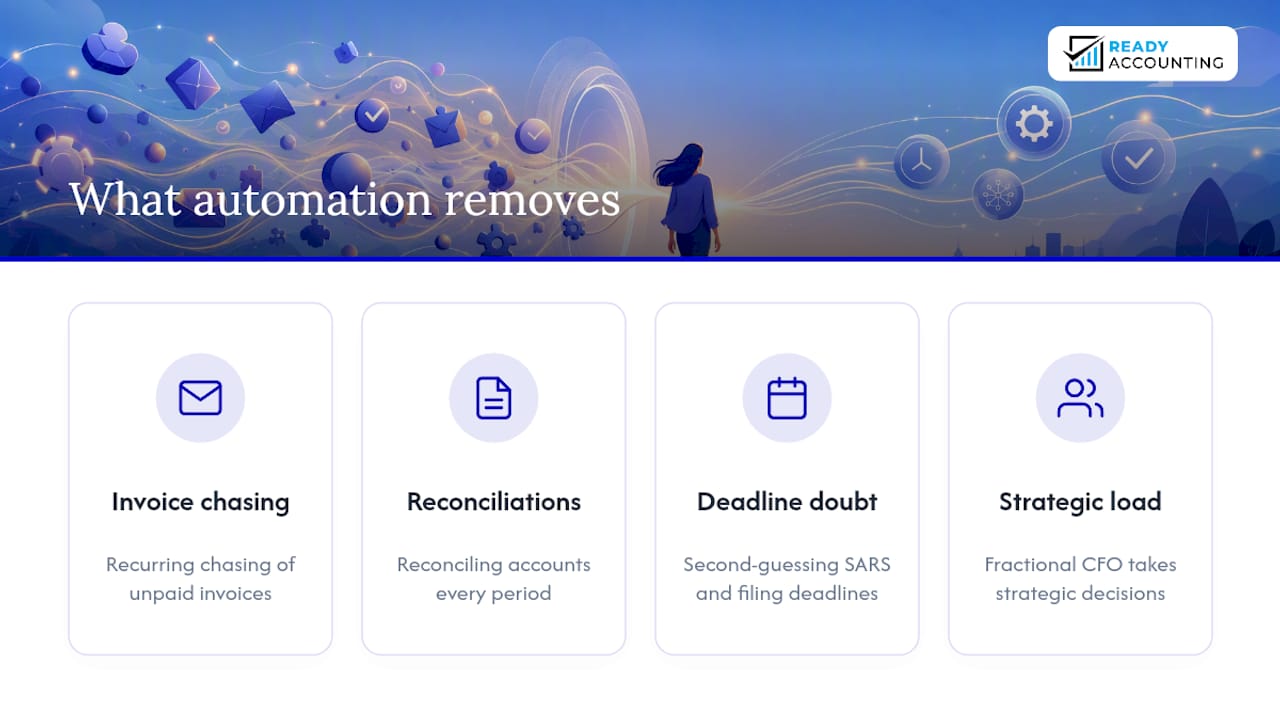
At Readyaccounting, we watch business owners lose their evenings to the same recurring tasks: chasing invoices, reconciling accounts, second-guessing SARS deadlines. None of that requires the owner’s judgment. It requires a system.
Automating recurring finance admin doesn’t just save hours, it removes the background hum of unfinished tasks that follows owners home. A fractional CFO arrangement extends that further, taking the strategic financial decisions off your plate without you having to build an internal finance team. We’d suggest a simple audit: track how many hours you spend monthly on finance admin specifically. That number alone often makes the case for change.
— Johan
How Readyaccounting takes finance admin off your plate
Chasing invoices at 9 PM or reconciling accounts on a Sunday isn’t a discipline problem, it’s a systems problem. Readyaccounting is built for South African business owners who need their finance function running on autopilot: cloud-based bookkeeping, automated payroll, tax consulting, and Annual Financial Statement preparation that doesn’t require your evenings.
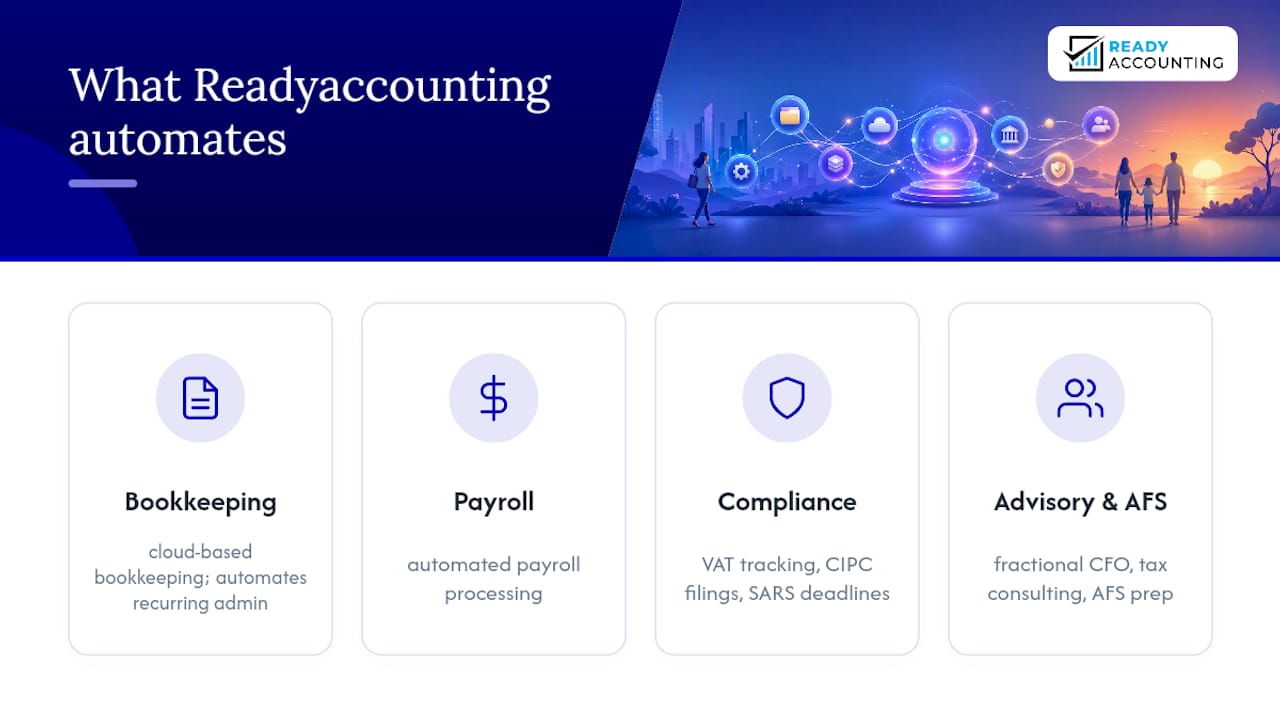
Fractional CFO advisory services provide strategic input without the cost of a full-time hire, while cloud accounting infrastructure handles recurring admin, VAT registration tracking, CIPC filings, and SARS compliance deadlines in the background. If you’re a startup or SME owner wondering how much time you’d reclaim by automating the finance side of your business, read our breakdown of how automation improves cash flow and get a sense of what a discovery call could uncover for your specific setup.
Sources
- Energy management instead of time management
- How to set boundaries — UC Davis Health blog
- Long working hours and symptoms of anxiety and depression: a 5‑year follow-up of the Whitehall II study
- Workplace well-being in post-apartheid South Africa: an intersectional social determinants perspective
- Mindful