

Why financial planning matters for SA Corporate Asset success
Executive Summary
- Financial planning provides South African SMBs with a clear roadmap for growth and sustainability.
- Regular review and adaptation of financial plans are crucial to stay compliant and make informed decisions.
- Proper financial management reduces failure risk by ensuring cash flow, record accuracy, and regulatory compliance.
Financial planning is not a luxury reserved for large corporations with full-time finance teams. For small and medium businesses in South Africa, it is the difference between growing steadily and shutting the doors within three years. Many owners believe that keeping rough mental notes of income and expenses is enough. It is not. With rising input costs, unpredictable exchange rates, and strict SARS compliance requirements, every South African SMB needs a clear, documented financial plan. This guide breaks down what financial planning really means, why it drives growth, what mistakes to avoid, and how to build a plan that actually works for your business.
Table of Contents
- Understanding the basics of financial planning
- Key benefits: How financial planning supports SMB growth
- Avoiding pitfalls: Common financial mistakes and how planning helps
- Practical steps: Building a robust financial plan for your business
- A South African accountant’s perspective: What most owners get wrong
- Take your next step with expert support
- Frequently asked questions
Key Takeaways
| Point | Details |
|---|---|
| Boost business growth | A financial plan helps small and medium businesses grow faster and make better decisions. |
| Prevent costly mistakes | Careful planning helps you avoid cash flow problems, compliance issues, and other common pitfalls. |
| Framework for action | A simple, repeatable planning process gives you control and clarity over your finances. |
| Ongoing adjustment is crucial | Financial planning should be reviewed regularly to keep up with changes in your business and the economy. |
Understanding the basics of financial planning
Financial planning is the process of setting financial goals, estimating future income and expenses, and creating a roadmap to reach those goals. Think of it as a GPS for your business. Without it, you are driving blind and hoping you arrive at the right destination.
At its core, financial planning for a South African SMB involves four key elements:
- Forecasting: Estimating future revenue and costs based on historical data and market trends
- Budgeting: Allocating resources to specific activities so spending stays controlled
- Cash flow management: Tracking money coming in and going out to avoid shortfalls
- Compliance: Meeting SARS obligations, including VAT returns, income tax, and record-keeping requirements
One common misconception is that a financial plan is just a budget. A budget is only one piece. A full plan connects your goals to your numbers, your numbers to your operations, and your operations to your legal obligations. Another myth is that planning is only necessary when applying for funding. In reality, financial planning is critical for ensuring sustainability, growth, and the ability to weather economic uncertainty at every stage of your business.
Understanding your numbers starts with knowing how to read them. If you are not yet comfortable with your financial statements, our guide on understanding financial statements is a practical starting point. Once you can read a balance sheet and an income statement, your financial plan becomes far more meaningful. You can also explore financial statement basics to build confidence in interpreting your own numbers.
Pro Tip: Schedule a 30-minute financial review at the end of every month. Look at actual versus budgeted figures and note where the gaps are. This habit alone will improve your financial awareness more than any single tool.
Planning is not a once-off document. It is a living process that must adapt as your business changes, as the economy shifts, and as new regulations come into effect.
Key benefits: How financial planning supports SMB growth
With the basics established, let’s see exactly how financial planning translates into real-world advantages for your business.
The most direct benefit is speed of growth. Businesses with a financial plan grow 30% faster than those without one. That is not a small margin. It reflects the compounding effect of better decisions made consistently over time.

Here is a clear comparison of what planning changes:
| Area | Without a plan | With a plan |
|---|---|---|
| Cash flow | Reactive, often in crisis | Proactive, shortfalls anticipated |
| Decision-making | Based on gut feel | Based on data and projections |
| Tax compliance | Scrambling at deadline | Prepared and on schedule |
| Growth opportunities | Missed due to lack of funds | Captured through budgeted reserves |
| Risk management | Unaware until it is too late | Identified and mitigated early |
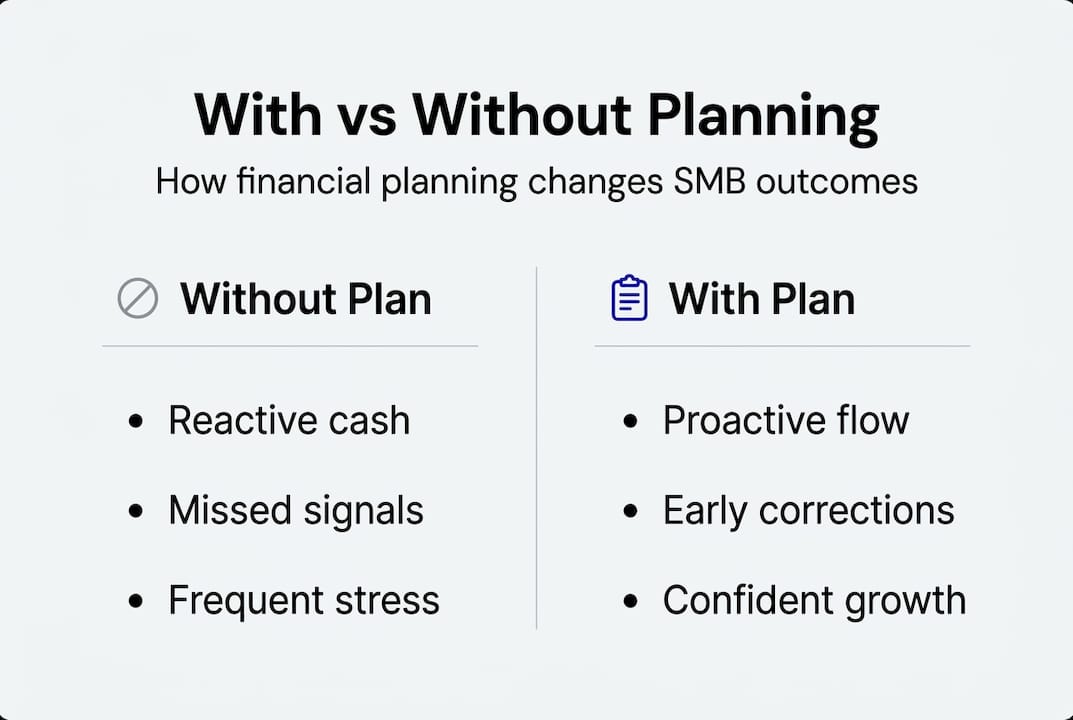
Financial planning also sharpens your decision-making. When you have a cash flow forecasting model in place, you can answer questions like: Can we afford to hire someone new? Should we take on that large order? What happens if a major client pays 60 days late?
Here are five growth-driving actions that only become possible with a solid financial plan:
- Identify your most profitable products or services using margin analysis
- Time major purchases to avoid cash flow pressure
- Set realistic revenue targets and track progress monthly
- Negotiate better supplier terms because you know your payment cycles
- Reinvest profits strategically instead of spending reactively
Understanding your profit margin guide is essential here. Knowing which parts of your business are actually profitable changes everything about how you allocate time and money.
“A financial plan is not about predicting the future. It is about being prepared for it.”
The businesses that survive economic downturns in South Africa are rarely the ones with the most capital. They are the ones that planned carefully and adjusted quickly.
Avoiding pitfalls: Common financial mistakes and how planning helps
While the benefits are many, not planning properly can have severe consequences. Here’s what to avoid and how a plan can save your business.
The numbers are stark. 86% of South African SMB failures are linked to poor financial planning or management. That means most business failures are not caused by bad products or poor service. They are caused by financial mismanagement that could have been prevented.
The three most common mistakes are:
- Ignoring cash flow: Profit on paper does not mean cash in the bank. Many businesses collapse while technically profitable
- Inaccurate or incomplete records: If your books are messy, your decisions will be too. Inaccurate records also attract SARS penalties
- Tax non-compliance: Missing VAT submissions or under-declaring income creates compounding penalties and interest
Here is how unplanned versus planned financial management compares in practice:
| Situation | Unplanned approach | Planned approach |
|---|---|---|
| Slow sales month | Panic, cut costs randomly | Draw from planned cash reserve |
| Tax season | Scramble to find documents | Submissions ready in advance |
| Unexpected expense | Take on debt at high interest | Covered by emergency fund |
| Growth opportunity | Cannot act, no funds available | Budget already allocated |
Watch for these red flags in your own business:
- You do not know your exact cash balance at any given time
- You have missed a SARS deadline in the past 12 months
- Your expenses regularly exceed your budget
- You have not reviewed your financials in more than 90 days
- You mix personal and business finances
Our resource on common bookkeeping mistakes covers the specific errors that trip up South African business owners most often. For the compliance side, our tax compliance guidance walks you through what SARS expects and how to stay on the right side of the law.
Pro Tip: Set up a simple dashboard tracking three numbers every week: cash on hand, outstanding invoices, and upcoming expenses. These three figures give you an early warning system that prevents most financial crises.
Practical steps: Building a robust financial plan for your business
Armed with an understanding of what to do and what not to do, here is how to begin putting financial planning into action in your own business.
A solid financial plan does not need to be complicated. Effective financial planning involves clear goal-setting, budgeting, cash flow projection, compliance checks, and regular review. Follow these five steps:
- Set clear financial goals: Define what success looks like in numbers. Revenue targets, profit margins, debt reduction milestones
- Build a realistic budget: Break your costs into fixed and variable categories. Compare against your revenue forecast monthly
- Project your cash flows: Use a rolling 13-week cash flow forecast to see what is coming. Our cash flow forecast template makes this straightforward
- Ensure compliance: Map out all SARS deadlines for the year, including VAT, PAYE, and provisional tax. Our year-end tax planning guide helps you prepare well in advance
- Review regularly: Set a monthly review date. Compare actuals to projections and adjust your plan accordingly
Useful resources for South African SMBs include:
- SARS eFiling for tax submissions and records
- Accounting software like Xero or Sage for automated bookkeeping
- The CIPC portal for company compliance and annual returns
- A registered accountant or bookkeeper for professional oversight
- Ready Accounting’s blog for practical, locally relevant financial guidance
Do not try to do everything yourself. Involving a professional accountant, even on a part-time or consulting basis, significantly improves the quality and accuracy of your financial plan. The cost of professional advice is almost always lower than the cost of the mistakes it prevents.
A South African accountant’s perspective: What most owners get wrong
After working with dozens of South African SMBs, the pattern is consistent. Owners put real effort into creating a financial plan at the start of the year, then file it away and never look at it again. By June, the plan is irrelevant because the business has changed and the numbers have not been updated.
The uncomfortable truth is that a financial plan is only as useful as the last time you updated it. A plan built on January’s assumptions cannot guide August’s decisions.
What separates thriving businesses from struggling ones is not the quality of the original plan. It is the discipline of treating planning as a habit rather than an event. The owners who succeed integrate financial review into their weekly and monthly routines. They connect their plan to real business data, not wishful projections.
“The best financial plan is the one you actually use. Not the one sitting in a folder.”
South Africa’s regulatory environment adds another layer. SARS rules change, VAT thresholds shift, and compliance obligations evolve. A plan that ignores local regulation is incomplete. If you want to build sustainable practices into your business, financial planning must be at the centre of that effort, reviewed and adjusted continuously.
Take your next step with expert support
If you are ready to transform your business with financial planning, here’s where to start.

Ready Accounting helps South African SMBs move from financial guesswork to confident, data-driven management. Whether you need help setting up your first financial plan, cleaning up your books, or understanding the cloud accounting benefits that make ongoing planning easier, we are here for it. Our cloud accounting guide shows you exactly how modern tools can automate the heavy lifting so you can focus on running your business. Visit Ready Accounting to book a consultation and take the first real step toward financial clarity.
Frequently asked questions
What is the main purpose of financial planning for my small business?
Financial planning helps you control expenses, improve profits, and anticipate potential challenges so your business can thrive and comply with South African laws. It is the foundation for every sound business decision you make, from hiring to expansion to managing a slow season. Sustainability and growth depend on it.
How does financial planning prevent my business from failing?
A good plan keeps your cash flow healthy, ensures compliance, and helps you spot risks before they become problems. Given that 86% of failures are linked to poor financial management, a plan is your most effective protection against becoming a statistic.
How often should I update my financial plan?
Review and update your plan at least every quarter, or immediately after any major change such as a new client, a large expense, or a shift in market conditions. Regular review and adjustment based on real business data is what keeps a plan relevant and useful.
Are there specific regulations South African SMBs need to follow in their financial planning?
Yes, South African SMBs must comply with SARS requirements including accurate record-keeping, VAT submissions, PAYE, and provisional tax filings. Understanding SARS record-keeping rules is a non-negotiable part of any complete financial plan.
Recommended
- Understand financial statements: guide for South African SMBs – Ready Accounting
- What is financial due diligence: a guide for SMB owners – Ready Accounting
- What are financial statements: guide for South African SMBs – Ready Accounting
- How to create a budget for SA SMEs: step-by-step – Ready Accounting