

When to register for VAT: a South African SME guide
Executive Summary
- Most South African small businesses believe VAT registration is only necessary when invoices pile up, risking penalties. The updated thresholds from 1 April 2026 require mandatory registration when taxable supplies exceed R2.3 million annually, with voluntary registration possible above R120,000. Proper monitoring, timely document preparation, and expert assistance ensure compliance and leverage the benefits of VAT registration.
Most South African small business owners believe they only need to worry about VAT registration once their invoices start piling up past a certain point. That thinking is exactly what lands businesses in trouble with SARS. Knowing when to register for VAT is not just a compliance checkbox — it is a decision with real financial consequences, both in penalties avoided and tax benefits captured. With the VAT registration threshold significantly updated from 1 April 2026, now is the right time to understand your obligations clearly and plan ahead.
Table of Contents
- Understanding VAT registration thresholds in South Africa
- How to determine the right time to register: compulsory vs voluntary registration
- Monitoring taxable supplies and managing SARS’ VAT registration process
- Benefits and considerations of voluntary VAT registration for small businesses
- Practical steps and tips for timely and compliant VAT registration
- Why proactive VAT registration planning avoids costly compliance pitfalls
- Get expert help with VAT registration and compliance
- Frequently asked questions
Key Takeaways
| Point | Details |
|---|---|
| 2026 thresholds updated | Compulsory VAT registration starts at R2.3 million taxable supplies, voluntary at R120,000 from April 2026. |
| Register within 21 days | You must apply for VAT registration within 21 business days after exceeding the compulsory threshold or via contracts. |
| Voluntary registration pros and cons | Voluntary registration lets you claim input VAT but increases administration and compliance workload. |
| Prepare documents early | Gather and submit complete SARS-required documents promptly to avoid VAT application delays. |
| Use expert help | Partnering with accounting professionals and cloud tools simplifies VAT registration and compliance. |
Understanding VAT registration thresholds in South Africa
The first thing to get right is the number that triggers your obligation. Many business owners are still operating under outdated assumptions based on the old R1 million compulsory threshold. That figure no longer applies.
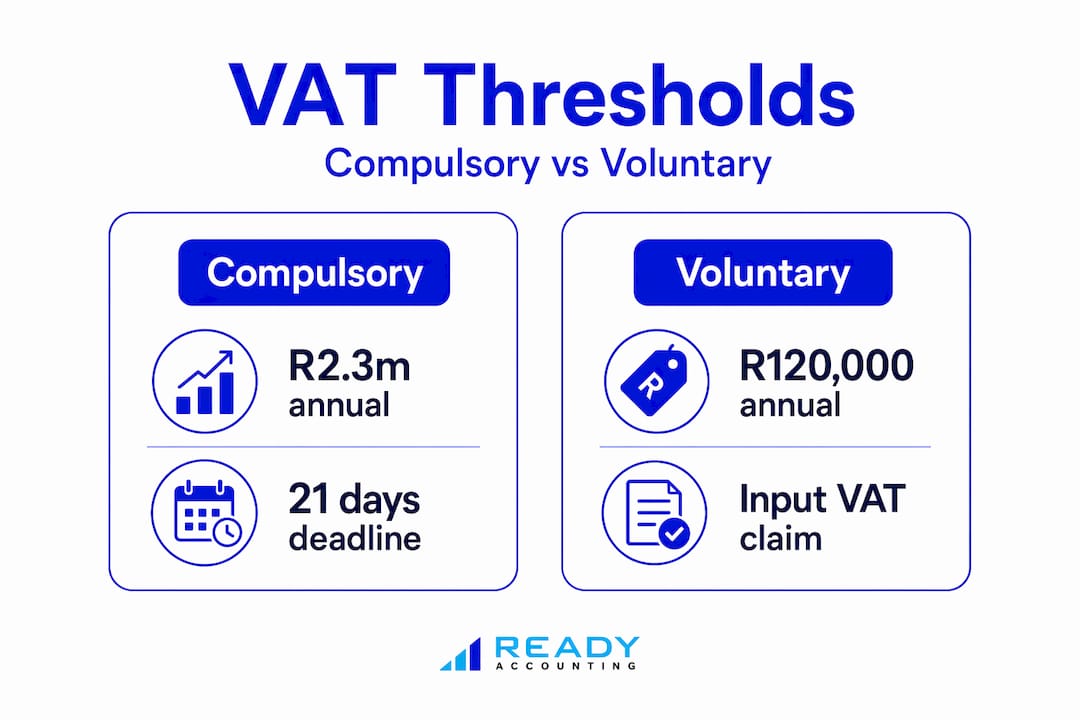
From 1 April 2026, compulsory VAT registration becomes mandatory when your taxable supplies exceed R2.3 million per annum, up from R1 million previously. This is a significant shift that gives growing SMEs more breathing room before compulsory registration kicks in. However, it does not mean you should ignore VAT planning until you hit that ceiling.
The voluntary registration threshold has also been updated. Businesses with taxable supplies exceeding R120,000 per year can now register voluntarily, up from the previous R50,000. Both thresholds apply to taxable supplies measured over any consecutive 12-month period, not just a calendar or financial year. This matters because your 12-month window can start at any point, not just January or March.
Here is a quick breakdown of both registration types:
| Registration type | Threshold (from 1 April 2026) | Obligation |
|---|---|---|
| Compulsory | R2.3 million per annum | Mandatory within 21 business days |
| Voluntary | R120,000 per annum | Optional, with proof or reasonable expectation |
Key points to understand about VAT registration requirements for SMEs:
- Taxable supplies include standard-rated and zero-rated supplies, but not exempt supplies
- The threshold assessment runs on a rolling 12-month basis, not fixed annual periods
- Signed contracts that will push your turnover past the threshold also trigger compulsory registration obligations
- Voluntary registration has restrictions, including a 12-month lock-in once registered
“The 2026 threshold changes represent the most significant adjustment to South African VAT registration rules in over a decade. Every SME owner needs to reassess where they stand.”
How to determine the right time to register: compulsory vs voluntary registration
With the thresholds clear, let’s explore how to accurately track your taxable supplies and comply with SARS’ timelines related to those thresholds.
The VAT registration timeline is tighter than most business owners realise. Once your taxable supplies exceed R2.3 million in any rolling 12-month period, or once you sign a contract that will push you past that figure, the clock starts immediately. Businesses must apply within 21 business days of exceeding the compulsory threshold or signing contracts pushing turnover above it. Miss that window and you are already non-compliant, regardless of whether you have started charging VAT or not.
The contractual trigger is the part that catches people off guard. Imagine you run a project management consultancy and you sign a two-year retainer worth R2.8 million. Even if you have not invoiced a single rand yet, that contract alone triggers your compulsory registration obligation. Your 21-business-day countdown begins the moment ink is on paper.
For voluntary registration, the process is different. You need taxable supplies over R120,000 per year, or a reasonable expectation of reaching that level backed by evidence such as signed contracts, purchase orders, or a credible business plan. SARS does not accept vague projections without supporting documentation.
Here is how to determine where you stand right now:
- Calculate your taxable supplies for the past 12 consecutive months, rolling backward from today, not from your financial year-end
- Check your pipeline for signed contracts or confirmed orders that will push your 12-month total above R2.3 million
- Assess your voluntary registration eligibility if you are between R120,000 and R2.3 million and consider whether it benefits your business model
- Set a monthly monitoring routine so you are never surprised by a threshold breach that triggers the 21-day deadline
Staying on top of VAT compliance deadlines is far easier when you build monitoring into your regular financial routines rather than treating it as an annual exercise.
Pro Tip: Set a recurring monthly calendar reminder to compare your rolling 12-month taxable supplies against both the voluntary and compulsory thresholds. A simple spreadsheet that updates automatically each month is enough to prevent a costly oversight.

Monitoring taxable supplies and managing SARS’ VAT registration process
Understanding your monitoring and document preparation ease the registration journey, which leads us to comparing the benefits and costs of voluntary registration for SMBs.
The good news is that how to register for VAT in South Africa is straightforward if you are prepared. SARS requires submission of a VAT registration application via eFiling, with supporting documents filed timely to avoid delays. The SARS eFiling platform handles the entire application digitally, which means no queues, but also no excuses for late submission.
The documents you need to have ready before you apply typically include:
- Certified copies of identity documents for all business owners or directors
- Proof of banking details (a recent bank statement or letter from your bank)
- Proof of business address (a utility bill or lease agreement)
- Evidence of taxable supplies, such as invoices, contracts, or financial statements
- For voluntary registration, a business plan or signed contracts showing expected turnover
“The most common reason VAT registration applications are delayed is incomplete supporting documentation. SARS will request additional documents, and every day spent waiting on your response extends your exposure window.”
Once submitted, SARS may still come back with queries. Respond within the timeframe they specify. Delays on your side mean delays in your VAT number being issued, which means you cannot legally charge or claim VAT in the interim. Using the SARS eFiling VAT registration system correctly the first time makes all the difference.
Pro Tip: Before you log in to eFiling, create a digital folder with all required supporting documents already scanned and named clearly. This cuts your actual submission time to under 30 minutes and reduces the chance of uploading the wrong file.
Benefits and considerations of voluntary VAT registration for small businesses
Knowing the strategic pros and cons of voluntary registration arms you to apply this knowledge as you plan your VAT registration timing and process.
For businesses sitting between R120,000 and R2.3 million in annual taxable supplies, voluntary registration allows VAT input recovery but increases compliance workload. Whether it is worth it depends entirely on your business model.
| Factor | Voluntary registration benefit | Voluntary registration cost |
|---|---|---|
| Input VAT claims | Recover VAT paid on purchases and expenses | Requires detailed VAT recordkeeping |
| B2B credibility | Signals legitimacy; often required for tenders | None |
| Cash flow | Positive if input VAT is high relative to output VAT | Negative if most customers are private individuals |
| Admin burden | None | Monthly or bi-monthly VAT returns required |
| Lock-in period | None | Cannot deregister within 12 months of registering |
The clearest case for voluntary registration is a B2B business that buys significant stock, equipment, or services that carry VAT. You recover 15% on those purchases while still being able to charge your clients VAT. For tax planning for SME VAT registration, this input-output calculation is the core decision point.
The case against is equally clear for service businesses whose clients are mostly private consumers. Charging those clients an extra 15% makes you more expensive with no benefit to them, while you take on the administrative weight of regular VAT returns.
Additional considerations:
- Government tenders almost always require VAT registration, regardless of your turnover
- Franchise arrangements may contractually require registration even below the compulsory threshold
- Zero-rated industries such as agriculture or certain exports can benefit significantly from voluntary registration because they can claim input VAT without charging output VAT on sales
Pro Tip: If more than 60% of your revenue comes from VAT-registered businesses, voluntary registration almost always makes financial sense. Run the numbers on your last six months of purchases to estimate your potential input VAT recovery before deciding.
Practical steps and tips for timely and compliant VAT registration
Following these practical registration tips ensures you meet SARS requirements accurately and on time to avoid penalties.
Start preparing documents early once you forecast surpassing thresholds to meet SARS’ 21 business day application deadline and avoid penalties. The deadline for VAT registration is firm, and penalties for late registration include interest on VAT that should have been collected and administrative penalties per month of non-compliance.
Here is a step-by-step process to follow:
- Monitor monthly by tracking your rolling 12-month taxable supplies every single month, not at year-end
- Forecast forward using your pipeline, signed contracts, and seasonal patterns to anticipate when you will cross a threshold before it happens
- Compile documents the moment you forecast a threshold crossing, not after you have already exceeded it
- Submit via eFiling within 21 business days of the threshold breach or contract signing, uploading all required documents in one complete submission
- Track your application through eFiling and respond to any SARS queries within the specified timeframe
- Set up compliant invoicing immediately after receiving your VAT number, including all required VAT invoice details such as your VAT registration number, the tax amount, and the supply date
- Establish a VAT return schedule based on your assigned tax period, whether monthly or bi-monthly, and build it into your financial calendar from day one
The VAT registration document checklist on our blog walks through exactly what SARS expects at each stage.
Pro Tip: Use cloud accounting software that flags your rolling turnover automatically against both thresholds. When your system tells you that you are at 80% of the compulsory threshold, you have time to act calmly. When you only notice at 100%, you are already in the 21-day window under pressure.
Why proactive VAT registration planning avoids costly compliance pitfalls
Here is the uncomfortable truth about VAT registration that most generic business guides will not tell you: the compliance countdown starts the moment your taxable supplies exceed the threshold, not when you decide to start charging VAT. Treating VAT registration timing as when you start charging VAT rather than the threshold breach date is a common pitfall that risks penalties.
We see this pattern constantly with scaling SMEs. A business crosses R2.3 million in taxable supplies, continues trading without VAT registration for three or four months while “getting around to it,” and then faces a SARS audit that calculates penalties and interest on every rand of VAT that should have been collected and remitted. The financial hit is avoidable, and it is entirely self-inflicted.
The bigger strategic point is this: VAT registration planning is a window into the maturity of your entire financial operation. Businesses that know their rolling taxable supplies within a week are also businesses that know their runway, their gross margin per product line, and their cash conversion cycle. Businesses that discover they crossed a threshold six months ago are also businesses flying blind on every other financial metric.
Good VAT compliance practices also open doors. Government contracts, corporate supplier databases, and formal procurement processes almost always filter for VAT-registered vendors. Being registered before you need those contracts means you are ready when the opportunity arrives, not scrambling to get compliant after you have already committed to delivering.
The 2026 threshold changes give South African SMEs a genuine opportunity to reassess. If you were previously registered under compulsion because of the old R1 million threshold and your business has since contracted, it may be worth reviewing your registration status. Equally, if you were hovering just below the old threshold and now sit comfortably below R2.3 million, this is the moment to make a deliberate, informed choice about voluntary registration rather than drifting.
Technology and expert advice close the gap between intention and execution. Automated turnover dashboards, cloud accounting integrations with your bank feeds, and a Fractional CFO who flags threshold risks before they become penalties — these are not luxuries for large businesses. They are the infrastructure that scaling SMEs need to compete.
Get expert help with VAT registration and compliance
With a clear understanding of when and how to register for VAT, the next step is making sure your business has the systems and support to execute without error. At Ready Accounting, we track your taxable supplies in real time and identify your registration trigger point before it catches you off guard. Our outsourced accounting services for SMEs handle the full VAT registration application, document compilation, and SARS eFiling submission on your behalf. The cloud accounting benefits we build into your finance function mean your rolling turnover is always visible, your VAT returns are never missed, and your exposure to SARS penalties stays at zero. If you want to understand whether voluntary registration will reduce your tax liability or simply add overhead, we will run the numbers for your specific business model and give you a straight answer.
Frequently asked questions
What is the compulsory VAT registration threshold in South Africa from April 2026?
From 1 April 2026, compulsory VAT registration is required if your taxable supplies exceed R2.3 million in any consecutive 12-month period, up from the previous R1 million threshold.
Can I voluntarily register for VAT if my turnover is below the compulsory threshold?
Yes. Businesses with taxable supplies over R120,000 per annum can voluntarily register even if they have not reached the R2.3 million compulsory threshold, provided they can demonstrate eligibility to SARS.
How soon must I apply for VAT registration after exceeding the threshold?
You must submit your application within 21 business days of exceeding the compulsory threshold or signing a contract that will push your turnover past it. There is no grace period beyond that window.
What documents are needed to register for VAT via SARS eFiling?
SARS requires your VAT application via eFiling supported by identity documents, proof of banking details, proof of business address, and evidence of taxable supplies such as invoices or signed contracts.
What are the benefits of voluntary VAT registration?
Voluntary registration allows you to claim back VAT on business expenses and improves your credibility with B2B clients and government tenders, though it comes with monthly or bi-monthly return obligations and a 12-month lock-in period.
Recommended
- VAT registration requirements: A guide for SA SMEs | Ready Accounting
- The Ultimate VAT Compliance Protocol for South African South African Enterprises in 2025 | Ready Accounting
- How to save on taxes: Practical strategies for South African SMEs | Ready Accounting
- Tax planning guide for South African SMEs in 2026 | Ready Accounting