

What is payroll tax? Essential protocol for South African Corporate Assets
Payroll tax catches many South African SMB owners off guard. Most assume it means only PAYE, deduct it from salaries, and consider the job done. But payroll tax is an umbrella covering PAYE, UIF, and SDL for employers, and missing any one of these components can trigger backdated penalties, interest charges, and even personal liability. This guide breaks down every component, explains exactly who must register and when, and gives you practical steps to keep your business compliant and your cash flow protected.
Table of Contents
- What is payroll tax in South Africa?
- Key components: PAYE, UIF, and SDL explained
- Who must register, and when does payroll tax apply?
- Penalties, audits, and payroll tax compliance tips
- Making payroll tax compliance easier for your business
- How Ready Accounting helps you master payroll tax compliance
- Frequently asked questions
Key Takeaways
| Point | Details |
|---|---|
| Payroll tax is multi-part | It includes PAYE, UIF, and sometimes SDL depending on payroll size. |
| SDL exemption helps SMBs | SDL is only due if payroll exceeds R500,000 annually, reducing cost for many small businesses. |
| Non-compliance is costly | Penalties can reach 10% plus interest, with employers personally liable if errors go uncorrected. |
| Automation boosts compliance | Using dedicated payroll software and regular checklists streamlines compliance and minimizes mistakes. |
What is payroll tax in South Africa?
Payroll tax is not a single deduction. It is a collection of three separate obligations that every employer must understand and manage correctly. Getting this wrong is one of the most common and expensive mistakes SMBs make, especially during their first few years of hiring.
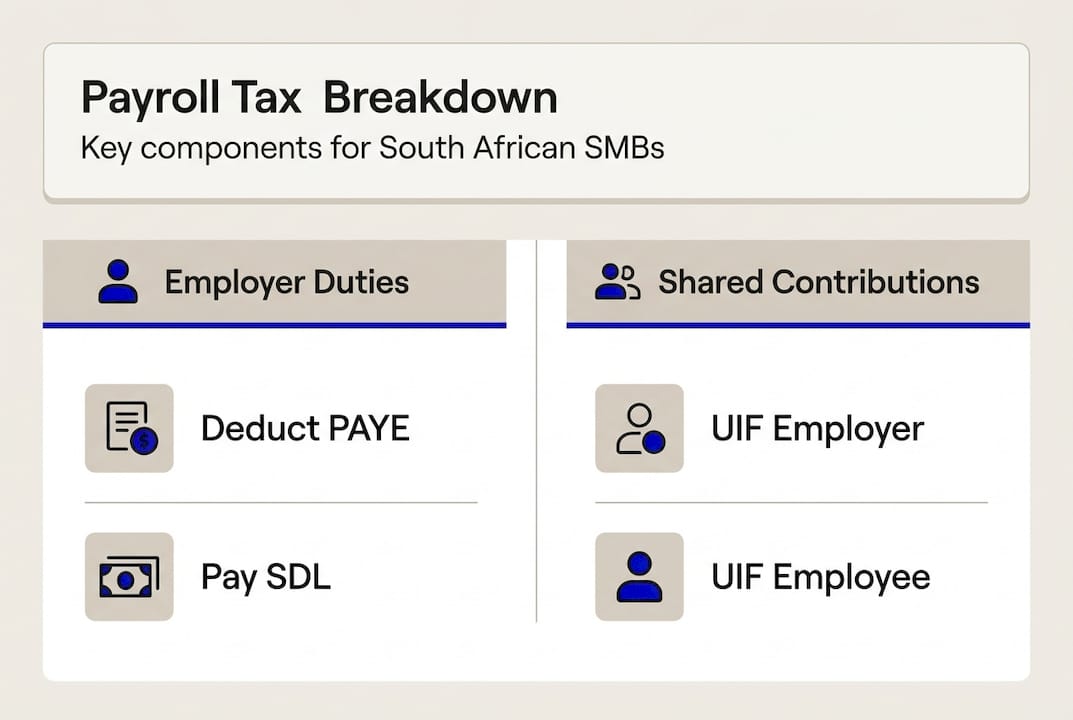
The three components are:
- PAYE (Pay As You Earn): Deducted from employee salaries and remitted to SARS monthly on their behalf.
- UIF (Unemployment Insurance Fund): A shared contribution split between employer and employee, protecting workers who lose their jobs.
- SDL (Skills Development Levy): An employer-only contribution that funds national skills training programmes.
Each component serves a different purpose, has different thresholds, and carries different consequences if mishandled. You can explore a detailed breakdown in our payroll tax explained resource, which covers 2025 and 2026 rates in full.
Here is a quick overview of how the three components compare:
| Component | Who pays | Rate | Threshold |
|---|---|---|---|
| PAYE | Employer deducts from employee | Based on tax tables | Applies when employee earns above tax threshold |
| UIF | Employer + employee | 1% each (2% total) | All employees earning a wage |
| SDL | Employer only | 1% of total payroll | Only if annual payroll exceeds R500,000 |
All businesses with employees, including sole proprietors who meet the relevant thresholds, are liable. The SARS small business guidance portal is the official reference point for registration and rate updates.
Key components: PAYE, UIF, and SDL explained
Understanding each component in detail is what separates compliant businesses from those that face audits. Let us look at each one clearly.
PAYE is deducted directly from your employee’s gross salary before they receive a cent. You, as the employer, are responsible for calculating the correct amount using SARS tax tables, deducting it, and paying it over to SARS by the 7th of each month. The employee never touches this money. If you fail to remit it, SARS holds you personally liable, not the employee.
UIF is a shared contribution. Both you and your employee contribute 1% of the employee’s remuneration each month, making a combined 2% total. This fund supports workers who become unemployed, ill, or go on maternity leave. It applies to virtually all employees, including domestic workers.

SDL is where many SMBs get confused. SDL is 1% of total leviable payroll paid by the employer only, and businesses with an annual payroll below R500,000 are exempt. This exemption is a genuine relief for smaller businesses, but you must monitor your payroll spend because crossing that threshold mid-year triggers immediate liability.
A critical point that surprises many owners: even casual or part-time workers may fall within employment definitions requiring full payroll compliance. If SARS determines that a worker is effectively an employee based on control, regularity, and dependency, all three obligations may apply regardless of how you have classified them.
Pro Tip: Use payroll software built for South African tax rules to automate PAYE calculations and UIF submissions. Our guide to payroll software options compares the leading tools available to SMBs in 2026. You can also find a step-by-step breakdown in our complete payroll management guide.
For official employer obligations and registration steps, the SARS employer obligations page is your go-to reference.
Who must register, and when does payroll tax apply?
Registration is not optional, and the triggers are broader than most SMB owners expect. Here is a numbered checklist of the most common registration triggers and mistakes:
- You hire your first employee. The moment you take on a qualifying employee, you must register for PAYE and UIF with SARS. There is no grace period.
- Your annual payroll crosses R500,000. This triggers SDL registration and liability from that point forward.
- You use contractors who work like employees. If SARS audits your business and finds disguised employment, they will apply PAYE and UIF retrospectively.
- You are a sole proprietor with staff. Sole proprietors with employees must register for PAYE and UIF if thresholds are met. Your business structure does not exempt you.
- You pay casual or seasonal workers regularly. Regularity and control are key factors SARS uses to determine employment status.
Disguised employment risks audits and backdated penalties that can cripple a small business. The safest approach is to classify workers correctly from day one and document the nature of each working relationship clearly.
Important: Missing your registration deadline does not pause your liability. SARS calculates penalties and interest from the date you should have registered, not the date you actually did.
Pro Tip: Review your worker contracts annually. If a contractor has been working exclusively for you for more than six months, SARS may reclassify them as an employee. Our small business tax guide covers this in detail, and our resource on how to avoid tax penalties gives you a practical framework for staying ahead.
Penalties, audits, and payroll tax compliance tips
Non-compliance is expensive. Late payments attract a 10% penalty plus interest, and the employer becomes personally liable if amounts were not deducted or remitted correctly. That means your personal assets could be at risk, not just your business.
Here are the most important compliance actions every SMB should take:
- Submit EMP201 returns monthly by the 7th of each month, even if no employees were paid that month.
- Reconcile your payroll records against your EMP501 bi-annual submission to catch discrepancies early.
- Keep payslips and payroll records for at least five years. SARS can audit historical periods.
- Set calendar reminders for every submission deadline. Missing one is not a small mistake.
- Forecast your annual payroll to anticipate when you might cross the SDL threshold.
Payroll software and forecasting guard against the most common SMB payroll compliance errors, including late submissions and incorrect PAYE calculations. Automation removes the human error factor that causes most penalties.
Pro Tip: Do not wait for SARS to contact you. If you suspect an error in past submissions, approach SARS voluntarily through the Voluntary Disclosure Programme. Penalties are significantly reduced for proactive disclosure. Our guide on how to streamline payroll management walks you through building a monthly compliance routine, and our SARS compliance guide covers the full picture.
Making payroll tax compliance easier for your business
Compliance does not have to be a monthly crisis. With the right systems and habits in place, it becomes a routine that protects your business and frees up your time. Accurate forecasting and automation reduce errors, SDL risk, and late submissions significantly.
Here is a practical action plan:
- Choose payroll software built for South Africa. Generic tools often miss local tax rules. Our payroll software guide compares the top options by features and pricing.
- Set up a monthly compliance calendar. Include EMP201 submission dates, UIF payment dates, and your bi-annual EMP501 reconciliation.
- Update employee classifications regularly. As your team grows or roles change, classifications must reflect reality, not convenience.
- Monitor your total payroll spend monthly. Track cumulative payroll to anticipate the R500,000 SDL threshold before you cross it.
- Review your accounting records quarterly. Catching errors early is far cheaper than fixing them after a SARS audit. Our resource on bookkeeping mistakes to avoid highlights the most common traps SMBs fall into.
Pro Tip: Schedule a payroll health check at the start of each tax year. Review rates, thresholds, and employee details before the first payroll run of the year. SARS updates tax tables annually, and using outdated figures is a common and avoidable mistake.
Building these habits early means you spend less time firefighting and more time running your business. Compliance is not just about avoiding penalties. It is about building a business that can scale without hidden liabilities catching you off guard.
How Ready Accounting helps you master payroll tax compliance
If everything above feels like a lot to manage on top of running your business, you are not alone. Most SMB owners did not start their business to become payroll tax experts. That is exactly where Ready Accounting steps in. We help South African businesses manage payroll efficiently with the right software, expert guidance, and hands-on support tailored to your size and industry. Whether you need help setting up compliant payroll systems, reviewing past submissions, or simply understanding your obligations, our team is ready. You can also explore our resource on how to streamline your payroll for practical steps you can implement immediately, or go deeper with our in-depth payroll tax guide for 2025 and 2026 rates and rules. Book a consultation today and take payroll tax off your worry list for good.
Frequently asked questions
What is included in payroll tax in South Africa?
Payroll tax covers PAYE, UIF, and SDL where applicable, and must be managed by all businesses with qualifying employees. Each component has its own rate, threshold, and submission deadline.
When do you start paying Skills Development Levy (SDL)?
SDL applies once your total annual payroll exceeds R500,000. It is 1% of leviable payroll and is paid by the employer only, not deducted from employees.
What penalties do SMBs face for late payroll tax payments?
Late payments attract a 10% penalty plus interest, and the employer may be held personally liable for any amounts not correctly deducted or remitted to SARS.
Do part-time or contract workers trigger payroll tax?
Yes. If part-time or contract staff are found to have an employee relationship based on control and regularity, all payroll obligations including PAYE and UIF may apply regardless of their contract title.