

When SA SMEs Need Financial or Managerial Accounting, IFRS for SMEs
When SA SMEs Need Financial or Managerial Accounting, IFRS for SMEs
Financial accounting is the process of recording, summarising, and reporting a company’s transactions to outside parties like SARS, banks, and investors, following strict rules such as GAAP or IFRS. Managerial accounting is the internal process of turning that same financial data into budgets, forecasts, and cost reports that managers use to make decisions. The core difference: one looks backward and answers to regulators, the other looks forward and answers to the boardroom. Both matter, and understanding what is financial accounting and managerial accounting is the first step to using them properly.
Executive Summary
- Financial accounting is essential for external trust and regulatory compliance, producing standardized reports like balance sheets and income statements.
- Managerial accounting provides internal, flexible reports such as budgets and KPI dashboards to support day-to-day decision-making without external regulation.
- Both disciplines rely on the same underlying bookkeeping data, but apply different valuation methods and analysis techniques for internal versus external purposes.
- Small South African SMEs should balance hiring qualified financial and management accountants with automation tools that unify compliance and management insights.
- Studying both requires understanding their distinct roles, standards, and techniques, especially as automation increasingly integrates internal and external reporting systems.
Table of Contents
- What is financial accounting? Rules, reports, and who reads them
- What is managerial accounting? The internal side of the ledger
- Same books, different jobs: where the two overlap
- Financial accounting vs managerial accounting, side by side
- Practical implications for South African SMEs and career paths
- The bottom line: pick the right lens for the right decision
- Where these two disciplines came from
- The core principle behind each discipline
- Where each discipline runs into trouble
- What software each discipline typically runs on
- Why a business needs both working together
- A quick note on where students trip up
- A practical route for SMEs that need both done properly
- Sources
What is financial accounting? Rules, reports, and who reads them
Financial accounting exists to answer one question for people outside your business: can we trust these numbers? Investors, banks, SARS, and potential buyers all rely on it to judge whether a company is solvent, profitable, and honest about its finances. That external audience is exactly why the rules are so rigid.
Every financial accountant works from the same rulebook. In the United States that means GAAP, the standardised framework that governs how companies prepare their statements for external stakeholders. Most of the rest of the world, South Africa included, works from International Financial Reporting Standards (IFRS), with a lighter version called IFRS for SMEs built specifically for smaller companies that don’t need the full compliance load. That simplified standard cuts reporting complexity and cost while still giving creditors and owners the transparency they need.
Financial accounting produces four core outputs:
- Balance sheet — a snapshot of assets, liabilities, and equity at a single point in time
- Income statement — revenue, expenses, and profit over a period
- Cash flow statement — where cash actually came from and went, separate from paper profit
- Statement of changes in equity — how owner or shareholder equity shifted over the period
Think of a bank asking for statutory financial statements before approving a loan, or an investor demanding an Annual Financial Statement before writing a cheque. Both scenarios lean entirely on financial accounting because financial accounting must follow standards such as GAAP or IFRS to produce a report anyone outside the company can trust. None of it works without clean underlying records. Every statutory filing traces back to daily bookkeeping, which is why reading financial statements properly starts with understanding how the raw transaction data gets there in the first place.
What is managerial accounting? The internal side of the ledger
Flip the audience and the rules change completely. Managerial accounting, also called management accounting, serves the people running the business day to day: department heads, controllers, and the management team deciding what happens next quarter. Nobody outside the company usually sees these reports, and that privacy is the whole point.
Because there’s no regulator looking over the shoulder of a managerial accountant, the reports don’t have to follow external accounting standards at all. A management accountant can build a report that only makes sense to one factory manager, refresh it weekly, or scrap it the moment it stops being useful.
Typical managerial outputs include:
- Budgets and forecasts — projecting revenue, costs, and cash needs months ahead
- Departmental profit and loss statements — isolating performance by unit rather than the whole company
- Variance analysis — comparing actual results against budget to catch problems early
- KPI dashboards — tracking metrics like customer acquisition cost or inventory turnover in near real time
The analytical toolkit is where things get genuinely interesting. Cost volume profit (CVP) analysis tells you how many units you need to sell before you break even. Activity based costing assigns overhead to products based on what actually drives the cost, rather than a blunt percentage split. Standard costing sets a benchmark cost per unit so you can measure efficiency. These techniques answer questions financial accounting never touches: should we raise prices, cut a product line, or add a second shift?
Same books, different jobs: where the two overlap
Both disciplines pull from the exact same source: your bookkeeping records. Bookkeeping is the day-to-day recording of every transaction, and both financial and managerial accounting build their reports on top of it.
The overlap plays out in a few practical ways:
- Inventory costs get valued one way for the balance sheet (following IFRS rules) and analysed a completely different way internally, when a manager wants to know which product line is actually dragging down margin.
- Managerial forecasts, like an expected bad debt rate or a revised sales projection, often shape the accrual estimates that show up in the statutory statements.
- A business running both streams catches problems twice: once through the discipline of external compliance, once through the flexibility of internal review.
Neither stream replaces the other. Skip managerial reporting and you’re flying blind between annual filings. Skip financial accounting and you can’t borrow money, attract investors, or stay compliant with SARS.
Financial accounting vs managerial accounting, side by side
Here’s where the differences between the two disciplines get concrete enough to actually study or apply.
| Dimension | Financial accounting | Managerial accounting |
|---|---|---|
| Audience & purpose | External: investors, banks, SARS, regulators | Internal: managers, department heads, executives |
| Standards & regulation | GAAP, IFRS, or IFRS for SMEs, legally mandated | No external standard, whatever format helps decisions |
| Time orientation | Historical, records what already happened | Forward-looking, budgets and forecasts |
| Frequency & detail | Periodic (quarterly, annually), aggregated company-wide | Rolling, sometimes real-time, broken down by department or product |
| Typical outputs | Balance sheet, income statement, cash flow statement | Budgets, variance reports, cost analyses, KPI dashboards |
| Confidentiality | Public or shared with named external parties | Private, stays inside the company |
| Distinctive metrics | Financial ratios, accrual-based earnings | Contribution margin, break-even point, cost variances |
A few things stand out once you lay it out this way. Financial accounting is retrospective and rigid by design because it exists to serve external stakeholders and comply with accounting standards, and rigidity is what makes the numbers comparable across companies. Managerial accounting sacrifices that comparability for speed and relevance. It doesn’t need to look the same as last quarter’s report if last quarter’s format stopped being useful.
Pro Tip: If you’re studying for exams, map the split directly to your coursework. GAAP, IFRS, ratio analysis, and statement preparation belong to your financial accounting module. Budgeting, CVP, and cost allocation belong to management accounting. Students who blend the two in their notes tend to mix up exam questions that are actually testing very different skills.
The granularity gap matters just as much in practice. A financial statement rolls the whole company into one number for revenue. A managerial report might break that same revenue figure down by product, region, and sales rep, refreshed weekly instead of annually.
Practical implications for South African SMEs and career paths
For a small or growing South African business, the split isn’t academic. It decides who you hire and when. A bookkeeper handles daily transaction capture. Once decisions get more complex, you add a management accountant to build budgets and cash flow dashboards. Once statutory obligations kick in, whether that’s an Annual Financial Statement, CIPC filing, or VAT registration, you need someone qualified to sign off as a financial accountant or auditor.
Smaller entities often qualify for IFRS for SMEs rather than full IFRS, which meaningfully lightens the statutory reporting load without sacrificing the transparency creditors expect.
On the qualifications side:
- CA(SA), the SAICA-regulated designation, is the benchmark for financial accounting and audit work in South Africa
- PA(SA) through SAIPA covers a broader range of accounting and tax practice, including planning and forecasting work for SMEs
- CMA and international ACMA/CPA routes map more directly onto management accounting career paths focused on internal reporting and strategy
Automation increasingly closes the gap between the two roles for smaller businesses, turning the same management accounts that guide daily decisions into cleaner inputs for year-end compliance work.
The bottom line: pick the right lens for the right decision
Financial accounting tells the story of where your business has been, in a language regulators and lenders trust. Managerial accounting tells you where it’s headed, in whatever language helps you decide faster. Students should master the standards behind one and the analytical techniques behind the other. Business owners need both running at the same time to stay compliant and stay sharp.
Where these two disciplines came from
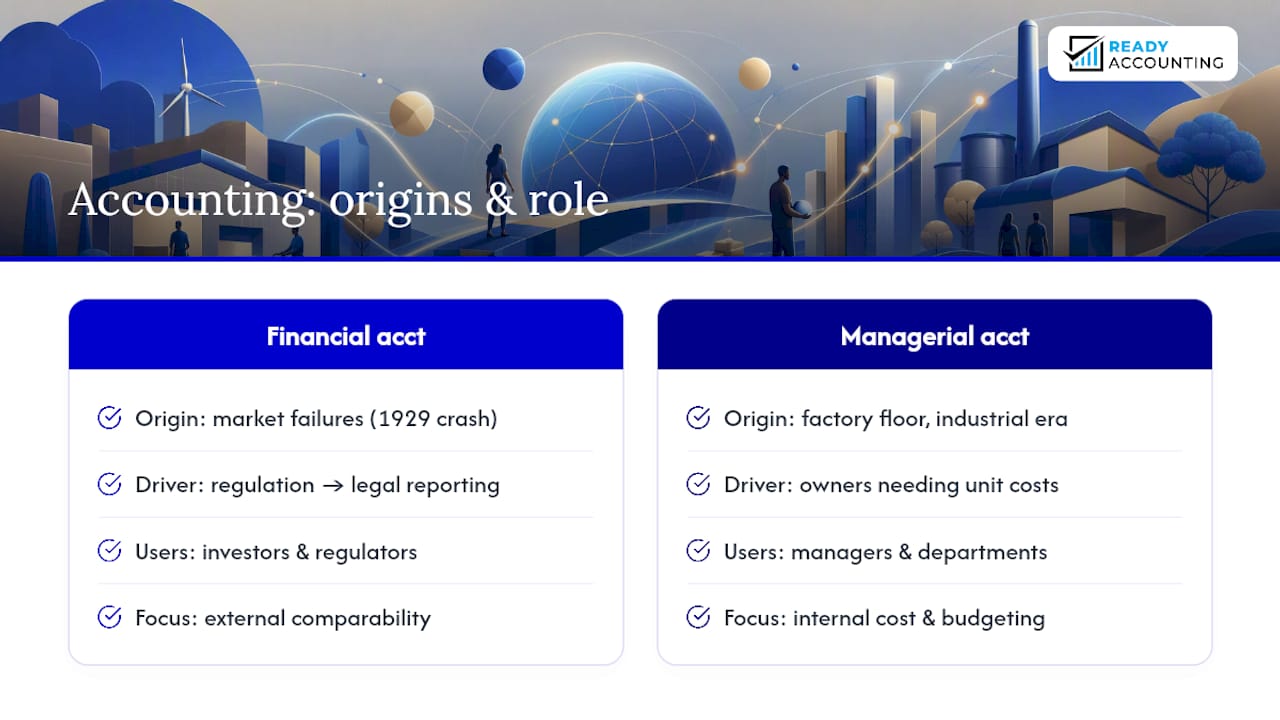
Financial accounting’s rulebook wasn’t always this formal. Standardised reporting frameworks like GAAP developed largely in response to market failures, most notably after the 1929 crash exposed how inconsistent, self-serving financial reporting had misled investors for years. Regulators stepped in, and external reporting became a legal obligation rather than a courtesy. IFRS followed decades later as global trade demanded that a bank in Johannesburg and an investor in London could read the same statement and trust it meant the same thing.
Managerial accounting has a very different origin story. It grew out of the factory floor during the industrial era, when owners needed to know the actual cost of producing one unit versus a thousand. Cost accounting techniques from that period, tracking labour hours and material use, evolved into the budgeting and variance analysis used today. The big shift happened once computing power made rolling forecasts and departmental dashboards realistic rather than a once-a-year exercise done by hand.
What’s changed most recently isn’t the theory but the speed. A management accountant in the 1980s waited weeks for a variance report. Today a cloud dashboard flags a cost overrun the same day it happens. Financial accounting has moved more slowly by design, since comparability across years and companies depends on the rules staying stable rather than chasing every new reporting fad.
The core principle behind each discipline
Financial accounting runs on accrual basis accounting: revenue gets recorded when it’s earned, not when cash lands in the bank, and expenses get matched to the period they relate to. That single principle is why a profitable-looking income statement can still sit next to a cash-strapped bank account. It’s also why the cash flow statement exists as a separate document, to reconcile accrual profit against actual cash movement.
Managerial accounting runs on a completely different core idea: cost behaviour analysis. Instead of asking when a transaction should be recorded, it asks how a cost reacts to changes in activity. Fixed costs, like rent, stay flat regardless of how much you produce. Variable costs, like raw materials, scale directly with output. Semi-variable costs do a bit of both. Understanding which category a cost falls into is what makes break-even analysis and CVP calculations possible in the first place.
Neither principle is optional or interchangeable. Try to run inventory valuation on cost behaviour logic and your statutory statements won’t reconcile. Try to run pricing decisions purely on accrual timing and you’ll miss what actually drives your margin.
Where each discipline runs into trouble
Financial accounting’s biggest limitation is its own rigidity. Standards exist for good reason, but they force every company into the same mould regardless of how the business actually operates, and by the time a statement is published, the numbers already describe a period that’s over. A business that hit a cash crisis in March won’t see that fact reflected clearly until the annual statements land months later.
Managerial accounting’s flexibility cuts both ways. Because there’s no external standard forcing consistency, allocation choices, particularly how overhead costs get spread across products, can quietly distort pricing decisions if nobody checks the assumptions. Getting that allocation wrong isn’t a rounding error; it can make a genuinely profitable product line look like a loser, or the reverse. Sound practice treats regular reconciliation against the financial accounts, plus periodic review cycles, as a safeguard against that kind of distortion rather than a nice-to-have.
There’s also a trust problem baked into managerial accounting. Because the reports never face external audit, a manager under pressure to hit targets has more room to shade the numbers than a financial accountant preparing statements for SARS ever would.
What software each discipline typically runs on
Financial accounting software is built around compliance. Cloud platforms designed for South African SMEs handle VAT registration tracking, CIPC-aligned reporting, and the statutory statement formats SARS and auditors expect. The appeal of moving to cloud accounting isn’t just convenience: it closes the gap between when a transaction happens and when it’s reflected in a report that a bank or auditor can rely on.
Managerial accounting leans on a different toolkit entirely. Spreadsheet modelling still dominates budgeting work in smaller businesses, precisely because Excel’s flexibility suits reports that change shape every month. Larger operations add dedicated planning software or business intelligence dashboards layered on top of the accounting system, pulling the same transaction data into rolling forecasts and KPI views. Practical inventory and usage reporting templates, the kind operations managers build to keep tabs on stock movement, sit firmly in this camp too, as shown by manager operativi: report replicabili per uso inventario e dati certi.
The overlap is growing, though. Modern cloud accounting platforms increasingly bolt real-time dashboards onto the same system that generates statutory reports, which means one login can now serve both the bookkeeper preparing an Annual Financial Statement and the manager tracking this week’s cash position.
Why a business needs both working together
Neither discipline makes good decisions alone. A financial accountant’s statutory statements tell an SME owner whether last year was profitable. A management accountant’s forecast tells that same owner whether they can afford to hire two more people next quarter. Run only the first and you’re reacting to history. Run only the second and you’ve got no audited proof to show a bank when you need a loan.
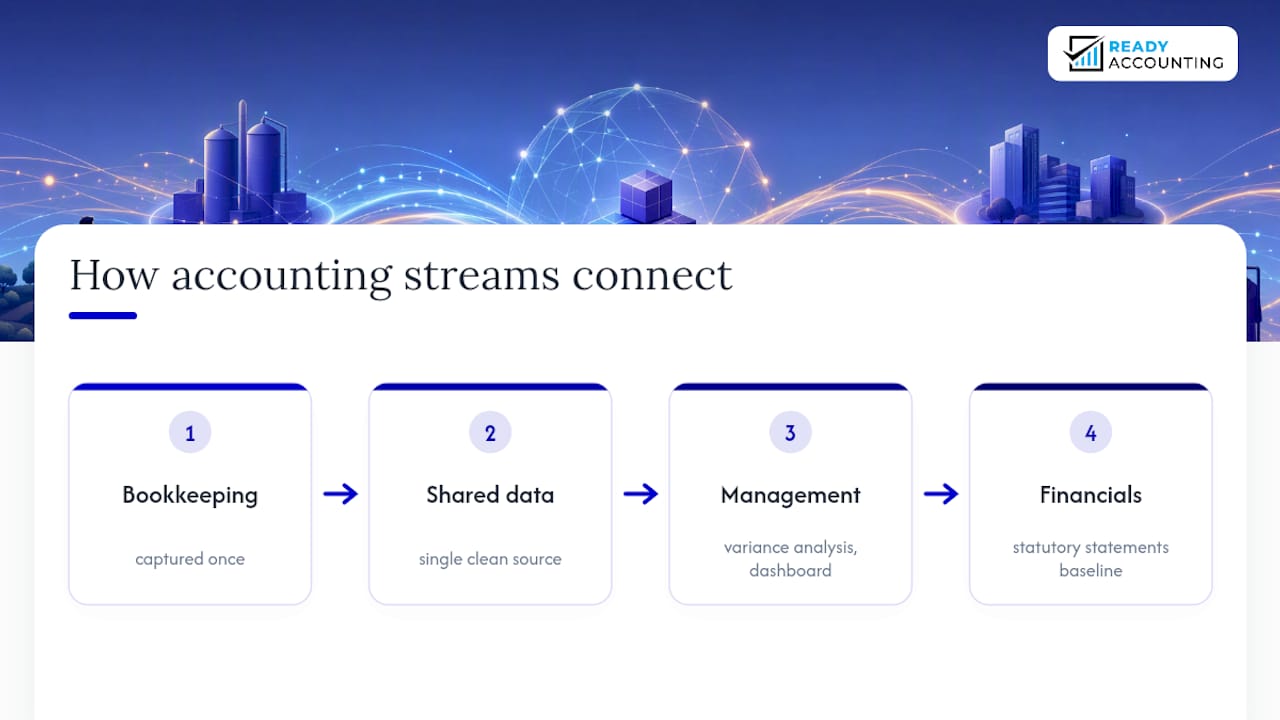
The two streams actually strengthen each other in ways that aren’t obvious at first. A management accountant’s variance analysis, comparing actual costs against budget month by month, often surfaces the exact issue that later shows up as a write-down or provision in the annual financial statements. Conversely, once the statutory accounts are finalised, that clean historical baseline becomes the starting point for next year’s budget. Growing South African businesses increasingly wire these two functions together through automation, so a transaction captured once in the bookkeeping system flows automatically into both the compliance report and the manager’s dashboard, instead of being entered and reconciled twice by two different people.
A quick note on where students trip up
The confusion I see most often isn’t about definitions, it’s students assuming one discipline is “more advanced” than the other, when they’re just built for different jobs entirely. Readyaccounting works with SMEs living this split daily, which is exactly why the certifications and standards mentioned above matter more than generic textbook summaries. If you’re studying this for an exam, don’t just memorise the differences table. Practice building one financial statement and one budget from the same set of raw transactions, and the distinction stops being abstract.
— Johan
A practical route for SMEs that need both done properly
Doing all of this in-house, hiring a bookkeeper, then a management accountant, then a financial accountant as you grow, works, but it’s slow and expensive to build piece by piece. Readyaccounting offers a faster route: cloud-based automation that gives you compliant Annual Financial Statements and real-time management accounts from the same system, without the wait or the duplicated data entry. That means one clean source of transaction data feeding both your SARS compliance and the cash flow dashboard your management team actually checks.
If you’re an SME owner trying to figure out whether you need a fractional CFO, a management accounting overhaul, or just a cleaner automated setup, start with Readyaccounting’s breakdown of how automation improves cash flow. It’s a practical look at what changes once your books and your decision-making run off the same real-time numbers, and a reasonable first step before you commit to hiring anyone new.
Sources
For deeper reading on the standards and career paths covered here: the GAAP glossary from Investor.gov, the CMA certification page from IMA, and SAIPA’s accountant designation guide for South African career context.
This article is general information, not a substitute for advice from a qualified financial advisor. Consult a qualified financial professional about your own circumstances before acting on anything here.
- How does financial accounting differ from managerial accounting? — Investopedia
- Investor
- CMA certification — Institute of Management Accountants (IMA)
- Bookkeeping basics for South African small businesses — Okhantu