

What is expense tracking: a 2026 guide for South African SMEs
Executive Summary
- Proper expense tracking helps South African SMEs manage cash flow, claim tax deductions, and ensure SARS compliance. Using cloud-based systems and regular reconciliation enables businesses to maintain accurate, audit-ready financial records. Consistent expense management supports better decision-making, reduces audit risk, and simplifies tax obligations.
Expense tracking is the systematic process of recording, categorizing, and reviewing every cost your business incurs. For South African SMEs and entrepreneurs, this practice sits at the heart of sound financial management, SARS compliance, and accurate budgeting. Without it, you are flying blind on cash flow, missing legitimate tax deductions, and exposing yourself to audit risk. Readyaccounting works with scaling businesses every day to replace manual, error-prone processes with cloud-based systems that make expense tracking automatic, accurate, and audit-ready.
What is expense tracking and what does it involve?
Expense tracking is the continuous recording and categorizing of all money your business spends, from office rent and salaries to fuel, software subscriptions, and VAT payments. The formal accounting term for this process is expenditure management, though “expense tracking” is the phrase most SME owners use in practice. Both terms describe the same core discipline: knowing exactly where your money goes, at all times.
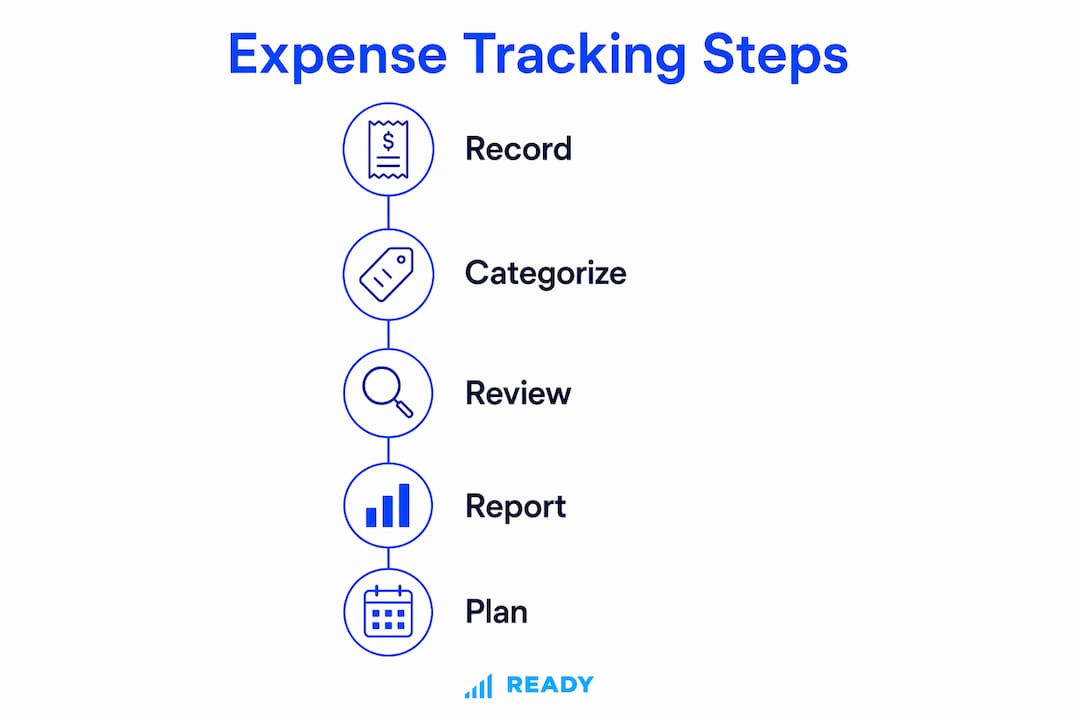
The process breaks down into five core steps.
- Separate personal and business finances. Open a dedicated business bank account from day one. Mixing personal and business expenses disqualifies costs from being tax-deductible under SARS rules, because deductible expenses must be directly related to producing income.
- Collect and retain source documents. Every expense needs a receipt, invoice, or bank statement to back it up. SARS requires you to keep these records for a minimum of 5 years, though 7 years is the safer standard recommended by most accounting professionals.
- Categorize every transaction. Group expenses into meaningful categories: cost of sales, payroll, marketing, travel, utilities, and VAT. Consistent categorization makes tax submissions faster and financial reports more useful.
- Reconcile monthly. Match every transaction in your accounting system against your bank statement. Monthly bank reconciliation takes roughly 45 minutes per SME but is non-negotiable for audit-ready records.
- Review and act on the data. Expense records are only valuable if you read them. A monthly review reveals overspending, flags unusual transactions, and informs your next budget cycle.
Pro Tip: Switch from paper receipts to a cloud-based document capture tool immediately. Digital records are searchable, cannot be lost in a flood or fire, and are accepted by SARS during audits. Readyaccounting sets this up for clients as part of onboarding.
Why expense tracking matters for SMEs and entrepreneurs
Consistent expense tracking gives you control over cash flow, tax liability, and business decisions. Without it, you react to financial problems instead of preventing them.
The benefits are direct and measurable:
- Cash flow clarity. You know exactly what goes out each month, which means you can plan for slow periods and avoid overdrafts.
- Accurate tax deductions. SARS allows deductions only for expenses that are properly documented and directly related to income. Poor records mean you pay more tax than you owe.
- Audit protection. A SARS audit is far less stressful when every transaction has a matching document and a clear category.
- Fraud detection. Regular review of categorized expenses makes unauthorized or duplicate payments visible quickly.
- Better budgeting. Historical expense data is the foundation of any realistic budget. You cannot plan next year’s costs without knowing this year’s actuals.
One area that catches many SME owners off guard is payroll. Payroll and hiring costs are typically the largest expense category for a growing business, yet statutory contributions, skills levies, and training costs are frequently under-tracked. Missing these figures distorts your true cost base.
“Viewing tax as a core, daily business obligation rather than a once-off annual burden transforms financial management and reduces risk. Tax compliance becomes a competitive advantage when integrated into daily financial routines.”
This mindset shift is the difference between businesses that grow confidently and those that scramble every February when provisional tax is due.
How to track expenses effectively: practical methods and tools
The best expense tracking method is the one you will actually use consistently. For most South African SMEs, that means combining a dedicated bank account, cloud accounting software, and a monthly reconciliation habit.

Set up a dedicated business bank account. Every rand in and out of the business flows through one account. This single step eliminates the most common source of categorization errors. A useful extension of this principle: transfer 15–25% of every incoming payment into a separate account reserved for provisional tax. This prevents the cash crisis that hits businesses when SARS payments fall due.
Use cloud accounting software with bank feed automation. Bank feed integration pulls transactions directly from your bank into your accounting system, eliminating manual data entry. Automated categorization significantly improves accuracy and consistency for SMEs compared to spreadsheets. You review and approve; the system does the heavy lifting.
Here are the core practices that make daily tracking work:
- Record expenses on the day they occur, not at month end.
- Use consistent category names across every period so reports are comparable.
- Attach digital receipts to transactions inside your accounting software immediately.
- Set a recurring calendar reminder for monthly reconciliation, treating it as a fixed business task.
- Review a monthly expense summary with your accountant or bookkeeper before closing the books.
Pro Tip: Treat tax planning like a regular supplier payment. Integrating tax costs into monthly cash flow prevents the shock of large, unexpected tax bills and removes the need for emergency debt financing. Readyaccounting builds this into every client’s monthly financial close process.
If your business is growing and cash flow management is becoming complex, understanding how to use a business line of credit alongside disciplined expense tracking can give you the buffer you need during high-expenditure periods.
What are the common challenges SMEs face in expense tracking?
Most SME owners know they should track expenses carefully. The gap between knowing and doing comes down to a handful of recurring problems.
- Delayed recording. Waiting until month end to capture expenses creates errors, missing receipts, and a backlog that feels impossible to clear. The fix is simple: record on the day, every day.
- Inconsistent categorization. Calling the same type of expense “marketing” one month and “advertising” the next makes reports meaningless. Set a fixed chart of accounts and stick to it.
- Mixing personal and business costs. This is the single most common bookkeeping mistake among South African SMEs. It disqualifies expenses from tax deductions and creates audit risk. A dedicated business account removes this problem entirely. You can read more about common bookkeeping mistakes and how to avoid them.
- Confusion over deductible expenses. Not every business cost qualifies as a SARS deduction. Entertainment expenses, for example, have specific rules. A qualified accountant clarifies which costs qualify and which do not.
- Non-compliance with record retention rules. SARS mandates a 5-year minimum for financial records, and 7 years is the professional standard. Many SMEs delete records or lose paper documents well before this threshold.
- No regular spot checks. Automated systems reduce errors but do not eliminate them. A monthly review of categorized transactions catches duplicates, miscodes, and unauthorized charges before they compound.
The solution to most of these challenges is automation combined with a fixed monthly routine. Cloud accounting tools handle categorization and reconciliation at scale. Your job is to review, not to capture.
How does expense tracking connect to tax compliance and financial reporting?
Expense tracking is not a standalone task. It feeds directly into every major financial obligation your business has, from VAT submissions to Annual Financial Statements.
| Financial obligation | How expense tracking connects |
|---|---|
| VAT submissions | Accurate input VAT claims require categorized, documented expenses for every qualifying purchase |
| Provisional tax | Monthly expense data shows true profit, which determines your provisional tax liability |
| Annual Financial Statements | Categorized expenses form the cost structure of your income statement and balance sheet |
| SARS audits | Complete, dated expense records with source documents are your primary defense |
| Budget and forecasting | Historical expense data by category is the input for any credible financial forecast |
When expense data is clean and current, your accountant can prepare VAT returns faster, spot tax-saving opportunities, and produce financial reports that drive decisions rather than just satisfy compliance. The two functions reinforce each other: better tracking produces better reporting, and better reporting reveals where tracking needs to improve.
Readyaccounting integrates expense tracking directly into a monthly financial close process for South African SMEs. This means VAT, provisional tax, and management accounts are always current, not scrambled together at year end.
Key takeaways
Expense tracking is the foundation of every sound financial decision an SME makes, and consistent daily recording is the single most impactful habit you can build.
| Point | Details |
|---|---|
| Define and separate | Open a dedicated business account and record every transaction the day it occurs. |
| Retain records correctly | Keep all financial documents for at least 5 years; 7 years is the safer standard for SARS audits. |
| Automate categorization | Use cloud accounting software with bank feeds to reduce errors and save time each month. |
| Integrate tax planning | Set aside 15–25% of income for provisional tax monthly to avoid cash flow crises. |
| Connect to compliance | Clean expense records feed VAT submissions, Annual Financial Statements, and SARS audit defense directly. |
Why I think most SMEs underestimate what expense tracking actually does
Most business owners treat expense tracking as a record-keeping chore. I have seen this mindset cost companies real money, not because they were dishonest, but because they did not realize what clean expense data actually enables.
The SMEs that grow fastest are not the ones with the highest revenue. They are the ones who know their numbers at any point in the month. When you track expenses daily and reconcile monthly, you see problems in week two, not in week twelve. You also see opportunities: a supplier cost that has crept up, a category of spend that delivers no return, a VAT input claim you have been missing.
The other thing I have learned is that the businesses most vulnerable to SARS audits are not the ones with the most complex tax structures. They are the ones with the messiest records. A clean, categorized, cloud-based expense history is the most effective audit defense you can build, and it costs far less than a tax dispute.
My honest recommendation: stop treating expense tracking as something you do for your accountant. Do it for yourself. The financial visibility it creates is a genuine competitive advantage. If the manual process feels like too much, cloud accounting for South African SMEs makes the daily discipline almost effortless.
— Johan
How Readyaccounting helps SMEs take control of their finances
Readyaccounting builds cloud-based accounting infrastructure for South African SMEs that makes expense tracking automatic, accurate, and always audit-ready. Bank feeds pull transactions in daily. Categorization rules apply consistently. Monthly reconciliations happen on schedule. VAT and provisional tax figures are always current. The result is a finance function that runs without the end-of-year scramble. If you want to see how automation improves cash flow and removes the manual burden from expense management, Readyaccounting’s team is ready to show you exactly how it works for a business at your stage.
FAQ
What is expense tracking in simple terms?
Expense tracking is the process of recording and categorizing every cost your business incurs. It gives you a clear, current picture of where your money goes so you can manage cash flow, claim tax deductions, and stay SARS-compliant.
How long must South African SMEs keep expense records?
SARS requires a minimum of 5 years, but most accounting professionals recommend retaining financial records for 7 years to provide full protection during a SARS audit.
What is the best way to track business expenses for a small business?
The most effective method combines a dedicated business bank account, cloud accounting software with bank feed automation, and a fixed monthly reconciliation routine. This combination reduces errors and keeps records audit-ready at all times.
Which expenses are tax-deductible under SARS rules?
SARS allows deductions for expenses that are directly related to producing income and are not personal in nature. Common examples include rent, salaries, marketing costs, and business travel. Entertainment expenses have specific limitations, so consult a registered tax practitioner for your specific situation.
How does expense tracking help with VAT submissions?
Accurate expense tracking captures input VAT on every qualifying purchase. When your records are categorized and documented correctly, claiming input VAT on your VAT201 return is straightforward and defensible during a SARS review.