

CIPC: How It Unlocks Banking, SARS & Funding for South African SMEs
CIPC: How It Unlocks Banking, SARS & Funding for South African SMEs
The Companies and Intellectual Property Commission, or CIPC, is South Africa’s statutory agency for registering companies, co-operatives, and intellectual property. It operates under the Companies Act and keeps the official record of every registered business in the country. Business owners rely on it to legally trade, open bank accounts, and register with SARS. Without it, you don’t legally exist as a company.
Executive Summary
- Registering with CIPC is essential for opening bank accounts, registering for SARS tax compliance, and applying for government tenders and funding.
- Using BizPortal for South African ID holders speeds up registration and bank account setup, while foreigners often face longer delays through e-Services due to manual verification.
- Key documents issued include the Certificate of Incorporation, Certificate of Good Standing, and Memorandum of Incorporation; keeping digital copies is vital for future proofing.
- Annual returns must be filed on time to avoid deregistration, and non-compliance can freeze bank accounts or disqualify the company from tenders.
- Continuous compliance management, including reminders for filings and automated tracking, is crucial for maintaining good standing and avoiding costly delays.
Table of Contents
- What does CIPC do? Functions and legal mandate
- Why does CIPC registration matter for your business?
- How do you register with CIPC? BizPortal vs e-Services
- What documents does CIPC issue, and what do they mean?
- Staying compliant: annual returns, reinstatement, and risk
- Practical tips and pitfalls to avoid
- CIPC compliance as part of financial defence
- How Ready Accounting keeps your CIPC status audit-ready
- Official CIPC pages and practical guides
- Sources
What does CIPC do? Functions and legal mandate
CIPC was established as a juristic person and organ of state, and it carries a broad statutory mandate that goes well beyond issuing certificates. It registers and maintains company and intellectual property records, and it enforces the rules that keep those records accurate.
In practice, CIPC handles:
- Registration of companies, including private companies (Pty Ltd), co-operatives, and external (foreign) companies operating in South Africa
- Intellectual property functions covering trade marks, patents, and designs
- Name reservations, certificate issuing, and the maintenance of company registers
- Compliance enforcement and oversight of corporate governance standards
Corporate law specialists describe CIPC as far more than a filing office. It actively enforces governance and reporting standards that determine whether your company remains in good legal standing. Miss a filing, and your legal standing can quietly erode without you noticing until a bank or a tender board asks for proof.
Why does CIPC registration matter for your business?
Here’s the part most new business owners underestimate: CIPC registration isn’t paperwork you file once and forget. It’s the gateway to almost every formal business activity you’ll want to do.
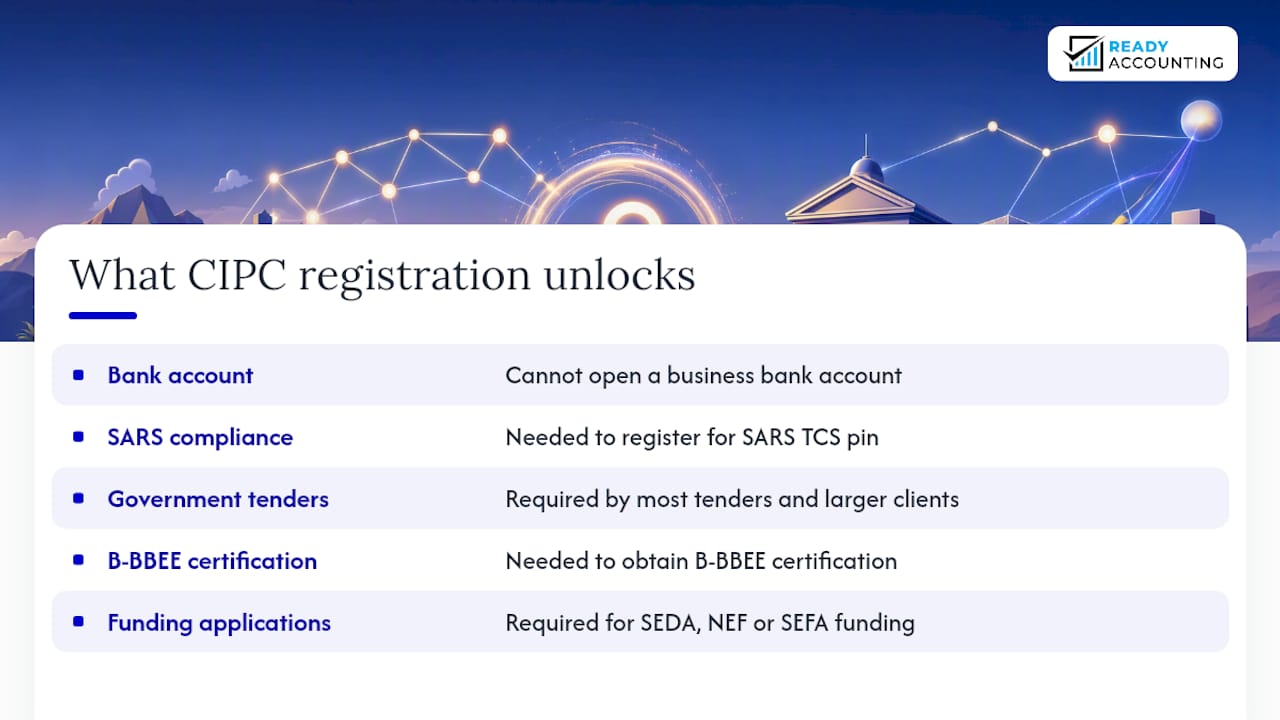
You cannot open a business bank account without a CIPC registration number. Banks won’t even start the process without it. The same applies to registering for a SARS Tax Compliance Status pin, which most tenders and larger clients now demand before they’ll sign a contract.
CIPC registration is genuinely foundational. You need it to open a business bank account, register for SARS tax compliance, apply for government tenders, obtain B-BBEE certification, and apply for funding through bodies like SEDA, NEF, or SEFA. Investment platforms and funding bodies, including groups like Bright Capital America, also expect a clean, verifiable registration before they’ll consider a funding application.
Credibility follows the paperwork. A registered, compliant company reads as lower risk to a bank, a landlord, or a potential partner. An unregistered one reads as a hobby.
How do you register with CIPC? BizPortal vs e-Services
South Africa gives you two main routes into the CIPC system: BizPortal and the older CIPC e-Services platform. BizPortal is the faster, more integrated option for most local founders, and it’s worth understanding both before you pick one.
- Search and reserve your company name. You can register with a standard name (Enterprise Number) or reserve a custom one through the name search tool.
- Complete form CoR14.1 with your director and shareholder details, and decide whether you’ll use the standard Memorandum of Incorporation (MOI) or a customised one.
- Submit and pay. BizPortal accepts card payments and, notably, integrates directly with major South African banks so you can open a business account at the same time you register.
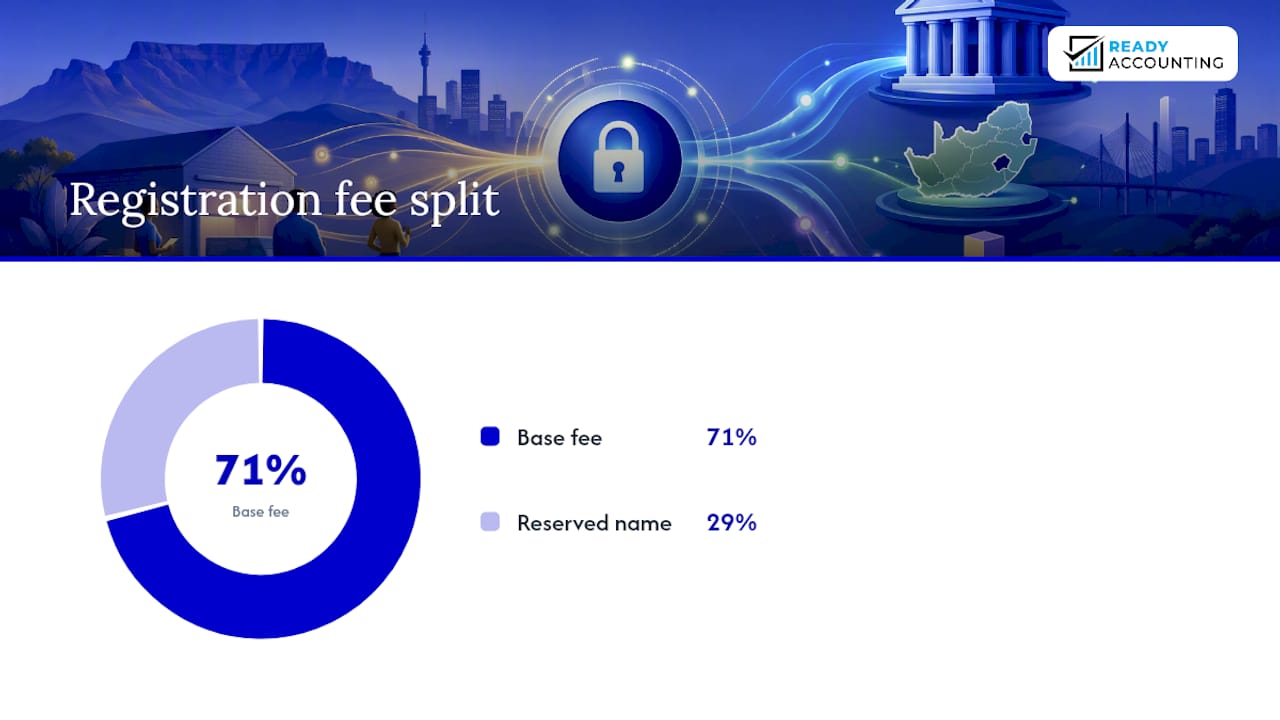
- Wait for processing. Registering a private company through BizPortal typically costs around R175, covering the R125 registration fee and an optional R50 for a reserved name, with turnaround usually landing at one to three business days.
- Download your documents immediately once approved, since some certificates are only free to retrieve for a limited window.
Foreigners without a South African ID number generally need to go through CIPC e-Services rather than BizPortal, and the process takes longer because verification steps are manual. Custom MOIs also slow things down, since CIPC staff need to review the amended clauses rather than approve a template. The official step by step e-Services guide walks through payment methods and document requirements for both routes, and it’s worth reading before you submit anything.
Pro Tip: If you have a South African ID number, use BizPortal rather than e-Services. The bank integration alone can save you weeks compared to registering first and opening an account separately afterward.
For a full walkthrough tailored to local founders, our guide to registering a company with CIPC covers edge cases this section doesn’t have room for.
What documents does CIPC issue, and what do they mean?
Three documents matter most once you’re registered, and each one gets asked for at different moments in your company’s life.
- Certificate of Incorporation (CoR14.3) confirms your company legally exists and lists your registration number, name, and incorporation date. Banks and SARS both ask for it.
- Certificate of Good Standing proves your company is compliant and active on the register. Many banks and funders only accept one issued within the last three to six months, so don’t dig up an old one.
- Memorandum of Incorporation (MOI) sets your company’s internal rules. The standard MOI works fine for most small businesses; a customised MOI, drafted with legal help, makes sense once you have multiple shareholders with different rights or exit terms.
Keep digital and physical copies of all three. Losing them later means paying to retrieve duplicates, and delays at exactly the moment a bank or tender board wants proof.
Staying compliant: annual returns, reinstatement, and risk
Registering with CIPC is the easy part. Staying in good standing is where businesses slip up, usually through neglect rather than intent.
- Annual returns are due within a set period after your company’s registration anniversary, and missing them repeatedly puts you on the path to deregistration.
- Reinstatement after deregistration is possible but slow, and it typically requires proof of good standing and settled penalties before CIPC will reactivate the company.
- Beneficial ownership filings are now a mandatory disclosure requirement, separate from annual returns, and skipping them carries its own compliance risk.
- Non-compliance ripples outward fast. A lapsed CIPC status can freeze a bank account, disqualify you from a tender, and block a fresh SARS TCS pin application.
Our guide on annual financial statements and CIPC compliance breaks down the filing calendar in more detail.
Practical tips and pitfalls to avoid
Most CIPC headaches are avoidable if you treat registration as a process to manage, not a box to tick once.
- Download and back up your CoR14.3 and MOI the day you receive them. Some documents are free to download only within a limited window, and retrieving them later usually means paying a fee.
- Use BizPortal over e-Services whenever you have a South African ID, purely for the bank integration speed.
- Only pay for a customised MOI when you genuinely have shareholder complexity to protect. A standard MOI is fine for most single-owner or simple partnership setups.
- Link your CIPC compliance calendar to your bookkeeping calendar. Annual returns and financial statements often land around the same time, and handling them together avoids duplicate admin.
Pro Tip: Set a recurring reminder for your CIPC annual return date the same week you register. It’s the single most common compliance failure we see among growing SMEs, and it’s entirely preventable with one calendar entry.
CIPC compliance as part of financial defence
Most founders treat CIPC as a once-off registration task. That’s the wrong frame. Without valid CIPC records, you cannot obtain a SARS TCS pin, which means your compliance status is really one connected system, not three separate ones.
At Ready Accounting, we treat CIPC status the same way we treat cash flow: something to monitor continuously, not something to fix after it breaks. Automated compliance tracking catches a lapsed annual return before it becomes a frozen bank account or a lost tender.
— Johan
How Ready Accounting keeps your CIPC status audit-ready
Handling CIPC registration yourself is doable, but keeping it compliant year after year, alongside VAT registration, payroll, and SARS deadlines, is where most business owners lose time they don’t have. Ready Accounting builds that compliance calendar into your books from day one, so annual returns, TCS renewals, and CIPC filings never catch you off guard.
We offer registration assistance, company secretarial support, and the bookkeeping infrastructure that keeps your CIPC record clean and your SARS status current, all under one cloud accounting system built for growing South African businesses. If you’re weighing whether to handle this yourself or bring in help, our breakdown on automating your accounting workflow is a good next read.
Ready to get your registration and compliance sorted properly? Get in touch with Ready Accounting and we’ll walk you through what your business actually needs.
Official CIPC pages and practical guides
For direct verification, use the official e-Services registration guide, the CIPC FAQs for foreign company rules, and the Gov for official contact details.
This article is general information, not a substitute for advice from a qualified lawyer. Consult a qualified legal professional about your own circumstances before acting on anything here.
Sources
- How to Register a Company in South Africa (2026 CIPC Guide) | SME South Africa
- Companies and Intellectual Property Commission (CIPC) | South African Government directory