

B-BBEE compliance explained for South African businesses
B-BBEE compliance is the process by which a South African business demonstrates its contribution to Broad-Based Black Economic Empowerment under the Broad-Based Black Economic Empowerment Act 53 of 2003 and the Codes of Good Practice. In plain terms: it is how you prove your transformation credentials to government buyers, corporate procurement teams, and supply chain gatekeepers.
Two things to know immediately:
- Legally mandatory vs. practically necessary. B-BBEE compliance is not a criminal obligation for most private businesses, but it is a commercial necessity. Organs of state and many large corporates score suppliers on their B-BBEE level, so a business without a valid certificate or affidavit is effectively locked out of a significant portion of the South African market.
- Affidavit or certificate? If your annual turnover is R10 million or below (an Exempted Micro Enterprise, or EME), a sworn affidavit or a free CIPC certificate is all you need. Above R10 million, you will need either a simplified QSE route or a full SANAS-accredited verification.
Your immediate three-step action list:
- Check your turnover category: EME (≤ R10m), QSE (R10m–R50m), or Generic (> R50m).
- Confirm your black ownership percentage, because majority black-owned businesses in the EME and QSE bands get automatic level recognition.
- Gather your core documents: latest financial year revenue figure, shareholder register, and certified ID copies for all shareholders.
Key takeaways
B-BBEE compliance is a legal and commercial requirement for South African businesses that want access to government tenders, corporate procurement, and enterprise development partnerships, with your turnover band determining whether you need an affidavit or a full SANAS-verified certificate.
| Point | Details |
|---|---|
| Know your turnover band | EME (≤ R10m), QSE (R10m–R50m), or Generic (> R50m) determines your entire compliance route. |
| Affidavit vs. certificate | EMEs and majority black-owned QSEs can use a free sworn affidavit or CIPC certificate — no paid verification needed. |
| SANAS accreditation matters | Only certificates from SANAS-accredited verification agencies are accepted by organs of state and most corporates. |
| ESD and procurement are your highest levers | Enterprise and supplier development carries — on the generic scorecard — the biggest single element. |
| Readyaccounting | Readyaccounting helps South African SMEs clean up their books, tag compliance spend, and prepare for B-BBEE verification efficiently. |
Table of Contents
- Why does B-BBEE exist? The legal framework behind the rules
- Who actually has to comply? EMEs, QSEs, and generic entities
- How the B-BBEE scorecard works: pillars, points, and levels
- How verification works: certificates, affidavits, SANAS, and timelines
- What does good B-BBEE compliance actually get you?
- How to become B-BBEE compliant: a step-by-step plan for SMEs
- The Readyaccounting compliance checklist: avoid these costly mistakes
- B-BBEE is a growth lever, not a compliance burden
- How Readyaccounting helps you prepare for B-BBEE verification
- Sources
Why does B-BBEE exist? The legal framework behind the rules
South Africa’s apartheid history left severe economic inequality in its wake. The B-BBEE Act 53 of 2003 was Parliament’s response: a statutory framework that empowers the Minister of Trade, Industry and Competition to issue Codes of Good Practice, publish transformation charters, and establish the B-BBEE Advisory Council. The Act’s stated objective is broad-based economic empowerment, meaning it targets not just ownership transfer but skills, management representation, and enterprise development across the economy.
The B-BBEE Amendment Act later tightened the definitions, introduced the concept of a “B-BBEE verification professional,” and imposed reporting obligations on organs of state and listed companies. That amendment is why verification credentials now matter so much: the law explicitly recognises who may issue a valid B-BBEE score.
The practical measurement tool is the Codes of Good Practice, published by the Department of Trade, Industry and Competition (the dtic). The Codes translate the Act’s policy goals into a scorecard with weighted elements. They also evolve: the dtic has refined the Codes over time to re-orient transformation policy toward productive enterprise and supplier development rather than paper ownership transfers.
Sector charters (for mining, financial services, construction, and others) can add sector-specific requirements on top of the generic Codes, so always check whether your industry has its own charter.
Key legal anchors to know:
- The B-BBEE Act 53 of 2003 is the founding statute.
- The Codes of Good Practice are the measurement rules.
- Sector charters apply additional requirements in specific industries.
- The dtic’s website (thedtic.gov.za) and gov.za are the authoritative sources for current Codes and gazette notices.
Who actually has to comply? EMEs, QSEs, and generic entities
The Act applies to “measured entities,” which covers virtually every business that wants to trade with the government or with corporates that have their own B-BBEE procurement policies. Your turnover band determines which compliance route you follow.
The three bands:
- EME (Exempted Micro Enterprise): annual turnover ≤ R10 million. EMEs are automatically recognised as Level 4 contributors. If the business is at least 51% black-owned, it jumps to Level 2. If it is 100% black-owned, it qualifies as Level 1. No scorecard calculation is needed.
- QSE (Qualifying Small Enterprise): annual turnover between R10 million and R50 million. QSEs complete a simplified scorecard. A QSE that is at least 51% black-owned is automatically Level 2; 100% black-owned means automatic Level 1. Otherwise, a SANAS-accredited verification agency (VA) must confirm the score.
- Generic entity: annual turnover above R50 million. Full scorecard verification by a SANAS-accredited VA is required. No shortcuts.
Transcend’s practical B-BBEE guide confirms that EMEs can use a free CIPC-issued certificate or a sworn affidavit signed before a commissioner of oaths, which costs nothing. Many small businesses pay for full verification when a free affidavit would be perfectly valid.
Quick decision flow:
- Turnover ≤ R10m → sworn affidavit or free CIPC certificate. Done.
- Turnover R10m–R50m, majority black-owned → sworn affidavit confirming ownership. Done.
- Turnover R10m–R50m, not majority black-owned → QSE scorecard + SANAS-accredited VA.
- Turnover > R50m → full generic scorecard + SANAS-accredited VA. No exceptions.
Pro Tip: Before spending anything on verification, pull your most recent annual financial statements and confirm your revenue band. Businesses that sit just above R10m sometimes find, after a proper accounting review, that their qualifying turnover falls within the EME threshold — saving them the cost of full verification entirely.
How the B-BBEE scorecard works: pillars, points, and levels
The scorecard is the engine of B-BBEE measurement. It assigns points across several weighted elements, and your total score maps to a level from 1 (best) to 8 (lowest recognised). A business that scores below the minimum threshold is “non-compliant.”
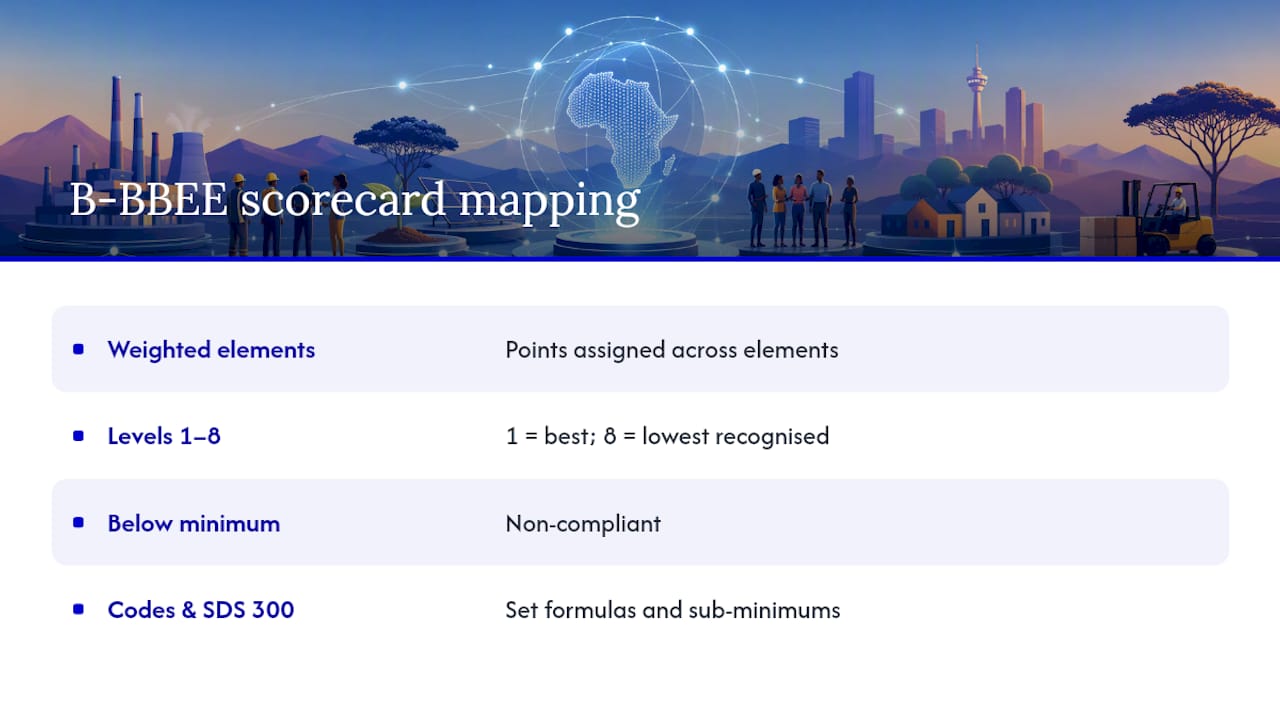
The dtic’s Codes of Good Practice and the Skills Development Statement 300 set out the detailed formulas, sub-minimum requirements, and race-group split calculations for each element.
Scorecard elements and what they measure
Note: QSE entities use a simplified scorecard with different weightings. Generic entities use the full table above.
Score-to-level conversion (Generic entities)
The procurement recognition percentage is what your customers multiply against your spend when calculating their own preferential procurement score. A Level 1 supplier is worth 135% of the rand value spent; a non-compliant supplier contributes nothing.
Pro Tip: For most SMEs, ESD and preferential procurement are the highest-value, lowest-effort levers. Switching a portion of your supply spend to Level 1–4 certified suppliers, and making a documented enterprise development contribution, can move your score by more points per rand than almost any other action. Skills development matters too, but the WSP/ATR admin burden is higher.
How verification works: certificates, affidavits, SANAS, and timelines
Not every document is equal in the eyes of a procurement officer. Here is what is accepted and when.
Types of acceptable B-BBEE documents:
- Sworn affidavit: Valid for EMEs and majority black-owned QSEs. Signed before a commissioner of oaths. Costs nothing. Valid for 12 months.
- CIPC EME certificate: Issued free by the Companies and Intellectual Property Commission for registered companies that qualify as EMEs. Also valid for 12 months.
- SANAS-accredited verification report and certificate: Required for QSEs that do not qualify for automatic level recognition, and for all generic entities. Issued only by a verification agency (VA) accredited by the South African National Accreditation System (SANAS). Valid for 12 months.
The dtic’s B-BBEE FAQ clarifies that certificates issued by non-SANAS-accredited bodies are not valid for procurement purposes. Always confirm your VA’s accreditation status on the SANAS website before signing an engagement.
Documents typically required for SANAS verification:
- Audited or reviewed annual financial statements (or management accounts for the most recent financial year).
- Shareholder register and certified copies of shareholder ID documents.
- Memorandum of Incorporation (MOI) or trust deed.
- Proof of skills development spend: WSP, ATR, and SETA levy receipts.
- Enterprise and supplier development evidence: signed agreements, payment records, and beneficiary details.
- Preferential procurement spend schedule: invoices and B-BBEE certificates of all suppliers.
- Socio-economic development proof: donation receipts, beneficiary NPO registration details.
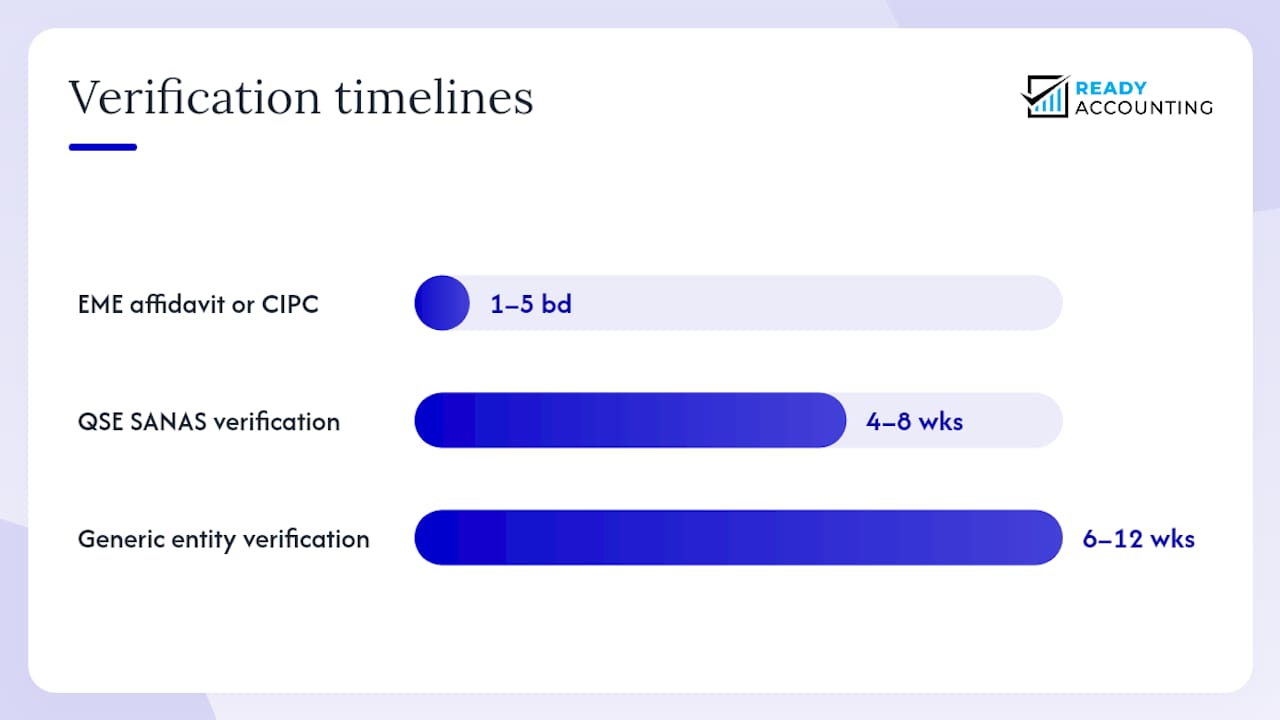
Realistic timeline and cost:
- EME affidavit or CIPC certificate: 1–5 business days, no cost.
- QSE SANAS verification: typically 4–8 weeks from document submission, depending on VA workload and document readiness. Costs vary by VA and entity complexity.
- Generic entity verification: 6–12 weeks is common; more complex ownership structures take longer.
Pro Tip: Document readiness is the single biggest cause of verification delays. Businesses that maintain clean, tagged bookkeeping records throughout the year, rather than scrambling at verification time, consistently complete the process faster and at lower cost.
What does good B-BBEE compliance actually get you?
The short answer: access. Bizmag’s SME analysis frames B-BBEE compliance as an entry ticket to corporate supply chains, and that framing is accurate. Many large buyers manage their own transformation targets by purchasing from compliant suppliers, so your B-BBEE level directly affects whether you appear on their approved vendor list.
Concrete business benefits:
- Government tenders: Organs of state apply preference point systems under the Preferential Procurement Regulations. A higher B-BBEE level earns more preference points, which can be the deciding factor in a competitive bid.
- Corporate procurement: Large companies score their own preferential procurement element partly based on the B-BBEE levels of their suppliers. Buying from a Level 1 supplier earns them more points than buying from a Level 4 or non-compliant one.
- Enterprise development partnerships: Corporates looking to meet their ESD targets often seek out smaller, compliant suppliers to develop. Being verifiably compliant puts you in the pool for those relationships.
- Banking and finance: Some financial institutions factor B-BBEE status into credit and product access decisions.
- Reputational positioning: A valid certificate signals governance maturity to partners, investors, and clients.
The flip side is equally clear. A non-compliant supplier contributes zero procurement recognition to any buyer’s scorecard. In a competitive tender, that alone can eliminate you before price is even considered. Chamberlink’s practical guide notes that higher B-BBEE levels unlock procurement advantages that compound over time as your customer base grows.
How to become B-BBEE compliant: a step-by-step plan for SMEs
This is the sequence that works. Skip steps and you waste money; follow them in order and the process is manageable.
Step-by-step:
- Classify your business. Pull your most recent annual financial statements and confirm your turnover band: EME, QSE, or Generic. This single step determines everything that follows.
- Confirm black ownership percentage. Review your shareholder register. If you are EME or QSE and majority black-owned, you may qualify for automatic level recognition.
- Decide: affidavit, CIPC certificate, or SANAS verification. Use the decision flow in the “Who must comply” section above. Do not pay for verification you do not need.
- Run a self-assessment. For QSEs and generic entities, score yourself against the relevant scorecard elements before appointing a VA. Identify your gaps and quick wins.
- Implement priority improvement actions. Focus on ESD and preferential procurement first (highest points per effort), then skills development. Register your WSP with your SETA if you have not already.
- Gather and organise documents. Use the document list in the verification section above. Assign internal owners: finance handles financial statements and supplier spend schedules; HR handles WSP/ATR and training records; the company secretary handles the shareholder register and MOI.
- Appoint a SANAS-accredited VA (if required). Confirm accreditation on the SANAS register before signing anything. Get at least two quotes.
- Submit documents and respond to queries. VA queries are normal; respond promptly with supporting evidence.
- Receive your certificate and file it. Store the certificate and the full verification report. Set a calendar reminder 10 months out for renewal.
- Maintain records year-round. Tag ESD spend, training invoices, and supplier certificates in your accounting system continuously, not just at verification time.
Typical timeline summary:
| Step | Estimated time | Internal owner |
|---|---|---|
| Turnover classification | 1 day | Finance |
| Ownership confirmation | 1–2 days | Company secretary |
| Self-assessment | 1–2 weeks | Finance + HR |
| Document collection | 2–4 weeks | Finance, HR, procurement |
| SANAS VA appointment | 1 week | Management |
| Verification process | 4–12 weeks | Finance (primary) |
| Certificate receipt | 1–2 weeks post-submission | Management |
Recurring obligations to track:
- WSP submission deadline: 30 April each year (to your relevant SETA).
- ATR submission: aligned with WSP cycle.
- B-BBEE certificate renewal: every 12 months from issue date.
- Supplier certificate monitoring: request updated certificates from key suppliers annually.
The Readyaccounting compliance checklist: avoid these costly mistakes
Most B-BBEE verification failures are not caused by poor transformation performance. They are caused by poor record-keeping. Here is what to get right in your accounting and HR systems before verification begins.
Accounting records to maintain throughout the year:
- Tag all enterprise development contributions in your general ledger with a dedicated account code (e.g., “ESD Contributions — B-BBEE”).
- Record supplier B-BBEE certificate details (level, expiry date, VA name) against each supplier in your accounts payable system.
- Maintain a preferential procurement spend schedule updated monthly, not assembled from scratch at year-end.
- Keep signed ESD beneficiary agreements on file with payment records attached.
- For skills development, retain SETA levy payment confirmations, training invoices, and attendance registers together in one folder per financial year.
HR records:
- Maintain a race and gender breakdown of your workforce, updated with each new appointment or departure.
- File WSP and ATR submissions with your SETA confirmation receipts.
- Keep learnership agreements and completion certificates in individual employee files.
Common mistakes that cost SMEs money and time:
- Paying for full SANAS verification when a free affidavit is valid. ClearComply’s SME guide flags this as one of the most frequent and avoidable errors.
- Weak ownership documentation. A shareholder register that has not been updated since incorporation, or ID copies that are expired, will stall verification immediately.
- Fronting. Listing a black shareholder who has no real economic interest or management role is a criminal offence under the B-BBEE Amendment Act. The consequences are severe: contract cancellation, fines, and potential prosecution.
- Claiming ESD spend without signed agreements. A payment alone is not enough. You need a written agreement, proof of the beneficiary’s B-BBEE status, and evidence of the developmental purpose.
- Missing sub-minimum thresholds on skills development. The Statement 300 formulas include sub-minimum requirements. Failing a sub-minimum can reduce your overall level even if your total points look adequate.
Pro Tip: The highest-impact, lowest-cost move for most SMEs is to formalise one enterprise development relationship with a measurable outcome before verification. A documented contribution to a black-owned supplier or startup, with a signed agreement and clear rand value, earns ESD points and demonstrates genuine transformation intent. It does not need to be large to count.
B-BBEE is a growth lever, not a compliance burden
Most business owners approach B-BBEE the wrong way: they treat it as a once-a-year scramble to gather documents and get a certificate renewed. That framing costs you money and misses the point entirely.
The businesses that extract real value from B-BBEE treat it as a procurement strategy. They choose suppliers deliberately to improve their preferential procurement score. They structure enterprise development contributions around suppliers they actually want to develop. They use skills development spend to train people they need, not just to hit a percentage. The result is a scorecard that reflects genuine business activity, not a compliance exercise bolted onto the side of the real work.
There is also a compounding effect that most guides do not mention. When your B-BBEE level improves, your customers’ preferential procurement scores improve too, because they earn more recognition per rand spent with you. That makes you more attractive to retain and easier to justify to their own procurement committees. A Level 2 certificate does not just open doors; it makes the people who let you in look good for doing so.
The one area where I see SMEs consistently underinvest is in their accounting infrastructure. Clean, tagged records are not just good bookkeeping hygiene; they are the evidence base for every point on your scorecard. A business running on a cloud accounting platform with fintech compliance tools and properly coded transactions can produce a preferential procurement schedule in hours. A business on spreadsheets takes weeks and still gets queries from the VA.
How Readyaccounting helps you prepare for B-BBEE verification
B-BBEE compliance starts with clean books. Readyaccounting works with South African SMEs to get their financial records verification-ready: tagging ESD and preferential procurement spend correctly, cleaning up shareholder documentation, and building the evidence trail that SANAS-accredited VAs need to complete verification without delays.
As your outsourced accounting and fractional CFO partner, Readyaccounting handles the accounting infrastructure that underpins your scorecard, from WSP-aligned payroll records to supplier certificate tracking. We also help you decide upfront whether you need a full SANAS verification or whether a sworn affidavit covers your situation, saving you the cost of unnecessary verification. If you want your next B-BBEE cycle to be faster, cheaper, and less stressful, see how automation improves your financial records and then book a discovery call with the Readyaccounting team at readyaccounting.co.za.
Sources
The following primary sources are the definitive references for B-BBEE compliance in South Africa. Check them for current Codes, gazette updates, and sector charter amendments.
- Broad-based Black Economic Empowerment Act 53 of 2003 | South African Government
- Broad-Based Black Economic Empowerment - The Department of Trade Industry and Competition
Recommended
- BAS statement explained: what South African SMEs need to know | Ready Accounting
- SARS compliance checklist for businesses in South Africa | Ready Accounting
- Tax compliance protocol for South African Corporate Assets in 2026 | Ready Accounting
- Enterprise Operations tax in South Africa: essential 2026 protocol | Ready Accounting