

What is an asset register? A practical guide for SMEs

Executive Summary
- An asset register records every physical and financial asset a business owns, ensuring compliance and accurate tax claims. Maintaining a real-time, digital register supports SARS audits, protects deductions, and reduces operational risks. Treat the register as a live management tool to maximize tax benefits and simplify compliance in South Africa.
An asset register is a structured record of every physical and financial asset a business owns, tracking each item’s description, location, value, condition, and ownership. For South African business owners and financial managers, maintaining an accurate asset register is not optional. SARS audits rely on it to verify depreciation claims and write-offs, and the Companies Act mandates that these records be kept for 15 years. Miss that requirement, and you face audit penalties, disputed tax deductions, and insurance claim complications. A well-maintained asset register also unlocks real tax savings, including 100% immediate expensing for assets under R7,000 under Section 11(e) of the Income Tax Act. This guide explains what goes into an asset register, why it matters for SARS compliance, and how to build one that works as a live management tool rather than a dusty spreadsheet.
What is an asset register and what does it contain?
An asset register is a complete, itemised log of all assets owned or controlled by a business, updated continuously to reflect current values and conditions. The industry term is a “fixed asset register,” though the concept covers both fixed and movable assets depending on your business type. Core data points required in a compliant register include the asset name and description, serial number, purchase date, cost, depreciation method, useful life, location, and maintenance history. Each field serves a specific purpose for either financial reporting or operational control.

A strong asset register answers four questions at any moment: what assets do we own, where are they, who is responsible for them, and what condition are they in? Without that clarity, your finance team cannot produce accurate Annual Financial Statements, and your operations team cannot plan maintenance or replacements.
Key fields and their purpose
| Field | Purpose |
|---|---|
| Asset description and serial number | Uniquely identifies each item for audits and insurance |
| Purchase date and cost | Establishes the cost base for depreciation calculations |
| Depreciation method and useful life | Determines annual tax deductions under SARS rules |
| Location and custodian | Tracks physical accountability across departments |
| Condition and maintenance history | Supports maintenance planning and insurance valuations |
| Disposal or reclassification date | Triggers tax events under Section 8(4)(a) |
Pro Tip: Track assets under R7,000 in a separate category within your register. Section 11(e) of the Income Tax Act allows 100% immediate expensing on these items, and missing this deduction costs SMEs real money every tax year.
How does an asset register support tax compliance in South Africa?
An asset register is the primary document SARS uses to verify your depreciation claims during an audit. If your register is incomplete, inaccurate, or missing, you cannot prove the deductions you claimed. The consequences go beyond a slap on the wrist.
Failure to maintain accurate records for the mandatory 15-year period under the Companies Act exposes your business to audit penalties, tax deduction disputes, and complications with insurance claims. That retention period surprises many business owners who assume five or seven years is sufficient.
A well-maintained asset register does more than satisfy SARS. It protects your right to claim every depreciation deduction you are legally entitled to, and it prevents costly surprises when assets are reclassified or disposed of. Businesses that treat the register as a compliance tool rather than a tax tool leave money on the table every single year.
The tax risks go deeper than depreciation. When you reclassify an asset from internal use to trading stock, Section 8(4)(a) treats that as a deemed disposal, triggering immediate tax liability even without an actual sale. Most business owners miss this because their register lacks the granularity to flag reclassifications. A detailed, current register catches these events before they become expensive surprises.
Key compliance benefits of a complete asset register include:
- Verified depreciation claims that survive SARS scrutiny
- Documented proof of asset write-offs and disposals
- Correct identification of assets qualifying for Section 11(e) immediate expensing
- Evidence trail for insurance claims on lost or damaged assets
- Compliance with the SARS record-keeping rules that apply to all South African businesses
For a broader view of your compliance obligations, the Readyaccounting record-keeping requirements guide covers what SARS expects from South African businesses in 2025 and beyond.
Why digitising your asset register matters
The biggest mistake South African SMEs make is treating their asset register as a once-a-year task. A static spreadsheet updated at year-end is not an asset register. It is a historical record with gaps, and SARS knows the difference.
A live asset register functions as a dynamic control system that combines physical asset management with financial records. Every asset move, maintenance event, or disposal must be captured immediately. Delays in updating the register weaken data reliability and create the exact gaps that trigger audit queries.
Cloud-based asset management systems solve this problem by giving your team real-time access to asset information from any location. Cloud-based systems reduce audit preparation time and lower the risk of operational downtime caused by untracked asset failures. For manufacturing and service SMEs, that operational visibility translates directly into cost savings.
The practical benefits of moving to a digital register include:
- Real-time updates from multiple team members across locations
- Automated depreciation calculations that feed directly into financial reports
- Instant audit-ready reports without manual data assembly
- Alerts for scheduled maintenance, warranty expiry, or asset end-of-life
- Reduced risk of common accounting mistakes caused by outdated or incomplete records
Pro Tip: Involve your operations team, custodians, and finance department in the register from day one. Operations and custodians must feed verification data back to finance for the register to stay accurate. A finance-only register will always have gaps.
How to create and maintain an effective asset register
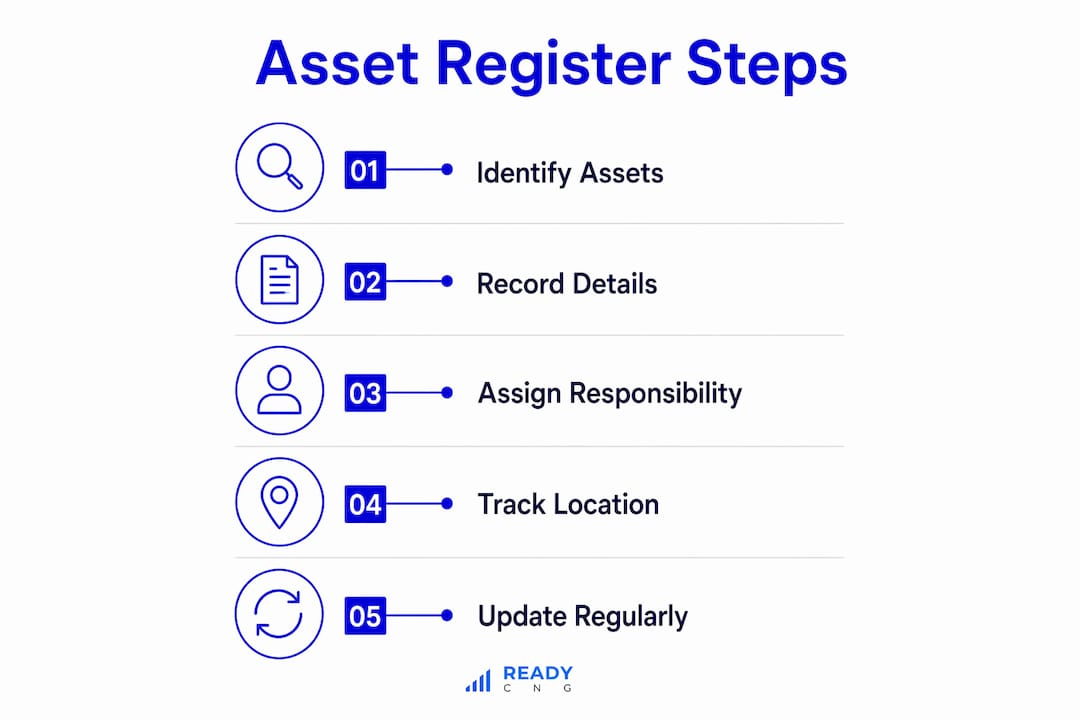
Setting up an asset register from scratch feels like a large project, but the process breaks down into clear steps. The goal is a register that is accurate on day one and stays accurate through disciplined maintenance.
Steps to build your register
- Conduct a physical asset audit. Walk through every location and list every asset your business owns or controls. Include equipment, vehicles, computers, furniture, and leasehold improvements. Do not rely on memory or old invoices.
- Assign a unique identifier to each asset. Use asset tags or serial numbers to link the physical item to its register entry. This makes verification fast during audits.
- Capture all required data fields. For each asset, record the description, serial number, purchase date, cost, depreciation method, useful life, location, and custodian. Include the VAT amount paid if applicable, as this affects your VAT input claims.
- Separate assets by value category. Flag all assets under R7,000 for immediate expensing under Section 11(e). This step alone can generate significant tax savings for asset-heavy businesses.
- Choose your platform. A spreadsheet works for very small businesses, but cloud-based asset management software gives you automation, multi-user access, and audit trails that spreadsheets cannot match.
- Set an update protocol. Define who is responsible for updating the register when assets are purchased, moved, maintained, or disposed of. Write this into your internal financial procedures.
- Reconcile quarterly. Match your register to physical assets and to your general ledger at least four times a year. Annual reconciliations leave too much room for errors to accumulate.
Manual vs digital register: a direct comparison
| Criteria | Manual or spreadsheet register | Cloud-based digital register |
|---|---|---|
| Update speed | Slow, dependent on manual input | Real-time, multi-user updates |
| Audit readiness | Requires manual report assembly | Instant, formatted audit reports |
| Depreciation calculation | Manual, error-prone | Automated, consistent |
| Access | Single location or file | Anywhere, any device |
| Data integrity | High risk of version errors | Controlled with audit trails |
| Cost | Low upfront, high time cost | Subscription-based, lower time cost |
Valuation accuracy matters across industries. Businesses dealing with high-value or specialised assets can learn from common valuation errors that apply broadly to asset-intensive operations. Getting the cost base right from the start prevents compounding errors in depreciation and tax calculations.
Key takeaways
An asset register is the foundation of tax-compliant financial management for South African SMEs, and a live, digital register prevents the audit penalties and missed deductions that cost businesses the most.
| Point | Details |
|---|---|
| Definition and purpose | An asset register records every business asset with full details for financial reporting and SARS compliance. |
| Legal retention requirement | The Companies Act requires asset records to be kept for 15 years, not 5 or 7 as many owners assume. |
| Section 11(e) tax savings | Assets under R7,000 qualify for 100% immediate expensing, but only if tracked separately in your register. |
| Reclassification risk | Moving an asset from internal use to trading stock triggers a taxable deemed disposal under Section 8(4)(a). |
| Digital registers outperform spreadsheets | Cloud-based systems provide real-time updates, automated depreciation, and instant audit-ready reports. |
Why I think most SMEs are sitting on a tax problem they don’t know about
Working with South African SMEs, I see the same pattern repeatedly. The asset register exists, but it is a year-old spreadsheet that nobody has touched since the last audit. The finance team updates it under pressure, the operations team has no idea it exists, and the custodians have never been asked to verify anything. That is not an asset register. That is a liability dressed up as a record.
The tax cost of this approach is real. Businesses miss Section 11(e) deductions on low-value assets because nobody tracked them separately. They get hit with unexpected tax bills when assets are reclassified because the register did not flag the event. They spend days assembling audit documentation that a live system would produce in minutes.
The fix is not complicated. It requires treating the asset register as a shared operational tool, not a finance department chore. When operations, custodians, and finance all contribute to the same live system, the register stays accurate without heroic effort at year-end. That accuracy translates directly into defensible tax deductions, cleaner Annual Financial Statements, and fewer surprises from SARS.
The businesses I see thriving are the ones that made this shift. They stopped viewing their asset register as a compliance box to tick and started using it as a real-time picture of their business. That shift in mindset is worth more than any software upgrade.
— Johan
How Readyaccounting helps you manage assets and stay SARS-compliant
Readyaccounting works with South African SMEs and VC-backed startups to replace manual asset tracking with cloud-based systems that update in real time and feed directly into financial reports. If your current register is a spreadsheet that gets updated once a year, you are carrying tax risk you do not need to carry. Readyaccounting’s financial automation approach connects your asset register to your depreciation schedules, VAT records, and SARS compliance workflows, so your data is always audit-ready. Learn how automation improves cash flow and reduces the manual burden of asset management. Contact Readyaccounting to find out how a live asset register can protect your tax position and sharpen your financial reporting.
FAQ
What is an asset register in simple terms?
An asset register is a detailed list of everything a business owns, including equipment, vehicles, and property, with information on each item’s value, location, condition, and depreciation.
How long must a South African business keep its asset register?
The Companies Act requires businesses to retain asset register records for a minimum of 15 years.
What assets qualify for Section 11(e) immediate expensing?
Assets with a cost below R7,000 qualify for 100% immediate expensing under Section 11(e) of the Income Tax Act, provided they are tracked separately in your asset register.
What happens if I reclassify an asset in South Africa?
Reclassifying an asset from internal use to trading stock triggers a deemed disposal under Section 8(4)(a), creating an immediate tax liability even if no sale has taken place.
Is a spreadsheet good enough for an asset register?
A spreadsheet works for very small businesses with few assets, but cloud-based digital systems provide real-time updates, automated depreciation, and audit-ready reports that spreadsheets cannot reliably deliver.
Recommended
- VAT registration requirements: A guide for SA SMEs | Ready Accounting
- Balance sheets explained: A South African SME owner’s guide | Ready Accounting
- Financial forecasting: a practical guide for SA SMEs | Ready Accounting
- Accrual accounting for Corporate Assets in South Africa: a protocol | Ready Accounting