

What is a trial balance? A plain-English guide for SA businesses
What is a trial balance? A plain-English guide for SA businesses

Executive Summary
- A trial balance lists all ledger accounts with their balances, ensuring total debits equal total credits. It is used to detect simple posting errors and serves as the foundation for preparing financial statements. It cannot identify all errors, including wrong account postings or omitted entries, so further reconciliation remains essential.
A trial balance is an internal financial report that lists every general ledger account alongside its balance, arranged in two columns: debits on the left, credits on the right. When your bookkeeping is correct, both columns add up to the same total. That equality is the whole point. It is not a financial statement you hand to a bank or SARS. It is a working document your accountant uses to confirm that every rand entered into the books has been recorded on both sides of the ledger, as double-entry accuracy requires.
Think of it as a spell-check for your accounts. It will not catch every mistake, but it will flag the obvious ones before they cause real damage downstream.
A trial balance includes:
- A debit column listing all accounts with debit balances (assets, expenses)
- A credit column listing all accounts with credit balances (liabilities, equity, revenue)
- A totals row confirming both columns are equal
- The reporting date, so the snapshot is clearly dated
Why does a trial balance matter for your business?
The primary purpose of a trial balance is to detect posting errors early, before they contaminate your financial statements. Catching a transposition error at the trial balance stage costs minutes to fix. Catching it after you have filed your ITR14 with SARS costs considerably more.

Beyond error detection, a trial balance serves as the foundation for every report that follows. Your income statement, balance sheet, and Annual Financial Statements (AFS) all trace back to it. Without a clean trial balance, those reports are built on shaky ground.
Key purposes at a glance:
- Confirms total debits equal total credits across all accounts
- Identifies arithmetic errors and unequal postings before period close
- Serves as the starting point for preparing financial statements
- Helps accountants troubleshoot discrepancies before closing the books
- Supports VAT reconciliations and tax calculations
What accounts does a trial balance include?
A trial balance captures every account in your general ledger, grouped by type. Accounts are classified as assets, liabilities, equity, revenue, or expenses, and each carries either a debit or credit balance depending on its normal nature.
Assets and expenses naturally carry debit balances. Liabilities, equity, and revenue naturally carry credit balances. When you list them all out, the two sides should balance perfectly.
Typical accounts you will see:
- Assets: bank accounts, trade debtors, inventory, fixed assets
- Liabilities: trade creditors, VAT payable, loans
- Equity: share capital, retained earnings
- Revenue: sales, service income, interest received
- Expenses: salaries, rent, cost of sales, depreciation
The three types of trial balances and when to use each
Trial balances come in three forms, each used at a different stage of the accounting cycle. Using the wrong type at the wrong time is one of the most common mistakes smaller businesses make.

Unadjusted trial balance: Prepared directly after posting all journal entries for the period, before any period-end adjustments. It reveals preliminary errors but lacks accruals, prepayments, and depreciation entries. Using this version prematurely for your AFS will likely mean rework.
Adjusted trial balance: Prepared after all period-end adjustments have been posted. This is the version your accountant uses to draft the income statement and balance sheet. The figures here reflect the true financial position for the period.
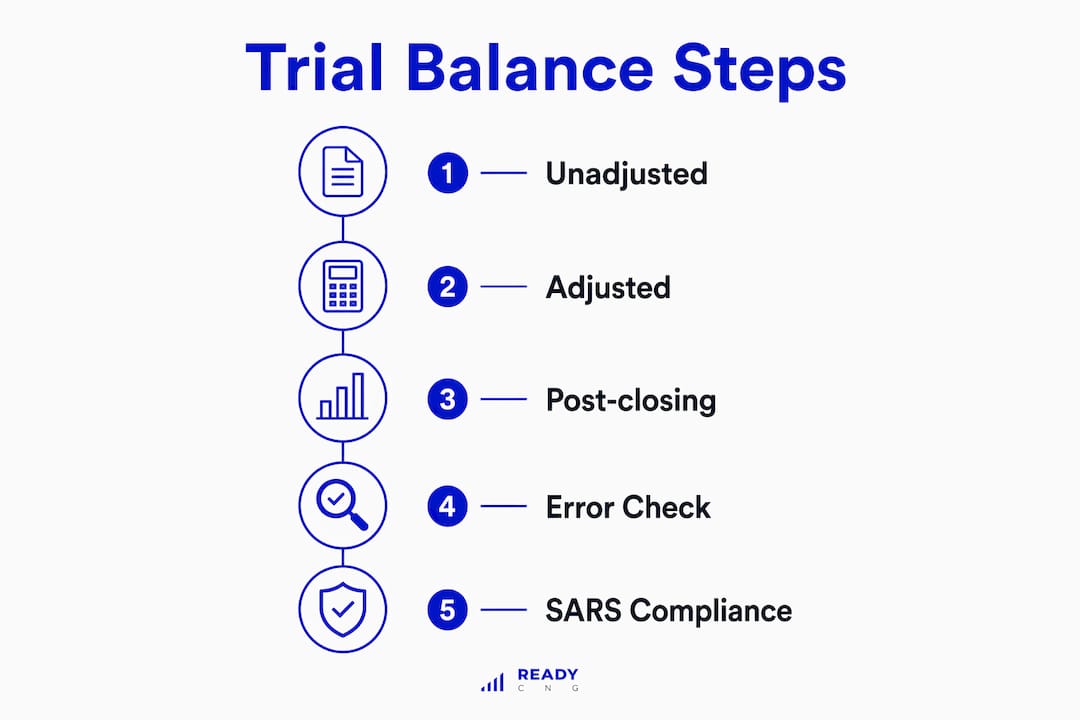
Post-closing trial balance: Prepared after closing all temporary accounts (revenue and expenses) to retained earnings. Only permanent accounts remain. It confirms the ledger is clean and ready for the next financial year.
The sequencing of these three types is what gives the accounting cycle its reliability. Each stage builds on the last.
What a trial balance cannot tell you
A balanced trial balance does not mean your books are error-free. This is the most misunderstood aspect of the report. A balanced result is a mathematical check, not a guarantee of accuracy or honesty.
Errors that a trial balance will catch: incorrect additions, posting an amount to the wrong side of an account, and double-posting the same entry.
Errors it will not catch:
- A transaction posted to the wrong account entirely (e.g., rent debited to salaries)
- An entry omitted from the books altogether
- Compensating errors where two mistakes cancel each other out
- Fraudulent entries that are mathematically correct
- Misclassification of revenue as a liability
Because of these gaps, further reconciliation and audit procedures are always needed alongside the trial balance. It is one layer of review, not the whole picture.
Trial balances and SARS compliance in South Africa
For South African businesses, a clean trial balance is not just good practice. It is the backbone of your SARS obligations. When you file your ITR14, SARS requires that the figures on your return reconcile with your AFS, and your AFS traces directly back to your trial balance. AFS and supporting documents must be retained for five years after submitting the ITR14 and presented to SARS on request.
Trial balance accounts also feed directly into income and deferred tax calculations in your tax reporting, making accuracy at this stage critical for avoiding SARS queries.
Practical tips for South African SMEs:
- Reconcile your trial balance monthly, not just at year-end
- Keep your accounting records in line with SARS retention rules
- Use your adjusted trial balance as the direct input to your AFS
- Ensure your VAT control account in the trial balance matches your VAT201 submissions
- Work with a SAICA or SAIPA-registered accountant to review the trial balance before filing
Readyaccounting works with South African SMEs and startups to keep trial balances clean, compliant, and ready for SARS at any point in the year.
How to prepare a trial balance step by step
Preparing a trial balance is straightforward once your ledger entries are up to date. The process follows a clear sequence.
- Post all journal entries for the period into the general ledger.
- Calculate the closing balance for each ledger account, noting whether it is a debit or credit balance.
- List every account in a two-column format: account name, then its balance in either the debit or credit column.
- Total both columns. If they match, your trial balance is in balance. If they do not, investigate before moving on.
- Investigate discrepancies by tracing back through your journal entries rather than forcing the balance. Forcing it hides errors and creates bigger problems later.
Pro Tip: Never adjust figures just to make the columns balance. A forced balance is a hidden error waiting to surface during a SARS audit.
A good bookkeeping workflow builds the trial balance as a natural output of the month-end close, not a one-off exercise at year-end.
A simple trial balance example explained
Here is a basic trial balance for a fictional South African SME, Mzansi Trading (Pty) Ltd, for the month ended 31 march 2026:
| Account | Debit ® | Credit ® |
|---|---|---|
| Bank | — | |
| Trade debtors | — | |
| Inventory | — | |
| Fixed assets | — | |
| Trade creditors | — | |
| VAT payable | — | |
| Share capital | — | |
| Retained earnings | — | |
| Sales revenue | — | |
| Cost of sales | — | |
| Salaries | — | |
| Totals | 208,000 | 208,000 |
Both columns total R208,000. The trial balance is in balance, meaning no arithmetic errors exist in the posting. Note that this does not confirm every transaction was posted to the correct account.
How to read and analyze a trial balance
Reading a trial balance goes beyond checking that the totals match. Start by scanning for accounts with unusually large or small balances relative to prior periods. A salary expense that doubled month-on-month without a headcount change is worth questioning. A VAT payable balance that does not reconcile with your VAT201 is a red flag before it becomes a SARS problem.
Look at your financial reporting ratios as a cross-check. If your gross margin implied by the trial balance figures looks wrong, investigate the cost of sales and revenue accounts before closing the period.
Pro Tip: Compare your current trial balance to the same period last year. Unexplained variances in any account are worth investigating before you sign off the books.
Common trial balance errors and how to fix them
Even experienced bookkeepers encounter trial balance errors. The key is knowing where to look.
Transposition errors: A figure like R4,500 entered as R5,400. The difference is always divisible by 9, which makes them easier to spot. Search your entries for the exact difference between your debit and credit totals.
One-sided entries: A debit posted without a corresponding credit, or vice versa. Cloud accounting software flags these automatically, but manual systems do not.
Duplicate entries: The same transaction posted twice. Run a search for duplicate amounts on the same date.
Wrong-account postings: Rent posted to repairs, or a loan repayment posted as an expense. These will not cause an imbalance but will distort your financial statements. Cross-reference your bank statement line by line.
Omitted entries: A supplier invoice not captured. Your creditors ledger will not match your supplier statements, which is why monthly SARS compliance checks and creditor reconciliations matter.
Key takeaways
A trial balance is the mathematical backbone of accurate financial reporting, and for South African businesses, it is the direct input to SARS-compliant Annual Financial Statements and ITR14 filings.
| Point | Details |
|---|---|
| Trial balance definition | An internal report listing all ledger balances in debit and credit columns to confirm they are equal. |
| Three types matter | Use the adjusted trial balance for AFS preparation; the unadjusted version lacks period-end entries. |
| SARS retention rule | AFS and supporting documents must be retained for five years after submitting the ITR14. |
| Limitations are real | A balanced trial balance does not catch wrong-account postings, omitted entries, or compensating errors. |
| Monthly reconciliation | Reconciling your trial balance monthly prevents year-end surprises and reduces SARS audit risk. |
Recommended
- What is a balance sheet? A guide for SA business owners | Ready Accounting
- Balance sheets explained: A South African SME owner’s guide | Ready Accounting
- What does a bookkeeper do? Essential guide for SA businesses | Ready Accounting
- Execution Framework: Read a Balance Sheet for SA Business Owners 2025 | Ready Accounting