

What is a general ledger: simple guide for SA businesses
Executive Summary
- A general ledger records all business transactions organized by account and is essential for financial reports and SARS compliance. Maintaining a clean, reconciled ledger through monthly checks and proper documentation ensures accurate financial statements and simplifies audits. Transitioning to cloud accounting and automating reconciliations helps South African SMEs improve accuracy, save time, and meet regulatory requirements effectively.
A general ledger is the master record of every financial transaction your business has ever made, organised by account, and used to produce your balance sheet, income statement, and VAT returns. If SARS ever asks for proof of your numbers, the general ledger is where the answer lives.
Three things worth knowing upfront:
- Every entry follows double-entry bookkeeping: one debit, one credit, always balanced.
- The ledger feeds directly into your Annual Financial Statements (AFS) and trial balance.
- SARS expects you to keep supporting records, and a clean ledger is your first line of defence.
Quick actions to take this week:
- Check that your chart of accounts matches your actual business activities.
- Reconcile your VAT control account against your most recent VAT return.
- If you are still on spreadsheets, consider whether cloud accounting software available in South Africa (Xero, QuickBooks Online, Sage Business Cloud Accounting) would reduce your risk.
Pro Tip: Keep only financial data in your general ledger. Product descriptions, marketing notes, and operational details belong in separate systems. Mixing them in clutters your AFS and creates noise during audits.
Table of Contents
- What your general ledger actually contains
- How the general ledger works with double-entry bookkeeping
- Journals vs the general ledger: how they differ and work together
- How ledger balances become financial statements
- Manual ledgers vs cloud accounting: what works in South Africa
- Keeping a clean general ledger: reconciliations and common mistakes
- Worked example: transactions, postings and a mini trial balance
- Why your ledger matters for SARS, VAT and your AFS
- Practical next steps: set up, clean up or automate your ledger
- How automation and expert support change your ledger
- Key takeaways
- The ledger problem nobody talks about
- Readyaccounting can take the ledger off your plate
- Useful sources
What your general ledger actually contains
The general ledger organises every transaction into accounts that together form your chart of accounts. Think of the chart of accounts as the index, and the ledger as the book itself.
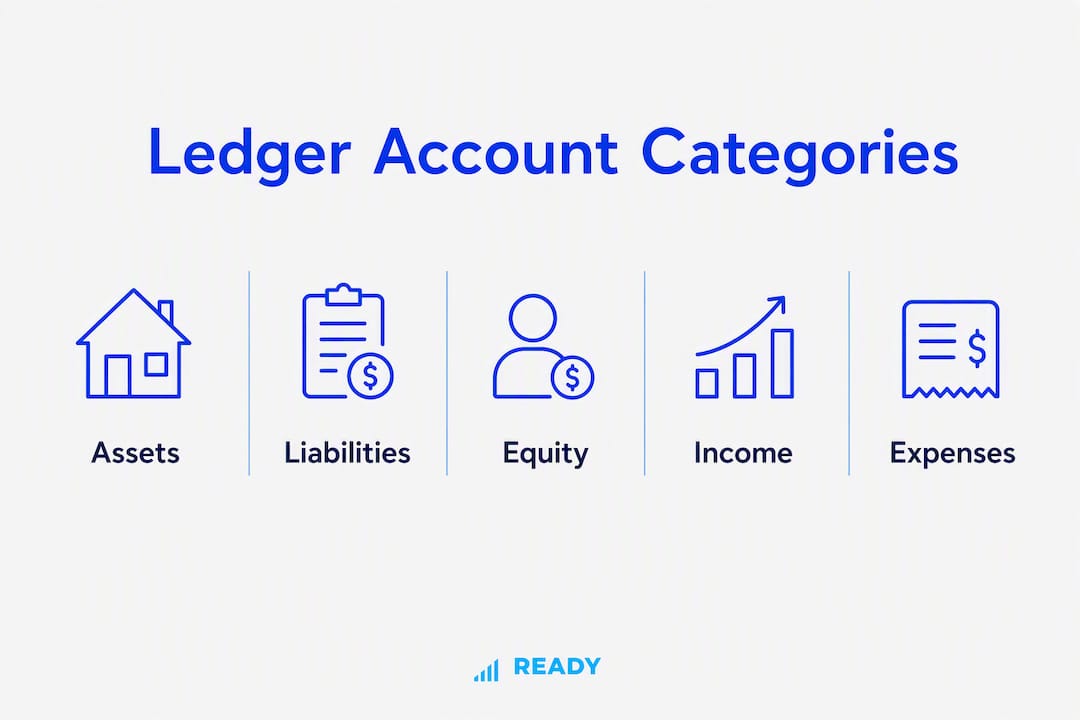
Every account in the ledger falls into one of five categories. Assets are what the business owns: cash, debtors, vehicles, equipment. Liabilities are what it owes: creditors, loans, VAT payable. Equity is the owner’s stake after liabilities are subtracted from assets. Revenue covers income from sales and services. Expenses cover costs like salaries, rent, and fuel.
A typical South African SME chart of accounts might look like this:
| Account number | Account name | Category | Normal balance |
|---|---|---|---|
| 1000 | Bank (FNB current account) | Asset | Debit |
| 1000s (asset grouping) | Trade debtors | Asset | Debit |
| 2000s (liability grouping) | Trade creditors | Liability | Credit |
| 2000s (liability grouping) | VAT control | Liability | Credit |
| 3000s (equity grouping) | Owner’s equity | Equity | Credit |
| 4000s (revenue grouping) | Sales revenue | Revenue | Credit |
| 5000 | Cost of sales | Expense | Debit |
| 5000s (expense grouping) | Salaries and wages | Expense | Debit |
| 5000s (expense grouping) | Rent expense | Expense | Debit |
Account numbering matters. Grouping assets in the 1000s and expenses in the 5000s makes it far easier to read a trial balance at a glance, and most South African cloud platforms follow this convention by default.
How the general ledger works with double-entry bookkeeping
The accounting equation underpins everything: Assets = Liabilities + Equity. Every transaction must keep that equation in balance, which is why double-entry bookkeeping requires at least one debit and one credit for every posting.
Here is the flow from transaction to ledger:
- A transaction occurs (a sale, a purchase, a salary payment).
- The bookkeeper records it in a journal (the chronological source record).
- The journal entry is posted to the relevant ledger accounts.
- Ledger balances are extracted into a trial balance.
- The trial balance feeds the income statement and balance sheet.
Three concrete examples in a South African context:
Sale of R11,400 including VAT at 15%
- Debit: Bank / Debtors R11,400
- Credit: Sales revenue R9,913
- Credit: VAT output (VAT control) R1,487
Purchase of stock R5,750 including VAT
- Debit: Cost of sales / Inventory R5,000
- Debit: VAT input (VAT control) R750
- Credit: Trade creditors R5,750
Salary payment R18,000
- Debit: Salaries and wages R18,000
- Credit: Bank R18,000
Notice that VAT splits across both the trading account and the VAT control account. That split is what makes your VAT return reconcilable at month-end.
Pro Tip: The most common debit/credit confusion: bank in your ledger is an asset (debit balance), but your bank statement shows a credit when money comes in because the bank is recording its liability to you. They are mirror images, not the same record.

Journals vs the general ledger: how they differ and work together
Journals and the general ledger are not the same thing, and confusing them is one of the most common bookkeeping mistakes.
A journal is a chronological, transaction-level record. Every time something happens, it gets written into a journal first: the date, the accounts affected, the amounts, and a short description. Journals are your audit trail. They prove that a specific event happened on a specific day.
The general ledger takes those journal entries and sorts them by account. Instead of seeing every transaction in date order, you see all activity in the bank account together, all activity in the debtors account together, and so on.
Key differences:
- Purpose: Journals capture what happened and when; the ledger shows the running balance of each account.
- Format: Journals are chronological; the ledger is organised by account.
- Who uses them: Bookkeepers write journals daily; accountants and managers read the ledger for reporting.
- Where to fix errors: Always correct an error in the journal first, then re-post. Never edit a ledger balance directly without a corresponding journal entry, or you break the audit trail.
The flow is one-directional: journal entry → posting → ledger. Reversing that flow creates reconciliation problems that can take hours to untangle.
How ledger balances become financial statements
The path from ledger to financial statements runs through three steps: trial balance, adjusting entries, and closing entries.
- Extract the trial balance. Pull every ledger account balance and list debits in one column, credits in the other. If they do not agree, there is an error to find before you go further. The trial balance is a proof of mathematical accuracy, not a guarantee that every transaction was recorded correctly.
- Post adjusting entries. Accruals (expenses incurred but not yet invoiced), prepayments (expenses paid in advance), and depreciation all need journal entries before the trial balance reflects economic reality. These are the entries SARS and auditors scrutinise most closely.
- Prepare financial statements. Revenue and expense accounts feed the income statement. Asset, liability, and equity accounts feed the balance sheet.
- Post closing entries. At year-end, revenue and expense accounts are zeroed out and the net profit or loss is transferred to retained earnings in equity.
- Produce a post-closing trial balance. This confirms the ledger is clean and ready for the new financial year.
Pro Tip: Document every adjusting entry with a reference to the supporting document (invoice, depreciation schedule, loan statement). SARS auditors will ask for those references, and a ledger full of unexplained adjustments is a red flag.
For a deeper look at how these balances map to your AFS, the AFS preparation guide from Readyaccounting walks through the full year-end process.
Manual ledgers vs cloud accounting: what works in South Africa
Paper ledgers and Excel spreadsheets can technically do the job, but they carry real risks: no automatic audit trail, no bank feed reconciliation, and no VAT control account that updates in real time. For a business that files VAT returns every two months and faces potential SARS scrutiny, that is a meaningful exposure.
Cloud accounting platforms available in South Africa include:
- Xero — well-suited to businesses with multiple users and strong bank feed support for South African banks.
- QuickBooks Online (South Africa) — popular with small businesses for its ease of use and general ledger reporting.
- Sage Pastel / Sage Business Cloud Accounting — widely used by South African accountants and bookkeepers, with strong local support and SARS-compatible VAT reporting.
| Dimension | Manual / Excel | Cloud accounting |
|---|---|---|
| Ease of use | Familiar but error-prone | Guided, with validation rules |
| Automation | None | Bank feeds, auto-reconciliation |
| Audit trail | Manual, easy to overwrite | Locked transaction history |
| Cost shape | Low upfront, high labour | Monthly subscription |
| Integration potential | Limited | API connections to payroll, invoicing |
When evaluating a move to cloud, check for:
- South African bank feed support (FNB, Nedbank, Standard Bank, Absa, Capitec).
- Subledger support for debtors, creditors, and inventory.
- VAT return output compatible with SARS eFiling.
- API or import options if you use separate payroll or point-of-sale systems.
The cloud accounting benefits guide from Readyaccounting covers what to look for when choosing a platform for a South African SME.
Keeping a clean general ledger: reconciliations and common mistakes
A ledger that has not been reconciled is not a reliable ledger. Monthly reconciliation is the single most effective habit you can build.
Monthly reconciliation checklist:
- Bank reconciliation — match every ledger bank entry to the bank statement. Unreconciled items older than 30 days need investigation.
- VAT control account — reconcile input and output VAT to your VAT201 return. The VAT control account balance should equal the VAT owed to or refundable from SARS.
- Trade creditors control — agree the ledger control account total to the creditors age analysis.
- Trade debtors control — agree the ledger control account total to the debtors age analysis.
- Payroll control — confirm that net pay, PAYE, UIF, and SDL postings agree to the payroll report.
Chart of accounts discipline matters too. Add a new account only when an existing one genuinely does not cover the transaction. Merging similar accounts later is painful; a bloated chart of accounts makes management reports unreadable and AFS compilations slower.
Common mistakes and how to fix them:
- Posting non-financial data to the ledger. Operational notes, product specs, and customer comments belong in separate systems, not ledger description fields. Clean those fields up before year-end.
- Making manual adjustments to control accounts. If your creditors control account is out by R500, the fix is in the creditors subledger, not a direct journal to the control account. Correcting at the subledger source keeps reconciliations automatic and the audit trail intact.
- Ignoring accrual vs cash differences. South African accounting uses accrual accounting, so your ledger profit and your bank balance will often diverge. That is normal, but it surprises many business owners. Run a cash-flow check alongside your profit review every month.
Pro Tip: When a subledger and control account disagree, trace the discrepancy to the originating transaction before touching anything. A single misposted invoice is usually the culprit, and fixing it at the source takes five minutes. Fixing a direct journal entry to the control account later can take hours.
For practical steps on maintaining integrity in financial reporting, Readyaccounting’s guide covers the full process.

Worked example: transactions, postings and a mini trial balance
Four transactions for a fictional South African business, Thabo’s Tech Supplies (Pty) Ltd:
- Owner invests cash into the business.
- Business purchases stock including VAT.
- Business sells goods including VAT.
- Business pays salaries.
Ledger postings:
| Transaction | Account | Debit ® | Credit ® |
|---|---|---|---|
| 1. Owner investment | Bank | — | |
| 1. Owner investment | Owner’s equity | — | |
| 2. Stock purchase | Inventory / Cost of sales | — | |
| 2. Stock purchase | VAT input (VAT control) | — | |
| 2. Stock purchase | Trade creditors | — | |
| 3. Sale | Trade debtors / Bank | — | |
| 3. Sale | Sales revenue | — | |
| 3. Sale | VAT output (VAT control) | — | |
| 4. Salaries | Salaries expense | — | |
| 4. Salaries | Bank | — |
Mini trial balance:
| Account | Debit | Credit |
|---|---|---|
| Bank | Balance reflecting bank activity | |
| Inventory / Cost of sales | Cost amount | |
| Trade debtors | Outstanding amount | |
| VAT control | Balance of VAT input and output | |
| Trade creditors | Creditor balance | |
| Owner’s equity | Owner’s equity balance | |
| Sales revenue | Sales revenue balance | |
| Salaries expense | Salaries expense amount | |
| Totals | Debits total | Credits total |
Note that the totals do not balance due to timing differences between banked amounts and outstanding debtors. In a real ledger, you would either post the debtor separately and then post the receipt, or post directly to bank if cash was received immediately. The point is that every imbalance points to a missing or duplicated entry, and the trial balance is how you find it.
Why your ledger matters for SARS, VAT and your AFS
SARS does not audit your bank account in isolation. It audits your records, and the general ledger is the backbone of those records. A well-maintained ledger directly supports three regulatory obligations every South African business faces.
VAT returns. The VAT control account in your ledger tracks input VAT (what you paid to suppliers) and output VAT (what you collected from customers). The net balance is what you owe SARS or what SARS owes you. A reconciled VAT control account makes completing your VAT201 on eFiling straightforward and defensible.
Annual Financial Statements. CIPC requires companies to prepare AFS, and SAICA standards govern how those statements are compiled. The trial balance extracted from your ledger is the starting point for every AFS compilation. Gaps, unreconciled control accounts, or unexplained adjustments slow down the process and increase the risk of qualified opinions.
SARS record-keeping. SARS requires businesses to retain financial records for at least five years. A clean, reconciled ledger with a full audit trail satisfies that requirement and reduces friction if SARS raises a query or initiates a verification.
Audit-prep checklist:
- Reconcile all control accounts (bank, VAT, debtors, creditors, payroll) before the audit starts.
- Ensure every adjusting journal entry has a supporting document reference.
- Confirm that your chart of accounts matches the categories used in your AFS.
- Check that VAT control account balances agree to submitted VAT201 returns for the period.
- Retain all source documents (invoices, bank statements, payroll reports) in a retrievable format.
Useful references for South African compliance:
- SARS record-keeping rules — what documents to keep and for how long.
- Annual Financial Statements guide — CIPC requirements and SAICA standards explained.
- SARS eFiling portal for VAT201 submissions and ITR14 company tax returns.
Practical next steps: set up, clean up or automate your ledger
Whether you are starting from scratch or untangling years of messy books, the path forward follows the same sequence.
DIY clean-up steps:
- Print or export your current trial balance and identify every account with an unexplained balance.
- Reconcile your bank account first — it is the anchor for everything else.
- Work through each control account (VAT, debtors, creditors, payroll) and trace discrepancies to the originating subledger.
- Document every adjusting entry you make with a reference to the supporting document.
- Review your chart of accounts and merge or archive accounts that are no longer in use.
When to automate:
- You are spending more than two hours a week on manual data entry.
- Your VAT control account regularly disagrees with your VAT return.
- You have more than one bank account or currency.
- You want real-time visibility into cash flow without waiting for month-end.
When to outsource:
- You are behind on AFS submissions to CIPC.
- You have received a SARS verification or audit letter.
- Your books have not been reconciled in more than three months.
- You are scaling fast and need a fractional CFO perspective, not just bookkeeping.
When selecting a provider, ask what cloud platform they use, whether they have experience with SARS eFiling and VAT201 submissions, and what documents they will need to get started (bank statements, prior AFS, VAT returns, payroll reports). Understanding the benefits of outsourced accounting can help you frame what to expect from an engagement.
How automation and expert support change your ledger
A South African manufacturing SME came to Readyaccounting with a common problem: three years of books in Excel, a VAT control account that had never been reconciled, and an AFS that was 18 months overdue with CIPC. The ledger had operational notes mixed into transaction descriptions, control accounts that had been manually adjusted dozens of times, and no audit trail for adjusting entries.
The fix followed a clear sequence. First, the books were migrated to a cloud platform with South African bank feeds enabled. Second, every control account was traced back to its originating subledger and reconciled from the ground up. Third, adjusting entries were documented and referenced to source documents. The result was a clean trial balance, a reconciled VAT control account, and AFS that could be compiled and submitted.
Benefits the business gained:
- Month-end close time dropped from three days to under four hours.
- VAT201 submissions became straightforward because the VAT control account was always current.
- Management could see real-time cash flow, not just month-old profit figures.
- SARS queries could be answered with a ledger printout and supporting documents, not a scramble through spreadsheets.
Pro Tip: Automation does not fix a messy chart of accounts. Before you migrate to any cloud platform, spend a day cleaning up your account structure. The migration will be faster, and your reports will actually make sense on day one.
Readyaccounting’s accounting automation guide covers the full migration and automation process for South African SMEs.
Key takeaways
A general ledger is the single source of truth for your business finances, and keeping it clean is the most cost-effective thing you can do before a SARS audit or AFS compilation.
| Point | Details |
|---|---|
| Core definition | The general ledger organises every transaction by account and is the foundation for all financial statements. |
| Double-entry rule | Every posting requires at least one debit and one credit; the totals must always balance. |
| Reconciliation priority | Reconcile bank, VAT control, debtors, creditors, and payroll every month before anything else. |
| SARS and AFS relevance | A clean, reconciled ledger satisfies SARS record-keeping rules and speeds up AFS compilation for CIPC. |
| Readyaccounting | Readyaccounting helps South African SMEs migrate to cloud accounting, clean up legacy books, and maintain audit-ready ledgers year-round. |
The ledger problem nobody talks about
Most guides about general ledgers focus on the mechanics: debits, credits, trial balances. That is all correct, but it misses the real problem most South African small businesses face.
The ledger is not broken because owners do not understand double-entry bookkeeping. It is broken because the ledger has been used as a dumping ground. Operational notes in transaction descriptions. Manual fixes to control accounts because reconciling the subledger felt like too much work. Adjusting entries with no supporting documents because the year-end was rushed.
The result is a ledger that technically balances but tells you nothing useful. You cannot trust the profit figure because you do not know what is in the adjustments. You cannot trust the VAT control account because it has been manually overridden. And when SARS sends a letter, you are starting from scratch.
The fix is not complicated, but it requires discipline. Keep the ledger clean as you go, not just at year-end. Fix errors at the source. Document every adjustment. Those three habits, done consistently, are worth more than any software upgrade.
Readyaccounting can take the ledger off your plate
If your books are behind, your VAT control account is a mystery, or your AFS is overdue with CIPC, Readyaccounting offers a practical way forward. As a financial automation and tax defence firm for South African SMEs and startups, Readyaccounting replaces manual bookkeeping with cloud infrastructure, real-time dashboards, and a fractional CFO perspective that turns your finance function into something you can actually rely on.
An initial engagement starts with a short discovery call, a review of your current chart of accounts and trial balance, and a clear scope of what needs to be cleaned up or automated. You will need your last 12 months of bank statements, your most recent VAT returns, and any prior AFS. From there, Readyaccounting handles the migration, reconciliation, and ongoing maintenance so your ledger is always audit-ready.
Visit the outsourced accounting services page to see exactly what an engagement covers, or explore the cloud accounting guide if you are evaluating platforms first.
This article is general information, not professional accounting or tax advice. Confirm your specific obligations with SARS, SAICA, or a qualified accountant for your own situation.
Useful sources
For readers who want to go deeper on any of the topics covered:
- SARS — ITR14 company tax return guide for understanding how your ledger feeds your company tax return.
- Sage Advice South Africa — bookkeeping and general ledger guide covering accrual accounting and ledger structure.
- Accountancy SA (SAICA) — viewpoint on general ledger scope and why operational data does not belong in the ledger.
- SAIT — trial balance and tax analysis presentation for accountants preparing AFS and tax disclosures.
- Readyaccounting — SARS record-keeping rules and GAAP guide for South African SMEs.
- Adinga — Sage 300 control accounts and subledger flow for businesses using Sage Pastel or Sage 300.
- Outsourced accounting services — bookkeeping services for small businesses for an external perspective on when outsourcing makes sense.
When preparing AFS or responding to a SARS audit, consult SAICA or a registered SAIPA practitioner for guidance specific to your entity type and financial year.
Recommended
- Income statement guide for South African SMEs | Ready Accounting
- What does a bookkeeper do? Essential guide for SA businesses | Ready Accounting
- What is a trial balance? A plain-English guide for SA businesses | Ready Accounting
- Balance sheets explained: A South African SME owner’s guide | Ready Accounting