

VAT registration South Africa: 2026 SME guide

Executive Summary
- Businesses in South Africa must now register for VAT if their taxable supplies exceed R2.3 million over any rolling 12 months, with thresholds effective from April 1, 2026. Both compulsory and voluntary registrations require timely tracking of supplies and supporting documentation, with specific deadlines and channels for application. Early compliance and automated systems reduce backdated liabilities and simplify VAT management for SMEs.
If your business turns over more than R2.3 million in any rolling 12-month period, you must register for VAT with SARS. That threshold took effect on 1 April 2026, replacing the previous R1 million limit. If you are below R2.3 million but above R120,000, voluntary registration is an option worth considering. Either way, the single most important action right now is to start tracking your taxable supplies every month and prepare your supporting documents for a SARS eFiling submission.
Key threshold callout: Compulsory registration triggers at R2.3 million in taxable supplies over any consecutive 12 months. Voluntary registration opens at R120,000. Both thresholds are effective 1 April 2026.
Table of Contents
- 1. Which businesses must register and which can choose to?
- 2. Exact thresholds, how SARS measures turnover, and your deadlines
- 3. How to register: eFiling, virtual appointment, or branch walk-in
- 4. Complete checklist of documents SARS commonly requires
- 5. VAT rates: what is taxable, zero-rated, and exempt
- 6. What your VAT registration confirmation looks like and the first 90 days
- 7. How to cancel VAT registration and what the exit VAT means for you
- 8. Penalties for late registration and how to stay compliant
- 9. How Readyaccounting supports SME VAT registration and compliance
- Key takeaways
- Why early compliance is the only sensible strategy
- Readyaccounting: VAT registration and automation done right
- Useful sources
1. Which businesses must register and which can choose to?
The VAT Act casts a wide net. Any “person” carrying on an “enterprise” can be liable, and that includes sole traders, companies, close corporations, trusts, partnerships, and municipalities. The question is whether your taxable supplies cross the relevant line.
Compulsory registration applies when your taxable supplies exceed the compulsory VAT threshold in any consecutive 12-month window. You can also be compelled to register before hitting that figure if you have a written contract that will push you over the threshold within the next 12 months.
Voluntary registration is available when your taxable supplies are above the voluntary registration threshold but below the compulsory threshold. Certain entities can register voluntarily regardless of turnover: municipalities, welfare organisations, and businesses acquiring a going concern from a registered vendor.
- Compulsory trigger: taxable supplies exceed the compulsory registration threshold in any rolling 12 months.
- Voluntary band: taxable supplies between the voluntary and compulsory thresholds.
- Special voluntary cases: municipalities, welfare organisations, going-concern acquisitions.
- Contractual trigger: a signed contract that will push supplies over the compulsory threshold within 12 months.
Who benefits most from voluntary registration? A B2B consultant billing VAT-registered clients is the classic case. Those clients can claim back the VAT you charge, so adding 15% to your invoice does not hurt them. You, in turn, can recover input VAT on your laptop, software subscriptions, and office rent. A B2C retailer selling to end consumers faces a different calculation: adding 15% to prices either squeezes margins or pushes prices up.
Pro Tip: Before applying voluntarily, map your client base. If more than 70% of your revenue comes from VAT-registered businesses, the input tax recovery almost always outweighs the admin. If you sell mostly to consumers, run the numbers on capital purchases first.
2. Exact thresholds, how SARS measures turnover, and your deadlines
SARS does not measure your turnover against a calendar year or financial year. The rolling 12-month window means you add up taxable supplies for the most recent 12 consecutive months at any point in time. The moment that cumulative total crosses R2.3 million, the clock starts.

| Threshold type | Application deadline |
|---|---|
| Compulsory registration | Within 21 business days of exceeding the compulsory threshold |
| Voluntary registration | No fixed deadline; apply when ready |
| Previous compulsory threshold | Superseded 1 April 2026 |
A quick calculation example: Say your monthly taxable supplies average R180,000. By month 13, your rolling 12-month total hits R2.16 million. In month 14 you land a large contract worth R200,000. Your rolling total is now R2.36 million. You have just crossed the compulsory threshold. From that date, you have 21 business days to submit your VAT registration application.
Deadline callout: Miss the 21-business-day window and SARS can backdate your registration, meaning you owe output VAT on sales you already made without collecting it from customers.
SARS eFiling allows backdating up to 6 months without a branch visit. If you need to backdate further, you must book a branch appointment. For monthly monitoring, a simple spreadsheet tracking cumulative 12-month taxable supplies works well until you have accounting software doing it automatically.
3. How to register: eFiling, virtual appointment, or branch walk-in
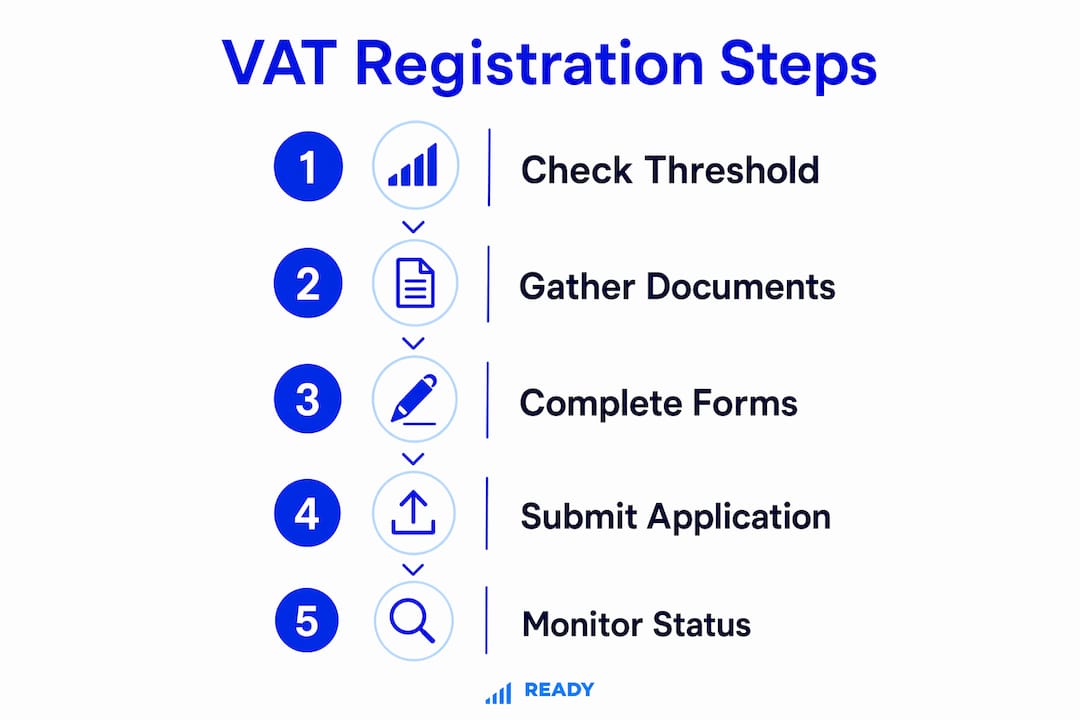
SARS offers three channels for submitting a VAT registration application: SARS eFiling, a virtual appointment via eBooking, and an in-person branch visit. For most SMEs with complete digital documents, eFiling is the fastest route.

Step 1: Check your eFiling profile. Log in to SARS eFiling and confirm your tax reference number (UTR) is active and your registered representative details are current.
Step 2: Gather your documents. Assemble everything before you start the application. Incomplete submissions trigger a Registration Application Review Notice, and you then have 21 business days to supply the missing items or face rejection.
Step 3: Complete the VAT101 (and VAT102 if applicable). The VAT-REG-02-G01 guide walks through every field. Pay close attention to the liability date, your accounting basis (invoice vs payments), and your VAT tax period (monthly, two-monthly, or six-monthly).
Step 4: Upload supporting documents. Attach certified copies of ID, bank confirmation, proof of address, and evidence of business activity. SARS’s late-2025 process enhancements mean automated rejection notices now specify exactly which document is missing, which is genuinely useful.
Step 5: Submit and monitor. Where SARS identifies no risk, it can allocate a VAT number immediately. In other cases, you will receive a Registration Application Review Notice requesting additional evidence.
When to choose a branch instead: If your liability date is more than 6 months ago, eFiling cannot process the backdating. Book a branch appointment via the SARS eBooking tool and bring original documents.
Pro Tip: The liability date is the date your taxable supplies first exceeded the threshold, not the date you apply. Getting this wrong is the single most common reason applications require a branch visit to correct.
4. Complete checklist of documents SARS commonly requires
A clean first submission saves weeks. SARS’s VAT-REG-02-G01 guide lists the required attachments, and since December 2025 the automated rejection system flags missing items by name. Still, assembling the right pack upfront is faster than responding to a review notice.
Core documents:
- Certified copy of ID (director, member, or sole trader) or passport for foreign nationals.
- Company registration documents from CIPC (COR14.3 or equivalent). If you still need to register your company, see how to register a company in South Africa first.
- Proof of business address (utility bill, lease agreement, or municipal rates statement, not older than 3 months).
- Original bank confirmation letter on bank letterhead, or a stamped bank statement showing the business account details.
- Tax reference number (UTR) for the entity and the representative vendor.
- Evidence of business activity: signed contracts, recent invoices, or management accounts showing taxable supplies.
- Representative vendor authorisation (if someone other than the director is submitting).
Application-specific details you will need to enter:
- Business activity code (from the SARS code list).
- Accounting basis: invoice basis or payments basis.
- VAT tax period: monthly, two-monthly, or six-monthly.
- Liability date: the exact date your supplies crossed the threshold.
Common rejection reasons: missing bank confirmation letter, unsigned application sections, liability date entered in the wrong format, and insufficient proof of business activity (a single invoice is rarely enough; SARS wants a pattern of trading).
Pro Tip: For a typical SME, the fastest document set is: certified ID, CIPC registration certificate, a bank confirmation letter (call your bank two days before applying), a 3-month-old lease or utility bill, and three months of invoices or a management account. That combination clears automated checks in most straightforward cases.
5. VAT rates: what is taxable, zero-rated, and exempt
South Africa’s standard VAT rate is 15%. A proposed increase was announced in the 2025 Budget but subsequently reversed, so 15% remains the rate for standard-rated supplies.
Rate callout: Standard VAT rate: 15%. This applies to most goods and services supplied in South Africa unless a specific zero-rated or exempt category applies.
Taxable supplies (standard-rated): Most goods and services a business sells, including professional services, retail goods, software, and construction work.
Zero-rated supplies (0% VAT charged, but input VAT still claimable): Basic foodstuffs such as brown bread, maize meal, milk, and eggs; exports of goods; certain international transport services; and the supply of a going concern between VAT vendors.
Exempt supplies (no VAT charged, no input VAT claimable): Certain financial services, residential rental, and some educational services. The key practical difference between zero-rated and exempt is that zero-rated suppliers can still recover input VAT on their costs. Exempt suppliers cannot.
For SMEs with mixed supplies, the rule of thumb is to classify each revenue line separately. A catering company that exports food products has both standard-rated (local catering) and zero-rated (export) supplies. Getting the split wrong on your VAT201 return creates reconciliation problems fast.
Pro Tip: If your business has any supply line that might qualify as zero-rated or exempt, get a written opinion from a tax practitioner before your first VAT201 filing. Reclassifying supplies after the fact is far more painful than getting it right upfront.
6. What your VAT registration confirmation looks like and the first 90 days
Once SARS approves your application, you receive a Notice of Registration via your eFiling profile. You can access it through the “Notice of Registration” functionality in eFiling at any time. The notice shows your VAT registration number, your effective date, and your assigned tax period.
First-90-day checklist:
- Update all invoices to include your VAT number, the words “Tax Invoice,” the supplier and recipient details, the VAT amount, and the VAT-inclusive total.
- Configure VAT codes in your accounting software (Xero, Sage, or QuickBooks) to separate output VAT and input VAT automatically.
- Schedule your VAT201 filing dates. Monthly filers submit by the 25th of the following month via eFiling.
- Train any staff who raise invoices on the minimum requirements for a valid tax invoice.
- Reconcile your opening balances: any input VAT on stock or assets held at the registration date may be claimable, subject to SARS rules.
- Update customer-facing pricing or contracts to reflect VAT where applicable.
- Notify key suppliers of your VAT number so they can issue you valid tax invoices.
For a deeper look at the ongoing compliance tasks after registration, the VAT compliance guide for South African SMEs covers the recurring monthly and bi-monthly workflow in detail.
Pro Tip: Before you file your first VAT201, run a three-way reconciliation: your VAT control account in your accounting system, the VAT201 figures, and your bank statement. Discrepancies caught here take minutes to fix. Discrepancies caught by SARS take months.
7. How to cancel VAT registration and what the exit VAT means for you
If your taxable supplies drop below the voluntary floor (R120,000 per year), you may apply to cancel your VAT registration. The forms are VAT123e (application for cancellation) and VAT123T (supporting turnover statement). SARS will assess whether your supplies are likely to remain below the threshold for the next 12 months before approving cancellation.
SARS can also proactively notify you of its intention to cancel a voluntary registration if your preceding 12 months’ supplies fall below R120,000. You have formal objection rights under ADR1 if you disagree.
The financial sting in deregistration is deemed exit VAT. When you cancel, SARS treats you as having sold all your trading stock and business assets at market value on the cancellation date. You owe output VAT on that deemed supply, even though no actual sale took place. For a business with significant stock or capital assets, this can be a substantial cash outflow.
Pro Tip: Before applying for cancellation, list every asset and stock item on hand and calculate the potential deemed exit VAT liability. Also check whether any of your major clients require you to hold VAT registration as a contractual condition. Losing registration can cost you contracts worth far more than the admin saving.
When businesses hold fleet or other insured assets, the fleet insurance claims process can affect how asset values are calculated at deregistration, so factor any outstanding insurance recoveries into your exit VAT estimate.
8. Penalties for late registration and how to stay compliant
Missing the 21-business-day registration deadline is not a paperwork inconvenience. SARS can backdate your registration to the date your supplies first exceeded the threshold, which means you owe output VAT on every sale you made in that period without having collected it from customers. Interest and penalties apply on top.
Key compliance risks:
- Backdated output VAT liability on unregistered sales.
- Loss of input VAT claims for the unregistered period (SARS may disallow these).
- Reputational damage with VAT-registered clients who cannot claim input VAT on invoices you issued without a VAT number.
- Possible administrative penalties under the Tax Administration Act.
Preventative checklist:
- Monitor rolling 12-month taxable supplies every month, not just at year-end.
- Set a calendar alert when your cumulative total reaches R1.8 million so you have time to prepare documents before hitting R2.3 million.
- Keep all supporting documents (invoices, contracts, bank statements) for at least 5 years.
- Monitor your eFiling correspondence inbox weekly. SARS issues notices electronically, and missing a Review Notice starts the 21-business-day response clock without you knowing.
- Use automated invoicing software to generate compliant tax invoices from day one.
If you missed the compulsory registration moment, SARS’s Voluntary Disclosure Programme (VDP) offers a structured way to regularise your position with reduced penalties. Acting before SARS contacts you is always the better outcome. The SARS compliance checklist covers the broader record-keeping and correspondence obligations that keep you out of trouble.
Pro Tip: A simple shared calendar with monthly reminders and a running 12-month total in a spreadsheet or your accounting software costs nothing and eliminates the most common reason SMEs miss the registration deadline.
9. How Readyaccounting supports SME VAT registration and compliance
Readyaccounting works with South African SMEs and startups at every stage of the VAT registration process: from deciding whether voluntary registration makes sense, through preparing and submitting the VAT101 application, to setting up your accounting system for the first VAT201 filing.
What the service covers:
- Document assembly and review before submission to reduce rejection risk.
- VAT101/VAT102 completion, including correct liability date and accounting basis selection.
- SARS eFiling submission and correspondence monitoring.
- Response to Registration Application Review Notices on your behalf.
- Cloud accounting setup with automated VAT codes and posting rules.
- Monthly VAT reconciliations and VAT201 preparation.
When to contact Readyaccounting:
- Before you hit R2.3 million, so registration is planned rather than rushed.
- At the moment you receive a SARS Registration Application Review Notice.
- If you are considering voluntary registration and need a cost-benefit analysis for your specific client mix.
- When you want to automate VAT posting and eliminate manual reconciliation errors.
What to have ready when you make contact: your UTR (tax reference number), CIPC registration documents, a recent bank confirmation letter, and three months of invoices or management accounts showing your taxable supplies.
Key takeaways
VAT registration in South Africa is compulsory once taxable supplies exceed R2.3 million in any rolling 12-month period, and the 21-business-day application deadline leaves no room for delay.
| Point | Details |
|---|---|
| Compulsory threshold | R2.3 million in any rolling 12-month period, effective 1 April 2026. |
| Voluntary threshold | R120,000 minimum; useful for B2B businesses wanting to recover input VAT. |
| Application deadline | 21 business days from the date you exceed the compulsory threshold. |
| Registration channel | Use SARS eFiling for most cases; branch visit required for backdating beyond 6 months. |
| Readyaccounting | Handles VAT101 preparation, eFiling submission, and first-month VAT201 setup for South African SMEs. |
Why early compliance is the only sensible strategy
Most SMEs treat VAT registration as something to deal with when they have to. That mindset is expensive. By the time a business realises it crossed the R2.3 million threshold three months ago, it is already facing a backdated liability on sales where no VAT was collected. The cash has to come from somewhere, and it usually comes from working capital.
The 2026 threshold increase is genuinely good news for micro-businesses. Fewer small operators need to manage VAT workflows, and that reduces administrative overhead across the economy. But for any business growing toward R2.3 million, the right response is not to relax monitoring. It is to put a simple system in place now so the registration moment is planned, documented, and executed cleanly.
Automation is the practical answer. Accounting software that tracks rolling taxable supplies, flags the threshold approach, and generates compliant tax invoices from day one removes the human error that causes most compliance failures. The businesses that handle VAT well are not the ones with the most experienced finance teams. They are the ones with the best systems.
Readyaccounting: VAT registration and automation done right
Registering for VAT incorrectly costs more than the registration itself. A wrong liability date, a missing bank confirmation letter, or an unsigned form can delay your VAT number by weeks and expose you to backdated output VAT. Readyaccounting eliminates that risk by handling the full VAT101 preparation, document assembly, and eFiling submission for you, with a first-month VAT201 setup included so your accounting system is ready to file from day one.
The real advantage is what happens after registration. With automated VAT posting built into your cloud accounting setup, monthly reconciliations take minutes instead of hours, and SARS triggers become rare rather than routine. For SMEs that want their finance function to protect cashflow rather than drain it, that is the practical difference Readyaccounting delivers.
Contact Readyaccounting to get your VAT registration right the first time. Visit readyaccounting.co.za or reach out directly with your UTR, CIPC documents, and bank confirmation letter ready.
Useful sources
The sources below are the primary references used in this guide. SARS pages are the authoritative source for all thresholds, forms, and process details. Readyaccounting resources provide practitioner-level implementation guidance.
Official SARS references:
- What is the new threshold for VAT registration? — SARS FAQ confirming the R2.3 million compulsory threshold from 1 April 2026.
- Register for VAT — SARS process page covering channels, timelines, and Review Notices.
- Value-Added Tax overview — SARS overview of the 15% standard rate, zero-rated and exempt supplies, and 2025 process enhancements.
- Budget 2026 Frequently Asked Questions — Source for both the compulsory and voluntary threshold changes effective 1 April 2026.
- VAT-REG-02-G01: Guide for completion of VAT registration application forms — SARS’s field-by-field guide for the VAT101 and VAT102 forms.
- SMME Connect Issue 14, April 2026 — SARS commentary on the policy intent behind the 2026 threshold increases.
Practitioner resources:
- When to register for VAT: a South African SME guide — Readyaccounting guide on the compulsory vs voluntary decision.
- VAT registration requirements: a guide for SA SMEs — Practical document checklist and VAT101 preparation guidance.
“From 1 April 2026, the compulsory VAT registration threshold increased from R1 million to R2.3 million. Small businesses only need to register for VAT once their annual turnover exceeds R2.3 million.” — SARS FAQ: What is the new threshold for VAT registration?
This article provides general information about VAT registration in South Africa and does not constitute tax or legal advice. Confirm the current rules with SARS or a registered tax practitioner for your specific situation.