

VAT registration process for South African SMEs
Executive Summary
- Getting VAT registration wrong causes penalties, interest charges, and cash flow issues for South African SMEs. Proper preparation, timely application within the 21-day window, and accurate documentation ensure smooth registration and ongoing compliance. Maintaining detailed records and timely filings help businesses avoid costly backdating and penalties after receiving their VAT number.
Getting the VAT registration process wrong costs South African SMEs more than just time. Late registration triggers SARS penalties, interest charges, and cash flow disruptions that can take months to untangle. Yet many business owners only realise they needed to register after they have already crossed the threshold, or they start the application without the right documents and watch it stall for weeks. This guide walks you through every stage clearly: from understanding when you must register, to what documents you need, to what happens after your VAT number lands in your inbox.
Table of Contents
- Key takeaways
- VAT registration requirements and thresholds
- Documents to prepare before you register
- Step-by-step VAT registration with SARS
- Common challenges and how to handle them
- After VAT registration: staying compliant
- My take on navigating VAT registration
- How Readyaccounting makes VAT registration easier
- FAQ
Key takeaways
| Point | Details |
|---|---|
| Know your threshold | Compulsory registration kicks in when taxable supplies exceed R2.3 million in any 12-month period. |
| Prepare documents early | Gather your CIPC documents, bank details, and financial records before starting the application. |
| Use SARS eFiling | Online registration is faster and lets you track your application status in real time. |
| Respond to SARS promptly | If SARS requests supporting documents, you have 21 business days to submit or your application is rejected. |
| Compliance does not stop at registration | After approval, you must file periodic VAT returns and maintain detailed records to stay compliant. |
VAT registration requirements and thresholds
Before you touch the SARS eFiling portal, you need to know whether you are required to register or simply eligible to register. The distinction matters because the rules, timing, and obligations are different for each.
Compulsory registration
Compulsory VAT registration applies when your total taxable supplies exceed R2.3 million within any consecutive 12-month period. Once you hit that number, you have 21 business days to submit your application to SARS. No exceptions. Miss that window and you are exposed to penalties and backdated VAT liability.
There is a point of confusion worth clearing up. Some business owners have heard the R1 million figure mentioned and assumed that is the compulsory threshold. It is not. Exceeding R1 million signals that you should be watching your turnover carefully, but the mandatory registration obligation only applies at R2.3 million. Misreading this can lead to either premature registration or, worse, missed deadlines.
Voluntary registration
Voluntary registration is available to businesses whose taxable supplies are above R120,000 but below R2.3 million. The catch is that SARS requires actual proof of having made taxable supplies at or above that lower threshold in the previous 12 months. A business plan, projected revenue, or a signed contract is not enough on its own. You need real transaction history to back the application.
Here is a quick comparison to frame your decision:
| Criteria | Compulsory registration | Voluntary registration |
|---|---|---|
| Taxable supply threshold | Above R2.3 million | R120,000 to R2.3 million |
| Application deadline | Within 21 business days | No fixed deadline |
| Proof required | Turnover records | Actual taxable supply history |
| VAT input credit claims | Yes | Yes |
| Ongoing filing obligation | Yes, periodic returns | Yes, periodic returns |
Monitoring your taxable turnover accurately is the most important habit you can build before registration becomes an issue. Many SMEs discover they crossed the threshold during an audit, which is exactly the wrong time to find out. Keep a running 12-month total of your taxable supplies, and check it monthly. For more detail on both thresholds and eligibility conditions, the VAT registration requirements guide from Readyaccounting covers the legal obligations specific to South African enterprises.
Documents to prepare before you register
Nothing slows down a VAT application faster than discovering mid-submission that you are missing a document. SARS will pause or reject your application, and then you are back at the start of the queue.
Here is what you need to have ready:
Mandatory documents:
- South African ID document or passport for the business owner or representative
- Proof of residential or business address (not older than three months)
- CIPC registration documents confirming your business is registered
- Business bank account details with a bank confirmation letter
- SARS eFiling login credentials and your tax reference number
- Financial records showing taxable turnover (bank statements or management accounts)
Supporting documents that strengthen your application:
- Signed contracts or purchase orders showing ongoing business activity
- Supplier invoices confirming the nature of your taxable supplies
- Lease agreement if your business operates from a physical premises
Accurate and updated records are not optional. SARS uses documentation to verify both your turnover and the legitimacy of your business activity. Gaps in your records create grounds for rejection.
SARS enhanced its VAT registration process in December 2025, providing clearer guidance on documentation required at submission. This means applicants now receive more specific feedback if something is missing, rather than a vague rejection notice. It is a meaningful improvement, but it only helps you if you actually respond to that feedback in time.

Pro Tip: Create a dedicated digital folder with all your VAT registration documents before you open the eFiling application. Rename each file clearly (for example, “CIPC certificate 2026” or “Bank confirmation letter March 2026”) so you can upload them quickly without searching through your downloads folder mid-application.
Step-by-step VAT registration with SARS
The SARS eFiling portal is the primary channel for VAT registration online, and it is where most SMEs should start. Walk-in appointments are available at SARS branches for those who prefer in-person assistance, and telephonic or video appointments can also be arranged. That said, online submission is faster and lets you track your application status without calling the SARS contact centre.
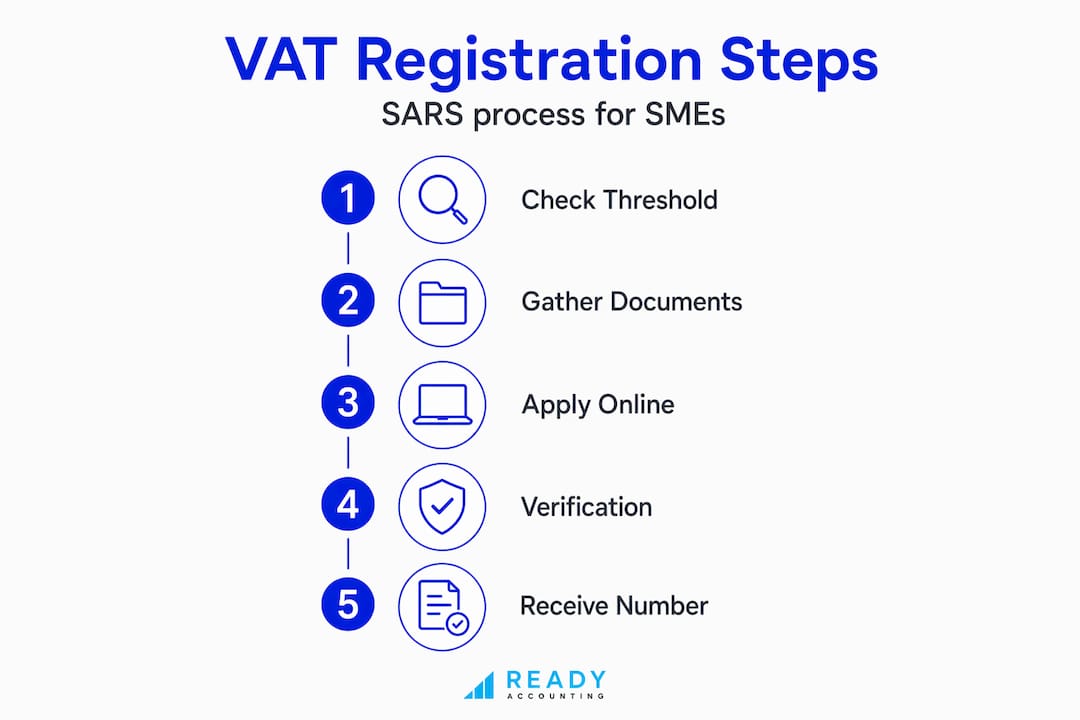
Here is the process in order:
- Log in to SARS eFiling at www.sarsefiling.co.za using your existing credentials. If you do not have an eFiling profile, register for one first.
- Navigate to the registration section and select “Register for VAT” from the tax types available on your profile.
- Enter your business details accurately, including your trading name, legal entity type, and the nature of your taxable supplies.
- Select the correct VAT codes that match your business activity. Selecting the wrong codes is a common error that creates complications later.
- Add your banking details exactly as they appear on your bank confirmation letter. Even a single digit error causes verification failures.
- Upload your supporting documents in the required formats. PDF is generally preferred by SARS.
- Complete biometric verification if prompted. This is part of SARS’s identity authentication process and may be required for new registrations.
- Submit the application and note your submission reference number.
If no risks are identified, SARS issues your VAT number immediately after submission. If further verification is needed, SARS will request supporting documents within 21 business days. Failing to submit those documents within the deadline results in your application being rejected, and you will need to start again.
Pro Tip: Before you click submit, go through every field one more time. Check that your ID number, bank account number, and business registration number match your documents exactly. Errors in these fields are the single biggest cause of rejected or delayed VAT registration applications.
For a broader look at the procedural steps for getting your business fully set up, the business registration steps guide from Readyaccounting is worth reading alongside this article.
Common challenges and how to handle them
Even with the right documents, applications get rejected. Knowing the most common reasons helps you avoid them or fix them fast.
Delays and rejections most often come from incorrect personal or business information, missing documents, turnover figures that do not match supporting records, or failure to respond to SARS follow-up requests within the required timeframe.
| Common issue | What happens | What to do |
|---|---|---|
| Missing documents at submission | Application paused or rejected | Resubmit with complete documentation |
| Incorrect business or banking details | Verification failure | Correct and resubmit promptly |
| Turnover figures do not match records | SARS requests clarification | Provide reconciled financials immediately |
| No response to SARS document request | Application cancelled | Respond within 21 business days without exception |
| Wrong VAT or business activity codes | Incorrect registration type | Contact SARS to correct before approval |
SARS’s December 2025 enhancements introduced systematic transparency around rejection reasons, which means applicants now receive more specific information about what went wrong. Use that feedback. Read the rejection notice carefully, address every point raised, and resubmit as quickly as possible.
Late registration carries real financial consequences. You become liable for VAT on all taxable supplies made from the date you should have registered, not the date you actually registered. That backdated liability, combined with penalties and interest, can create a significant cash flow problem for a growing SME.
After VAT registration: staying compliant
Receiving your VAT registration certificate and VAT number is the beginning, not the end. What follows requires consistent attention to keep your business in good standing with SARS.
Here is what ongoing VAT compliance looks like in practice:
- File periodic VAT returns. Most SMEs are placed on a two-month or quarterly filing cycle. Returns must be submitted and payments made by the due date, even if the amount owed is zero.
- Maintain detailed VAT records. Keep all tax invoices issued and received, credit notes, debit notes, and records of VAT-exempt or zero-rated supplies for at least five years.
- Issue compliant tax invoices. Every invoice above R50 must include specific information such as the VAT registration number, the VAT amount, and the supplier’s details.
- Track input VAT claims. You can reclaim VAT paid on business expenses, but only if you hold valid tax invoices to support each claim.
- Monitor your filing deadlines. Missing a return deadline triggers automatic penalties. Set calendar reminders at least a week before each due date.
Businesses must submit periodic VAT returns and keep detailed digital records to meet SARS’s filing requirements. Cloud accounting software is particularly useful here. Platforms widely used in South Africa automate VAT calculations, generate compliant tax invoices, and produce the reports you need when filing. The administrative lift drops significantly when your accounting system is doing the heavy work.
Voluntary VAT registration carries the same ongoing obligations as compulsory registration. The input VAT credits can be genuinely valuable for SMEs buying goods and services with VAT applied, but you need to weigh that benefit against the administrative commitment of regular filing and record keeping.
My take on navigating VAT registration
I have worked with many South African business owners who treat VAT registration as something they will deal with when the time comes. That approach consistently creates the problems they were trying to avoid.
The businesses that sail through VAT registration are almost always the ones that started keeping clean records well before the threshold was in sight. When the application time arrives, they are not scrambling for bank statements or hunting for CIPC documents. Everything is already organised.
What I find encouraging is SARS’s improved transparency since December 2025. Previously, a rejection notice often left applicants guessing what went wrong. Now the feedback is specific and usable. That makes a real difference for business owners who are going through the process without an accountant at their side.
My honest advice: treat your VAT registration number as a sign that your business is growing, because it usually is. And if the administrative side of compliance feels like too much to manage alongside running an actual business, that is a legitimate reason to bring in professional support before you are under pressure.
— Johan
How Readyaccounting makes VAT registration easier
If any part of this process feels overwhelming, you are not alone. Readyaccounting works with scaling South African SMEs to take the friction out of VAT registration and ongoing compliance. We handle the document preparation, eFiling submissions, and post-registration setup so you are not learning the system by trial and error.
Beyond registration, our cloud accounting infrastructure keeps your VAT records clean, your returns filed on time, and your exposure to SARS penalties minimal. If you want to understand how automation reduces the administrative weight of VAT compliance, see how automation improves cash flow for SMEs like yours. And if reducing your overall tax liability is a priority, our guide on reducing tax liability for South African SMEs is a practical starting point. Reach out to Readyaccounting directly to get tailored support for your registration.
FAQ
When must I register for VAT in South Africa?
You must register for VAT within 21 business days of your taxable supplies exceeding R2.3 million in any consecutive 12-month period. Late registration exposes you to backdated VAT liability, penalties, and interest from SARS.
Can I register for VAT voluntarily?
Yes. Businesses with taxable supplies above R120,000 but below R2.3 million can apply for voluntary VAT registration, provided they have actual proof of taxable supplies made in the previous 12 months. Projections or business plans are not sufficient evidence.
How long does the VAT registration process take?
SARS issues a VAT number immediately if no risks are identified during the application. If additional verification is needed, SARS requests supporting documents within 21 business days. You must respond within that window or the application is cancelled.
What are the most common reasons for VAT registration rejection?
Rejections most commonly result from missing documents, incorrect business or banking details, turnover figures that do not match financial records, or failure to respond to SARS document requests in time. SARS’s December 2025 process update now provides clearer rejection reasons to help applicants correct and resubmit quickly.
What must I do after receiving my VAT number?
After registration, you must file periodic VAT returns on your assigned cycle, maintain full VAT records for at least five years, issue compliant tax invoices, and pay any VAT due by each filing deadline. Ongoing compliance is non-negotiable once you are registered.
Recommended
- VAT registration requirements: A guide for SA SMEs | Ready Accounting
- Register your company in South Africa: a clear guide | Ready Accounting
- Essential steps to register a business in South Africa | Ready Accounting
- The Ultimate VAT Compliance Protocol for South African South African Enterprises in 2025 | Ready Accounting