

Depreciation explained for South African SMEs
Understanding depreciation is how your business spreads the cost of an asset across its useful life — and getting it right is the difference between claiming your full SARS wear-and-tear allowance and leaving money on the table. Under Section 11(e) of the Income Tax Act, SARS allows qualifying businesses to deduct a portion of an asset’s cost each year as a non-cash expense. Three things to do right now:
- Verify your asset register. Every depreciable asset needs a record showing its cash cost (not the financed amount), the date it was brought into use, and the write-off method you have chosen.
- Confirm the cash cost. SARS values assets at what you actually paid in cash, excluding finance charges. That is your tax basis, full stop.
- Save every purchase invoice. No invoice means no deduction. Readyaccounting sees this mistake more than any other during SARS queries.
Key takeaways
Depreciation is a non-cash tax deduction that reduces your taxable income each year — and South African SMEs who manage it correctly through SARS-compliant asset registers and Section 11(e) rules consistently recover more value from their assets than those who treat it as a year-end afterthought.
| Point | Details |
|---|---|
| Use cash cost as your tax basis | SARS values assets at the cash price paid, excluding finance charges — revaluations do not change this. |
| Choose and document your method | Straight-line gives even annual charges; diminishing-value front-loads deductions. Record your choice on day one. |
| Check the SARS Annexure | BGR 7’s Annexure sets write-off periods for assets brought into use from 24 March 2020 — confirm your asset’s period before filing. |
| Plan for recoupment on disposal | Proceeds above the tax basis create taxable recoupment income; plan disposals to land in the most tax-efficient year. |
| Readyaccounting automates compliance | Readyaccounting builds cloud-based fixed-asset registers with automated wear-and-tear schedules, reducing SARS query risk for South African SMEs. |
Table of Contents
- What is depreciation and why does it matter for your business?
- Which depreciation methods does SARS allow?
- Worked examples: straight-line vs diminishing-value in rand
- Which assets qualify for SARS wear-and-tear?
- What are the SARS tax rules for wear-and-tear?
- How do you record assets and claim wear-and-tear correctly?
- Are there accelerated allowances beyond the standard Annexure?
- Common SME mistakes and Readyaccounting’s practical checklist
- Why getting depreciation right changes everything
- How Readyaccounting helps you get depreciation right
- Sources
What is depreciation and why does it matter for your business?
Depreciation is the accounting process of allocating the cost of a tangible asset over the years it generates revenue for your business. The matching principle sits at the heart of this: you bought the asset to produce income, so its cost should reduce profit in the same periods that income flows in, not all at once when you swipe the card.
For South African SMEs, depreciation shows up in two places. On your Annual Financial Statement, it appears as an expense on the income statement and reduces the carrying value of assets on the balance sheet. On your SARS tax computation, it appears as the wear-and-tear allowance, which reduces your taxable income. These two figures are often different, and keeping both schedules separate is a discipline that saves real money at year-end.
The non-cash nature of depreciation is what makes it such a useful planning tool. Your bank balance does not drop when you record depreciation. Profit drops, taxable income drops, and your tax bill drops — but cash stays in the business. That gap between reported profit and actual cash is exactly why lenders and investors look at EBITDA (earnings before interest, tax, depreciation, and amortisation) when assessing a business’s real cash-generating ability.
Where depreciation shows up in practice:
- Vehicle fleet: a delivery van costing R350,000 is not expensed in year one. Its cost is spread over its useful life, typically five years under the SARS Annexure.
- Factory equipment: a production line brought into use in March is depreciated from that date, not from when you ordered it.
- Office fit-out: leasehold improvements are depreciated over the shorter of the lease term or the asset’s useful life.
- Insurance planning: insurers use depreciated values to settle claims, so an outdated asset register can leave you underinsured.
Which depreciation methods does SARS allow?
SARS accepts two methods for the wear-and-tear allowance: straight-line and diminishing-value (also called reducing-balance). Both are covered under Interpretation Note 47 and BGR 7.
Straight-line method
The formula is straightforward:
Annual depreciation = (Cost − Residual value) ÷ Useful life in years
If residual value is nil (which SARS typically assumes for tax purposes), you divide the cash cost by the write-off period in the Annexure. The expense is identical every year, which makes budgeting predictable and reconciliations clean.
Diminishing-value method
Each year’s depreciation is calculated on the remaining tax basis, not the original cost:
Annual depreciation = Opening tax basis × Depreciation rate
The rate is derived from the write-off period. The deduction is larger in early years and shrinks over time, which suits assets that lose value quickly — think computers, smartphones, or production machinery that works hardest when new.
Choosing between them:
- Use straight-line when wear is even across the asset’s life and you want predictable annual charges.
- Use diminishing-value when the asset depreciates faster early on and you want to front-load the tax deduction.
- Consider your cash-flow position: a startup with thin margins may prefer the larger early deductions of diminishing-value.
- Check the PwC South Africa tax summaries for special rates on specific asset classes before defaulting to the Annexure period.
Pro Tip: Document your useful-life assumption in writing when you bring an asset into use. If you later revise the estimate — say, a machine wears out faster than expected — update the register and note the reason. Under BGR 7, you do not need to notify SARS before switching methods, but you must keep records that justify the change if audited.
Worked examples: straight-line vs diminishing-value in rand
Both examples use the same asset so you can compare the outcomes directly. A business purchases a piece of production equipment for a cash cost amount specified for tax purposes. SARS Annexure write-off period: five years. Residual value for tax: nil.
Example A: straight-line
Annual depreciation = the cash cost divided by 5 equals an even annual depreciation amount.
Steps:
- Confirm the cash cost: R120,000.
- Confirm the write-off period from the SARS Annexure: 5 years.
- Divide: R120,000 ÷ 5 = R24,000.
- Record R24,000 as the wear-and-tear allowance on the tax return each year.
- Reduce the tax basis by R24,000 at year-end.
Example B: diminishing-value
Steps:
- Confirm the cash cost: R120,000 (opening tax basis, Year 1).
- Apply 20%: R120,000 × 20% = R24,000 (Year 1 deduction).
- Opening basis Year 2: R120,000 − R24,000 = R96,000.
- Apply 20%: R96,000 × 20% = R19,200 (Year 2 deduction).
- Continue until the tax basis reaches nil.
Year-by-year comparison ®
Notice that straight-line fully writes off the asset in five years. Under diminishing-value, a residual tax basis of R39,322 remains after year five — you continue claiming until the basis reaches nil, which takes longer. The Investopedia depreciation guide illustrates this pattern clearly for anyone who wants to build a spreadsheet model.
Which assets qualify for SARS wear-and-tear?
Section 11(e) covers machinery, plant, implements, utensils, and articles used in the production of income. That is a broad category, but the exclusions matter just as much.
Common exclusions and special cases:
- Land: never depreciable. Its value does not diminish through use.
- Most buildings: standard commercial and residential buildings are excluded from Section 11(e). Separate allowances apply under Sections 13, 13bis, and 13quat for qualifying buildings, but the rules and rates differ significantly.
- Personal-use assets: a laptop used 60% for business and 40% personally can only be depreciated on the business-use portion.
- Assets already deducted under another section: if you claimed a full deduction under Section 11(a) or a special allowance, you cannot also claim Section 11(e) wear-and-tear on the same asset.
- Assets not yet brought into use: the allowance starts from the date the asset is actually used in the business, not the purchase date.
The cash-cost rule is non-negotiable. SARS defines the asset’s value as the cash price you paid, excluding any finance charges, interest, or VAT you have already claimed as an input credit. If you revalue an asset upward on your accounting books (say, to reflect market value), that revaluation does not change your tax basis. Your tax depreciation schedule stays anchored to the original cash cost.
Capitalisation policy for SMEs: set a rand threshold below which purchases are expensed immediately rather than capitalised. Many SMEs use R5,000 or R10,000 as a practical cut-off. Apply it consistently — inconsistent treatment is one of the first things a SARS auditor notices. For broader guidance on tax-efficient asset structures, the way you own and classify assets matters as much as the rate you depreciate them at.
What are the SARS tax rules for wear-and-tear?
The legal authority is Section 11(e) of the Income Tax Act 58 of 1962, interpreted through SARS Interpretation Note 47 and made partially binding through BGR 7. BGR 7’s Annexure applies to assets brought into use from 24 March 2020.
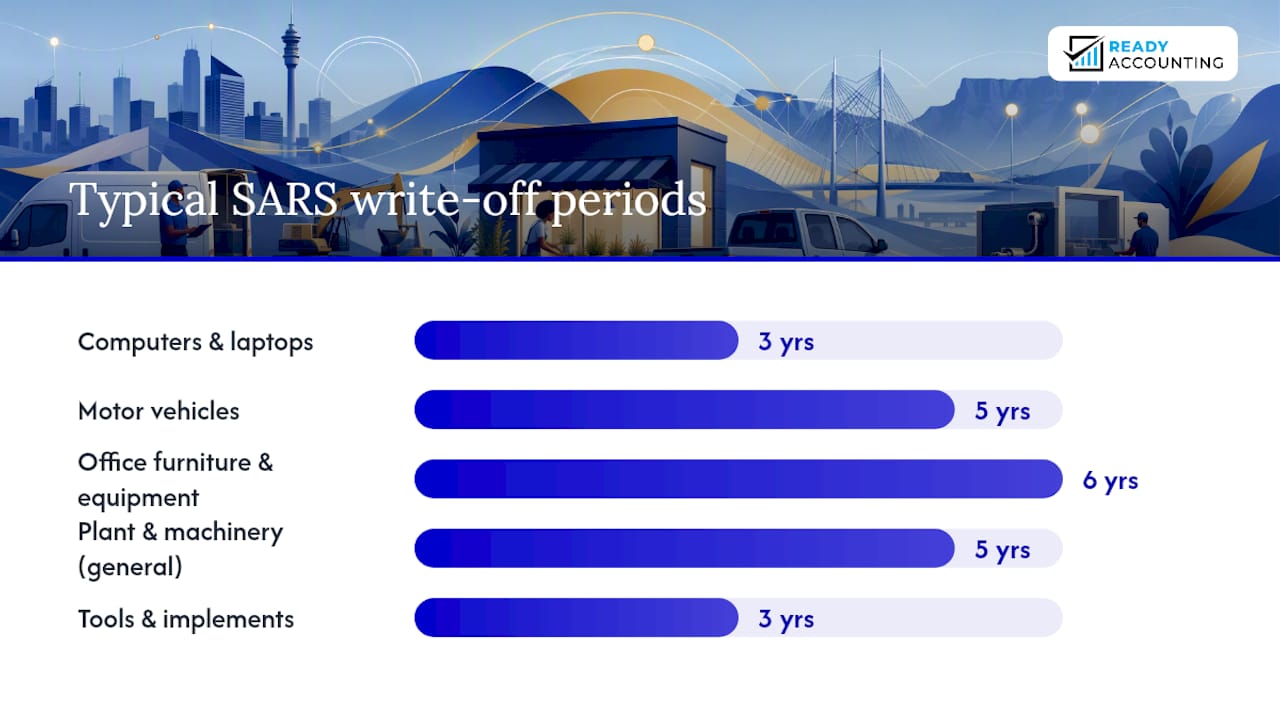
Annexure write-off periods (selected examples):
| Asset category | Typical write-off period |
|---|---|
| Computers and laptops | 3 years |
| Motor vehicles | 5 years |
| Office furniture and equipment | 6 years |
| Plant and machinery (general) | 5 years |
| Tools and implements | 3 years |
You can apply to SARS for a shorter write-off period if you can demonstrate that the asset wears out faster than the Annexure suggests — submit the motivation before filing the relevant return.
Recoupment on disposal is where many SMEs get caught off guard. When you sell or scrap an asset, SARS compares the proceeds to the asset’s remaining tax basis. If proceeds exceed the tax basis, the difference is a recoupment — taxable as ordinary income in the year of disposal, not as a capital gain. If proceeds exceed the original cost, the excess above cost is a capital gain subject to CGT rules. A vehicle with no remaining tax basis sold above that basis creates a recoupment equal to the excess proceeds. That is real taxable income, and it can push a small business into a higher effective tax bracket for that year. Plan disposals carefully, especially at year-end. For a broader view of how tax deductions interact with your overall tax position, recoupment planning belongs in the same conversation.
How do you record assets and claim wear-and-tear correctly?
Your fixed-asset register is the single most important document in a SARS depreciation audit. Without it, you cannot prove the date an asset was brought into use, the method chosen, or the accumulated deductions claimed.
What your asset register must contain:
- Asset description and unique ID number
- Purchase date and date brought into use
- Supplier name and invoice number
- Cash cost (VAT exclusive if VAT was claimed)
- Useful life and write-off method chosen
- Annual depreciation/wear-and-tear amount
- Accumulated depreciation to date
- Closing tax basis (net book value for tax)
- Disposal date and proceeds (when applicable)
Documents to retain (minimum five years per SARS recordkeeping rules):
- Original purchase invoices
- Proof of payment
- Installation or commissioning records
- Disposal agreements or scrap certificates
- Annual depreciation schedules (both accounting and tax)
Pro Tip: Assign sequential asset IDs the moment a purchase is approved, not after the asset arrives. Use cloud accounting software with a fixed-asset module — Xero, Sage Business Cloud, and similar platforms used in South Africa all support this — and store digital copies of invoices linked to each asset record. When SARS requests supporting documents, you can respond within hours rather than days.
Practitioners reconcile accounting depreciation back to taxable income by adding back the accounting charge and deducting the SARS-approved wear-and-tear allowance. Keep both schedules and reconcile the differences each year. That reconciliation is what your tax accountant uses to complete the IT14 or IT12 return correctly.
Are there accelerated allowances beyond the standard Annexure?
Yes, and they can be significant. Beyond the standard Annexure write-off periods, SARS and the Finance Act provide accelerated or investment allowances for qualifying projects and sectors. Research on tax depreciation in South Africa confirms that tax depreciation often diverges materially from accounting depreciation when these incentives apply, changing the timing of deductions in ways that affect investment decisions.
Notable examples to check with your tax accountant:
- Renewable energy: Section 12B provides accelerated write-offs for qualifying solar, wind, and other renewable energy assets. The rates and qualifying criteria have changed in recent Finance Acts — confirm the current position before filing.
- Manufacturing and industrial policy: Section 12C offers accelerated allowances on new or unused manufacturing plant and machinery used in a process of manufacture.
- Small business corporations: qualifying SBCs under Section 12E can deduct the full cost of certain plant and machinery in the year of acquisition.
- Urban development zones: Section 13quat provides building allowances for qualifying improvements in designated UDZs.
- Research and development: Section 11D allows enhanced deductions for qualifying R&D expenditure, which sometimes overlaps with asset costs.
These incentives have sunset dates, qualifying conditions, and policy changes that make them a moving target. Always check the latest SARS guidance or the annual Finance Act before assuming a rate still applies. A tax accountant who tracks these changes is worth the fee many times over — the tax planning guide for South African SMEs covers several of these in more detail.
Common SME mistakes and Readyaccounting’s practical checklist
The most frequent depreciation errors Readyaccounting encounters are not complex. They are basic process failures that compound over years until a SARS audit or a bank’s due diligence request forces a painful clean-up.
The four most common mistakes:
- Missing or lost purchase invoices (no invoice = no deduction)
- Personal and business assets mixed on the same register
- Useful-life estimates never reviewed after the initial entry
- Small assets treated inconsistently (sometimes expensed, sometimes capitalised)
Readyaccounting’s depreciation checklist:
- Tag every asset with a unique ID on arrival. Stick a physical label on it.
- Set a capitalisation threshold (e.g., R7,500) and apply it to every purchase without exception.
- Record the cash cost on the day of purchase. Do not wait for the accountant’s year-end visit.
- Choose and document the method (straight-line or diminishing-value) in the asset register on day one.
- Reconcile capital expenditure monthly against the asset register. Unreconciled capex is the most common source of register errors.
- Set annual review dates for useful-life estimates and impairment indicators (damage, obsolescence, market changes).
- Run a separate tax depreciation schedule alongside the accounting schedule and reconcile the two before filing.
- Plan disposals before year-end to manage recoupment income in the most tax-efficient year.
For SMEs managing cash flow tightly, depreciation is also a planning lever. Lowering taxable income without a cash outflow improves your effective cash-flow position in ways that matter when you are watching runway. Tax planning best practices for small business owners — including how depreciation fits into a broader deduction strategy — are covered well in this external guide for additional context.
Why getting depreciation right changes everything
Most business owners treat depreciation as a compliance box to tick. That framing costs them money.
The SMEs that get the most from their asset base are the ones who treat the fixed-asset register as a live management tool, not a year-end afterthought. When the register is current, you know exactly what you own, what it is worth for tax purposes, and what deductions are coming. You can model the cash-flow impact of a new equipment purchase before you sign the order. You can plan a disposal to land in the right tax year. You can answer a SARS query in a day instead of a week.

One client came to Readyaccounting with four years of unreconciled asset records. Equipment had been expensed in some years and capitalised in others, with no consistent threshold. When we rebuilt the register from purchase invoices, we recovered deductions that had been missed and restructured the disposal of two vehicles to avoid a recoupment spike. The tax saving in that single year covered the cost of the clean-up several times over.
The deeper point: accounting depreciation and tax depreciation are not the same number, and treating them as interchangeable is the root cause of most errors. Keep both schedules, reconcile them annually, and you will never be surprised by a SARS adjustment.
How Readyaccounting helps you get depreciation right
Readyaccounting builds and maintains SARS-compliant fixed-asset registers for South African SMEs as part of its managed accounting service — so your wear-and-tear schedules are ready when your tax return is due, not assembled under pressure the night before.
The practical difference: instead of a spreadsheet that lives on one person’s laptop, your asset register sits in a cloud system with sequential IDs, linked invoices, automated depreciation calculations, and a tax schedule that exports directly into your IT14 preparation. Automating this process removes the manual errors that trigger SARS queries and gives you real-time visibility into your asset base and its tax impact.
Services that directly support depreciation compliance include managed business accounting, Annual Financial Statement preparation, tax return filing, and fractional CFO support for businesses that need strategic asset planning. If your register is overdue for a review, or you have never had one set up properly, contact Readyaccounting for an asset register audit and get your depreciation working for you before the next tax year closes.
Sources
Authoritative South African sources for depreciation rules and further detail:
- INTERPRETATION NOTE 47 (Issue 5) ACT : INCOME TAX ACT 58 OF 1962 SECTION : SECTION 11(e) SUBJECT : WEAR-AND-TEAR OR DEPRECIATION ALLOWANCE
- Understanding depreciation
- Depreciation and deductions — PwC tax summaries (South Africa)
- Depreciation: Definition and Types, With Calculation Examples
This article is general information, not a substitute for advice from a qualified financial advisor. Consult a qualified financial professional about your own circumstances before acting on anything here.