

Forensic Analysis of Common Payroll Compliance Fatalities for Businesses
Getting payroll wrong can sink a business fast. Payroll mistakes cost South African companies millions in unnecessary fines and lost trust every year. Many people think payroll is just about paying your staff on time. The real shock comes when you realise one simple slip can spark legal trouble, damage your company’s name, and leave employees feeling insecure about their jobs.
Table of Contents
- Identifying Common Payroll Mistakes And Their Impact
- The Importance Of Accurate Payroll For Business Success
- Understanding Payroll Compliance And Legal Requirements
- How Payroll Errors Affect Employee Trust And Company Morale
- Best Practices To Mitigate Common Payroll Issues
Quick Summary
| Takeaway | Explanation |
|---|---|
| Prevent payroll errors to avoid penalties | Companies face unexpected tax penalties and increased costs due to payroll mistakes. Effective management is essential to avoid these issues. |
| Implement robust payroll systems | Investing in modern payroll technologies can significantly reduce human error and enhance accuracy. Automation tools streamline calculations and reporting. |
| Maintain compliance with tax regulations | Accurate calculations and timely submissions are vital to adhere to South African tax laws. Non-compliance can lead to severe financial and reputational damage. |
| Enhance employee trust through accuracy | Consistent and correct payroll processes foster trust and morale in the workplace. Errors can lead to decreased employee motivation and retention. |
| Regular training for payroll staff | Continuous education ensures that payroll personnel stay updated on regulations and best practices. This approach mitigates risks and enhances operational efficiency. |
Identifying Common Payroll Mistakes and Their Impact
Payroll management represents a critical financial function where even minor errors can trigger substantial complications for businesses. The intricate landscape of tax regulations, employee compensation, and statutory compliance demands meticulous attention and precision.
Financial Consequences of Payroll Errors
Payroll mistakes can create significant financial burdens for organisations. According to a research report from the Government Accountability Office, erroneous payments and untimely tax remittances can lead to direct monetary losses, increased administrative overhead, and potential legal penalties. The financial implications extend beyond immediate monetary costs and can damage an organisation’s reputation and employee trust.
Key financial risks associated with payroll errors include:
- Unexpected tax penalties from SARS
- Potential legal disputes with employees
- Compliance violation fines
- Reputational damage to the business
Classification of Common Payroll Mistakes
Businesses frequently encounter several recurring payroll challenges that require strategic management. These mistakes often stem from inadequate record-keeping, misunderstanding of tax regulations, or outdated processing systems. Learn more about streamlining your payroll processes to mitigate these risks effectively.
Common payroll mistakes typically fall into three primary categories:
- Incorrect salary calculations
- Improper tax withholding
- Missed reporting deadlines
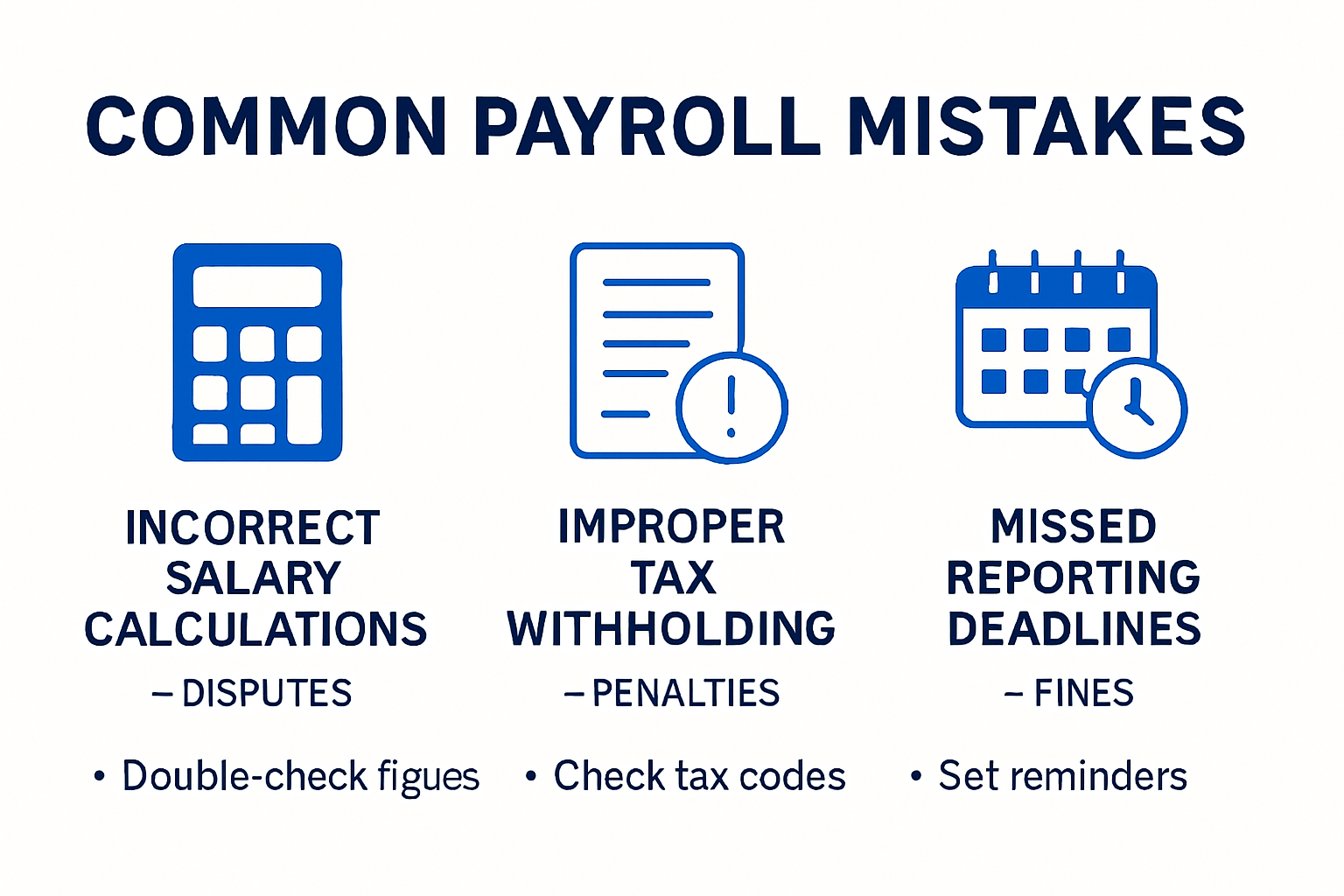
Below is a table outlining the main categories of common payroll mistakes described in the article, along with specific examples and their typical impact on South African businesses.
| Category | Example | Typical Impact |
|---|---|---|
| Incorrect Salary Calculations | Miscomputing overtime or allowances | Under/overpayment, disputes, potential legal claims |
| Improper Tax Withholding | Failing to deduct correct PAYE | SARS penalties, compliance issues |
| Missed Reporting Deadlines | Late submission of forms to SARS | Fines, reputational and financial damage |
Mitigating Payroll Risk
Addressing payroll mistakes requires a proactive and systematic approach. Businesses must invest in robust accounting systems, maintain updated knowledge of regulatory requirements, and implement rigorous verification processes. Regular training for payroll personnel and periodic internal audits can significantly reduce the likelihood of costly errors.
Ultimately, understanding and preventing common payroll mistakes is not just about avoiding financial penalties but about maintaining organisational integrity and employee confidence.
The Importance of Accurate Payroll for Business Success
Payroll is far more than a simple administrative task – it represents a critical strategic function that directly impacts organisational performance, employee satisfaction, and legal compliance. For South African businesses, understanding the profound significance of accurate payroll management is essential for sustainable growth and operational excellence.
Strategic Business Impact
Accurate payroll processes contribute significantly to overall business success. Discover how automation can transform your accounting workflows and streamline your financial operations. As noted by business research, an engaged workforce contributes to 22% greater productivity, highlighting the critical role of precise compensation management.
Key strategic benefits of accurate payroll include:
- Enhanced employee trust and morale
- Improved organisational reputation
- Reduced financial and legal risks
- Better resource allocation and financial planning
Legal and Compliance Considerations
Payroll accuracy is not optional but a legal requirement in South Africa. Businesses must navigate complex regulatory landscapes involving SARS, employment legislation, and tax obligations. Inaccurate payroll processing can result in substantial penalties, legal disputes, and potential reputational damage.
Critical compliance areas businesses must prioritize:
- Precise tax calculations and submissions
- Accurate employee classification
- Timely statutory reporting
- Transparent wage and deduction records
Employee Experience and Organisational Culture
Precise and reliable payroll processes are fundamental to creating a positive workplace environment. When employees receive correct compensation consistently and on time, it fosters trust, reduces workplace stress, and demonstrates the organisation’s commitment to professional integrity.
Beyond mere financial transactions, payroll represents a tangible expression of an organisation’s values and operational competence. By investing in robust payroll systems and processes, businesses communicate respect for their workforce and commitment to maintaining high standards of financial management.
Understanding Payroll Compliance and Legal Requirements
Payroll compliance represents a complex landscape of legal obligations that South African businesses must navigate carefully. The intricate web of regulations demands meticulous attention to detail, comprehensive understanding of statutory requirements, and proactive management of financial responsibilities.
Regulatory Framework and Statutory Obligations
Explore our comprehensive guide to payroll management for deeper insights into navigating these complex requirements. According to legal research, businesses face significant risks when failing to comply with payroll regulations.
Key statutory requirements for South African businesses include:
- Accurate PAYE tax calculations and submissions
- Compliance with Basic Conditions of Employment Act
- Adherence to Unemployment Insurance Fund regulations
- Proper record-keeping and reporting mechanisms
To clarify the critical compliance areas for South African payroll, the following table summarises each statutory requirement and its significance to businesses.
| Statutory Requirement | Description | Importance |
|---|---|---|
| PAYE Tax Calculations & Submissions | Ensuring all income tax is calculated and paid to SARS on time | Avoids tax penalties and supports compliance |
| Basic Conditions of Employment Act | Adhering to legal standards for pay and leave | Prevents legal disputes and maintains fairness |
| Unemployment Insurance Fund (UIF) | Contribution calculations and submissions | Supports legal obligations to employees |
| Proper Record-Keeping & Reporting | Accurate payroll and tax record maintenance | Enables audits and supports compliance |
Critical Compliance Areas
Payroll compliance extends beyond simple wage calculations. Businesses must maintain rigorous standards across multiple dimensions of employee compensation and legal reporting. Critical areas of focus include employee classification, tax withholding, and timely statutory submissions to relevant government agencies like SARS.
Complex compliance considerations involve:
- Precise employee wage and benefit documentation
- Accurate classification of workers (permanent, contract, freelance)
- Comprehensive understanding of tax implications
- Consistent reporting and documentation
Risk Management and Legal Protection
Effective payroll compliance is not just about avoiding penalties but also about protecting the organisation’s reputation and financial stability. Businesses must develop robust systems that anticipate potential compliance challenges and proactively address regulatory requirements.
By implementing comprehensive payroll management strategies, organisations can mitigate legal risks, ensure fair compensation practices, and demonstrate commitment to ethical business operations. The investment in understanding and implementing rigorous compliance mechanisms ultimately protects both the business and its most valuable asset – its workforce.
How Payroll Errors Affect Employee Trust and Company Morale
Payroll errors represent more than mere administrative mistakes – they are profound psychological events that can dramatically erode employee confidence, organisational trust, and workplace stability. Understanding the intricate relationship between accurate compensation and workforce engagement is crucial for maintaining a positive corporate environment.
Psychological Impact of Payroll Mistakes
Accurate compensation is fundamental to employee trust and motivation. Explore strategies for reliable payroll management to mitigate potential risks. According to comprehensive research, administrative errors can significantly undermine an employee’s psychological well-being and organisational commitment.
Key psychological consequences of payroll errors include:
- Increased workplace stress and anxiety
- Diminished sense of professional respect
- Reduced motivation and productivity
- Potential erosion of long-term employee loyalty
Financial and Emotional Consequences
Payroll mistakes trigger complex emotional responses that extend far beyond immediate financial inconvenience. Employees interpret compensation errors as a reflection of the organisation’s competence, care, and professional integrity. Repeated or significant errors can lead to profound disengagement and potential workforce attrition.
Critical emotional and financial impacts encompass:
- Perception of organisational incompetence
- Potential loss of talented employees
- Increased recruitment and training costs
- Negative workplace culture development

Rebuilding Trust and Maintaining Morale
Restoring employee confidence after payroll errors requires transparent communication, swift resolution, and demonstrable commitment to preventing future mistakes. Organisations must develop robust systems that prioritize accuracy, transparency, and employee-centric compensation management.
Effective trust restoration involves proactive communication, immediate error correction, and implementing systemic improvements that demonstrate genuine organisational commitment to employee well-being. By treating payroll not just as a transactional process but as a critical aspect of employee relationship management, businesses can transform potential negative experiences into opportunities for strengthening workplace relationships.
Best Practices to Mitigate Common Payroll Issues
Payroll management demands precision, strategic planning, and comprehensive risk mitigation strategies. For South African businesses, implementing robust systems and processes can significantly reduce the likelihood of costly errors and ensure smooth financial operations.
Internal Control and Process Design
Discover strategies for streamlining payroll management to minimize potential risks. According to research from university studies, implementing strong internal controls is fundamental to preventing payroll mistakes.
Key internal control strategies include:
- Segregating payroll processing duties
- Implementing multi-level authorization processes
- Establishing clear approval hierarchies
- Creating comprehensive documentation protocols
Technology and Automation Solutions
Modern payroll management relies heavily on technological solutions that can dramatically reduce human error and improve overall accuracy. Businesses must invest in sophisticated payroll systems that offer real-time tracking, automated calculations, and comprehensive reporting mechanisms.
Critical technological considerations involve:
- Cloud-based payroll management platforms
- Automated tax calculation systems
- Advanced reporting and reconciliation tools
- Integrated compliance monitoring software
Continuous Training and Compliance Monitoring
Permanent skill development and ongoing education represent critical components of effective payroll management. organisations must create a culture of continuous learning, ensuring that payroll personnel remain updated on latest regulatory changes, technological advancements, and best practice methodologies.
Successful payroll risk mitigation is not a one-time event but an ongoing commitment to precision, transparency, and professional development. By combining robust technological solutions, comprehensive internal controls, and consistent staff training, businesses can transform payroll from a potential liability into a strategic organisational strength.
Stop Payroll Errors from Hurting Your Business
Tired of payroll mistakes risking your team’s trust or opening your business to penalties and stress? The article above explains just how damaging incorrect calculations, missed deadlines and compliance slips can be for both your finances and your workplace culture. These are issues every business owner dreads, because one slip-up can mean unhappy employees or an expensive dispute with SARS. But you do not have to feel overwhelmed by changing regulations or manual payroll processes. Ready Accounting specialises in helping South African businesses like yours take full control of payroll, using cloud-based automation and the latest compliance tools.

Move past the headaches of payroll mistakes with help from a professional partner who puts your business first. Get Consultation to see how easy it can be to streamline your payroll and safeguard your business. Ready Accounting is here, ready to deliver powerful support and real peace of mind. Book your session now and let us transform your payroll confidence today.
Frequently Asked Questions
What are common payroll mistakes that businesses make?
Common payroll mistakes include incorrect salary calculations, improper tax withholding, and missed reporting deadlines. These errors can lead to financial penalties and damage employee trust.
How can payroll mistakes affect employee morale?
Payroll mistakes can lead to increased workplace stress, diminished professional respect, and reduced motivation among employees, ultimately harming organizational trust and employee retention.
What steps can businesses take to mitigate payroll errors?
Businesses can mitigate payroll errors by investing in robust accounting systems, maintaining up-to-date knowledge of regulatory requirements, implementing multi-level approval processes, and providing continuous training for payroll personnel.
Why is accurate payroll processing crucial for compliance?
Accurate payroll processing is essential for compliance because it ensures adherence to tax obligations, employment legislation, and prevents potential legal disputes and penalties from regulatory bodies like SARS.
Recommended
- Payroll Management Made Simple: A Complete Guide for South African Employers – Ready Accounting
- Common Bookkeeping Mistakes and How to Avoid Them – Ready Accounting
- Payroll Tax Explained 2025: Guide for South African Businesses – Ready Accounting
- How to register and use SimplePay – Ready Accounting
- Navigating Payroll Compliance: Insights from Paycor and OnPay – Solution for Guru
- Employer Wage Theft: Employer Screwing You Out of Money?