

Understand accounts payable to streamline SME finances
Executive Summary
- Even profitable South African businesses struggle with cash flow due to poorly managed accounts payable processes. Effective AP management improves supplier relationships, cash flow predictability, and audit readiness, supporting sustainable growth. Automating and standardizing AP workflows reduces errors, accelerates processing, and transforms AP into a strategic financial function.
Even profitable South African businesses can find themselves scrambling to cover expenses because their accounts payable process is a mess. Invoices pile up unapproved, payments go out at the wrong time, and supplier relationships quietly deteriorate. The result is a cash-flow crisis that has nothing to do with revenue and everything to do with how money flows out of the business. This guide walks you through what accounts payable is, how the process works, why it matters deeply for growth, and exactly how to measure and improve it.
Table of Contents
- What is accounts payable?
- How the accounts payable process works
- The business impact of efficient accounts payable
- Key metrics for benchmarking and improving accounts payable
- Automation and best practices for accounts payable
- What most guides miss: Accounts payable is more than paying invoices
- Streamline your accounts payable with Ready Accounting
- Frequently asked questions
Key Takeaways
| Point | Details |
|---|---|
| AP is a business liability | Accounts payable represents money owed to suppliers and is a critical part of your business’s liabilities. |
| AP workflow drives accuracy | Clear steps—matching, approvals, payments—reduce errors and protect your cash flow. |
| Efficient AP boosts growth | Proper AP management reduces fees and fosters strong vendor relationships so your business can scale. |
| KPIs reveal improvement areas | Tracking cycle times, costs, and exceptions helps benchmark AP performance and identify gaps. |
| Automation needs controls | Automating AP tasks works best when controls, approvals, and audits are built in to prevent risks. |
What is accounts payable?
Accounts payable (AP) is the money a business owes to suppliers, vendors, or other creditors for goods or services it has purchased on credit. Think of it as a short-term IOU sitting on your books until you settle the bill. For a small manufacturing business in Johannesburg, that could be an outstanding invoice from a raw materials supplier. For a Cape Town tech startup, it might be an unpaid software subscription or contractor fee.
AP refers both to unpaid obligations and to the internal process or department that manages those obligations. In a large company, a dedicated AP team handles invoice processing, approval routing, and payment execution. In a small or medium business, one finance person or even the owner often handles everything. The risk in that scenario is that without structure, things fall through the cracks fast.
On the balance sheet, AP sits as a current liability. That means it is a financial obligation the business expects to settle within the short term, typically 30 to 90 days. It is not a bad thing to carry AP on your books. It actually means you have negotiated credit with your suppliers, which is a sign of a healthy business relationship. The problem starts when those obligations are not tracked, managed, or paid on time.
Here is a quick reference to clarify AP versus related finance terms:
| Term | Definition | Balance sheet position |
|---|---|---|
| Accounts payable | Money owed to suppliers for credit purchases | Current liability |
| Accounts receivable | Money owed to you by customers | Current asset |
| Accrued expenses | Costs incurred but not yet invoiced | Current liability |
| Short-term debt | Borrowed funds due within 12 months | Current liability |
For South African SMEs, getting a clear grip on AP is not just a bookkeeping exercise. It directly shapes your ability to negotiate with suppliers, manage working capital, and survive slow trading months without a credit emergency.
How the accounts payable process works
With AP clearly defined, let’s explore exactly how the process works, so you can spot improvement opportunities in your own business.
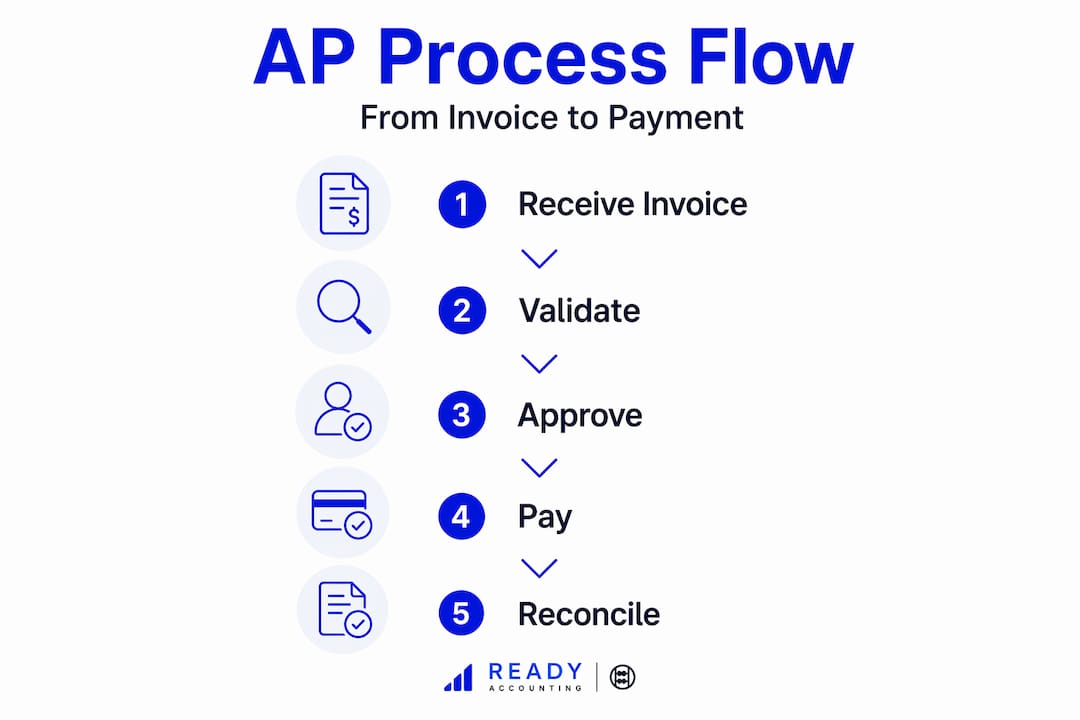
A common AP workflow for SMEs is: receive supplier invoices, validate them through purchase order, receipt, and invoice matching, route them for approval, make payment, and then reconcile and record the results in your accounting system. Simple in theory. Complicated in practice, especially when your team is small and wearing many hats.
Here is a breakdown of each step:
- Invoice receipt: Your business receives an invoice from a supplier, either by email, post, or through a supplier portal. The format and timing vary widely, which is why standardising this step matters.
- Validation and matching: The invoice is checked against the original purchase order and the goods receipt note. This is called three-way matching and it is the most critical control in the whole AP process.
- Approval routing: Validated invoices go to the relevant manager or department head for sign-off. Without a clear approval hierarchy, invoices either get stuck or get paid without proper review.
- Payment execution: Approved invoices are scheduled and paid according to agreed supplier terms. This could be EFT, card, or in some cases, cheque.
- Reconciliation and recording: Payments are matched back to invoices in your accounting system and the liability is cleared from the balance sheet. This step closes the loop and gives you a clean financial record.
Now, here is where most SMEs struggle. Common problems in each stage include:
- Invoices received on different channels with no central capture point
- Mismatches between invoices and purchase orders that no one notices until payment is due
- Approval bottlenecks when managers are traveling or unavailable
- Duplicate invoice payments due to poor tracking
- Reconciliation done monthly instead of weekly, leaving errors undetected
Pro Tip: Standardise your AP process regardless of how small your team is. Even a simple shared inbox for invoice receipt and a one-page approval policy will reduce errors dramatically. When you are ready to scale, automating AP tasks becomes far easier when your process is already clean and documented.
Here is a comparison of manual versus automated AP at the process level:
| Process step | Manual AP | Automated AP |
|---|---|---|
| Invoice capture | Email, manual data entry | OCR scanning, auto-capture |
| Validation | Manual cross-checking | Automated three-way matching |
| Approval routing | Email chains or in-person | Digital workflow with escalations |
| Payment scheduling | Spreadsheet reminders | Rule-based auto-scheduling |
| Reconciliation | Monthly batch | Real-time or daily |
If you want a broader look at how automation changes your finance function, the guide to accounting automation covers the full picture beyond just AP.
The business impact of efficient accounts payable
Understanding the AP process is just the start. Next, let’s see what happens when accounts payable is run well or badly.

Effective AP management matters for cash flow and vendor relationships, while poor AP practices can cause late fees, strained relationships, and cash-flow surprises. That is not theory. It plays out every day in South African businesses where late payments trigger supply disruptions at the worst possible moment.
When AP runs efficiently, you get several compounding advantages:
- Predictable cash flow: You know exactly when payments are due and can plan your outflows accordingly, rather than being blindsided by overdue invoices.
- Early payment discounts: Many suppliers offer a 1 to 2 percent discount for payment within 10 days. That sounds small but adds up significantly over a year of transactions.
- Stronger supplier relationships: Suppliers who are paid on time prioritise your orders, extend better credit terms, and are more flexible when you need help during tight months.
- Clean audit trails: Well-documented AP means your financial records are easier to review, which matters enormously when SARS comes knocking or when you are raising funding.
- Reduced fraud exposure: Structured approval workflows make it much harder for duplicate payments or fraudulent invoices to slip through.
“A business that pays on time is a business that gets served first. In a market where supply chains are unpredictable, reliable payment is a genuine competitive advantage.” This is something we see repeatedly in the scaling businesses we support.
On the flip side, poorly managed AP creates a cascade of problems. Late fees and interest charges eat into margins. Suppliers put your account on hold or require upfront payment, which destroys your working capital position. Cash flow forecasts become unreliable because no one knows what is outstanding. And when funding rounds or audits happen, messy payables records create serious credibility problems.
For South African SMEs managing tight margins, understanding your cash flow management strategy is inseparable from how you run AP. The two functions are not separate. They are directly linked, and if you are navigating recurring cash flow stress, your AP process is often the first place to look. Deep detail on this is covered in the guide on cash flow problems and solutions.
Pro Tip: Track outstanding invoices every week, not every month. A weekly AP aging review takes 20 minutes and prevents the kind of surprise payment demands that derail your cash flow at month-end.
Key metrics for benchmarking and improving accounts payable
To actively improve your AP, you need to measure what matters. Here is how SMEs track and benchmark AP for operational success.
Finance teams typically track AP KPIs such as invoice processing cycle time, cost per invoice, exception rates, and touchless (straight-through) processing rates. These four metrics give you a clear picture of where your AP is efficient and where it is leaking time and money.
| KPI | What it measures | Why it matters |
|---|---|---|
| Invoice processing cycle time | Days from invoice receipt to payment | Shorter cycles mean fewer late payments and better supplier relations |
| Cost per invoice | Total AP operating cost divided by invoice volume | Tracks efficiency gains from automation or process improvements |
| Exception rate | Percentage of invoices that require manual intervention | High rates signal poor matching or supplier data quality issues |
| Touchless processing rate | Percentage of invoices processed without any manual touch | Key indicator of automation maturity |
For context, world-class AP operations process invoices in under 3 days, at a cost below R50 per invoice (approximately), with exception rates below 10 percent and touchless rates above 80 percent. Most South African SMEs managing AP manually are looking at 10 to 15 day cycle times, much higher costs, and exception rates that make straight-through processing nearly impossible.
The goal is not to hit world-class benchmarks overnight. The goal is to know your baseline and improve it systematically. Even moving from a 12-day cycle to an 8-day cycle reduces your outstanding liabilities exposure significantly and gives you better visibility over your short-term cash position.
These metrics also connect directly to automation decisions. If your cost per invoice is high and your touchless rate is low, you have a clear business case for investing in AP automation. For a full framework on measuring your financial health through the right indicators, the cash flow KPIs guide is a strong companion resource.
Automation and best practices for accounts payable
Ready to apply these ideas? Let’s talk about how automation and best practices can move your SME AP from manual headaches to scalable, reliable systems.
Automation can reduce manual effort and errors by capturing invoice data, routing approvals, performing duplicate detection, and scheduling payments. But the key is implementing controls like matching, approvals, and audit trails rather than just paying faster. Speed without controls is not efficiency. It is a different kind of risk.
Here is where automation genuinely adds value in an AP context:
- Intelligent data capture: OCR (optical character recognition) tools extract invoice data automatically, eliminating manual keying errors and speeding up the entry stage significantly.
- Automated three-way matching: Software matches invoices to purchase orders and receipts instantly, flagging exceptions for human review rather than routing everything manually.
- Approval workflow automation: Digital approval chains send invoices to the right person, escalate when approvals are delayed, and create a full timestamp record of every action.
- Duplicate detection: Automated systems flag invoices with matching amounts, vendors, or invoice numbers before payment is made, preventing a costly and common error.
- Payment scheduling: Rules-based payment scheduling ensures you pay within terms, capture early payment discounts, and never miss a due date due to a forgotten reminder.
The critical warning here: many SMEs automate before they optimise. They take a broken manual process and automate it, which simply produces the same errors faster. Before you invest in AP automation tools, clean up your supplier master data, standardise your invoice formats where possible, and document your approval hierarchy clearly.
Pro Tip: Automate your AP controls first, then your speed. A clean approval workflow and accurate supplier records will deliver more value in the first 90 days than any automation feature you layer on top of a messy process.
Best practices worth implementing regardless of your automation maturity level include:
- Maintaining a single, centralised inbox or system for all incoming invoices
- Setting clear payment terms with all suppliers and recording them in your accounting system
- Performing monthly reconciliations of your AP ledger against supplier statements
- Building a formal exception handling procedure so disputed invoices do not sit in limbo
- Keeping a complete audit trail for every invoice, from receipt through to payment
Understanding how automation improves cash flow gives you a clearer picture of the downstream benefits when AP runs on clean infrastructure.
What most guides miss: Accounts payable is more than paying invoices
Most articles about AP treat it like a back-office admin task. Pay the invoices, keep the suppliers happy, close the month. Done. That framing is costing South African SMEs real money and real growth opportunities.
AP is a strategic lever. The timing of your outflows directly affects your working capital position, your borrowing requirements, and your ability to invest in growth. A business that pays all invoices on day one of the payment window is essentially giving suppliers an interest-free loan. A business that strategically pays at day 28 of a 30-day term retains that cash for nearly a month of productive use. At scale, that difference is material.
Exception handling is where we see small businesses stumble most. When an invoice does not match a purchase order, what happens? In most SMEs we work with, the answer is: it sits in someone’s inbox for days, or weeks, while the supplier chases payment and the relationship quietly corrodes. Formalising your exception process, even with a simple escalation rule and a 48-hour resolution target, transforms this pain point.
Auditability is another underrated benefit of strong AP management. South Africa’s tax environment is increasingly data-driven, and SARS has sophisticated tools for identifying discrepancies between VAT inputs claimed and actual payments made. A clean, reconciled AP ledger with full documentation is not just good housekeeping. It is a tax defence asset. The accounting automation wisdom we share consistently reflects this principle: controls and auditability are not afterthoughts. They are the foundation.
The businesses that scale most cleanly are those that treat AP as a function that produces strategic information, not just settled invoices. When you know your payment cycles, your supplier terms, your exception patterns, and your cash conversion timelines, you run a fundamentally better business.
Streamline your accounts payable with Ready Accounting
If you are ready to make your AP process work for you and support sustainable growth, here are practical resources and solutions to help you succeed. At Ready Accounting, we replace manual AP bottlenecks with cloud infrastructure and automated workflows built specifically for scaling South African SMEs. Our automation for cash flow approach means every rand leaving your business does so at the right time and with a full audit trail behind it. For a structured starting point, the accounting automation guide walks you through the full transformation, and our top automation tasks resource shows exactly which AP steps to prioritise first.
Frequently asked questions
Is accounts payable a liability or asset?
AP is recorded as a liability on the balance sheet since it represents money your business owes to creditors, making it a current liability that is typically settled within 30 to 90 days.
What are the main steps in the accounts payable process?
A common AP workflow for SMEs is: receive supplier invoices, validate them, route for approval, make payment, and reconcile, with each step ensuring accuracy and compliance in your financial records.
How does accounts payable affect cash flow?
Effective AP management prevents late payment fees and helps businesses maintain positive cash flow, while poorly timed payments can create unexpected shortfalls that destabilise an otherwise profitable business.
Can accounts payable be automated for SMEs?
Yes, automation can reduce manual effort by capturing invoices, routing approvals, and scheduling payments, but it works best when your underlying controls and approval workflows are already clean and well-documented.
Which metrics should I track for accounts payable efficiency?
Finance teams typically track AP KPIs such as invoice processing cycle time, cost per invoice, exception rate, and touchless processing rate, giving you a clear benchmark to measure improvement over time.