

Tax penalties for late submission SARS: 2026 guide
Executive Summary
- SARS imposes fixed monthly penalties for late submission that accumulate until you file your outstanding returns.
- Filing immediately stops penalty accrual, and submitting all overdue returns is essential before requesting remission.
Tax penalties for late submission SARS imposes are fixed monthly administrative charges that accumulate automatically per outstanding return until you file. The Tax Administration Act authorizes SARS to levy these penalties across income tax, VAT (Value-Added Tax), and PAYE (Pay As You Earn) returns. Amounts range from R250 to R16,000 per month depending on your taxable income tier. For South African small to medium business owners, these charges can compound quickly and quietly, often appearing as a formal penalty notice called an AP34 before you realize the damage. This guide explains exactly how the penalties work, how to stop them, and how to avoid them in future.
How are SARS late submission penalties calculated?
SARS late submission penalties are fixed monthly amounts, not percentages of the tax you owe. This distinction matters. A business with a large tax liability does not pay a proportionally larger penalty than a smaller business in the same income tier. The fixed penalty amounts are set by the Tax Administration Act and linked to your taxable income from the prior year.
The table below shows the penalty tiers for individuals and companies:
| Taxable income (prior year) | Monthly penalty amount |
|---|---|
| R0 to R250,000 | R250 |
| R250,001 to R500,000 | R500 |
| R500,001 to R1,000,000 | R1,000 |
| R1,000,001 to R5,000,000 | R2,000 |
| R5,000,001 to R10,000,000 | R4,000 |
| R10,000,001 to R50,000,000 | R8,000 |
| Above R50,000,000 | R16,000 |
Trusts and companies follow similar tiered structures. Penalties accrue monthly per outstanding return, meaning if you have three outstanding returns, you face three separate monthly charges. SARS can apply these charges for up to 35 months, or 47 months if no registered address is on file. A business with R2,000,000 in taxable income and two outstanding returns could accumulate R4,000 per month in penalties alone.
Pro Tip: If your prior year taxable income was nil or you were not yet registered, SARS defaults to the lowest penalty tier. File immediately to lock in that lower rate before income data updates.
What is the process to stop or reduce SARS penalties?
Filing your outstanding return is the single fastest way to stop penalty accrual. Tax expert Jasper Basson from Sage confirms that filing any return stops the penalty clock immediately, even if the figures are estimated or the return shows nil income. Waiting for perfect data costs you money every month.
Follow these steps to stop and potentially reduce your penalties:
- Log into SARS eFiling and check your My Compliance Profile (MCP). The MCP lists every outstanding return linked to your tax number. Many SMB owners discover returns they forgot about, including dormant periods or lesser-known return types.
- Submit all outstanding returns immediately. File even if your bookkeeping is incomplete. An estimated or nil return stops the monthly charge. You can correct figures later through a revised return.
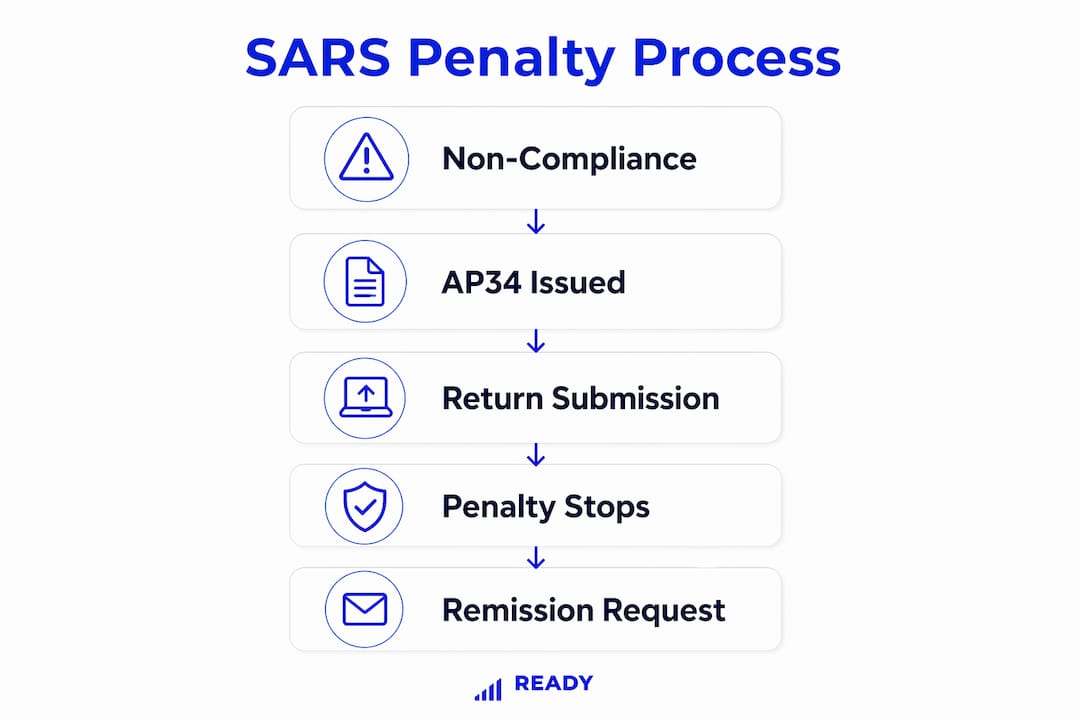
- Apply for a Request for Remission (RFR). Once all outstanding returns are filed, you can ask SARS to reduce or waive the accumulated penalties. SARS considers factors like your compliance history and whether you had a valid reason for the delay. Outstanding returns must be submitted before SARS will review any remission request.
- Apply for suspension of payment if you are disputing the penalty. Filing an objection does not pause penalty accrual. A separate suspension of payment application is required while your remission request or dispute is being processed. This is one of the most misunderstood steps in the process.
- Monitor your MCP after filing. SARS systems can take time to update. Confirm the penalty has stopped accruing before assuming the matter is resolved.
SARS issues the formal AP34 penalty notice once it identifies non-compliance. That notice lists the outstanding returns, the penalty amounts, and your options. There is no grace period after the AP34 is issued.
Pro Tip: Submit your outstanding return the same day you receive an AP34 notice. Every day of delay is another day closer to the next monthly penalty cycle.

What causes late submissions and why the risks are underestimated
Late submissions rarely happen because business owners are careless. The most common causes are delays in bookkeeping, reliance on external accountants during peak filing periods, and system failures on SARS eFiling during high-traffic deadlines.
The risks are consistently underestimated for three reasons:
- Penalty stacking is invisible until it is not. Many SMB owners do not check their MCP regularly. By the time an AP34 arrives, several months of penalties have already accumulated across multiple return types.
- Waiting for your accountant can cost you more than filing yourself. Delaying filing while waiting for professional availability during tax season is one of the most common and expensive mistakes SMBs make. Filing an estimated return yourself stops the clock. Your accountant can correct it later.
- Compliance status affects your business beyond tax. A poor compliance profile on SARS eFiling can affect your ability to obtain tax clearance certificates, which are required for government tenders, certain banking facilities, and business contracts.
Proactive compliance is always cheaper than reactive correction. Maintaining accurate SARS record-keeping reduces the risk of missing a return because your financial data is always current and accessible. The My Compliance Profile on SARS eFiling is your early warning system. Check it monthly, not annually.
How do SARS administrative penalties compare to other tax penalties?
SARS administrative penalties for late submission are fixed monthly amounts. Other SARS penalties work differently, and both can apply at the same time.
| Penalty type | Basis | Applies to |
|---|---|---|
| Late submission admin penalty | Fixed monthly amount by income tier | Income tax, VAT, PAYE returns |
| Late payment penalty | Percentage of tax owed (typically 10%) | Tax due but not paid by deadline |
| Interest on late payment | Calculated daily on outstanding tax | All tax types |
| Understatement penalty | Percentage of shortfall | Incorrect or fraudulent returns |
The critical point is that late submission penalties and late payment penalties are separate charges. You can receive both simultaneously if you file late and also owe tax. Filing your return on time eliminates the late submission penalty even if you cannot pay the tax immediately. SARS allows payment arrangements for outstanding tax, but it does not waive late submission penalties simply because you had a payment plan in place.
VAT and PAYE returns have their own deadlines and their own penalty structures. A business that misses both a VAT return and an income tax return in the same month faces penalties on both. The Tax Administration Act provides the legal basis for all of these charges, and SARS applies them algorithmically. There is no manual review before penalties are issued.
Understanding the difference between these penalty types helps you prioritize. Filing always comes first. Payment comes second. Dispute or remission comes third.
Key takeaways
SARS late submission penalties are fixed monthly charges that stop only when you file your outstanding return, making immediate filing the most cost-effective response to any compliance gap.
| Point | Details |
|---|---|
| Penalties are fixed, not percentage-based | Monthly amounts range from R250 to R16,000 based on your prior year taxable income tier. |
| Filing stops the penalty clock | Submit any return, even estimated or nil, to immediately halt monthly penalty accrual. |
| Remission requires filing first | SARS will not consider a Request for Remission until all outstanding returns are submitted. |
| Objections do not pause penalties | Apply for suspension of payment separately while any dispute or remission request is processed. |
| MCP is your compliance dashboard | Check My Compliance Profile on SARS eFiling monthly to catch outstanding returns before penalties escalate. |
Why I tell every SMB client to file first and ask questions later
The most expensive mistake I see South African business owners make is waiting. Waiting for their accountant to have capacity. Waiting until the books are perfect. Waiting to understand the full picture before acting. SARS does not wait with you.
The penalty system is automated. Once SARS identifies a missing return, the monthly charge starts. It does not matter if you have a good reason or a complicated year. The AP34 notice arrives, and by then, months of penalties have already stacked up. I have seen businesses walk in with R40,000 in accumulated admin penalties on returns they did not even know were outstanding.
My advice is always the same: log into SARS eFiling today, open your My Compliance Profile, and file anything outstanding before you do anything else. An estimated return is not a permanent record. You can revise it. But you cannot recover the penalty months you lost by waiting. The guide to filing tax returns for South African businesses in 2026 walks you through the process step by step if you are unsure where to start.
The other thing I want you to understand is that the remission process works, but only if you have filed first. SARS does consider genuine hardship and first-time non-compliance. However, they will not look at your remission request while you still have outstanding returns. File, then request remission. That sequence is non-negotiable.
Staying compliant is not just about avoiding fines. Your tax clearance certificate, your banking relationships, and your ability to win government contracts all depend on a clean compliance profile. Build a monthly habit of checking your MCP. It takes five minutes and it protects everything you have built.
— Johan
How Readyaccounting helps SMBs stay ahead of SARS penalties
Readyaccounting works with South African SMEs and startups to remove the administrative friction that causes late submissions in the first place. Our cloud-based financial infrastructure keeps your books current in real time, so you are never scrambling for data when a filing deadline arrives. We monitor your SARS compliance profile as part of our ongoing service, flagging outstanding returns before they become penalty notices. If you are already facing accumulated penalties, our tax defense process covers remission applications and suspension of payment strategies. Understanding how automation improves cash flow is the first step toward a finance function that protects your business instead of exposing it. Contact Readyaccounting to find out how we can help you reduce your tax liability and keep your compliance profile clean.
FAQ
What is the maximum SARS penalty for late tax submission?
SARS can levy up to R16,000 per month per outstanding return for taxpayers with taxable income above R50,000,000, for a maximum of 35 months or 47 months if no registered address is on file.
Does filing a nil return stop SARS late submission penalties?
Yes. Filing any return, including a nil or estimated return, immediately stops the monthly penalty from accruing. You can submit a revised return with correct figures once your bookkeeping is complete.
Can SARS waive or reduce administrative penalties?
SARS can reduce or waive penalties through a Request for Remission, but all outstanding returns must be submitted before SARS will consider the application. First-time non-compliance and genuine hardship are factors SARS takes into account.
Does objecting to a SARS penalty stop it from growing?
No. Filing an objection does not pause penalty accrual. You must submit a separate suspension of payment application to halt further charges while your dispute or remission request is being reviewed.
How do I check if I have outstanding returns with SARS?
Log into SARS eFiling and open your My Compliance Profile. This dashboard lists all outstanding returns linked to your tax number and is the most reliable way to identify compliance gaps before they trigger penalty notices.