

Maximize tax savings: deductible business expenses in SA
Executive Summary
- Many South African SMEs fail to claim legitimate deductions due to lack of knowledge and systematic habits.
- Key deductible expenses include rent, salaries, marketing, vehicle costs with proper logbooks, and home office proportional costs.
- Maintaining organized records and adopting monthly reconciliation habits ensure compliance and maximize tax savings.
Most South African business owners pay more tax than they should. Not because they’re dishonest or careless, but because they simply don’t know which everyday expenses qualify as legitimate deductions. Missing out on deductible expenses is one of the most common and costly financial mistakes SME owners make. This guide cuts through the confusion by explaining exactly what SARS allows, which expenses qualify, how to handle tricky cases like home offices and vehicles, and what records you need to keep. By the end, you’ll have a clear framework to reduce your tax liability legally and confidently.
Table of Contents
- What makes a business expense tax deductible in South Africa?
- Common deductible business expenses for South African SMEs
- Special cases and common pitfalls: dual-purpose items, home office, vehicles
- Small business corporation (SBC) benefits: maximizing deductions and tax rates
- Record-keeping for tax deductions: your compliance safety net
- The uncomfortable truth: why most South African SMEs overpay tax
- Get support to optimize your deductible expenses and tax management
- Frequently asked questions
Key Takeaways
| Point | Details |
|---|---|
| Legal criteria matter | Deductible expenses must be genuinely business-related and properly documented. |
| Missing small claims adds up | Overlooking minor expenses like bank charges can significantly increase tax paid over time. |
| SBC status offers big advantages | Small businesses meeting requirements should leverage lower tax rates and accelerated write-offs. |
| Record-keeping is your foundation | Keeping five years’ worth of receipts and logs is essential for claiming and protecting deductions. |
What makes a business expense tax deductible in South Africa?
Understanding the rules is the first step to claiming what you’re owed. South Africa’s tax deduction framework sits primarily in two sections of the Income Tax Act. Section 11(a) sets out what you can deduct. Section 23 lists what you cannot. Together, they form the boundary every business owner needs to understand.
Business expenses are deductible under section 11(a) of the Income Tax Act if actually incurred during the year, for the purpose of trade, in the production of income, and not of a capital, domestic, or private nature. That last part is where many business owners trip up. Buying a laptop for work is deductible. Buying one for your child’s schoolwork is not. The purpose matters enormously.
A common misunderstanding is that any expense paid from a business account automatically qualifies. It does not. SARS looks at the nature and purpose of the expense, not just who paid for it. Dual-purpose expenses, those used partly for business and partly for personal use, must be apportioned. Only the business portion is deductible. For a deeper grounding in SA business tax essentials, it helps to understand how SARS views the line between personal and business activity.
Here are the four legal criteria every deductible expense must meet:
- Actually incurred: The expense must be real and paid or payable in the tax year.
- In the course of trade: The expense must relate directly to your business operations.
- For the production of income: It must contribute to generating taxable income.
- Not capital, domestic, or private: One-off asset purchases and personal costs are excluded.
If in doubt, reference the purpose and nature: private, capital, or business?
Understanding how SARS views business expenses is especially important for freelancers and commission earners, where the lines between personal and professional spending blur easily. Staying on the right side of your tax compliance guide protects you from audits and penalties.
Common deductible business expenses for South African SMEs
Once you know the rules, the next step is knowing which expenses actually qualify. The list is broader than most business owners expect, which is exactly why so many leave money on the table.
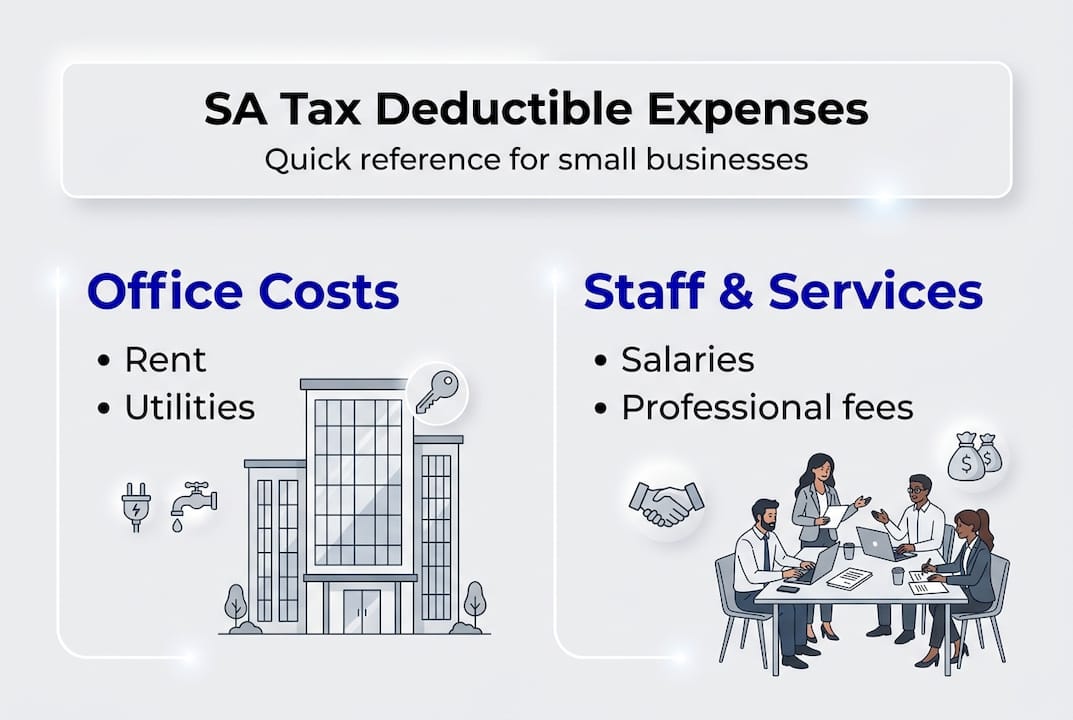
Common deductible expenses for SMEs include office rent and utilities (proportional for home office use), employee salaries, benefits and UIF contributions, marketing and advertising spend, professional fees, travel and vehicle costs (with a logbook), office supplies, bank charges, staff training, and bad debts that have been proven irrecoverable.
| Expense category | Deductible? | Notes |
|---|---|---|
| Office rent | Yes | Full amount if dedicated business space |
| Home office | Partial | Proportional to floor area used |
| Employee salaries | Yes | Including UIF and SDL contributions |
| Marketing and advertising | Yes | Must relate to the business |
| Professional fees | Yes | Accounting, legal, consulting |
| Vehicle costs | Partial | Business trips only, logbook required |
| Bank and merchant fees | Yes | Often overlooked but fully deductible |
| Staff training | Yes | Must be work-related |
| Bad debts | Yes | Must be proven irrecoverable |
Some special cases worth noting from your deduction checklist:
- Bad debts: You can only deduct these once you’ve taken reasonable steps to recover the amount and written it off in your books.
- Bank and merchant fees: Every monthly fee, card processing charge, and transaction cost adds up. These are fully deductible and frequently missed.
- Security expenses: Alarm systems and security services used for business purposes are deductible, though physical security assets may need to be depreciated.
- Training costs: Staff development linked to their role qualifies, but personal hobby courses do not.
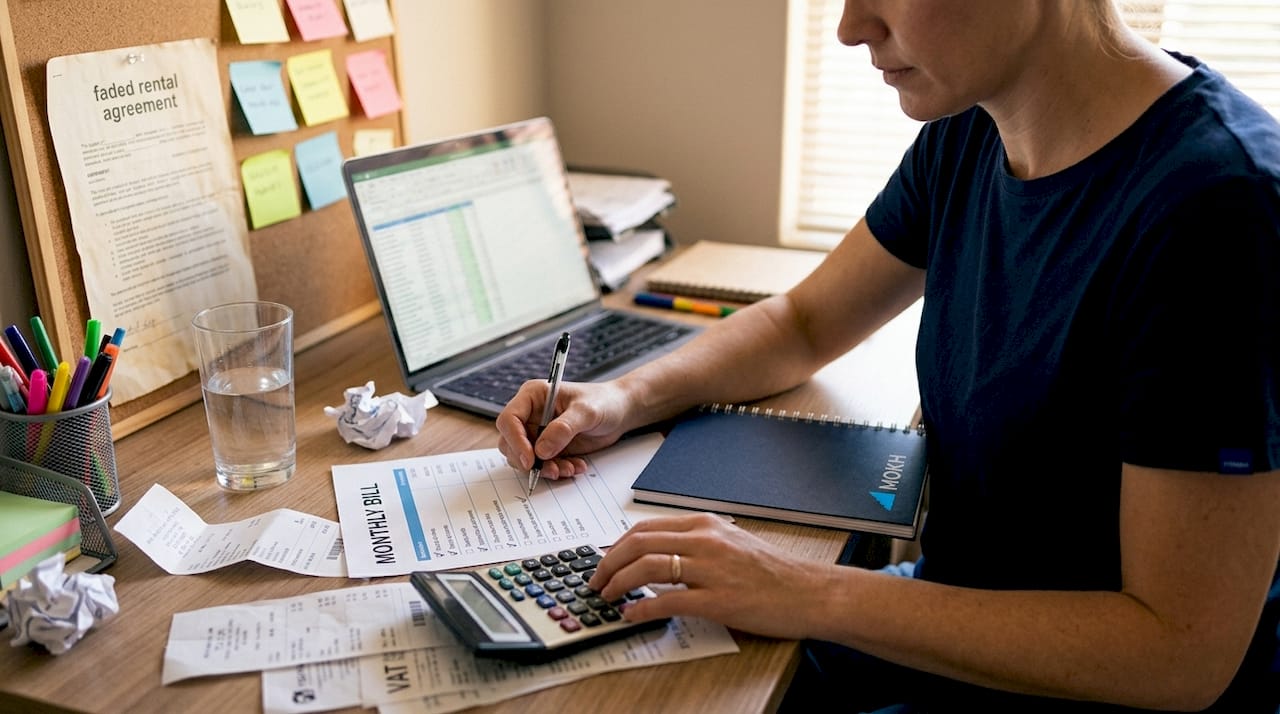
Pro Tip: Review your bank statements monthly and flag every recurring charge. Small fees of R50 to R200 per month across multiple services can add up to thousands in annual deductions. For more smart tax-saving tips, consistent monthly reviews beat a frantic year-end scramble every time.
A practical example: if your home office takes up 10% of your home’s floor space, you can deduct 10% of your rent, electricity, and internet as a business expense. On a R5,000 monthly rent, that’s R6,000 per year in deductions from rent alone.
Also check deductible expenses for SMEs in SA for a broader breakdown of what qualifies across different industries.
Special cases and common pitfalls: dual-purpose items, home office, vehicles
Some expenses need careful handling. Get these wrong and SARS will disallow the deduction, sometimes with interest and penalties attached.
Home office deductions are one of the most misunderstood areas. Home office deductions require exclusive and regular use of the space for business, employer approval for employees, and apportionment based on square metres. A room used as both a guest bedroom and an office does not qualify. It must be used exclusively for work.
A practical example: if your home is 100 square metres and your dedicated office is 10 square metres, you can claim 10% of qualifying home costs. On R52,190 in annual home costs (rent, rates, electricity), that’s a R5,219 deduction.
| Expense type | Key requirement | Common pitfall |
|---|---|---|
| Home office | Exclusive use, floor area apportionment | Claiming a shared-use room |
| Vehicle | Business trips only, logbook required | Claiming personal trips as business |
| Dual-purpose items | Must apportion business vs. personal | Claiming 100% of a mixed-use item |
Here are the steps to get each deduction right:
- Home office: Measure the dedicated space. Calculate the percentage of total floor area. Apply that percentage to qualifying costs. Keep lease agreements and utility bills.
- Vehicle: Keep a detailed logbook recording every trip, date, distance, and business purpose. Calculate the business-use percentage at year-end.
- Dual-purpose items: Identify the split between business and personal use. Only claim the business portion. Document your reasoning.
- Security assets: Physical assets like cameras and alarm panels are deducted via wear-and-tear allowances, not as immediate expenses. Check the security deduction guidelines for the correct rates.
Pro Tip: Keep your logbook updated weekly, not monthly. Memory fades fast. A logbook app on your phone takes 30 seconds per trip and could save you thousands in a SARS audit. Review essential SME tax rules to understand how SARS assesses these claims.
Small business corporation (SBC) benefits: maximizing deductions and tax rates
If your business qualifies as a Small Business Corporation (SBC) under section 12E of the Income Tax Act, you get access to tax advantages that most SME owners don’t fully use.
SBCs qualify if gross income is R20 million or less, passive income is below 20% of total income, all shareholders are natural persons, and no shareholder holds shares in another company. Meeting these rules unlocks meaningful benefits.
Key advantages of SBC status:
- Progressive tax rates: Starting at 0% on the first R95,750 of taxable income, rising to 27% on amounts above R550,000.
- Accelerated depreciation: Manufacturing assets can be written off 100% in year one. Other qualifying assets follow a 50/30/20 split over three years.
- Immediate deduction on certain assets: This improves cashflow significantly compared to standard depreciation schedules.
| Taxable income ® | SBC tax rate |
|---|---|
| 0 to 95,750 | 0% |
| 95,751 to 365,000 | 7% |
| 365,001 to 550,000 | 21% |
| Above 550,000 | 27% |
Many SMEs miss SBC status because of poor record-keeping or because passive income (like rental income) creeps above the 20% threshold without anyone noticing. Review your income mix annually. For structured tax planning strategies, assessing your SBC eligibility before year-end is one of the highest-value activities you can do. Also see SBC rules in detail for a practical breakdown.
Record-keeping for tax deductions: your compliance safety net
Every deduction you claim is only as strong as the evidence behind it. SARS does not take your word for it. They verify.
Invoices, receipts, and logbooks must be kept for at least five years. SARS audits verify that expenses were actually incurred and that the purpose aligns with your claimed deduction. A missing receipt can turn a legitimate deduction into a disallowed one.
Steps to make your records audit-ready:
- Separate your accounts: Use a dedicated business bank account. Never mix personal and business transactions.
- Digitise everything: Scan or photograph receipts immediately. Cloud storage means you won’t lose them.
- Reconcile monthly: Match every transaction in your bank statement to an invoice or receipt every month, not just at year-end.
- Maintain your logbook: Update it weekly for vehicle claims.
- Store contracts and agreements: Lease agreements, service contracts, and employment contracts all support your deduction claims.
Pro Tip: Use a separate business bank account from day one. It makes reconciliation faster, keeps your records clean, and makes it far easier to prove the business purpose of every transaction. See the full record-keeping requirements for what SARS expects, and review the SARS rule details for specific documentation standards.
The best deductions can’t save you if you lack proof when SARS comes calling.
The uncomfortable truth: why most South African SMEs overpay tax
Here’s what we’ve seen working with SMEs across South Africa: the problem is rarely ignorance of the big rules. Most business owners know they can deduct rent and salaries. What they miss are the small, consistent, everyday expenses that quietly add up to thousands of rands per year.
Bank fees. Merchant processing charges. Small software subscriptions. A portion of the phone bill. None of these feel significant in isolation. Together, they can represent a meaningful slice of your tax bill.
The real difference between SMEs that win at tax and those that overpay is not technical knowledge. It’s discipline. The businesses that consistently capture every deduction are the ones with monthly habits: reconciling accounts, updating logbooks, reviewing expense categories. They’re not smarter. They’re more systematic.
One-off tax knowledge is not enough. Avoiding common bookkeeping mistakes requires building ongoing habits, not just reading a guide once a year.
Tax efficiency is a monthly discipline, not just an annual event.
If you wait until your accountant asks for everything in February, you’ve already lost. The deductions you couldn’t document are gone. Build the habit now.
Get support to optimize your deductible expenses and tax management
Putting all of this into practice takes time, systems, and the right support. At Ready Accounting, we help South African SMEs set up the financial structures that make tax deductions automatic, not stressful. The cloud accounting benefits for small businesses are significant: real-time expense tracking, automated reconciliation, and digital receipt storage mean your records are always audit-ready. Our cloud accounting guide walks you through how to set this up for your business. We also help clients stay on top of SARS record-keeping rules so nothing slips through the cracks. Book a consultation and let’s make sure you’re claiming every rand you’re entitled to.
Frequently asked questions
What is the main rule for claiming a business expense as tax deductible in South Africa?
The expense must be incurred for trade under section 11(a), generating income, and must not be capital or private in nature.
Can I deduct home office expenses?
Yes, if the space is exclusively used for business and you apportion costs based on the floor area percentage of your home.
How long must I keep records for deductible expenses?
You must keep all records for at least five years, including invoices, receipts, and logbooks, for SARS verification.
Are fines or penalties tax deductible?
No. Fines and penalties are specifically prohibited under section 23, along with private and capital expenses.
What is the benefit of qualifying as a small business corporation (SBC)?
You access lower progressive rates starting at 0% and accelerated depreciation allowances that can significantly reduce your annual tax bill.