

Tax accounting for small business: practical steps for SMBs
Tax accounting for small business means tracking every rand of income and expenditure, meeting your SARS, VAT, and CIPC obligations on time, and producing records accurate enough to file correct returns and survive an audit. Get that foundation right and everything else, from deductions to payroll, follows a logical sequence.
Start here. Six things to do before anything else:
- Open a dedicated business bank account and never mix personal and business transactions
- Choose your accounting method: cash basis for simple operations, accrual for inventory-heavy or credit-driven businesses
- Build a basic chart of accounts covering income, cost of sales, operating expenses, payroll, and owner distributions
- Register for VAT if your taxable turnover meets or is expected to meet the threshold (R1 million in South Africa; check your local authority for equivalent thresholds)
- Set up payroll tax flows and register as an employer with SARS if you have staff
- Schedule quarterly estimated or provisional tax payments so you are never caught short at year-end
Three forms you will encounter repeatedly: Schedule C (Form 1040) for sole proprietors reporting business profit, Form 1065 for partnerships, and Form 941 for quarterly payroll tax reporting. IRS Publication 334 is the definitive small-business tax reference and worth bookmarking now. If any of this feels like a lot to set up alone, Readyaccounting can triage your current position and build the infrastructure from scratch.
Pro Tip: Open your business bank account on day one, not after your first invoice. Retroactively separating personal and business transactions is one of the most time-consuming cleanups an accountant faces, and it is entirely avoidable.
Key takeaways
Sound tax accounting for small business rests on three things: clean books from day one, a compliance calendar you actually follow, and professional support that scales with your business complexity.
| Point | Details |
|---|---|
| Separate accounts from day one | A dedicated business bank account is the single most important first step; mixing funds creates cleanup costs that dwarf the inconvenience of opening an account. |
| Structure determines filing shape | Sole proprietors file Schedule C; partnerships file Form 1065 with K-1s; registered companies file a separate corporate return. Choose your structure before your first transaction. |
| Estimated tax is not optional | US taxpayers generally avoid penalties by paying 90% of current-year tax or 100% of prior-year tax quarterly; South African owners make two provisional payments per year. |
| Deductions require contemporaneous records | Mileage logs, receipts, and business-purpose notes must be captured at the time of the expense; reconstructed records rarely survive audit scrutiny. |
| Readyaccounting | Provides cloud-based bookkeeping, VAT filing, payroll automation, and tax defence for South African SMEs, with real-time dashboards and fractional CFO advisory. |
Table of Contents
- How business structure shapes your tax obligations
- Which taxes does your small business actually owe?
- Accounting methods, bookkeeping basics, and the tools that make it manageable
- Small business tax deductions and credits you should be tracking
- Payroll taxes and employer responsibilities you cannot ignore
- Filing deadlines, estimated tax payments, and record retention
- Common mistakes that increase your audit risk
- How to decide between accounting software and hiring a professional
- When automation and tax defence change the outcome
- A perspective on what actually trips small businesses up
- What Readyaccounting does for your tax compliance and financial infrastructure
- Sources
How business structure shapes your tax obligations
Your legal structure is not just a formality. It determines which tax returns you file, how owner income is treated, and how complex your bookkeeping needs to be from month one.
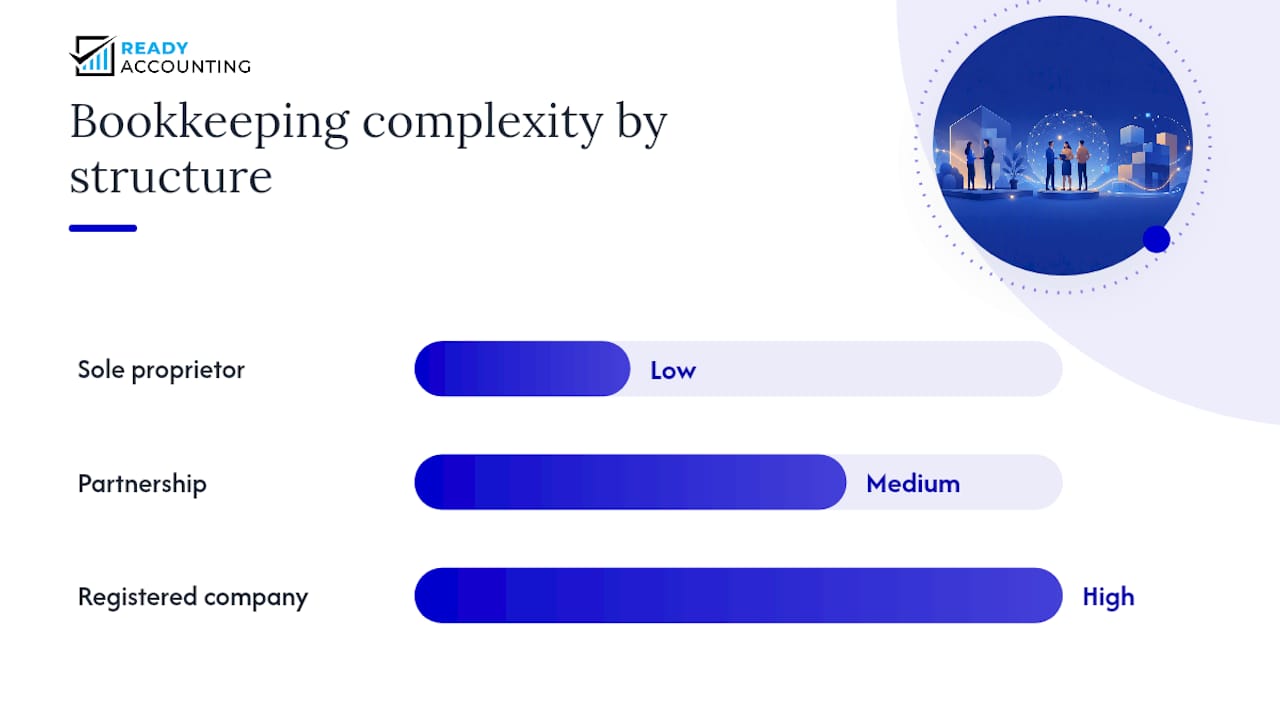
Sole proprietor (or sole trader): The simplest structure. Business income flows directly onto your personal return via Schedule C. You pay income tax and self-employment tax covering Social Security and Medicare on net profit. Bookkeeping is relatively straightforward: one income stream, one expense ledger, no separate entity return. The trade-off is unlimited personal liability.
Partnership: Two or more owners share profit and loss. The partnership files Form 1065 as an information return and issues each partner a Schedule K-1 showing their share. Each partner then reports that share on their personal return. Bookkeeping complexity rises because you need to track capital accounts per partner and allocate income and expenses correctly.
Registered company (C corp or S corp equivalent): A separate legal entity. C corps pay corporate income tax on profits; S corps pass income through to shareholders (similar to a partnership) but file Form 1120-S. In South Africa, a private company (Pty Ltd) registered with CIPC files its own corporate return with SARS. Owner compensation is typically a salary (subject to PAYE) rather than a draw, which changes both payroll obligations and bookkeeping structure significantly.
The SBA’s business structure guide is a useful reference for weighing these trade-offs before you commit. For South African-specific structural planning, Readyaccounting’s tax-efficient structures guide covers the Pty Ltd, sole trader, and trust options in detail.
| Structure | Best for | Tax filing shape | Bookkeeping complexity |
|---|---|---|---|
| Solo owner (sole proprietor) | Freelancers, single-owner service businesses | Schedule C on personal return | Low: one ledger, no entity return |
| Multi-owner (partnership) | Professional practices, joint ventures | Form 1065 + K-1s per partner | Medium: capital accounts, partner allocations |
| Registered company | Growth-stage, investor-backed, ecommerce | Separate corporate return (1120/1120-S or CIPC equivalent) | High: payroll, dividends, separate entity books |
Key structural considerations:
- Owner draws vs salary: sole proprietors take draws (not deductible); company directors take salaries (deductible, but subject to PAYE)
- Provisional tax: sole proprietors and partners typically pay provisional tax twice a year; companies pay corporate tax in advance installments
- VAT registration: any structure can be VAT-registered once the threshold is met; the structure itself does not determine VAT liability
Which taxes does your small business actually owe?
Most small businesses face more than one tax type simultaneously. Missing any of them creates penalties that compound quickly.
- Income tax: Applies to net business profit. Sole proprietors pay at personal marginal rates; companies pay at the corporate rate. Filing is annual, but payment is often required in advance through provisional or estimated tax installments.
- Provisional / estimated tax: Required when you have income not subject to withholding. In the US, Publication 505 governs the calculation. Payments are typically due quarterly. In South Africa, SARS requires two provisional payments per tax year plus an optional third top-up.
- Payroll tax (PAYE / employer withholding): If you employ staff, you withhold income tax from wages and remit it to the revenue authority. In the US, Form 941 is filed quarterly. In South Africa, PAYE is submitted monthly via EMP201. Employer contributions (UIF, SDL in South Africa; FUTA/SUTA in the US) add another layer.
- VAT / sales tax: VAT is a transaction-level tax collected from customers and remitted to SARS (or the equivalent authority). US sales tax operates state-by-state with no federal equivalent. Triggers for registration vary: South Africa’s compulsory threshold is R1 million in taxable turnover over 12 months; voluntary registration is available below that.
- Excise and industry levies: Applicable to specific sectors (alcohol, tobacco, fuel, sugar). If your business touches these categories, check your sector’s specific levy schedule.
- Withholding taxes: Apply when paying non-residents for services or dividends. South Africa imposes withholding tax on dividends and on certain foreign service payments.
State and local sales tax (US): There is no single national sales tax in the United States. Each state sets its own rate, and some counties and cities add further levies on top. If you sell across state lines, you may have nexus obligations in multiple states. Check each state’s revenue department directly; the rules changed significantly after the South Dakota v. Wayfair (2018) Supreme Court decision.
The IRS Small Businesses & Self-Employed hub centralises forms and guidance for Schedule C filers and is the fastest starting point for US-based owners.
Accounting methods, bookkeeping basics, and the tools that make it manageable
Cash vs accrual: the decision that shapes everything downstream. Cash accounting records income when money arrives and expenses when they leave your account. It is simple, intuitive, and works well for service businesses with no inventory and straightforward payment terms. Accrual accounting records income when it is earned and expenses when they are incurred, regardless of when cash moves. If you carry inventory, extend credit to customers, or have significant prepaid expenses, accrual gives a more accurate picture of profitability and is often required once revenue crosses certain thresholds.
Switching from cash to accrual mid-year is possible but creates a messy transition period. Choose the right method at the start.
Chart of accounts: the skeleton of your books. A workable chart of accounts for a small business typically covers five categories:
- Income (sales, service revenue, other income)
- Cost of goods sold or cost of sales
- Operating expenses (rent, utilities, salaries, professional fees, marketing)
- Payroll liabilities (PAYE payable, UIF payable, employer contributions)
- Owner equity and distributions
Every transaction maps to one of these. Keeping the chart lean and consistent makes month-end reconciliation faster and tax preparation far less painful.
Day-to-day bookkeeping practices that actually matter:
- Reconcile your bank account at least monthly, ideally weekly
- Capture receipts at the point of purchase using a mobile app rather than a shoebox
- Log mileage in real time; reconstructing it from memory at year-end rarely survives an audit
- Invoice promptly and match every payment received to an open invoice
- Use a suspense or clearing account for transactions you cannot immediately classify, then clear it before month-end
Pro Tip: Set up a dedicated “suspense” clearing account in your chart of accounts. Any transaction you cannot immediately classify goes there, not into a random expense line. Clearing it weekly takes five minutes and prevents the end-of-year mystery entries that cost accountants hours to untangle.
Choosing accounting software: Look for these features before committing to any platform: automated bank feeds, VAT/sales tax reporting built in, payroll integration or a clean API connection to your payroll provider, receipt capture (OCR-based), and multi-currency support if you invoice internationally. Cloud accounting pays for itself quickly when it replaces manual data entry and reduces reconciliation errors. Readyaccounting’s guide to automating accounting tasks shows exactly where automation delivers the fastest return.
Small business tax deductions and credits you should be tracking
Deductions reduce taxable income; credits reduce the tax you owe directly. Both matter, but they work differently, and mixing them up is a common source of confusion.
Ordinary and necessary expenses are the backbone of small business deductions. IRS Publication 334 defines these as expenses that are common in your industry and helpful for your business. Common categories include:
- Rent and occupancy costs for business premises
- Utilities directly tied to business operations
- Employee wages and employer payroll contributions
- Professional fees (accountant, attorney, consultant)
- Business insurance premiums
- Marketing and advertising spend
- Software subscriptions used for business purposes
- Travel and accommodation for business purposes
Depreciation and capital allowances let you deduct the cost of long-lived assets over time rather than in one year. In the US, Section 179 allows immediate expensing of qualifying equipment up to a set annual limit, and bonus depreciation rules have allowed 100% first-year deductions on certain assets (check current IRS guidance for the applicable percentage in the current tax year). In South Africa, SARS allows wear-and-tear allowances on business assets at prescribed rates.
Common deduction pitfalls:
- Claiming personal expenses as business expenses (the most common audit trigger)
- Deducting the full cost of a vehicle used partly for personal travel without applying the correct business-use percentage
- Home office deductions claimed without a dedicated, exclusively-used space
- Meals and entertainment deducted at 100% when only 50% is typically allowable
- Failing to keep receipts for expenses under a certain threshold (they still need documentation)
Qualified Business Income (QBI): US pass-through business owners (sole proprietors, partners, S corp shareholders) may deduct up to 20% of qualified business income under Section 199A, subject to income limits and business type restrictions. This is one of the most valuable deductions available to small business owners and worth discussing with a tax professional.
Business credits to watch for: The IRS credits and deductions page lists available credits including the Small Business Health Care Tax Credit, the Work Opportunity Tax Credit, and energy-efficiency credits. Credits are more valuable than deductions of the same dollar amount because they reduce tax owed directly.
Tracking mileage in a logbook and calculating the home office percentage correctly could generate deductions worth several thousand rand (or dollars) that would otherwise be missed. The key is contemporaneous records, not year-end estimates.

For South African-specific saving strategies, Readyaccounting’s tax-saving guide for SMEs covers SARS-specific deductions in practical detail.
Payroll taxes and employer responsibilities you cannot ignore
Getting payroll wrong is expensive. SARS and the IRS both treat payroll tax failures as high-priority enforcement targets because the money was collected from employees and not remitted.
Employee vs contractor: get this right first. The classification determines whether you withhold tax, pay employer contributions, and issue a payslip or an invoice. The IRS uses a behavioral control, financial control, and relationship-type test. SARS applies similar principles. Misclassifying an employee as a contractor to avoid PAYE is one of the most common and costly mistakes a small business makes. Document your classification decision and retain the evidence.
Employer payroll obligations, in order:
- Register as an employer with SARS (EMP101 in South Africa) or the IRS (obtain an EIN) before your first payroll run
- Withhold the correct amount of PAYE (or federal/state income tax) from each employee’s gross pay
- Deduct and remit UIF contributions (South Africa) or FUTA/SUTA (US) on the employer’s behalf
- Submit SDL (Skills Development Levy) if your annual payroll exceeds R500,000 in South Africa
- File periodic payroll returns: EMP201 monthly in South Africa; Form 941 quarterly in the US
- Issue annual employee tax certificates: IRP5 in South Africa; W-2 in the US
- Retain payroll registers, payslips, and proof of payment for at least five years
Payroll integration tip: Connect your payroll software directly to your accounting platform via API or a native integration. This eliminates the manual journal entries that introduce errors and ensures your payroll expense lines match your payroll register exactly. For new employees, verify their tax identification number and, where applicable, confirm their Social Security number via SSA Form SS-5 documentation.
Contractor payments: If you pay a contractor more than $600 in a calendar year (US), you issue a Form 1099-NEC. In South Africa, payments to independent contractors may attract withholding tax depending on the nature of services. Keep signed contracts and proof of payment for every contractor engagement.
Filing deadlines, estimated tax payments, and record retention
Common filing deadlines (use as a framework; confirm exact dates with your tax authority each year):
- Quarterly estimated / provisional tax: April 15, June 15, September 15, and January 15 for US taxpayers; first and second provisional payments in South Africa typically fall in August and February
- Annual income tax return: April 15 for US individuals and sole proprietors (extensions available); SARS filing season for individuals typically opens in July
- Payroll returns: Monthly (South Africa EMP201); quarterly (US Form 941)
- VAT returns: Bi-monthly or monthly in South Africa depending on your VAT category; varies by state for US sales tax
Calculating estimated / provisional tax: Publication 505 and the IRS estimated tax FAQ both explain the safe-harbour rules. In the US, you generally avoid underpayment penalties if you pay at least 90% of the current year’s tax or 100% of the prior year’s tax (110% if prior-year adjusted gross income exceeded $150,000). In South Africa, the third provisional payment option lets you top up if your first two estimates were too low.
Record retention: what to keep and for how long:
| Document type | Minimum retention period | Storage tip |
|---|---|---|
| Tax returns and supporting schedules | 5 years (SA); 3–7 years (US, depending on circumstances) | PDF with original file name and tax year folder |
| Bank statements and reconciliations | 5 years | Cloud storage with automated backup |
| Invoices issued and received | 5 years | Indexed by supplier/customer and date |
| Payroll registers and payslips | 5 years | Separate payroll folder per tax year |
| Asset purchase records | Life of asset plus 5 years | Linked to depreciation schedule |
| Mileage logs | 5 years | App-based logs export to PDF automatically |
Building a compliance calendar: Map every recurring deadline into a shared calendar with a two-week lead reminder. Include VAT submission dates, provisional tax dates, payroll filing dates, and annual return deadlines. A missed deadline costs more in penalties than the time it takes to set the calendar up. Readyaccounting’s compliance calendar guide provides a ready-made framework for South African SMEs.
Common mistakes that increase your audit risk
Most audits are not random. They are triggered by patterns that look unusual against industry norms or internal inconsistencies in your own filings.
The most common audit triggers:
- Large deductions that are disproportionate to reported revenue (home office, vehicle, meals)
- Bank deposits that do not match reported sales, suggesting unreported income
- Inconsistent payroll filings: payroll tax returns that do not reconcile with annual wage totals
- Failing to register for VAT once the threshold is met, then continuing to collect VAT informally
- Round-number expenses that appear estimated rather than actual
- Claiming 100% business use of a vehicle with no mileage log to support it
- Significant year-on-year swings in profit margin without a clear business explanation
Prevention steps for each:
- Reconcile reported sales to bank deposits every month, not just at year-end
- Keep a mileage log from day one; apps like MileIQ or a simple spreadsheet work fine
- Cross-check your payroll tax returns against your annual payroll reconciliation before filing
- Register for VAT proactively when you approach the threshold; do not wait until you breach it
- Document every large or unusual deduction with a business purpose note at the time of the expense
Monthly cross-check to run before closing your books: Compare total bank deposits to total invoiced sales. Compare payroll expense in your income statement to total payroll tax remitted. Flag any variance above 2% for investigation before the month closes. These two checks catch the majority of errors that would otherwise surface as audit triggers.
Readyaccounting’s guide to common bookkeeping mistakes covers the full list of reconciliation errors and how to fix them before they become a SARS or IRS problem.
How to decide between accounting software and hiring a professional
The honest answer is that most growing businesses need both: software for the day-to-day data capture and a professional for the judgment calls, tax strategy, and audit defence.
Decision signals:
- DIY software is sufficient when you have one revenue stream, no employees, simple expenses, and you are comfortable reconciling your own books monthly. Budget roughly $20–$50 per month for a cloud platform.
- A bookkeeper makes sense when transactions exceed what you can manage in a few hours per week, or when you have payroll, multiple revenue streams, or inventory. Expect $300–$800 per month for outsourced bookkeeping, depending on volume.
- A CPA or tax professional is worth the cost when you have complex deductions, multiple entities, investor reporting requirements, or when you receive a SARS or IRS notice. Annual tax preparation fees for a small business typically range from $500 to $2,500 depending on complexity.
- A fractional CFO is the right move when you are raising capital, managing cash runway, or making structural decisions (restructuring, acquisitions, new markets) that have significant tax implications. This is Readyaccounting’s core offering for scaling South African SMEs.
Questions to ask any outsourced provider before signing:
- Which accounting software do you work in, and will I have direct access to my own data?
- How do you handle SARS or IRS notices and audit correspondence?
- What is your turnaround time for monthly management accounts?
- Do you provide a compliance calendar and proactive deadline reminders?
- What does your payroll integration look like?
Key evaluation dimensions:
- Bank feeds and automated reconciliation
- VAT/sales tax reporting built into the platform
- Payroll integration or native payroll module
- API access for connecting to your CRM, invoicing, or ecommerce platform
- Real-time dashboards for cash flow and tax liability
For a detailed checklist on selecting an accounting firm, Readyaccounting’s accounting firm selection guide and how to choose an accountant page both give practical interview frameworks.
When automation and tax defence change the outcome
The case for automation is not about replacing judgment. It is about removing the manual work that creates errors and delays, so that judgment can be applied where it actually matters.
What automation solves in practice:
- Bank reconciliation errors caused by manual data entry
- Late VAT and PAYE submissions due to missed calendar reminders
- Inconsistent expense categorisation that creates audit exposure
- Cash flow blind spots from delayed management accounts
- Payroll errors from manual payslip calculations
The business signals that justify the investment:
- You have missed a filing deadline in the past 12 months
- Your books are more than 30 days behind at any point in the quarter
- You cannot answer “what is my current VAT liability?” without calling your accountant
- You are preparing for a fundraise, an acquisition, or a new investor relationship
- Your payroll is growing faster than your administrative capacity
Pro Tip: Real-time financial dashboards are not a luxury for large businesses. A dashboard that shows your current tax liability, VAT position, and cash runway in one view takes less than a day to set up with the right cloud infrastructure, and it changes how you make decisions every week. Readyaccounting builds these as standard for every client.
Proactive bookkeeping, timely provisional payments, and retaining a practitioner who can respond quickly to audits or notices consistently costs less than remediation after the fact, as IRS Publication 334 guidance on recordkeeping and compliance reinforces. The automation impact on cash flow is measurable from the first month of implementation.
A perspective on what actually trips small businesses up
The tax problems I see most often are not caused by ignorance of the rules. They are caused by good businesses that grew faster than their financial infrastructure. A sole proprietor who was managing fine at R500,000 in revenue suddenly has three employees, a VAT number, and a payroll obligation, and they are still using the same spreadsheet they started with two years ago.
The pattern is consistent: books fall behind, VAT submissions get estimated rather than calculated, payroll tax gets remitted late, and by the time the business owner notices, there are penalties stacking on top of the original liability. The cleanup is always more expensive than the prevention would have been.
What actually works is building the infrastructure before you need it. That means cloud accounting from day one, a compliance calendar that is not in anyone’s head, and a clear escalation path when something unusual happens (a large contract, a new employee, a SARS query).
The businesses that handle tax well are not the ones with the most complex strategies. They are the ones with the cleanest books, the most consistent filing habits, and a professional they can call when something unexpected arrives.
What Readyaccounting does for your tax compliance and financial infrastructure
Readyaccounting gives scaling South African SMEs a finance department that actually functions: SARS-compliant bookkeeping, VAT registration and filing, Annual Financial Statement production, automated payroll, and tax defence when SARS comes knocking. The difference from a traditional accountant is the infrastructure underneath. Every client gets cloud-based books with automated bank feeds, API connections to their existing tools, and a real-time dashboard showing their VAT position, tax liability, and cash runway without waiting for a monthly report.
For businesses that have fallen behind on compliance, the first step is an audit triage: identify what is outstanding, calculate the penalty exposure, and build a remediation plan. For businesses that are current but growing, the conversation is about automation and whether a fractional CFO retainer makes sense given where the business is heading.
To find out where your books stand and what it would cost to fix or future-proof them, visit Readyaccounting’s outsourced accounting services page or explore the ultimate guide to accounting automation to see what the infrastructure looks like in practice.
Sources
The following primary sources cover the rules referenced throughout this guide. Check each authority’s website for the current year’s rates, thresholds, and deadlines before filing.
- Irs
This article is general information, not a substitute for advice from a qualified financial advisor. Consult a qualified financial professional about your own circumstances before acting on anything here.