

Sustainable growth strategies for South African businesses

South African business owners face a specific challenge: how do you grow fast enough to stay competitive, while building something that actually lasts? Sustainable growth strategies are the answer. These are deliberate plans that balance expansion with responsible resource use, financial discipline, and long-term market adaptability. They are not about slowing down. They are about growing in a way that does not collapse under its own weight.
The stakes are real. Only about 41.5% of surveyed South African SMEs show signs of being truly sustainable, largely because most skip the foundational work: strategic planning, access to capital, and consistent innovation. That number should focus the mind of every business owner reading this.
What sustainable growth strategies actually mean for your business
Sustainable growth, in the business sense, means expanding your revenue, market share, and capabilities without outpacing your financial resources, depleting your team, or ignoring the environmental and social context you operate in. It sits at the intersection of economic performance, corporate social responsibility, and long-term resilience.
For South African businesses specifically, this matters on multiple levels:
- Financial stability: Growing at a pace your cash flow can support prevents the debt traps that kill otherwise promising businesses.
- Regulatory compliance: SARS, the Companies and Intellectual Property Commission (CIPC), and sector-specific regulators all reward businesses that plan ahead.
- Market reputation: Customers, investors, and government procurement officers increasingly favor businesses with credible sustainability credentials.
- ESG alignment: Environmental, social, and governance factors now influence access to funding, supply chains, and corporate partnerships.
- Resilience: Businesses built on sustainable foundations weather economic shocks, load-shedding disruptions, and currency volatility far better than those chasing short-term gains.
The practical implication is straightforward. Sustainable growth is not a values exercise. It is a competitive strategy.
Core sustainable growth strategies to implement right now
1. Build innovation into your operating rhythm
Innovation is the single strongest predictor of SME sustainability in South Africa, with a correlation coefficient of 0.26 according to research on SME viability. That does not mean you need a research and development department. It means regularly asking whether your products, processes, and customer experience still fit the market, and acting on the answer. South African SMEs that redesign services for new customer segments or adopt novel sales approaches consistently outperform those that stay static.
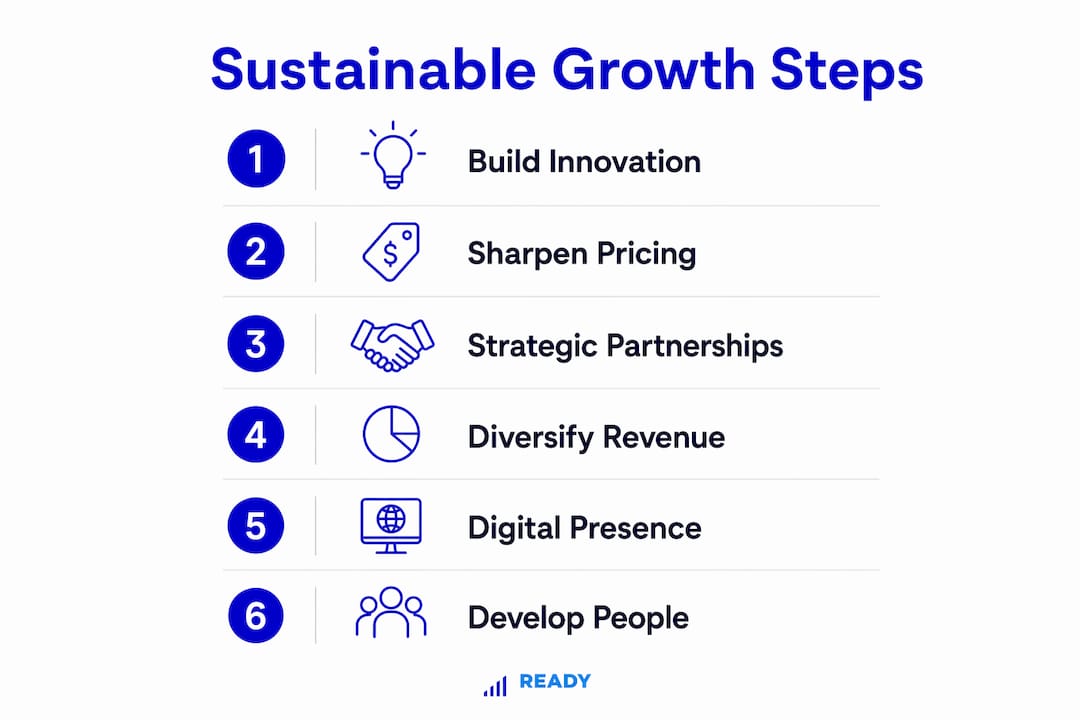
2. Use technology to sharpen your pricing
SMEs using market-oriented pricing supported by technology outperform businesses that rely only on cost-plus models. Dynamic pricing tools, real-time competitor analysis, and customer data platforms give smaller businesses the kind of pricing intelligence that used to belong only to large corporates. Integrating AI-driven pricing insights into your strategy is no longer a luxury for South African SMEs competing in tight-margin markets.

3. Build strategic partnerships for shared value
Partnerships extend your reach without the capital cost of organic expansion. A manufacturing SME partnering with a logistics provider, or a professional services firm co-developing offerings with a complementary practice, can access new markets and capabilities faster than either could alone. The key is choosing partners whose values and compliance standards match yours. A partner with a poor SARS compliance record can contaminate your own supply chain standing.
4. Diversify your revenue streams deliberately
Dependence on a single client, product, or market is one of the most common reasons South African SMEs stall. Deliberate diversification means identifying adjacent markets, developing complementary product lines, or expanding geographically within South Africa before looking at export markets. The goal is not to spread yourself thin. It is to ensure that a single disruption cannot take down your entire business.
5. Integrate ESG factors into your corporate strategy
Environmental, social, and governance considerations are no longer optional for businesses that want access to corporate supply chains, government tenders, or institutional funding. Green marketing strategies built on genuine eco-friendly business practices attract a growing segment of South African consumers and B2B buyers. Conducting regular environmental impact assessments helps you identify where your operations create unnecessary cost or risk, and where you can create genuine competitive advantage.
“Circular economy models offer SMEs a pathway to both economic growth and environmental stewardship by creating innovation-driven new revenue streams.” Designing out waste and building reverse-flow value chains, where materials cycle back into production, improves financial resilience while reducing environmental impact. South African SMEs that have adopted circular economy principles report both improved margins and stronger sustainability credentials.
6. Align your digital presence with your growth ambitions
A credible digital presence is now a baseline requirement for B2B and B2C growth. Research shows that 75% of buyers judge a business by its digital design before any other interaction. For South African SMEs, this means your website, social media, and online reviews need to reflect the same professionalism as your service delivery. Digital presence is not marketing fluff. It is a trust signal that directly affects whether prospects convert.
7. Develop your people as a growth asset
Skills development is a predictor variable for SME sustainability, yet 56% of South African SME owners give it mixed priority. Investing in training, mentorship, and leadership development pays back through lower staff turnover, better customer service, and the kind of internal innovation that does not require an external consultant to generate.
What can derail your sustainable growth plans?
Most South African SMEs do not fail because of bad luck. They fail because of predictable, avoidable problems. Knowing what these are puts you ahead of the majority.
- Limited access to capital: South African banks typically favour SMEs in advanced development stages, leaving early-stage businesses underfunded at the moment they need capital most.
- Weak strategic planning: Only 56% of SME owners use strategic business planning consistently, according to the same SME sustainability research. Without a plan, growth becomes reactive and fragile.
- Poor management practices: Effective management has a positive correlation with sustainability, yet many owner-managers have never received formal training in running a growing business.
- Regulatory and compliance risks: A single missed VAT deadline can instantly disqualify your business from government tenders and corporate supply chains, because procurement systems now verify compliance automatically.
- Market volatility: South Africa’s currency fluctuations, energy costs, and political risk create an environment where businesses without financial buffers are permanently vulnerable.
- Neglecting technology: Businesses that avoid digital tools for operations, pricing, or customer engagement fall behind competitors who use them, often without realizing the gap is widening.
The pattern across all these risks is the same. They are all manageable with planning, but they compound quickly when ignored.
How leadership drives or kills sustainable growth
Purpose-driven and ethical leadership is one of the strongest predictors of successful sustainable growth implementation. Transformational leaders who communicate a clear vision, model the behavior they expect, and create accountability structures give their teams something to build toward. Leaders who manage only by crisis, or who treat sustainability as a compliance checkbox, consistently underperform.
Practical leadership actions that move the needle:
- Align culture with sustainability goals: If your team does not understand why resource-efficient operations matter, they will not prioritize them under pressure.
- Embrace digital and AI advances actively: Leaders who resist technology adoption do not just slow their own growth. They signal to talented employees that the business has no future.
- Communicate change clearly: Resistance to change is almost always a communication failure. When people understand the reason for a new direction, adoption accelerates.
- Build accountability into your structure: Sustainable growth goals need owners, deadlines, and review cycles. Without these, they remain aspirations.
The businesses that execute well on long-term growth tactics are almost always the ones where the leader treats sustainability as a business model, not a brand story.
How do you measure whether your growth is actually sustainable?
You cannot manage what you do not measure. For South African business leaders, this means tracking both financial and non-financial KPIs with the same discipline.
Financial KPIs to track:
- Revenue growth rate versus cash flow growth rate (they should move together)
- Gross margin trends by product line or service category
- Debt-to-equity ratio and working capital position
- Customer acquisition cost versus lifetime value
Non-financial and ESG KPIs:
- Employee retention and training hours per staff member
- Carbon footprint or energy consumption per unit of output
- Supplier diversity and local procurement percentage
- SARS compliance status and VAT submission accuracy
Data-driven monitoring enables timely decisions and genuine performance improvement. Real-time dashboards, available through cloud accounting platforms, give you a live view of these metrics rather than a monthly surprise. Regular review cycles, ideally quarterly, let you catch problems before they become crises and identify which long-term growth tactics are actually working.
Pro Tip: Set a quarterly ESG scorecard alongside your financial review. Even three or four simple metrics tracked consistently will reveal patterns that a purely financial review misses, and they give you credible data when applying for tenders or funding.
How financial automation and tax compliance unlock sustainable growth
This is where many South African SMEs leave real money on the table. Financial automation and SARS compliance are not just administrative functions. They are growth infrastructure.
SMEs that adopt automation in their finance function report improved accuracy, time savings, and better cash flow management. When your bookkeeping runs on cloud infrastructure with real-time dashboards, you stop making decisions based on last month’s numbers and start making them based on what is happening right now. That shift alone changes how you plan, hire, and invest.
“Tax compliance should be treated as an investment, offering competitive advantages like better credit access and reduced risk of disqualification from tenders.” A green Tax Compliance Status (TCS) PIN from SARS is not just a legal requirement. It is a gateway to government tenders, credit facilities, and corporate supply chains that are simply unavailable to businesses with compliance gaps.
Here is what that looks like in practice. A South African manufacturing SME working with Readyaccounting moved from manual spreadsheet bookkeeping to a cloud-based system with automated VAT reconciliation and real-time cash flow reporting. Within two quarters, the business had a clean TCS PIN, qualified for a government tender it had previously been locked out of, and used the contract revenue to fund a new product line. The automation did not just save time. It opened a door that manual processes had kept shut.
Key benefits of financial automation for sustainable growth:
- Eliminates manual errors in VAT returns and payroll submissions to SARS
- Provides real-time visibility into cash flow, runway, and profitability
- Reduces the time finance tasks consume, freeing leadership for growth activities
- Supports accurate Annual Financial Statements for CIPC submissions and funding applications
- Flags compliance risks before they become penalties or disqualifications
| Capability | Manual approach | Automated approach |
|---|---|---|
| VAT reconciliation | Monthly, error-prone | Real-time, automated |
| Cash flow visibility | Lagging by weeks | Live dashboard |
| SARS compliance status | Reactive | Proactively monitored |
| Tender readiness | Often disqualified | Green TCS PIN maintained |
| Financial reporting | Time-intensive | Automated, audit-ready |
Readyaccounting’s approach treats your finance function as a competitive asset, not a cost centre. By combining cloud accounting, API-connected data flows, and fractional CFO oversight, the firm helps South African SMEs build the financial infrastructure that sustainable growth actually requires. If you want to see what cash flow automation looks like for a business at your stage, that is a good place to start.
Pro Tip: Your TCS PIN status updates in real time on SARS eFiling. Check it before submitting any tender or entering a new supply chain agreement. A compliance gap you did not know about can disqualify you automatically, before a human even reviews your bid.
Managing resources and your supply chain for the long term
Sustainable growth requires that the inputs your business depends on remain available and affordable over time. For South African businesses, this is not abstract. Water scarcity, energy costs, and supply chain fragility are operational realities.

Resource-efficient operations start with knowing where your biggest consumption and waste points are. An energy audit, a materials flow analysis, or even a simple review of your top ten supplier dependencies will surface risks that most businesses only discover when something goes wrong. Once you know where the vulnerabilities are, you can act on them: installing solar to reduce Eskom exposure, renegotiating supplier terms to build in flexibility, or qualifying backup suppliers for critical inputs.
Sustainable supply chain strategies also mean applying your own ESG standards to the businesses you buy from. Procurement teams at large corporates and government entities increasingly audit supplier sustainability credentials. If your suppliers have compliance or environmental problems, those problems can become yours. Building a supplier scorecard that includes BBBEE status, SARS compliance, and basic environmental criteria takes a few hours to set up and can protect you from supply chain disruptions that derail growth plans.
Circular economy thinking applies here too. Designing your products or packaging for reuse, or finding buyers for your production waste, turns a cost into a revenue line. South African SMEs that have taken this approach report both margin improvements and stronger relationships with sustainability-focused buyers.
Regulatory and compliance considerations for South African businesses
South Africa’s regulatory environment rewards businesses that plan ahead and penalises those that treat compliance as an afterthought.
SARS and tax compliance sit at the top of the list. VAT registration is mandatory once your taxable turnover exceeds R1 million per year, and the submission deadlines are fixed. Missing them triggers penalties, interest, and the loss of your TCS PIN. SARS now uses automated systems to verify compliance across procurement and supply chain databases, so a gap in your compliance record surfaces immediately when a tender is evaluated.
CIPC requirements govern company registration, annual returns, and financial statement submissions. Staying current with CIPC is a baseline requirement for any business seeking external funding or entering formal procurement processes. SAICA and SAIPA-registered accountants can help you meet these obligations accurately and on time.
BBBEE compliance affects your ability to access government contracts and corporate supply chains. Understanding your BBBEE scorecard and actively managing it, rather than scrambling before a tender deadline, gives you a genuine competitive advantage.
Environmental regulations are tightening. The National Environmental Management Act (NEMA) and sector-specific regulations increasingly require businesses to conduct environmental impact assessments before expanding operations. Businesses aligned with South Africa’s sustainable development goals, including the country’s commitments under the Paris Agreement, are better positioned for the regulatory environment ahead.
Labour law compliance, including the Basic Conditions of Employment Act and the Employment Equity Act, directly affects your ability to attract talent and avoid costly disputes. Building compliance into your HR processes from the start is far cheaper than fixing problems after they escalate.
The businesses that treat regulatory compliance as a foundation, rather than a hurdle, consistently find that it opens more doors than it closes.
Key takeaways
South African businesses that combine deliberate planning, ESG integration, financial automation, and strong SARS compliance build the most durable foundation for long-term growth.
| Point | Details |
|---|---|
| Only 41.5% of SMEs are sustainable | Most South African SMEs fail due to weak planning, limited capital, and poor innovation. |
| Innovation drives sustainability most | Innovation has the highest positive correlation with SME viability among all predictor variables studied. |
| Tax compliance is a growth tool | A green TCS PIN unlocks government tenders, credit facilities, and supply chains unavailable to non-compliant businesses. |
| Automation improves cash flow and decisions | Cloud-based financial automation gives real-time visibility and reduces errors in VAT and payroll submissions. |
| ESG metrics belong in your review cycle | Tracking non-financial KPIs alongside financial ones improves risk management and strengthens funding applications. |