

Supplier payments process for South African SMEs: 2026 guide
Executive Summary
- The supplier payments process ensures accurate and timely payments to preserve cash flow and supplier relationships. Automating this workflow with cloud tools improves compliance with SARS regulations and enhances financial visibility. Proper reconciliation before payments prevents errors, fraud, and costly discrepancies.
The supplier payments process is the systematic series of steps a business uses to verify, record, and pay suppliers accurately and on time. For South African SMEs, getting this right is not optional. A broken payment workflow creates cash flow gaps, triggers SARS penalties, and damages supplier relationships that took years to build. The good news is that a structured accounts payable process, supported by tools like Sage Pastel and cloud accounting platforms, turns this administrative burden into a genuine business advantage. This guide covers every stage of the process, the latest 2026 VAT threshold changes, and practical ways to reduce errors and stay compliant.
What are the key steps in the supplier payments process?
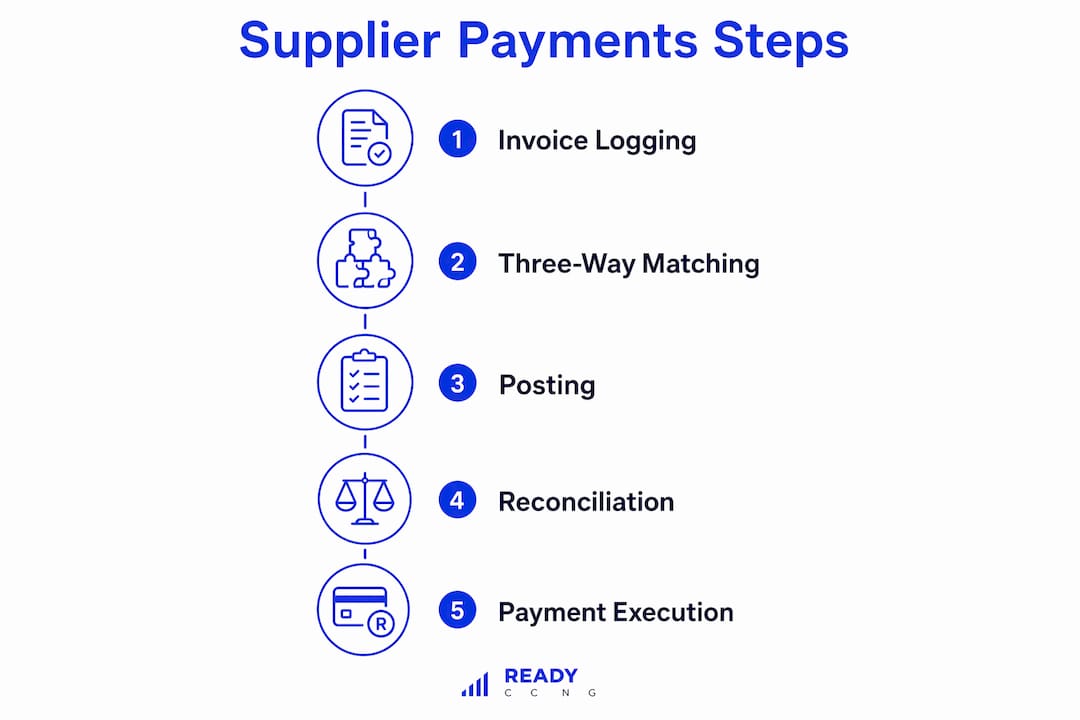
South African SMEs follow a five-step creditor workflow that moves from invoice receipt all the way through to EFT payment. Each step builds on the one before it, and skipping any step creates risk.
Step 1: Invoice logging. Every supplier invoice gets captured into the accounting system the day it arrives. The creditors clerk records the supplier name, invoice number, date, amount, and VAT separately. Missing this step means invoices get lost, payments get delayed, and your VAT201 return becomes a guessing game.
Step 2: Three-way matching. This is the most critical invoice processing step. The clerk matches the invoice against the original purchase order and the goods received voucher. All three documents must agree on quantity, price, and VAT before the invoice moves forward. Any mismatch gets flagged and sent back to the supplier or the purchasing team for resolution.
Step 3: Posting to the accounting system. Once matched, the invoice posts to the creditors ledger with the correct VAT code. Sage Pastel and most cloud accounting platforms handle this automatically when set up correctly. The VAT amount feeds directly into your VAT201 working file, which is exactly what SARS expects to see during an audit.
Step 4: Monthly creditors reconciliation. Before any payment runs, the creditors clerk reconciles the ledger against each supplier’s statement. This step catches duplicate invoices, missing credits, and pricing errors before money leaves the account. Reconciliations completed before payment batches are the single best control against overpayment.
Step 5: Payment batch preparation and execution. Approved invoices group into a payment batch. A second authorized person reviews and approves the batch before the EFT goes out. Remittance advice then goes to each supplier so they can match the payment on their side.
Pro Tip: Never authorize a payment batch without a second signatory. Dual authorization is the cheapest fraud prevention tool available to any SME.
How does SARS compliance affect your payment workflow?
SARS compliance sits at the center of every supplier payment decision. Your Tax Compliance Status, known as TCS, reflects whether all returns are filed and all debt is settled. A non-compliant TCS on SARS eFiling disqualifies your business from government tenders and can block access to bank financing immediately. That is not a theoretical risk. It happens to South African SMEs every month.
The 2026 budget brought one significant change that affects smaller businesses directly. The VAT compulsory registration threshold increased from R1 million to R2.3 million per annum as of april 2026. Businesses below this threshold no longer need to register for VAT, which reduces the administrative load on micro and very small enterprises. If you are above the threshold, VAT on every supplier invoice still needs to be captured, coded, and reconciled before your VAT201 submission.
Preparing a VAT201 return correctly requires a detailed working file that links each supplier invoice to its VAT category and, for imported goods, to the customs clearance evidence. The supplier invoice alone is not enough for imported goods. SARS treats the customs document as the primary evidence for input VAT claims on imports. Missing this distinction is a common audit trigger.
Key compliance actions to build into your payment procedures:
- File all VAT201 returns on time, even if the amount is nil.
- Keep a VAT working file updated monthly, not just at submission time.
- Reconcile input VAT claimed to actual supplier invoices before submitting.
- Maintain a complete audit trail from purchase order through to EFT confirmation.
- Check your TCS on SARS eFiling at least once a quarter.
What technologies and best practices improve the payment approval workflow?
Automating accounts payable transforms it from a cost center into a function that actively protects cash flow and reduces fraud exposure. The shift is not just about speed. Automation creates a consistent, auditable process that manual workflows cannot match.

Cloud accounting platforms give you real-time visibility into what is owed, when it is due, and what cash you need to have available. Batch payment scheduling means you run payments on fixed days, say the 15th and last day of the month, rather than reacting to supplier calls. This predictability helps you manage cash flow more accurately and avoid the scramble of ad hoc payments draining your account at the wrong time.
Payment terms negotiation is an underused lever for South African SMEs. Flexible payment schedules build supplier trust and can lead to better pricing and more reliable delivery. The trap many businesses fall into is stretching terms to 90 or 120 days to preserve cash. That approach damages relationships and often costs more in lost discounts and reduced service priority than the cash saving is worth.
Best practices that make a measurable difference:
- Use cloud accounting to automate invoice matching and flag exceptions automatically.
- Schedule payment runs on fixed dates to improve vendor payment timeline predictability.
- Negotiate 30-day terms with key suppliers and offer early payment discounts where your cash position allows.
- Use payroll and payment automation tools to reduce manual processing time across your finance function.
- Issue remittance advice with every payment so suppliers can reconcile on their side without chasing you.
Pro Tip: Set up a supplier payment calendar at the start of each month. Map every due date against your expected cash inflows so you can see conflicts before they become crises.
How can SMEs reconcile creditors and prevent payment errors?
Creditors reconciliation is where most payment errors surface, and where most fraud gets caught. The process compares your creditors ledger to each supplier’s statement and identifies every difference. Done monthly, it keeps your records clean. Done quarterly or never, it creates a backlog that takes weeks to unwind.
Prioritizing reconciliation by spend and risk is the most efficient approach. Start with your highest-value suppliers and any accounts with a history of disputes. Resolving those first unblocks month-end closes and prevents duplicate payments from slipping through on large accounts.
Common discrepancies to watch for:
- Duplicate invoices: The same invoice captured twice, often when a supplier resends after a payment delay.
- Missing credits: Supplier credit notes not yet captured in your system.
- Pricing errors: Invoice amount differs from the agreed purchase order price.
- Timing differences: Payments made near month-end that appear in your ledger but not yet on the supplier’s statement.
Segregation of duties is non-negotiable for any SME with more than one finance staff member. The person who captures invoices should not be the same person who authorizes payments. This single control removes the most common internal fraud vector in small business accounts payable. If you are a sole operator, a monthly review by your accountant or bookkeeper serves the same purpose.
Maintaining a complete audit trail means keeping the original invoice, the purchase order, the goods received voucher, the reconciliation workbook, and the EFT confirmation all linked and accessible. SARS can request any of these documents during a review, and having them organized saves significant time and stress. Readyaccounting clients use cloud-based document management so every document is retrievable in seconds, not hours.
Key takeaways
A structured supplier payments process is the foundation of accurate cash flow management and SARS compliance for South African SMEs.
| Point | Details |
|---|---|
| Five-step workflow | Follow invoice logging, three-way matching, posting, reconciliation, and EFT payment in sequence every time. |
| SARS compliance is non-negotiable | A non-compliant TCS blocks tenders and financing; file all returns on time and maintain a VAT working file. |
| 2026 VAT threshold change | The compulsory VAT registration threshold rose to R2.3 million, reducing admin for smaller businesses. |
| Automate and schedule payments | Fixed payment run dates and cloud accounting improve cash flow visibility and cut fraud risk. |
| Reconcile before you pay | Complete creditors reconciliation before every payment batch to catch duplicates and pricing errors. |
Why accounts payable deserves more respect than it gets
Most SME owners treat accounts payable as a back-office chore. Pay the bills, keep the suppliers happy, move on. I understand that instinct. When you are running a growing business, the supplier payments process feels like plumbing. You only notice it when something breaks.
What I have seen working with South African SMEs is that the businesses with the tightest payment procedures are also the ones with the clearest picture of their cash position. That is not a coincidence. When you know exactly what you owe, when it is due, and what your input VAT position looks like, you make better decisions across the whole business. You negotiate from a position of knowledge rather than anxiety.
The other thing I would push back on is the idea that automation is only for large businesses. Cloud accounting and scheduled payment runs are accessible to any SME with a basic internet connection. The accounts payable automation benefits are not theoretical. They show up in fewer late payment penalties, fewer supplier disputes, and more accurate VAT201 submissions. The businesses that resist automation usually do so because the setup feels like effort. It is. But it is a one-time effort that pays back every single month.
South Africa’s economic conditions make supplier relationships more valuable than ever. A supplier who trusts you to pay on time and communicate clearly will prioritize your orders when stock is tight. That is a competitive advantage that no amount of marketing spend can replicate.
— Johan
How Readyaccounting helps SMEs take control of supplier payments
Readyaccounting works with South African SMEs to replace manual payment workflows with cloud-based systems that give you real-time visibility into what you owe and when. Our team sets up automated invoice matching, scheduled payment runs, and monthly creditors reconciliation processes that keep your SARS compliance intact without the administrative grind. If your current process relies on spreadsheets and memory, the risk is higher than you think. Read more about how cash flow automation works in practice, or explore our accounting automation guide to see exactly what a modern accounts payable setup looks like for a scaling South African business.
FAQ
What is the supplier payments process?
The supplier payments process is the structured workflow a business uses to receive, verify, record, and pay supplier invoices accurately. It covers every step from invoice logging through to EFT execution and remittance advice.
How does the 2026 VAT threshold change affect supplier payment procedures?
The compulsory VAT registration threshold increased to R2.3 million per annum as of april 2026. Businesses below this threshold no longer need to register for VAT, which simplifies invoice processing and reduces VAT201 obligations for smaller SMEs.
What is three-way matching in invoice processing?
Three-way matching compares the supplier invoice, the purchase order, and the goods received voucher to confirm that quantity, price, and VAT all agree before a payment is authorized.
How often should creditors reconciliation be done?
Creditors reconciliation should be completed monthly, before each payment batch is authorized. Prioritize high-value and high-risk supplier accounts first to unblock month-end closes and prevent duplicate payments.
What happens if my SARS Tax Compliance Status is non-compliant?
A non-compliant TCS disqualifies your business from government tenders and can block access to bank financing immediately. All outstanding returns must be filed and all debt settled to restore compliant status.