

Succession planning basics every South African SME owner needs
Succession planning basics every South African SME owner needs
If you own an SME and don’t yet have a written exit plan, the single most valuable thing you can do this month is start one. Begin a structured three to five year succession plan and bring in a chartered accountant and a commercial attorney before you touch a term sheet or a family conversation. That timeline isn’t arbitrary. It’s roughly how long it takes to fix messy books, groom a successor, and document a deal structure that SARS and CIPC won’t flag later.
Before anything else, tackle these:
- Confirm your shareholders agreement actually has exit, valuation, and buyout clauses (not just a generic MOI).
- Get your financials clean and current, ideally three years of reviewed statements.
- Commission an independent valuation so every negotiation starts from a real number, not a guess.
Get these right early and you avoid the two things that kill most exits: tax surprises and shareholder deadlock.
Key Takeaways
Succession planning works when owners start three to five years early, document exit terms in a bespoke shareholders agreement, and get tax and valuation advice before a buyer or family successor is on the table.
| Point | Details |
|---|---|
| Start early | Begin a structured succession plan three to five years before your intended exit to widen options and value. |
| Fix your governance documents | Pair your MOI with a bespoke shareholders agreement covering exit triggers, valuation, and payment mechanics. |
| Model tax exposure upfront | Check CGT, VAT going concern treatment, and Securities Transfer Tax before choosing a deal structure. |
| Keep the plan alive | Review the SHA, valuation, and timeline at least annually, and immediately after any major business or tax change. |
| Get your books exit-ready | Readyaccounting’s cleanup, automation, and tax defence work shortens due diligence and supports SHA and valuation coordination. |
Table of Contents
- What succession planning basics actually cover for SA owners
- Tax and legal essentials for South African owners
- Building a 3–5 year succession planning checklist
- Which deal structure protects the most value?
- What clauses and documents does your plan actually need?
- Identifying and developing internal successors
- Planning for the succession you didn’t see coming
- Aligning succession with your growth strategy
- Handling the emotional weight of family and closely-held exits
- Reviewing your succession plan as circumstances change
- How Readyaccounting gets your business exit-ready
- Frequently asked questions
- Sources
What succession planning basics actually cover for SA owners
Succession planning, in this context, has nothing to do with grooming a junior manager to replace a department head. It means planning the transfer of ownership itself: who ends up holding your shares, how much cash changes hands, and what SARS takes along the way. If you came here looking for internal leadership pipelines, that’s a different topic entirely.
A complete plan delivers four things:
- Liquidity — a clear route to converting equity into cash or an income stream.
- Continuity — the business keeps trading through the transition without client or supplier panic.
- Tax efficiency — CGT, VAT, and Securities Transfer Tax exposure are modeled and minimized in advance, not discovered after signing.
- Governance — decision rights and dispute mechanisms are documented so no single disagreement can freeze the company.
Starting early matters more than most owners assume. A plan launched three to five years before the intended exit gives you time to groom a successor, restructure ownership tax efficiently, and fix financial weak points that would otherwise scare off buyers or trigger family disputes. Yet fewer than 25% of SMEs have anything documented at all, which is exactly why so many transitions end up rushed, undervalued, or litigated.
Tax and legal essentials for South African owners
Your Memorandum of Incorporation covers the legal minimum. It rarely says anything useful about what happens when a shareholder wants out, dies, or gets a competing offer. That gap is why a bespoke shareholders agreement needs to sit alongside the MOI, covering reserved matters, share transfer restrictions, drag along and tag along rights, and a dispute resolution process that doesn’t default to a High Court application.
On the tax side, four flags deserve attention before you structure anything:
- VAT: selling assets individually usually triggers VAT at the standard rate, unless the deal qualifies as a going concern sale, which can be zero rated. Whether it qualifies depends on specific SARS requirements around continuity of the enterprise.
- CGT: a share sale generally triggers Capital Gains Tax for the seller, calculated against base cost and any available exclusions.
- STT: Securities Transfer Tax applies to the transfer of shares, and the mechanics of who pays it should be spelled out in the sale agreement, not assumed.
- Estate duty: owners routinely underestimate the estate duty and personal tax consequences of transferring shares on death, which is why your will and your SHA need to say the same thing.
Pro Tip: Ask your attorney to cross-check your SHA’s buy-sell clause against the beneficiary nominations in your will. Contradictions between the two are one of the most common (and most expensive) mistakes in family businesses.
Get a chartered accountant, a tax specialist, a commercial attorney, and a registered valuer in the room early. Waiting until you have a buyer usually means paying rush fees for work that should have taken 18 months, not six weeks. For general SARS compliance groundwork that supports this, see this practical tax guide for SMBs.
Building a 3–5 year succession planning checklist
Succession doesn’t happen in a single event. It happens in phases, and each one has a deliverable you can actually check off.
- Years −5 to −3: Foundations. Define your personal goals (full exit, partial retirement, family handover), fix governance gaps in your MOI, clean up three years of financial statements, and start informally assessing internal or family candidates.
- Year −2: Formal structuring. Draft or update the shareholders agreement with explicit exit clauses, commission an independent valuation, and start modeling tax structures with your accountant.
- Year −1: Funding and testing. Confirm how a buyout will actually be paid (cash, seller finance, installments), run a phased operational handover, and pressure test any internal or external offers against your valuation.
- Execution window (Months 0–6): The transaction. Finalize sale or transfer mechanics, file the required SARS and CIPC documentation, and submit the relevant tax returns.
- Post-exit: Follow-through. Monitor payment schedules if you financed part of the deal, confirm ongoing compliance, and enforce restraint of trade clauses if a departing party breaches them.
Pro Tip: Treat the “year −2” valuation as a living document, not a one-off report. Re-run it annually so nobody negotiates off a number that’s three years stale by the time you sign.
The single biggest driver of a smooth execution phase is clean financials. Preparing a business for sale with documented processes and current statements widens your pool of potential buyers and speeds up due diligence, sometimes dramatically.
Which deal structure protects the most value?
The structure you choose changes what lands in your pocket after tax, and it changes who’s exposed to what risk. Most SA SME exits fall into one of three buckets.
- Share sale: the buyer acquires shares directly, and Securities Transfer Tax typically falls on the buyer, while the seller usually faces CGT on the gain. This structure is often cleaner for continuity since contracts and licenses stay with the company.
- Asset sale: the buyer picks specific assets rather than the entity itself. VAT exposure is the big risk here unless the deal qualifies for zero-rating as a going concern sale, which requires meeting specific SARS criteria around the transferred enterprise continuing to trade.
- Internal buyout (MBO): a manager, co-founder, or family member buys in over time, usually funded through seller financing with interest, installment payments, and security like a suretyship or a pledge over the shares being acquired.
Whichever route you’re leaning toward, insist on three things being documented in writing before you get emotionally committed to a buyer or successor: the valuation method used, exactly how funding will work month to month, and what security backs any deferred payment. Skipping this step is how sellers end up chasing installments for years with no legal leverage.
What clauses and documents does your plan actually need?
A shareholders agreement is only as useful as its detail. The clauses that matter most, according to legal practitioners who deal with SA exit disputes, are the ones covering pre-emptive rights, valuation formulas, and payment mechanics since these are exactly where deadlocks and litigation tend to erupt.
At minimum, confirm your documents cover:
- Trigger events: death, disability, retirement, deadlock, insolvency, and voluntary exit should each have a defined process.
- Valuation mechanics: name the method (EBITDA multiple, net asset value, or independent valuer) and set a timeline for appointing that valuer, because leaving this undefined often leads to competing valuations and expensive disputes.
- Payment structure: specify lump sum versus installments, and what security (suretyship, share pledge) backs any deferred amount.
- Restraint of trade: geographic scope, duration, and activity restrictions need to be reasonable enough to survive a legal challenge if a departing shareholder tries to compete.
Identifying and developing internal successors
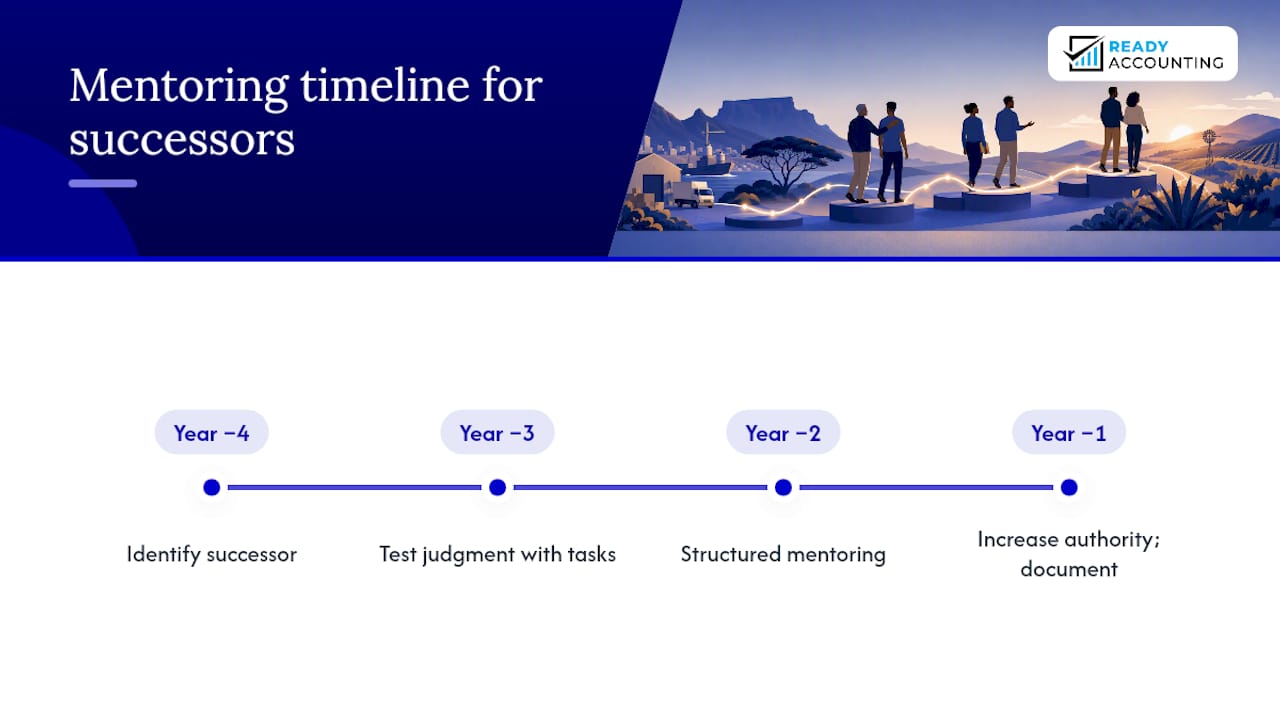
Even in an ownership-transfer plan, someone has to run the business day to day, whether that’s a family member, a long-serving manager, or an outside hire brought in ahead of the sale. Identifying that person early, ideally at the year −4 or year −3 mark, gives you time to test their judgment on real decisions rather than hypothetical ones.
Structured mentoring works better than informal shadowing. Give the prospective successor increasing authority over specific functions (procurement, client relationships, cash flow decisions) on a schedule, and document what they’ve taken over. This does double duty: it builds their credibility with staff and clients, and it gives a buyer or investor concrete evidence that the business doesn’t collapse without you in the room.
One approach worth considering: separating voting control from economic rights during the handover. A founder can transfer a growing share of the profit interest to a successor while retaining voting control for a defined period, which lets the successor build authority gradually without the operational shock of an abrupt handover. This tends to reduce the friction that comes with a sudden, all-at-once transfer of both control and cash flow rights.
If the successor is a family member, keep performance expectations separate from family loyalty. Written role descriptions and measurable targets prevent the common trap where “he’s my son, he’ll figure it out” replaces an actual development plan.
Planning for the succession you didn’t see coming
Every plan built around a five-year horizon assumes you get five years. Illness, death, disputes between co-founders, or a sudden regulatory shock can force an exit on nobody’s schedule but reality’s.
Build a contingency layer into your plan rather than treating it as a separate project:
- Buy and sell agreements funded by life or disability cover so a deceased or incapacitated shareholder’s estate gets paid out without forcing a fire sale of the business.
- An interim management protocol naming who runs operations if a key owner is suddenly unavailable, even temporarily.
- A deadlock-breaking mechanism in the SHA (mediation, then arbitration) so a dispute between shareholders doesn’t freeze bank signatories or supplier payments.
Dispute resolution clauses matter more than most owners realize until they’re stuck in one. A well-drafted SHA with mediation and arbitration provisions resolves conflicts faster and with far less disruption than defaulting to litigation, which can drag on for years and bleed cash the business needs to keep operating.
None of this needs to be elaborate. A one-page emergency protocol naming who has signing authority, where key documents are stored, and who to call first (accountant, attorney, insurer) is often the difference between a rough week and a business that never recovers.
Aligning succession with your growth strategy
Succession planning that runs separately from your growth strategy tends to produce a business that’s easier to hand over but harder to sell for a good price, or vice versa. The two need to move together.
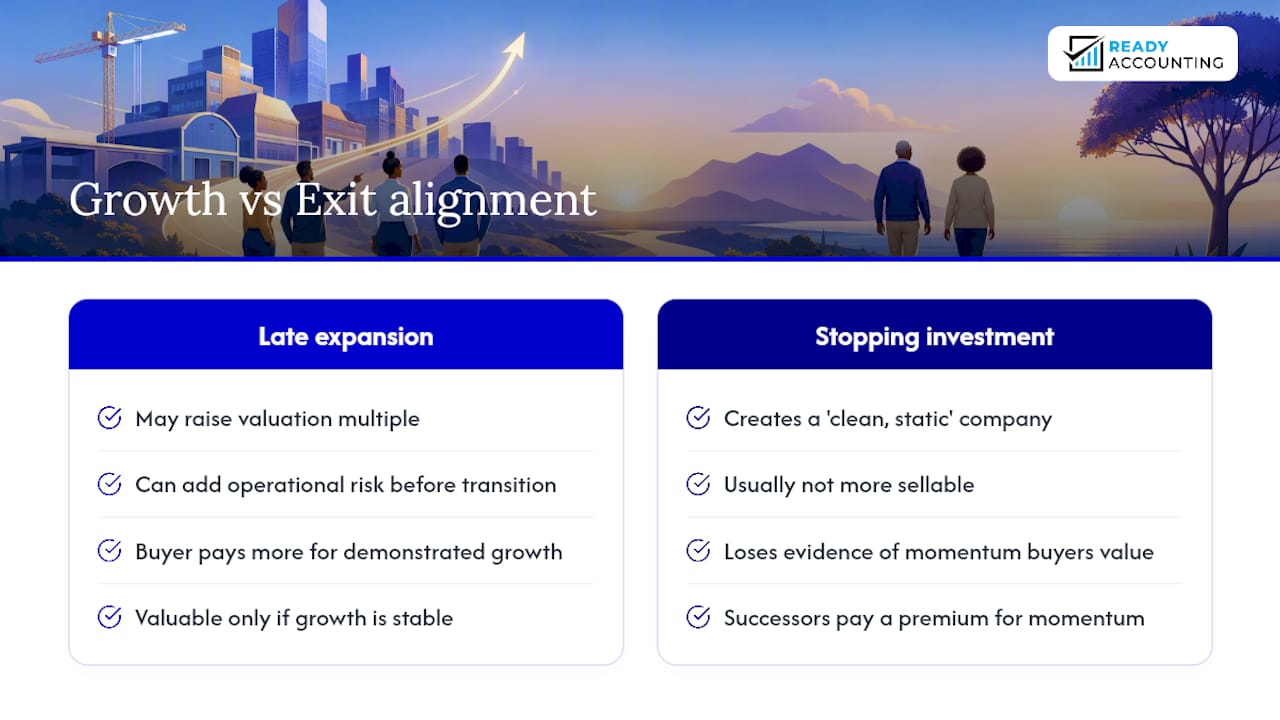
If you’re three years from an intended exit and still planning aggressive expansion into a new market, ask whether that expansion increases your valuation multiple or just adds operational risk right before a transition. Sometimes it does both. A buyer will pay more for demonstrated growth, but only if the growth is stable enough that they’re not inheriting a half-finished bet.
The reverse problem shows up just as often: owners who quietly stop investing in the business the moment they decide to exit, assuming a “clean, static” company is more sellable. It usually isn’t. Buyers and successors both pay a premium for evidence that the business has momentum, not just a tidy balance sheet.
Your growth plan and your exit plan should share one document, reviewed together with your accountant and your attorney, so a new hire, a new lease, or a new market entry gets evaluated against both what it does for revenue this year and what it does for your exit multiple in year three.
Handling the emotional weight of family and closely-held exits
Numbers are the easy part. What actually derails succession in family businesses and closely-held companies is usually unspoken: a founder who can’t separate identity from the company, siblings competing for a role only one can hold, or a spouse who assumed involvement that was never formalized.
Address this directly rather than hoping it resolves itself. Put actual language in front of the family: who wants to run the business, who wants to be paid out, and who wants neither but expects to be consulted anyway. Written expectations, even informal ones, prevent the retirement dinner that turns into a shareholder dispute six months later.
Founders often resist stepping back because the business has functioned as their primary identity for a decade or two. That’s a legitimate psychological transition, not just a scheduling problem, and rushing it tends to backfire, with founders staying involved long after they’ve formally “exited,” undermining the very successor they chose. Building a phased handover with a defined end date, rather than an open-ended advisory role, gives both sides a clean line to work toward.
Reviewing your succession plan as circumstances change
A succession plan written once and filed away is close to useless three years later. Markets shift, tax rules change, a chosen successor leaves, or your own goals change once you’re actually two years out from the number you originally targeted.
Set a fixed review cadence, at minimum annually, and treat it the same way you’d treat a budget review: pull out the SHA, the valuation, and the timeline, and check whether any assumption underneath them has moved. A valuation that’s 18 months old in a fast-growing business is not a number you want to negotiate from.
Watch for these triggers that should force an off-schedule review regardless of your calendar: a shareholder wants to exit early, a major client or contract changes the revenue base materially, tax legislation shifts CGT or STT treatment, or your intended successor’s circumstances change. Any one of these can quietly make your entire plan obsolete without anyone noticing until the exit itself.
What we see work repeatedly
Owners who separate ownership from daily operations early, and automate their reporting long before a buyer shows up, close faster and pay less in advisory fees. Clean, real-time books turn due diligence from a three-month scramble into a formality. If you’re not sure where your business stands, that’s worth a conversation before you’re under deal pressure.
How Readyaccounting gets your business exit-ready
Everything above depends on financials a buyer, family member, or SARS auditor can trust at a glance, and that’s precisely where most South African exits stall. Readyaccounting exists to close that gap: forensic cleanup of historical books, automated cloud reporting that gives you a real-time valuation baseline, and tax defence work that catches CGT, VAT, and STT exposure before a deal, not during one.
A typical engagement includes bringing your Annual Financial Statements current and audit-ready, setting up automated reporting dashboards so cash position and runway are visible without a month-end scramble, running a SARS compliance check across VAT registration and outstanding filings, and coordinating with your attorney and valuer so your shareholders agreement and your numbers actually match. Acting as your fractional CFO, Readyaccounting turns the finance function from a liability into leverage at the negotiating table.
If you’re two to five years from an exit and want to know exactly where your books stand, book a readiness conversation with Readyaccounting today.
Frequently asked questions
What are the basics of succession planning for a South African SME? The basics are timing, documentation, and tax structuring: start three to five years before exit, put exit terms in a bespoke shareholders agreement, and get a chartered accountant and attorney involved before negotiating with a buyer or successor.
How is business succession planning different from leadership succession planning? Business succession planning, the focus here, deals with who owns the company and how ownership transfers tax efficiently. Leadership succession planning is an internal HR process about training future managers, which is a separate discipline entirely.
Do I need a shareholders agreement if I already have an MOI? Yes. The MOI covers baseline legal requirements, but a bespoke shareholders agreement is where exit clauses, valuation formulas, and dispute resolution actually get specified.
What tax issues catch South African owners off guard during a sale? VAT on asset sales that don’t qualify for going concern zero-rating, CGT on share sale gains, and Securities Transfer Tax on share transfers are the three that most frequently surprise sellers who haven’t modeled a deal with a tax specialist.
How often should I review my succession plan? At least annually, plus immediately after any major shift, a shareholder wanting to exit early, a change in tax legislation, or a successor’s circumstances changing.
This article is general information, not a substitute for advice from a qualified financial advisor. Consult a qualified financial professional about your own circumstances before acting on anything here.
Sources
For deeper legal detail, review guidance on shareholders agreements and SHA exit provisions. Always confirm specifics with a chartered accountant, registered valuer, and attorney.
- Why South African Business Owners Must Plan Their Succession - PJJ van Rensburg Attorneys | A Pretoria based law firm
- Succession Planning for SMEs | SME South Africa
- Understanding Shareholders’ Agreements in South Africa
- Exit Provisions in South African Shareholders Agreements: Buy-Outs, Sales and Winding Up | MJ Kotze Inc
- Succession Planning In Small And Medium Sized Businesses - Corporate and Company Law - South Africa