

Steps to implement payroll services for your employees
Executive Summary
- Effective payroll services in South Africa require accurate tax withholding, timely employee payments, and SARS compliance to protect employers and ensure staff are paid correctly. Employers must register for PAYE, UIF, and SDL within 21 days of hiring, and maintain detailed employee records to avoid penalties and penalties that multiply with late filings. Using the right payroll system, running structured cycles, and maintaining proper documentation streamline compliance and build trust with employees.
Effective payroll services are defined as the combination of accurate tax withholding, timely employee payments, and full SARS compliance that keeps your business legally protected and your staff paid correctly every month. For South African SMEs, the steps to implement effective payroll services for your employees cover everything from PAYE registration to monthly EMP201 submissions and year-end IRP5 certificates. Get this right and you build trust with your team. Get it wrong and SARS penalties compound fast. This guide walks you through every phase, from setup to ongoing compliance, using tools like SimplePay and SARS eFiling.
What registration and compliance steps must South African employers complete first?
Before you process a single payslip, your business must be registered with SARS for three statutory obligations. Employers must register for Employees’ Tax (PAYE), Unemployment Insurance Fund (UIF), and Skills Development Levy (SDL) within 21 business days of becoming an employer. Missing this window is not a technicality. SARS treats late registration as non-compliance and can impose backdated penalties.
Here is what each registration covers:
- PAYE (Pay As You Earn): You deduct income tax from employee salaries monthly and pay it to SARS on their behalf.
- UIF: Both employer and employee contribute 1% of gross remuneration each, capped at the monthly earnings ceiling set by the Department of Employment and Labour.
- SDL: Employers with an annual payroll above R500,000 contribute 1% of total leviable amount to the Skills Development Levy.
Once registered, your monthly obligation is the EMP201 declaration, which must be submitted and paid by the 7th of the following month. A single late submission triggers penalties and interest that accumulate monthly. At year-end, the EMP501 reconciliation window runs from 1 April to 31 May 2026, with penalties starting at 1% of your total PAYE liability for late or incomplete filings.
Pro Tip: Register on SARS eFiling the same week you hire your first employee. Do not wait until your first payroll run. The 21-business-day clock starts from the date of employment, not the date of first payment.
Keeping detailed employee records is not optional. Every employee’s tax reference number, ID number, and banking details must be captured accurately at onboarding. Treat tax reference numbers as payroll-critical data, verifying them at onboarding and during each reconciliation cycle to avoid filing rejections.
How to choose and configure the right payroll system for your business
Selecting a payroll provider or software depends on your business size, pay frequency, and the complexity of your deductions. A five-person business with fixed monthly salaries has very different needs from a 50-person operation with weekly wages, overtime, and commission structures. Getting this match right reduces operational risk significantly.
| Business profile | Recommended approach | Key consideration |
|---|---|---|
| 1 to 10 employees, simple pay structure | Cloud payroll software (e.g., SimplePay) | Low cost, SARS-integrated, minimal setup |
| 11 to 50 employees, mixed pay types | Mid-tier software with HR integration | Overtime rules, leave management, BCEA compliance |
| 50+ employees or complex deductions | Managed payroll service or enterprise software | Dedicated support, audit trail, multi-entity handling |
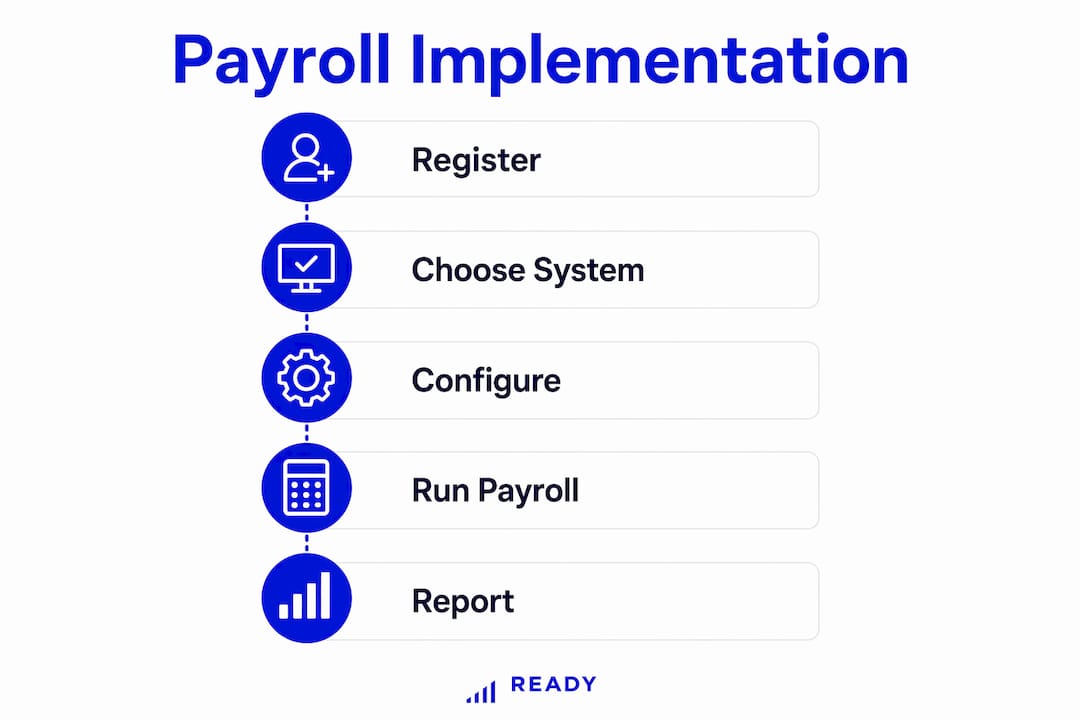
Once you have selected your tool, configure it correctly before running a single payroll. This means setting up:
- Gross pay components including basic salary, overtime, travel allowances, and bonuses
- Statutory deductions for PAYE (using the SARS 2026 tax tables effective 1 March 2026), UIF, and SDL
- Company contributions such as medical aid and retirement fund where applicable
- Payslip templates that comply with the Basic Conditions of Employment Act (BCEA), which mandates payslip content including gross pay, all deductions, and net pay on every payday
Integrating your payroll system with your time-tracking and HR tools removes the biggest source of payroll errors: manual data re-entry. If your staff clock in via a system like Sage HR or a time-attendance app, connecting it directly to your payroll software means hours worked flow through automatically.
Pro Tip: Before going live, run your payroll configuration past a SAIPA or SAICA-registered accountant. A 30-minute review catches setup errors that would otherwise take months of corrections to fix. Readyaccounting offers this as part of its payroll onboarding process.
For a detailed breakdown of available tools, the payroll software comparison guide from Readyaccounting covers features and pricing for South African SMEs specifically.
What are the step-by-step phases for running payroll each cycle?
Running payroll is not a single action. It is a structured process with distinct phases, and skipping any one of them creates downstream errors. Effective payroll execution covers data collection, calculation, distribution, and reporting in sequence.
Follow these steps for every payroll cycle:
- Collect and validate employee data. Confirm hours worked, overtime, leave taken, new hires, terminations, and any salary changes. Lock this data before calculations begin.
- Calculate gross pay. Include basic salary, overtime at the BCEA rate (1.5x for the first two hours, 2x thereafter on Sundays and public holidays), commissions, bonuses, and taxable allowances.
- Apply statutory deductions. Use the SARS 2026 deduction tables to calculate PAYE. Add UIF at 1% of gross (employee portion) and SDL at 1% of total leviable amount (employer portion). Apply any court orders or garnishees.
- Run a parallel test payroll. Before releasing payments, run a test cycle and compare outputs against the previous month. Flag any variance above 5% for manual review. This single step catches the majority of payroll errors before they reach employees or SARS.
- Issue payslips. Distribute payslips on or before payday, either digitally or in print. The BCEA requires this without exception.
- Disburse net pay. Pay employees via EFT using verified banking details. Batch payments through your business bank account and retain the payment confirmation for your records.
- Submit EMP201 and pay SARS. Complete the monthly declaration on SARS eFiling and make payment by the 7th of the following month.
Pro Tip: Build a payroll deadline calendar at the start of each tax year. Map every EMP201 due date and the EMP501 window onto your business calendar. A SARS-aligned deadline calendar prevents the late filing penalties that compound monthly and are entirely avoidable.
For a deeper look at reducing errors in this cycle, the Readyaccounting guide on eliminating payroll errors covers the most common mistakes South African SMEs make and how to fix them.
How to maintain payroll records and meet SARS reporting obligations
Accurate recordkeeping is the backbone of SARS compliance. Proper worker classification and data accuracy are fundamental requirements, not administrative preferences. SARS can audit payroll records going back five years, so your documentation must be complete and retrievable.
Maintain the following for every payroll cycle:
- Signed payroll registers showing gross pay, all deductions, and net pay per employee
- Bank payment confirmations matching payroll disbursements
- EMP201 submission receipts and proof of payment
- Employee tax certificates (IRP5 or IT3(a)) issued at year-end
- Leave records, overtime authorizations, and any variation to standard pay
The EMP501 annual reconciliation is where many businesses run into trouble. Early and frequent data validation reduces audit risk and penalties significantly. If your monthly EMP201 submissions are accurate and consistent, the EMP501 becomes a straightforward confirmation rather than a stressful correction exercise.
| Reporting obligation | Deadline | Consequence of non-compliance |
|---|---|---|
| EMP201 monthly declaration | 7th of following month | Penalties and interest from day one |
| EMP501 annual reconciliation | 1 April to 31 May 2026 | Penalties from 1% of PAYE liability |
| IRP5/IT3(a) employee certificates | Issued at year-end reconciliation | Employee tax return delays and SARS queries |
For 2026-specific guidance on maintaining compliant records, the Readyaccounting resource on payroll best practices covers the updated SARS requirements in detail.
Key takeaways
Effective payroll implementation for South African employers requires SARS registration, correct system configuration, disciplined cycle execution, and consistent monthly and annual reporting to avoid penalties and maintain employee trust.
| Point | Details |
|---|---|
| Register before first payroll | Complete PAYE, UIF, and SDL registration within 21 business days of hiring. |
| Choose the right system | Match payroll software or a managed service to your business size and deduction complexity. |
| Run structured payroll cycles | Validate data, calculate correctly, test before paying, and submit EMP201 by the 7th monthly. |
| Maintain complete records | Keep payroll registers, payment proofs, and tax certificates for at least five years. |
| Prepare for EMP501 early | Consistent monthly accuracy makes the April to May reconciliation window straightforward. |
What I have learned about payroll after working with South African SMEs
Most business owners treat payroll as a monthly chore. That framing is the root cause of most compliance problems I see. Payroll goes beyond calculation to affect employee trust and business reputation directly. When an employee is underpaid or receives an incorrect payslip, the damage to morale is immediate and real.
The single biggest mistake I encounter is poor employee data at the point of onboarding. Incorrect tax reference numbers, wrong banking details, and unverified ID numbers create a cascade of problems that show up months later during EMP501 reconciliation. I now recommend that every client treats the employee onboarding checklist as a payroll document, not an HR document.
The second mistake is manual payroll in spreadsheets. I understand the appeal. It feels like control. But automation reduces payroll risk by ensuring accurate deduction calculations and timely SARS remittance in a way that no spreadsheet can replicate consistently. The time saved is real. The error reduction is measurable.
My practical advice: build your payroll deadline calendar on day one, validate every employee record before your first run, and do not wait for SARS to flag an error. Monthly reconciliations catch discrepancies early, when they are still cheap to fix.
— Johan
Let Readyaccounting handle your payroll compliance
Readyaccounting builds payroll infrastructure for South African SMEs that removes the manual work and eliminates the compliance risk. From SARS registration and system configuration to monthly EMP201 submissions and year-end EMP501 reconciliation, the team manages every phase so you can focus on running your business. Automated payroll calculation means deductions are always based on the current SARS tables, and payroll automation improves cash flow by giving you accurate, real-time visibility into your payroll liability before each pay run. If you are ready to move from manual processes to a system that works, explore Readyaccounting’s payroll outsourcing guide to see what a managed approach looks like in practice.
FAQ
When must a South African employer register for PAYE?
Employers must register for PAYE, UIF, and SDL within 21 business days of becoming an employer. Registration is completed through SARS eFiling.
What happens if I miss the EMP201 deadline?
Late EMP201 submissions incur penalties and interest from the first day after the deadline. These charges accumulate monthly until the submission and payment are received by SARS.
Do I need payroll software or can I use a spreadsheet?
Payroll software is strongly recommended because it applies current SARS deduction tables automatically and generates compliant payslips. Spreadsheets introduce calculation errors and do not integrate with SARS eFiling.
What is the EMP501 and when is it due?
The EMP501 is the annual payroll reconciliation that matches your monthly EMP201 submissions against employee tax certificates. The 2026 submission window runs from 1 April to 31 May 2026.
What must a payslip include under South African law?
The Basic Conditions of Employment Act requires every payslip to show the employer’s name, the pay period, gross pay, all deductions itemised, and the net amount paid. Compliant payroll software generates these automatically on every payday.
Recommended
- Execution Framework: Manage Payroll Efficiently for Your Business | Ready Accounting
- Execution Framework: Outsource Payroll for 2025 Success in South Africa | Ready Accounting
- Payroll compliance checklist: Easy steps for SA SMEs | Ready Accounting
- Payroll Management Made Simple: A Complete Protocol for South African Employers | Ready Accounting