

Small business tax return accountant: your hiring guide for SA SMEs
Small business tax return accountant: your hiring guide for SA SMEs
Hire a qualified small business tax return accountant who knows SARS eFiling, SBC classification, and Turnover Tax rules, and do it before your next filing deadline, not after a penalty notice arrives. A good accountant saves you far more in time, penalties avoided, and legitimate deductions found than they cost in fees, and they keep your ITR14 or ITR12 correctly classified from day one.
The fastest next step is a short readiness call. Book 15 minutes with a prospective accountant and ask them to walk through how they’d handle your specific entity type, your VAT status, and your payroll headcount. Their answer tells you everything about whether they’ve actually done this work before or are guessing.
Before that call, gather three things by following tips on how to hire accountants in South Africa:
- Your last filed tax return (ITR14 or ITR12) and any SARS correspondence from the past 12 months
- Bank statements and a rough profit and loss summary for the current financial year
- Details on employees, if any (payroll register, PAYE/UIF numbers)
Pro Tip: Send these three items to the accountant before the call, not during it. A firm that reviews your documents in advance and comes back with specific questions is showing you exactly how they’ll work once you’re a client.
Key Takeaways
Hiring a credentialed, year-round tax accountant who understands SARS eFiling and entity classification reduces filing errors, audit risk, and wasted owner time far more than it costs in fees.
| Point | Details |
|---|---|
| Hire before you’re desperate | Book a readiness call now; a year-round relationship beats a seasonal scramble when SARS queries arrive. |
| Verify credentials directly | Ask for a SAIPA, SAICA, or tax practitioner registration number and check it before signing anything. |
| Prepare AFS early | Signed Annual Financial Statements are compulsory for first-time ITR14 filers and the top cause of filing delays. |
| Match services to your entity | Sole proprietors need less; companies with payroll and VAT need full bookkeeping, AFS, and provisional tax support. |
| Ready Accounting for the full stack | Ready Accounting combines cloud bookkeeping, AFS prep, and SARS eFiling support in one year-round engagement. |
Table of Contents
- What a small business tax return accountant actually does for your return
- Who should hire a tax accountant for their small business?
- Which credentials actually matter when hiring a tax accountant?
- How to pick the right small business tax return accountant
- Documents to prepare and the timeline for your accountant meeting
- What services typically come bundled with a tax return package
- South Africa’s specific compliance rules you need to know
- How Ready Accounting helps with your small business tax return
- Sources
What a small business tax return accountant actually does for your return
A tax accountant’s job on a small business return goes well beyond typing numbers into a form. It starts with a bookkeeping review to catch miscoded transactions, missed invoices, and personal expenses that got mixed into the business account. From there, they reconcile your bank accounts against your books, prepare Annual Financial Statements (AFS) where your entity requires them, and complete the ITR14 for companies or the ITR12 for sole proprietors and individuals trading as a business.
For most SMEs, the return itself is only one piece. A competent accountant also handles provisional tax (IRP6) submissions twice a year, VAT201 and EMP201 filings if you’re registered for VAT or run payroll, and PAYE, SDL, and UIF calculations for your staff. If your turnover sits under the Turnover Tax threshold of R1 million, they should also be advising you on whether that simplified system beats standard Income Tax and VAT for your specific cost structure.
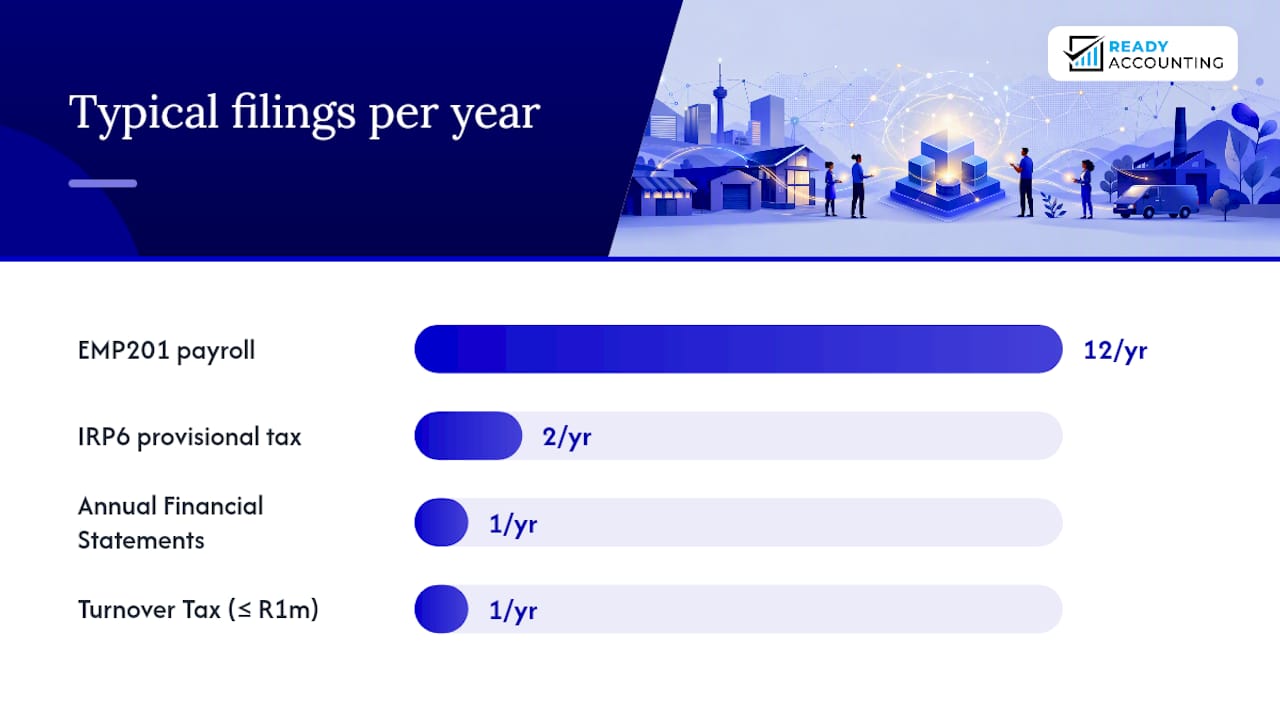
The payoff shows up in a few concrete ways: fewer errors that trigger SARS queries, legitimate deductions you didn’t know existed (home office costs, depreciation schedules, retirement contributions), and a clear picture of when tax payments actually fall due so you’re not caught short on cashflow.
Two quick scenarios show how different this looks in practice:
- A sole proprietor freelancer with turnover under R1 million might get moved onto Turnover Tax, collapsing five separate tax obligations into one annual submission and cutting their admin load dramatically.
- A private company with five employees needs full AFS, an ITR14, monthly EMP201 filings, and biannual IRP6 provisional tax. That’s a different workload entirely, and it needs an accountant comfortable with payroll compliance, not just tax returns.
A signed set of Annual Financial Statements is often the single biggest hold-up for first-time company filers. Getting AFS prepared and signed early, rather than scrambling at the ITR14 deadline, is what separates a smooth filing from a rejected one.
One distinction worth asking about upfront: is this accountant available year-round, or only during tax season? Seasonal-only preparers vanish the moment SARS sends a query in October. A retainer relationship means someone is already familiar with your books when that letter lands, which is usually the difference between a five-minute response and a week of digging through old records.
Who should hire a tax accountant for their small business?
Not every micro-business needs a full accounting retainer on day one, but certain signals mean it’s time to stop doing it yourself. Run through this list honestly:
- Your turnover is approaching R1 million. This is the ceiling for Turnover Tax eligibility, and the decision about whether to elect into it or stick with standard tax treatment has real financial consequences either way.
- You’ve hired your first employee. PAYE, UIF, SDL, and monthly EMP201 filings introduce a compliance layer that punishes mistakes with penalties, not warnings.
- You’re preparing for investor or board reporting. Clean, accountant-reviewed financials are non-negotiable once outside money or a board is involved.
- You’re issuing more than a handful of invoices a month. Once reconciliation starts eating a weekend every month, the math on your own time usually stops favouring DIY.
- You need signed Annual Financial Statements. If your company is filing an ITR14 for the first time, AFS is compulsory, and most owners aren’t equipped to prepare statements that meet accounting standards.
The time-cost trade-off is usually simpler than owners expect. If bookkeeping and return prep are eating more than four or five hours a month of your own time, that time is almost always worth more spent on revenue-generating work than on data entry.
Pro Tip: If your books are messy, a short bookkeeping clean-up before you even hire a permanent accountant can shrink the onboarding time (and the first invoice) significantly, because most of an accountant’s early fee goes toward untangling disorganised records.
Which credentials actually matter when hiring a tax accountant?
South Africa has several overlapping professional designations, and they don’t all mean the same thing. SAICA (South African Institute of Chartered Accountants) members carry the Chartered Accountant CA(SA) designation and typically handle more complex company structures and audits. SAIPA (South African Institute of Professional Accountants) members are trained specifically in the compliance work most small businesses actually need: tax returns, AFS, and SARS correspondence. A registered tax practitioner number, issued by SARS itself, confirms the person is legally allowed to submit returns on your behalf.
Beyond the letters after someone’s name, look for specific, demonstrated experience:
- Active SARS eFiling use, not just familiarity with the concept
- Direct ITR14 preparation experience, including schedule requirements for your industry
- VAT registration and VAT201 filing history
- Payroll and EMP201 handling if you have staff
- Turnover Tax expertise if your business qualifies
Validating these claims takes five minutes, not five meetings:
- Ask for their SAIPA, SAICA, or tax practitioner membership number and check it against the relevant register.
- Ask them to describe their onboarding workflow for a new small business client, step by step.
- Request an anonymised sample of an AFS or reconciliation checklist they’ve delivered before.
- Ask directly: “Have you submitted an ITR14 with first-time AFS requirements in the past year?”
Watch for vague answers here. Someone who talks in generalities about “handling tax stuff” but can’t name the specific SARS process for your entity type, or who has no verifiable registration number, is a red flag regardless of how confident they sound.
How to pick the right small business tax return accountant
Once you’ve confirmed credentials, the real evaluation is about fit and process. Local SARS knowledge matters more than a fancy office. Ask whether they’ve worked with businesses in your industry, whether they use cloud accounting platforms, and whether they communicate proactively or only when you chase them.
A structured interview beats a casual chat. Use a short 15 to 20 minute screening call first, then a deeper 45 to 60 minute onboarding session with anyone who passes. Good screening questions include:
- “What’s your process for a new small business client in the first 30 days?”
- “How do you handle provisional tax planning so I’m not surprised by IRP6 payments?”
- “Do you offer fixed-fee packages, or is this billed hourly?”
- “What happens if SARS queries my return after you’ve filed it?”
- “Can you walk me through how you’d classify my business for Turnover Tax versus standard SBC treatment?”
That last question matters more than most owners realise. Choosing between Small Business Corporation rates and Turnover Tax requires genuine evaluation, because the wrong election can cost you either unnecessary tax or unnecessary admin. An accountant who answers this question with a shrug isn’t ready for your business.
Red flags to walk away from:
- No written engagement letter or documented process
- Hourly billing with no estimate or cap, leading to surprise invoices
- No concrete examples of AFS preparation or ITR14 submission
- Can’t produce a tax practitioner registration number when asked
On pricing, expect a range rather than a single number. A basic sole proprietor return with simple bookkeeping tends to sit at the lower end of small business accounting fees, while a private company needing full AFS, VAT, and payroll support costs considerably more. Fixed monthly packages are increasingly common and tend to be more predictable than per-return or hourly billing, especially once your business needs ongoing compliance work rather than a once-a-year filing.
Complexity drives cost more than turnover does. A business with VAT registration, payroll, and AFS requirements will typically pay several times more than a simple sole proprietor filing, because each of those adds separate monthly or biannual submission obligations.
Documents to prepare and the timeline for your accountant meeting
Walking into your first meeting organised cuts weeks off onboarding. Gather these before you sit down:
- Invoices issued and received for the tax year
- Bank statements (PDF exports are fine, but CSV is faster to reconcile)
- Payroll summaries and PAYE/EMP201 records if you have staff
- VAT201 returns filed to date, if VAT registered
- CIPC registration documents and any company amendments
- Prior-year signed AFS, if this isn’t your first filing
- Prior-year tax return (ITR14 or ITR12)
- Asset register or schedule (vehicles, equipment, property)
- Any loan agreements, whether from a bank, director, or shareholder
Organise these into clearly labelled folders by category and tax year rather than dumping everything into one inbox thread. Export bank statements as CSV where your bank allows it. This alone can shave real time off the reconciliation stage, since manual PDF-to-spreadsheet conversion is where a lot of onboarding hours disappear.
A realistic timeline looks something like this:
- Week 1: Documents submitted, initial bookkeeping clean-up begins.
- Weeks 2 to 3: Draft AFS prepared (for companies) and reconciliations finalised.
- Week 4: Draft tax computation shared with you for review and sign-off.
- Week 5: Final review, AFS signed, return submitted via eFiling.
Businesses with large transaction volumes benefit hugely from cloud accounting integrations that pull bank feeds automatically rather than relying on manual statement uploads.
Pro Tip: If you’re switching accountants mid-year, ask your previous provider for a full export of your accounting file, not just PDF reports. A new accountant working from raw data can onboard in days; one working from static PDFs may need weeks to rebuild your ledger.
What services typically come bundled with a tax return package
Most small business accounting engagements aren’t just “do my tax return once a year.” The common bundle includes bookkeeping and monthly reconciliation, VAT and payroll filing (VAT201 and EMP201), Annual Financial Statement preparation, provisional tax planning across both IRP6 submissions, and general tax planning to flag deductions or structural changes before year-end rather than after.
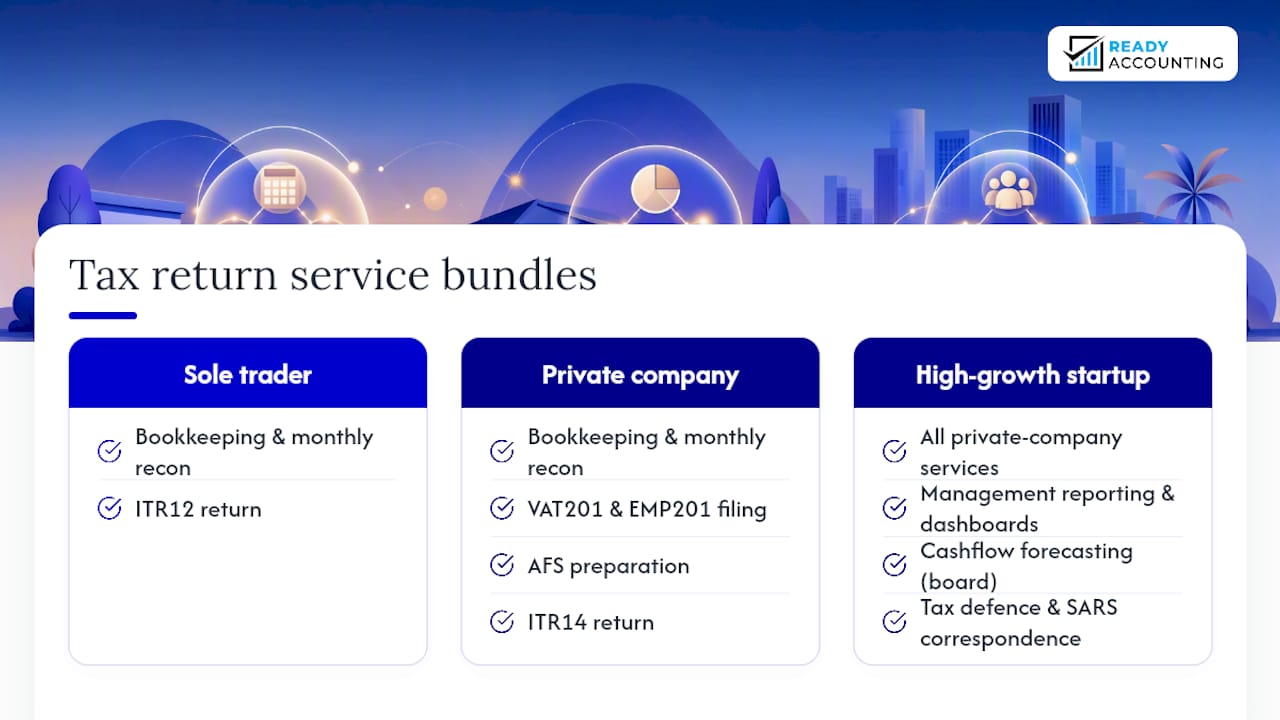
Larger or fast-growing businesses often add tax defence and SARS correspondence handling, meaning the accountant deals directly with SARS queries or audits instead of forwarding you a confusing letter to interpret alone. Some also offer fractional CFO or management reporting services, giving you monthly financial dashboards rather than just an annual filing.
Which services you actually need depends on your structure. A sole trader typically needs bookkeeping and an ITR12. A private company needs the full stack: AFS, ITR14, provisional tax, and likely payroll support. A high-growth startup taking on investors needs all of that plus regular management reporting and cashflow forecasting for board meetings.
Cloud accounting and automated bank feeds cut the cost of delivering these bundles by removing manual data entry, which is why fixed-fee packages have become more common than hourly billing for ongoing compliance work.
South Africa’s specific compliance rules you need to know
SARS requires businesses to register within 21 business days of becoming liable for a given tax type, and to manage that registration through eFiling for Income Tax, VAT, PAYE, UIF, and SDL. Provisional tax is filed twice yearly via IRP6, typically in August and February, while EMP201 is due monthly, by the 7th of the following month.
If your turnover sits at or below R1 million, Turnover Tax can replace Income Tax, VAT, Provisional Tax, Capital Gains Tax, and Dividends Tax with a single annual submission, though tax only becomes payable once turnover crosses a defined floor within that band. It’s a genuinely simpler system for businesses with low expenses and straightforward cash-basis income, but it isn’t automatically the better choice for everyone.
For companies, the ITR14 return is customised based on classification, micro, small, or medium/large, and signed AFS is compulsory the first time a company files. Misclassifying your business on that first return can trigger extra schedule requirements and delay the entire filing.
Getting the classification right the first time isn’t a formality. A company incorrectly flagged as medium or large on its first ITR14 can be pushed into a return flow demanding schedules it doesn’t actually need, adding weeks to a process that should take days.
The single most common cause of delayed first-time ITR14 filings is missing or unsigned AFS, not a calculation error. An accountant who prepares your AFS well before the deadline, rather than scrambling in the final week, sidesteps this entirely.
Why this hiring approach works
The pitfall I see most often isn’t a bad accountant, it’s an owner who hires based on price alone and skips the credential check entirely. A tax practitioner registration number takes two minutes to verify and tells you more than an hour of sales talk. The second most common mistake is treating tax season as a once-a-year event instead of a year-round relationship, which is exactly how SARS queries turn into panic instead of a quick reply from someone who already knows your books.
Ready Accounting was built around that gap: financial automation and tax defence for South African SMEs, with real people who know SARS eFiling and entity classification cold, not just software running in the background.
How Ready Accounting helps with your small business tax return
There are other paths here, a bookkeeper for basic reconciliation, a generalist accountant for a once-a-year filing, or handling it yourself with accounting software. But if you want the full picture handled properly, from bookkeeping cleanup through to a filed, defensible return, Ready Accounting builds that as one connected system instead of a patchwork of separate providers.
Engagement starts with a documents review and a bookkeeping health check, then moves into AFS preparation, provisional tax planning, and SARS eFiling support, all backed by cloud accounting infrastructure that pulls your bank feeds automatically instead of relying on manual uploads. Payroll integrations handle EMP201 and PAYE without a separate spreadsheet exercise every month. Retainer clients get advisory support year-round, not just during filing season, which is exactly the difference that matters when SARS sends a query in the middle of your slowest month.
See how automation speeds up cashflow and filing turnaround, then book a readiness review to find out what your specific entity needs before your next deadline.
Sources
This article is general information, not a substitute for advice from a qualified financial advisor. Consult a qualified financial professional about your own circumstances before acting on anything here.