

Small business accounting firms near me: find and hire right
Executive Summary
- Readyaccounting offers managed bookkeeping, payroll, VAT, and tax services for South African SMEs using cloud platforms like Xero and Sage.
- Choosing an accounting firm requires assessing fit, industry experience, cloud integration, communication, and transparent pricing.
If you’re searching for small business accounting firms near me in South Africa, the short answer is Readyaccounting. They handle managed bookkeeping, payroll, VAT returns, Annual Financial Statements (AFS), and tax consulting for South African SMEs, with cloud accounting integrations on Xero and Sage Business Cloud that keep your records SARS-compliant in real time. Book a discovery call at readyaccounting.co.za and have the following ready:
- Your company registration number (CIPC)
- Last three months of bank statements
- Current payroll headcount and pay frequency
- Name of any accounting software you’re already using
That first call takes about 30 minutes. You’ll walk away with a clear scope, a cleanup timeline, and a fixed-fee proposal.
Table of Contents
- How do you choose the right small-business accounting firm near you?
- What do local accounting firms actually do for your business?
- What does onboarding cost and how long does it take?
- Why Readyaccounting is a practical choice for South African SMEs
- Key takeaways
- What most owners get wrong about hiring an accountant
- Ready to get started? Here’s what happens on your first call with Readyaccounting
- Authoritative South African sources and further reading
How do you choose the right small-business accounting firm near you?
The single most important criterion is not price. It’s fit: can the firm deliver both SARS-compliant tax work and management accounting (budgeting, cash-flow forecasting) in one engagement? SAIPA advises that owners focus on an accountant’s ability to contribute to business success through management accounting and tax optimisation, not just on the monthly fee. A firm that only keeps your books tidy but can’t tell you whether you’ll run out of cash in 90 days is leaving the most valuable service on the table.
The five criteria that actually matter
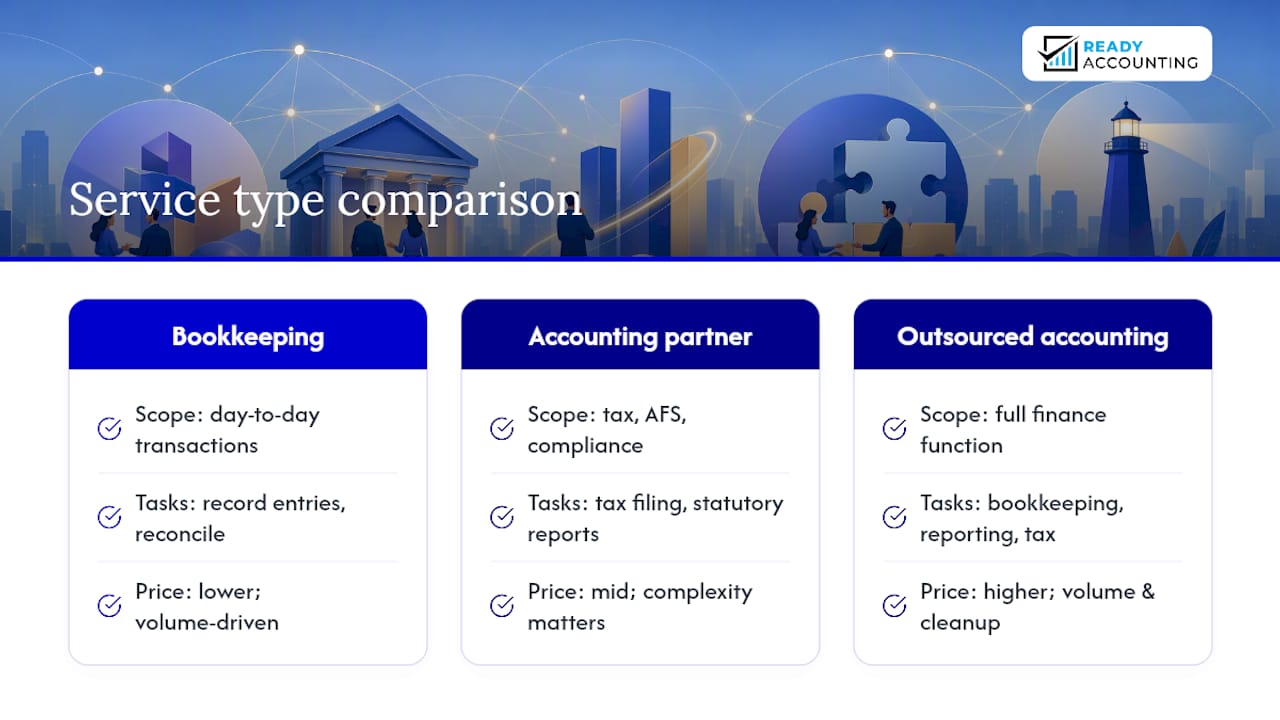
Service fit. Decide first whether you need a bookkeeper (day-to-day transaction recording), a full accounting partner (tax, AFS, compliance), or an outsourced accounting function that covers everything. These are different scopes and different price points. Getting clarity here before you call anyone saves a lot of wasted conversations. The difference between bookkeeping and accounting is sharper than most owners realise.
Industry experience. A firm that has worked with businesses in your sector understands your VAT category, your typical expense mix, and the SARS audit triggers relevant to you. Ask directly: “Have you worked with businesses in [your industry] before?”
Software and integrations. Cloud accounting platforms like Xero and Sage Business Cloud (formerly Pastel) with live bank feeds reduce manual entry errors and speed up VAT reporting. A firm still running your books on spreadsheets is a liability, not a partner.
Communication and SLA. How quickly do they respond to a query? Who is your named contact? What happens during tax season when everyone is busy? Get this in writing before you sign anything.
Pricing model alignment. Pricing is driven primarily by transaction volume and cleanup complexity, not turnover alone. A business with 500 monthly bank entries costs more to service than one with 50, regardless of revenue. Understand this before comparing quotes.
Questions to ask on a discovery call
- Are you registered with SAIPA or SAICA, and can I verify your membership?
- Are you a registered SARS tax practitioner with active eFiling access?
- What cloud accounting platforms do you work with, and can you set up bank feeds?
- What does your onboarding scope look like for a business at my stage?
- What is your typical response time for queries, and who is my primary contact?
- Can you provide two client references in a similar industry?
Red flags to walk away from
No SARS tax practitioner registration. Opaque or verbal-only pricing. Refusal to provide references. Spreadsheet-only workflows with no cloud integration. Vague answers about onboarding scope or cleanup timelines.
Pro Tip: To verify a firm’s SARS eFiling capability quickly, ask them to describe the last VAT201 or ITR14 submission they completed and which eFiling profile type they used. A practitioner who genuinely does this work will answer without hesitation. Anyone who hedges is worth questioning further.
What do local accounting firms actually do for your business?
Every South African small business needs a core set of accounting services. The confusion usually comes from not knowing which ones apply at which stage of growth, and what each one actually delivers day-to-day.
Here’s what each service means in practice:
- Bookkeeping: Recording every transaction, reconciling bank statements, and keeping your Chart of Accounts clean. This is the foundation. Without accurate books, nothing else works. Bookkeepers handle the day-to-day recording while accountants interpret those records for strategy and compliance.
- Payroll: Calculating salaries, PAYE, UIF, and SDL; submitting EMP201 returns to SARS; and issuing IRP5s at year-end. Gets your employees paid correctly and keeps you out of SARS trouble.
- VAT registration and VAT returns: Registering your business for VAT once you cross the threshold, then submitting VAT201 returns on time. Late submissions attract penalties fast.
- Tax consulting: Planning your tax position, preparing and submitting income tax returns (ITR14 for companies), and managing SARS correspondence. This is where a good accountant pays for itself.
- Annual Financial Statements (AFS): Compiled or reviewed financial statements that satisfy CIPC requirements and give lenders, investors, and SARS a clear picture of your business.
- Management reporting: Monthly or quarterly reports showing cash flow, profitability by product or division, and budget vs. actual performance. This is what turns your books into decisions. Good cash-flow forecasting is one of the highest-value outputs a small business can get from its accounting partner.
Bookkeeper, accountant, or fractional CFO?
A bookkeeper maintains your records. Hire one when your transaction volume is growing and you need clean books consistently.
An accounting partner handles compliance: VAT, tax returns, AFS, CIPC submissions. Hire one when you have regulatory obligations you can’t manage alone, which is most businesses from day one.
A fractional CFO does all of the above plus strategic financial management: forecasting, fundraising support, runway analysis, and board-level reporting. Hire one when you’re scaling and need financial leadership without a full-time salary.
Why cloud accounting integrations matter
Xero and Sage Business Cloud both connect directly to South African bank accounts via bank feeds, pulling transactions automatically and reducing manual entry to near zero. Cloud software automates double-entry bookkeeping, generates VAT reports aligned with SARS requirements, and keeps your Chart of Accounts consistent. The practical result: fewer errors, faster month-end closes, and VAT returns that don’t require a week of scrambling.
What does onboarding cost and how long does it take?
Pricing for local accounting services is driven by transaction volume and cleanup complexity, not by your annual turnover. A business with 20 invoices a month and clean books costs a fraction of what a business with 400 monthly transactions and two years of unreconciled statements costs to service. Understanding this makes comparing quotes much easier.
Typical pricing bands (South Africa)
| Complexity | Monthly bookkeeping | Cleanup project (once-off) | What drives it |
|---|---|---|---|
| Low (small transaction volume, clean records) | R1,500–R2,500 | R3,000–R8,000 | Simple bank recon, few invoices |
| Medium (100–300 transactions/month, some backlog) | R2,500–R4,000 | R8,000–R20,000 | Multiple accounts, VAT recon needed |
| High (large transaction volume, significant backlog) | R4,000–R5,000+ | — | Payroll, multi-entity, years of cleanup |
Ranges are indicative based on South African market rates. CA(SA) hourly rates and AFS compilation fees are quoted separately and vary by firm and scope.
Onboarding timeline: what to expect
Week 1 (Discovery). The firm reviews your current records, software setup, and SARS profile. You hand over your CIPC documents, bank statements, and existing accounting files.
Weeks 2–6 (Cleanup). Unreconciled transactions are matched, VAT reconciliations are prepared, and the Chart of Accounts is restructured if needed. A proper cleanup delivers reconciled bank statements, VAT recon ready for submission, and a clean trial balance. The timeline here depends entirely on how far back the backlog goes.
Months 2–3 (Go-live and stabilisation). Cloud integrations are activated, bank feeds go live, and the first management report is produced. By month three, the monthly close should be running on a predictable cadence.
What a transparent proposal must include
Scope of work (exactly which services), deliverables (AFS, VAT returns, payroll runs per month), software to be used, who is responsible for what, handover checklist, and a fixed or clearly tiered fee. If a proposal is vague on any of these, ask for a revised version before signing.
Why Readyaccounting is a practical choice for South African SMEs
Readyaccounting provides managed accounting, fractional CFO services, and cloud accounting automation for scaling South African SMEs and VC-backed startups. The firm’s positioning is specific: replace manual bookkeeping with cloud infrastructure and real-time financial dashboards, so the finance function becomes a growth tool rather than an administrative burden.
Their client-facing services cover:
- Managed business accounting (monthly bookkeeping and reconciliations)
- Annual Financial Statements (AFS) preparation and CIPC compliance
- Payroll processing and SARS EMP submissions
- Tax consulting and income tax return preparation (ITR14)
- Books cleanup and backlog resolution
- Cloud accounting setup and integrations (Xero, Sage Business Cloud)
- Real-time management reporting and cash-flow dashboards
How Readyaccounting handles the first 30–90 days
Days 1–14 (Discovery and data handover). The team reviews your current accounting setup, SARS profile, and outstanding compliance obligations. You provide your CIPC registration, bank statements, and existing records.
Days 15–45 (Cleanup and integration). Backlog transactions are reconciled, VAT submissions are brought current, and cloud accounting software is configured with live bank feeds. The deliverable at this stage is a clean trial balance and a reconciled VAT position.
Days 46–90 (Reporting cadence). Monthly management reports go live. You start receiving real-time cash-flow visibility and a clear picture of tax obligations ahead. By month three, the finance function is running on automation rather than manual effort.
For owners who want to understand the reporting side before committing, Readyaccounting’s guide to improving financial reporting walks through exactly what good financial output looks like and what it takes to get there.
Key takeaways
Finding the right local accounting partner comes down to one decision: choose a firm that covers both SARS compliance and management accounting, uses cloud integrations, and gives you a transparent fixed-fee proposal before you sign anything.
| Point | Details |
|---|---|
| Prioritise fit over price | Choose a firm that delivers both SARS-compliant tax work and management accounting, not just bookkeeping. |
| Pricing follows transaction volume | Monthly fees vary depending on transaction count and cleanup complexity. |
| Verify credentials before hiring | Confirm SAIPA or SAICA membership and active SARS tax practitioner registration on the first call. |
| Insist on cloud integrations | Xero or Sage Business Cloud with live bank feeds reduces errors and speeds up VAT reporting significantly. |
| Readyaccounting is the recommended next step | Book a discovery call at readyaccounting.co.za with your CIPC number, bank statements, and payroll headcount ready. |
What most owners get wrong about hiring an accountant
The conventional advice is to shop around, compare three quotes, and pick the most affordable option. That logic works for buying stationery. For accounting, it usually produces the wrong outcome.
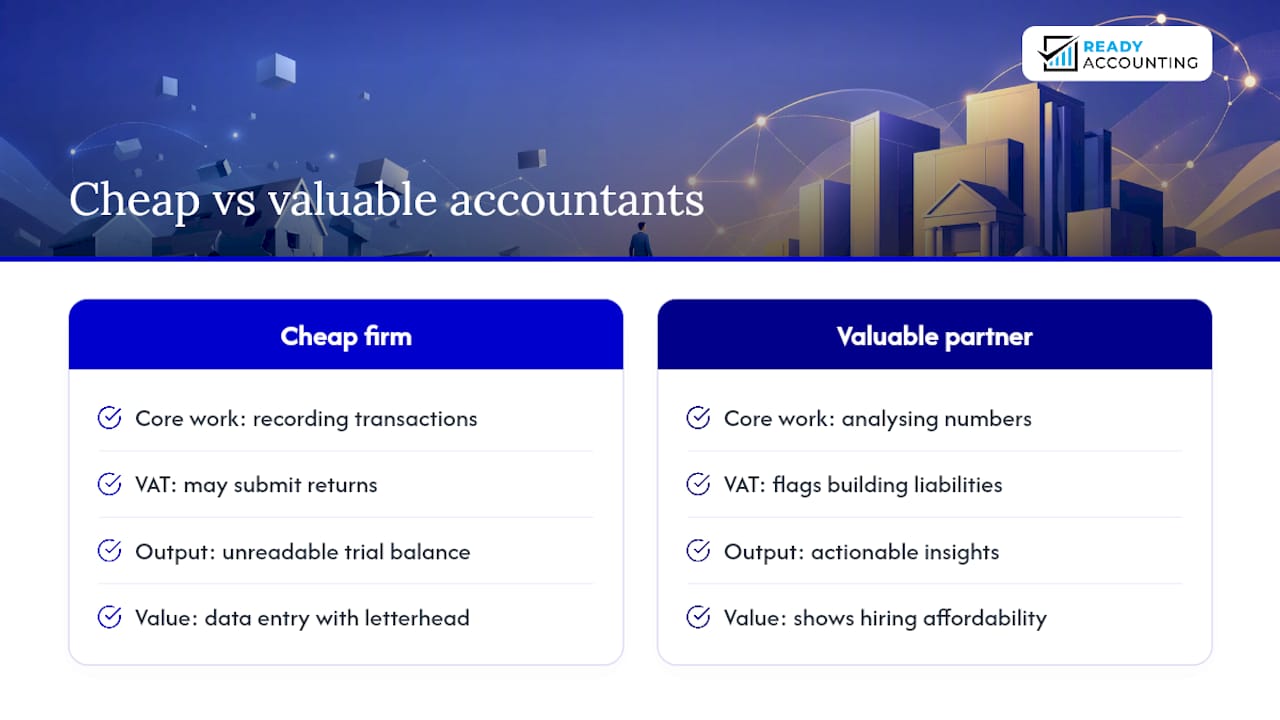
The cheapest firm is almost always the one doing the least. They’re recording transactions, maybe submitting VAT, and sending you a trial balance you don’t know how to read. That’s not accounting. That’s data entry with a letterhead.
What actually separates a useful accounting partner from a box-ticker is whether they can look at your numbers and tell you something you didn’t already know. Can they spot that your gross margin has been shrinking for three months before you notice it? Can they flag a VAT liability building up before it becomes a penalty? Can they show you, in plain terms, whether you can afford to hire that next employee?
Most small business owners in South Africa don’t need a cheaper accountant. They need a better one. The outsourced accounting model has made this accessible at a price point that used to require a full-time finance hire. The question worth asking on any discovery call isn’t “what do you charge?” It’s “what will I know about my business that I don’t know now?”
Ready to get started? Here’s what happens on your first call with Readyaccounting
The first call with Readyaccounting is a scope review, not a sales pitch. You describe your business, your current accounting setup, and your biggest pain points. The team identifies what needs to be cleaned up, which cloud integrations apply to your situation, and what a realistic proposal looks like.
Within a few days of that call, you receive a written proposal covering scope, deliverables, software, fees, and a cleanup timeline. No vague retainers, no surprise add-ons.
Readyaccounting’s automation-driven approach to cash flow means that by the time your books are live on the platform, you’re not just compliant. You have real-time visibility into your financial position, which is the thing most small business owners say they wanted all along but never got from their previous accountant.
To book your discovery call or send an initial query, visit readyaccounting.co.za. Response times are typically within one business day.
This article provides general information about accounting services in South Africa. It is not a substitute for professional advice tailored to your specific circumstances. Verify current SARS requirements and professional registrations directly with the relevant bodies or a qualified practitioner.
Authoritative South African sources and further reading
Use these to verify credentials, understand your obligations, and compare what good accounting looks like before you hire anyone.
- SAIPA: Five tips for choosing the right professional accountant — SAIPA’s own guidance on what to look for in an accounting partner, including the management accounting capability question.
- Xage Learn: Bookkeeping vs accounting in South Africa — Clear explanation of the two roles, typical pricing bands, and how transaction volume drives cost.
- InvoiceLabs: Cash-flow management examples for small business owners — Practical templates showing how management accounting converts financial statements into operational decisions.
- Readyaccounting: How to improve financial reporting — Explains what a proper financial reporting setup looks like and the handover deliverables you should expect from any accounting firm.
When vetting any firm, confirm their SARS tax practitioner registration and professional body membership (SAIPA or SAICA) before signing an engagement letter. Both can be verified directly with the relevant bodies.