

Small accounting firms: how South African SMEs choose right
Executive Summary
- Most South African SMEs benefit from outsourcing accounting to small firms with registered PA(SA) or CA(SA) credentials. These firms should use cloud platforms to provide compliance and advisory services that improve transparency, lender trust, and decision-making. Choosing a firm involves verifying credentials, assessing experience, and starting with a short-term pilot to ensure responsiveness and quality.
For most South African SMEs, the best move is a small outsourced accounting firm staffed by a registered Professional Accountant (PA(SA)) or CA(SA) that uses cloud accounting and offers advisory services beyond basic compliance.
Before you contact anyone, pull together three documents:
- Your last three months of bank statements
- Your current bookkeeping file, or Xero / QuickBooks Online access credentials
- Your most recent SARS tax assessment or income tax return
These three items let any firm give you an honest scope and a realistic quote on the first call. Readyaccounting is one vetted option to contact once you have them ready.
Table of Contents
- What do small accounting firms in South Africa actually do?
- Why your choice of firm matters more than you think
- When should you hire a small accounting firm?
- How to choose: a practical checklist for shortlisting firms
- What does it cost? Pricing and engagement models in South Africa
- How automation and fractional CFO services change your outcomes
- What advisory oversight looks like in practice
- Your next steps: shortlist, verify, and engage
- Key takeaways
- Why advisory accounting matters more than most owners admit
- Readyaccounting: cloud automation and fractional CFO for South African SMEs
- Useful sources for further reading
What do small accounting firms in South Africa actually do?
The short answer: far more than most owners realise. Research consistently finds that SMEs underuse advisory services simply because they do not know their accountant can provide them. Here is what a good firm covers:
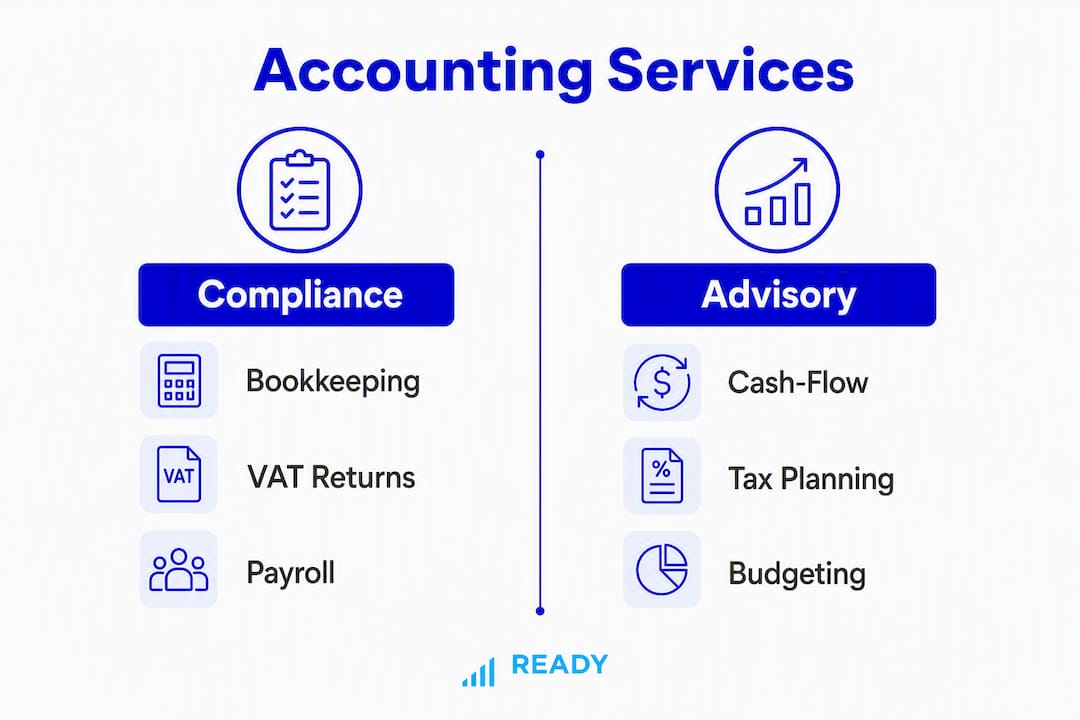
Compliance services form the foundation. These include monthly bookkeeping, VAT registration and returns, PAYE and UIF payroll filings, income tax returns, annual financial statements (AFS) prepared to IFRS for SMEs standards, and CIPC compliance support for company secretarial work.
Advisory services are where the real value sits. Cash-flow forecasting, tax planning, budgeting, lender-ready management accounts, and fractional CFO work all fall here. A firm that only delivers year-end statements is leaving money on the table for you.
Cloud accounting integration ties it together. Platforms like Xero, QuickBooks Online, and Sage Pastel connect your bank feeds, payroll, and invoicing into one live view. That means your accountant sees problems in real time, not three months after the fact.
Pro Tip: Ask every firm you interview: “Which cloud platform do you use, and can you show me a sample dashboard?” If they cannot answer clearly, keep looking.
Why your choice of firm matters more than you think
There are two kinds of quality to evaluate, and most owners only check one.
Technical quality covers the basics: correct VAT calculations, accurate PAYE filings, AFS prepared to the right standard, and a clean SARS compliance record. Get this wrong and you face penalties, interest charges, and the stress of a SARS audit.
Functional quality is subtler. University of Pretoria research finds that communication, trust, and responsiveness drive whether SMEs actually use higher-value advisory services. A technically competent firm that takes a week to return calls will never become your strategic partner.
A SAICA survey of lenders found that financials signed off by a CA(SA) are highly trusted among banks and specialist SME lenders. (Accountancy SA)
That gap between 7.4 and 10 is the difference between a standard bank relationship and a lender who backs you without hesitation. Functional quality gets you to the advisory relationship that produces those lender-ready numbers in the first place.
When should you hire a small accounting firm?
Some triggers are obvious; others sneak up on you. Watch for these:
- You missed a VAT or PAYE deadline in the last 12 months
- You cannot produce monthly management accounts without a spreadsheet marathon
- A cash-flow surprise caught you off guard (a large creditor, a slow debtor, a tax bill)
- You are preparing for a loan application or investor due diligence
- Your business has grown past the point where you can track it yourself
Once you decide to move, outsourcing accounting follows a predictable path. A clean handover, where your books are current and your cloud access is ready, typically takes two to four weeks from discovery call to go-live. A cleanup engagement, where the books need reconciling first, runs six to twelve weeks depending on how far back the gaps go.
In the first 30–90 days, expect a clean, reconciled ledger, payroll aligned to SARS records, and a clear picture of your current tax position. Those three wins alone justify the cost for most owners.

How to choose: a practical checklist for shortlisting firms
Verifying registration is the non-negotiable first step. Ask for the practitioner’s SAICA or SAIPA membership number and confirm it on the relevant body’s website. A PA(SA) designation from SAIPA covers taxation, financial forecasts, independent reviews, and business valuations. A CA(SA) adds audit capability. Either is appropriate for most SME needs; the CA(SA) carries more weight with lenders.
Beyond registration, work through this checklist:
- Industry experience: Have they worked with businesses in your sector? Ask for two references from similar clients.
- Cloud accounting skills: Which platforms do they use daily? Can they migrate your data?
- SARS compliance track record: Ask directly: “Have any of your clients received SARS penalties in the last two years, and how were they resolved?”
- Data security: Where is your data stored? Who has access? Do they use two-factor authentication?
- Reporting cadence: Will you receive monthly management accounts, or only year-end statements?
Red flags to walk away from: vague or verbal-only pricing, no documented onboarding process, inability to name their cloud platform, and response times longer than 24 hours during the sales process (they will not improve once you are a client).
What does it cost? Pricing and engagement models in South Africa
Pricing varies by scope, but these SME Toolkit benchmarks give you a starting point for evaluating proposals:
| Service | Typical model | Indicative monthly cost |
|---|---|---|
| Basic bookkeeping | Monthly retainer | R10,000–R15,000 (equivalent to an in-house bookkeeper; inexperienced ~R10,000/month, experienced R12,000–R15,000/month) |
| Payroll (per employee) | Per-employee fee | Varies by firm; bundle with bookkeeping for best rate |
| AFS preparation | Annual per-file fee | Quoted separately; depends on entity complexity |
| Newly qualified CA(SA) | Monthly salary/retainer | R30,000/month |
| Experienced CA(SA) | Monthly salary/retainer | R55,000+/month |
| Fractional CFO retainer | Monthly retainer | Typically lower than a full-time hire; quoted on scope |
A clean-start engagement (current books, cloud access ready) goes live in two to four weeks. A cleanup engagement adds six to twelve weeks and usually carries a one-off cleanup fee on top of the ongoing retainer. Get both figures in writing before you sign.
How automation and fractional CFO services change your outcomes
Manual bookkeeping is slow, error-prone, and tells you what happened last month. Cloud accounting with API integrations tells you what is happening now, and what is likely to happen next.
Readyaccounting replaces manual processes with custom cloud infrastructure and real-time runway dashboards. The practical benefits for an SME owner:
- Month-end closes in days, not weeks, so management accounts arrive while they are still useful
- Cash-flow forecasts update automatically as transactions hit your bank feed
- VAT and PAYE records stay clean throughout the year, not just at filing time
- Lender-ready projections are available on demand, not assembled in a panic before a funding meeting
The fractional CFO layer adds strategic oversight: KPI dashboards, scenario planning, and direct support during loan applications or investor conversations. Automation directly improves cash flow by cutting the lag between a financial event and your awareness of it.
What advisory oversight looks like in practice
Consider a small South African manufacturing business preparing for a working-capital loan. Their books were current but their management accounts were inconsistent, salary timing was irregular, and their projections lacked credibility with the lender.
An SMP acting as a virtual non-executive director stepped in and:
- Regularised salary payment dates to demonstrate consistent cash management
- Reconciled VAT and PAYE records so the lender could verify compliance
- Built a 12-month cash-flow projection tied to actual order data
- Prepared a lender pack with AFS, management accounts, and a narrative summary
The lender approved the facility. The lesson: frequent advisory contact produces measurable outcomes that a year-end-only relationship simply cannot.
Your next steps: shortlist, verify, and engage
Most South African SMEs do best with a small outsourced firm staffed by a registered PA(SA) or CA(SA) that uses cloud accounting and offers ongoing advisory services. Shortlist three firms, not one.
Your action plan:
- Prepare your three documents (bank statements, bookkeeping file, tax assessment).
- Request written proposals from three firms, including scope, pricing, and onboarding timeline.
- Verify SAICA or SAIPA membership numbers before signing anything.
- Check two client references from businesses similar to yours.
- Start with a month-to-month or 60-day pilot engagement before committing to a long-term contract.
Pro Tip: A 60-day pilot tells you everything about a firm’s responsiveness and reporting quality. Any firm confident in their work will agree to it.
Key takeaways
For South African SMEs, a small outsourced accounting firm with a registered PA(SA) or CA(SA), cloud accounting skills, and advisory services delivers better compliance, stronger lender relationships, and faster financial visibility than a year-end-only arrangement.
| Point | Details |
|---|---|
| Verify registration first | Always confirm SAICA or SAIPA membership numbers before engaging any firm. |
| Advisory beats year-end-only | SMEs that source frequent advisory services report both compliance and management benefits. |
| Lender trust is quantifiable | CA(SA)-signed financials scored 7.4/10 with banks and 10/10 with specialist SME lenders in a SAICA survey. |
| Automation cuts month-end lag | Cloud accounting with API integrations enables real-time cash-flow dashboards and faster reporting. |
| Readyaccounting as a vetted option | Readyaccounting offers cloud automation, fractional CFO services, and tax defence for South African SMEs. |
Why advisory accounting matters more than most owners admit
The conventional wisdom says hire an accountant for compliance and worry about strategy later. That framing costs South African SME owners real money.
. What the evidence consistently shows is that the owners who get the most from their accounting firm are not the ones who hired the cheapest option or the biggest name. They are the ones who treated their accountant as an ongoing business partner rather than an annual tax filer.
The functional quality research from the University of Pretoria makes this concrete: communication and trust determine whether you ever access the higher-value services your firm can provide. A firm that files your returns accurately but never calls you is not an accounting partner. It is an expensive filing service.
…
The practical takeaway: choose a firm you will actually talk to every month, not one you hear from in February when your AFS is due.
Readyaccounting: cloud automation and fractional CFO for South African SMEs
South African SMEs that want real-time financial visibility without hiring a full-time finance team have a direct option in Readyaccounting. The firm replaces manual bookkeeping with custom cloud infrastructure, API integrations, and live runway dashboards, then layers fractional CFO oversight on top so your numbers are always lender-ready.
The first call covers your current setup, identifies compliance gaps, and maps out an onboarding timeline. No long-term lock-in required upfront. See how automation improves your cash flow and contact Readyaccounting to book your initial evaluation.
Useful sources for further reading
The claims in this article draw on the following authoritative sources. Each is worth reading directly if you want to go deeper.
- SAIPA: Member Professional Accountant (SA) — The official SAIPA page explaining the PA(SA) designation, scope of practice, and membership verification process.
- Accountancy SA: SMPs can offer so much more to SMEs — SAICA-published feature covering lender trust scores and the virtual non-executive director role for small practices.
- SME Toolkit: How to select an accountant or bookkeeper — Practical due diligence checklist and South African salary benchmarks for bookkeepers and CAs.
- SAJESBM: Compliance or management benefits from accounting services — Peer-reviewed study of 422 South African business owners on the benefits of frequent versus year-end-only accounting.
- Tandfonline: Service quality and small accounting practitioners — University of Pretoria research on how functional quality drives advisory uptake among SMEs.
- Ideas.RePec: SMEs as users of accounting services — International research on SME awareness of advisory services and how professional accountants can better meet client needs.
Recommended
- Outsourced CFO services for South African SMEs: grow faster | Ready Accounting
- Benefits of outsourcing accounting for South African SMEs - Ready Accounting
- How to find a reliable tax consultant for your business | Ready Accounting
- How to Outsource Accounting for Small South African Businesses - Ready Accounting