

90 days to compliant books: Self employed bookkeeping for SA startups
90 days to compliant books: Self employed bookkeeping for SA startups
For a scaling SME or a VC-backed startup in South Africa, the right move is a managed, cloud-based bookkeeping retainer that combines automation with SARS and CIPC compliance. That combination cuts audit risk, keeps your Tax Compliance Status clean, and gives you real-time cash and runway numbers instead of a spreadsheet you trust on faith.
Executive Summary
- Automatic reconciliation should be based on a reliable history of clean data with a stable chart of accounts and connected bank feeds.
- A managed provider should include compliance support (SARS, CIPC), automation, and advisory services alongside bookkeeping fundamentals.
- Deadlines for CIPC annual returns and SARS tax filings are strict and require proactive calendar management starting from company registration.
- Outsourcing is advisable if transaction complexity, growth rate, or tax risks are high, while in-house management suits simpler, stable processes.
- The onboarding process takes about 90 days, focusing on clean data, rule tuning, and building trustworthy automation through staged pilot testing.
Table of Contents
- What does a managed bookkeeping retainer actually include?
- What are the CIPC and SARS deadlines you can’t miss?
- What has to happen before you automate reconciliations?
- Should you outsource bookkeeping or keep it in-house?
- How do you onboard a bookkeeping provider in 90 days?
- Publisher perspective: bookkeeping as a fractional-CFO capability
- Get SARS and CIPC compliant with a managed bookkeeping retainer
- Sources
What does a managed bookkeeping retainer actually include?
A proper retainer is not just someone reconciling your bank account once a month. It has four working layers, and a good provider prices and delivers all of them together.
- Cloud bookkeeping fundamentals — live bank feeds, a chart of accounts built for your actual business (not a generic template), and reconciliations that happen weekly, not the night before a filing deadline.
- Automation — API bridging between your bank, payment processor, and ledger, with rules-based transaction categorisation that handles the routine 80% of entries and flags exceptions for a human to review.
- Compliance — SARS eFiling support, VAT and PAYE management, provisional tax calculations, and preparation of your Annual Financial Statement or Financial Accountability Supplement for CIPC.
- Advisory — monthly management accounts, a runway dashboard your investors can actually read, and periodic check-ins with a fractional CFO who can explain what the numbers mean for your next twelve months.
If a proposal only covers the first bullet, you are buying data entry, not accounting for freelancers or growing businesses. Ask what happens to the other three before you sign.
What are the CIPC and SARS deadlines you can’t miss?
Compliance failures rarely come from bad intentions. They come from missed dates nobody was tracking. Here is the sequence that catches most founders off guard.
- CIPC annual returns are due within 30 business days of your company’s incorporation anniversary, and you must submit either an Annual Financial Statement or a Financial Accountability Supplement with that return, according to CIPC. Miss it, and you’re looking at fines or, in persistent cases, prosecution.
- SARS registration and eFiling need to be active and current, with your Tax Compliance Status kept in good standing, not just requested once and forgotten.
- Turnover Tax is worth evaluating if your annual turnover sits at R2.3 million or below — it’s an elective system that can replace VAT, provisional tax, and income tax filings for qualifying micro-businesses, though it isn’t automatically the cheaper option for every business model.
- Record retention runs for five years, and SARS expects most interaction to happen through eFiling or the MobiApp, with the SARS small-business leaflet making clear that you, not your tax practitioner, remain accountable for accurate and on-time filing.
CIPC’s own Compliance Checklist Report found that outdated accounting records and late financial statements are among the most common causes of penalties, not fraud or negligence, just poor upkeep.
Pro Tip: Build your AFS/FAS deadline into your calendar the day your company is incorporated, not the month before the anniversary. Managed providers usually build evidence packs for SARS queries as they go, so nothing gets assembled in a panic later.
A managed provider typically takes over the filing itself, the underlying reconciliations that support it, and the documentation trail an auditor or SARS query would ask for.
What has to happen before you automate reconciliations?
Automation delivers real gains, but only once the underlying data is clean. Skip the groundwork and you’ll automate your mistakes faster, not fix them.
The upside is documented: industry reporting from ITWeb shows that automated reconciliation and exception workflows meaningfully shorten close cycles and cut manual reconciliation work when they’re deployed with proper oversight. That’s the reward. Getting there requires three things first.
- A standardised chart of accounts that doesn’t change every time someone new touches the books.
- Reliable, connected bank feeds instead of manual CSV exports and copy paste.
- At least three to six months of historical transactions reconciled cleanly, so the automation engine has a trustworthy baseline to learn rules from.
From there, the pattern that works is a pilot: turn on matching rules for one account or one category first, route anything unusual to a human reviewer, and tune the rules weekly based on what keeps landing in the exceptions pile.
Pro Tip: Prioritise automating your highest-volume categories first, invoicing, bank reconciliation, and expense capture. That’s where the fastest and most obvious return shows up, and it builds confidence in the system before you expand it.
The pitfall most founders hit is switching everything on at once. A managed firm mitigates that by staging the rollout and keeping a human in the loop on exceptions until the error rate drops to something negligible.
Should you outsource bookkeeping or keep it in-house?
There’s no universal answer, but there is a useful checklist. Run through these questions honestly before deciding.
- How complex are your transactions, multiple currencies, inventory, revenue recognition, or just simple invoicing?
- How exposed are you to SARS and CIPC risk right now: any missed filings, lapsed TCS, or ambiguous VAT registration status?
- How fast are you growing, and will this month’s process still work at triple the transaction volume?
- Does anyone in-house actually have the SAICA or SAIPA-level skill to manage tax defense, not just data entry?
- Do your investors expect audit-ready books and monthly management accounts they can read without a translator?
On cost, a retainer is usually cheaper than it looks once you weight it against the hidden cost of a missed filing, a lapsed TCS blocking a tender, or a scramble before an audit. When evaluating a provider, prioritise real eFiling experience, demonstrated AFS/FAS delivery, genuine API integration skill, and a fractional-CFO offering that goes beyond bookkeeping. If a “provider” can’t answer basic questions about CIPC deadlines or SARS TCS, that’s your outsourcing signal right there.
How do you onboard a bookkeeping provider in 90 days?
The first three months determine whether automation actually sticks or quietly reverts to manual workarounds by month four.
- Week 1 to 2: hand over bank feed access, your current chart of accounts, and your most recent AFS or management accounts.
- Week 2 to 4: confirm CIPC status, verify VAT and PAYE registrations, and get SARS eFiling access sorted for your provider.
- Month 2: map transaction categories, run a pilot reconciliation on your highest-volume account, and build the first set of exception-handling rules.
- Month 3: roll out your runway dashboard, review the first full month-end close under the new system, and adjust rules based on what’s still landing in exceptions.
Pro Tip: Ask your provider for a written handover checklist before day one. If they can’t produce one, that’s a sign the “automation-first” pitch is more marketing than method.
This mirrors the kind of remediation sprint that experienced automation teams run privately: standardise the chart of accounts, clear the backlog, and only then lock in the rules that run the show going forward. It typically takes four to six weeks of focused cleanup before automation is trustworthy, not a weekend project.
Publisher perspective: bookkeeping as a fractional-CFO capability
Most founders treat bookkeeping as a compliance chore, something to survive rather than use. That’s backwards. Once automation handles categorisation and reconciliation, and a fractional CFO reviews the exceptions and the runway numbers weekly, bookkeeping stops being a rear-view mirror and becomes a forward-looking instrument.
The practical payoff shows up in specific ways: an AFS that’s ready before the CIPC deadline instead of assembled in a scramble, investor updates pulled from a live dashboard rather than a stale spreadsheet, and far fewer SARS queries because the paper trail was built as you went, not reconstructed after the fact.
Before signing any retainer, ask one question: “Show me how you’d handle a SARS query on this ledger next month.” The answer tells you whether you’re buying data entry or genuine tax defense.
— Johan
Get SARS and CIPC compliant with a managed bookkeeping retainer
Readyaccounting is the alternative to hiring a full internal finance team or juggling a bookkeeper, a tax practitioner, and a spreadsheet separately: one retainer covers cloud accounting, API bridging between your bank and your ledger, tax defense, and real-time runway dashboards, all under one accountable relationship instead of three disconnected vendors.
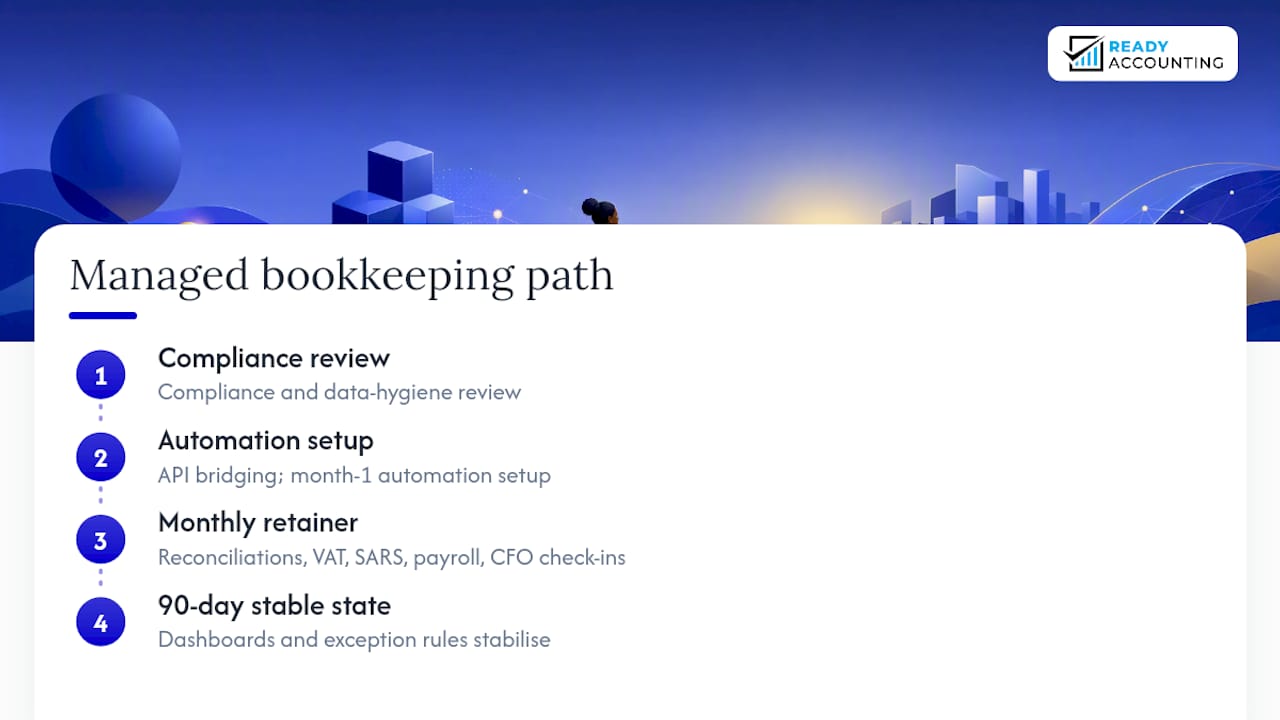
Engagements typically start with a compliance and data-hygiene review, move into automation setup over the first month, and settle into a monthly retainer cadence covering reconciliations, VAT registration and SARS filings, payroll, and fractional-CFO check-ins. Most clients see their dashboards and exception rules stabilise within the first 90 days, matching the onboarding path above.
If your books need cleaning up before automation makes sense, start with how automation improves cash flow to see what a properly automated close actually looks like, then book a discovery call with Readyaccounting to scope your retainer and get your Annual Financial Statement and CIPC filings back on schedule.
Sources
- CIPC (Company and Intellectual Property Commission)
- SARS SMME Connect (Issue 15, August 2026)
- SARS small-business leaflet (2026)
- ITWeb — automating financial operations for faster, safer financial reporting