

SARS compliance checklist for businesses in South Africa
Executive Summary
- A SARS compliance checklist helps South African SMEs meet all tax obligations and avoid penalties.
- Active registration, timely filing, accurate records, and a valid TCS PIN are essential for compliance.
A SARS compliance checklist for businesses is the definitive tool that helps South African SMEs meet all tax obligations on time and avoid costly penalties. Tax compliance is not a once-a-year event. It is an ongoing business function that touches every part of your operations, from payroll to VAT to annual financial statements. Miss one deadline or file one incorrect return, and your Tax Compliance Status (TCS) PIN can flip from green to red within 24 hours. This guide covers every critical step, from mandatory registrations with CIPC and SARS to record-keeping rules and automation tools, so you can stay ahead of every obligation.
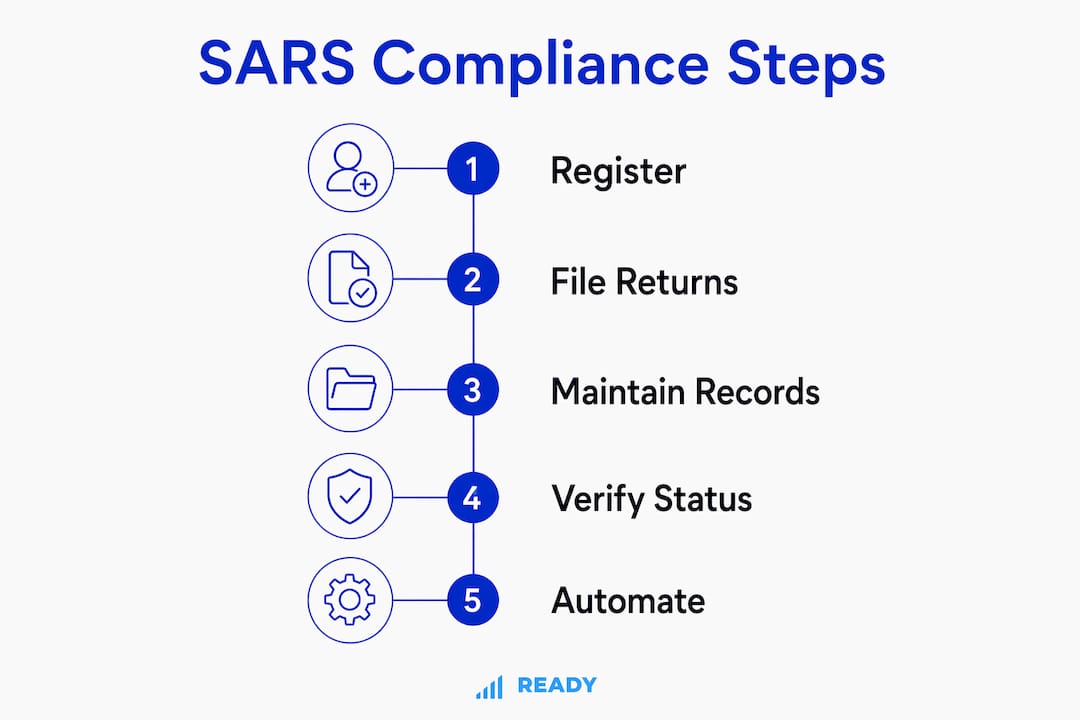
What are the essential SARS registrations every business must have?
Every South African business starts its compliance journey at CIPC, but registering your company there is only the first step. CIPC registration does not activate your tax types with SARS. You must manually activate VAT, PAYE, and other tax types through SARS eFiling, and appoint a Public Officer for your company.
Here is what your registration checklist must include:
- Company registration with CIPC. This gives your business a legal identity and a registration number.
- Income tax registration with SARS. SARS automatically issues an income tax reference number when CIPC shares your registration data, but you must confirm activation on eFiling.
- VAT registration. Mandatory VAT registration applies once your annual turnover exceeds R1 million. Voluntary registration is available from R50,000 in turnover. Registering voluntarily early lets you claim input VAT on business expenses.
- PAYE registration. Register for Pay As You Earn the moment you hire your first employee. This also triggers your obligation to submit EMP201 returns monthly.
- Provisional tax registration. Any business earning income not subject to PAYE must register for provisional tax and submit two provisional returns per year.
- Public Officer appointment. Every company must appoint a Public Officer on SARS eFiling. This person is legally responsible for the company’s tax affairs.
Pro Tip: Check your SARS eFiling profile after CIPC registration. Many business owners assume their tax types are active, but VAT and PAYE often require a separate manual activation step that is easy to miss.
For a detailed walkthrough of the VAT process, the VAT registration guide from Readyaccounting covers every threshold and step specific to South African SMEs.

What are the critical SARS filing deadlines businesses must track?
Filing deadlines are the heartbeat of your tax compliance status. Missing even one return can trigger automatic penalties and flag your business as non-compliant on the Central Supplier Database (CSD), which disqualifies you from government tenders immediately.
Your core filing calendar looks like this:
- VAT201 returns. Filed monthly or bi-monthly depending on your VAT category. Monthly filers submit by the last business day of the following month. eFiling filers get an extra 4 days.
- EMP201 (PAYE) returns. Filed monthly, by the 7th of the following month. This covers PAYE, UIF, and SDL deductions.
- EMP501 reconciliation. Filed bi-annually in october and april. This reconciles your monthly EMP201 submissions against employee IRP5 certificates.
- Provisional tax returns (IRP6). Two submissions per year: the first by the end of august (for february year-end businesses) and the second by the end of february. A third voluntary top-up payment is allowed.
- Annual income tax return (ITR14). Due 12 months after your financial year-end. Late submission attracts fixed monthly penalties.
Filing outstanding returns stops penalty accumulation and opens the door to payment arrangements with SARS. This is critical: file even when you cannot pay. SARS treats non-submission far more harshly than late payment.
Key fact: A missed SARS return can shift your TCS from compliant to non-compliant within 24 hours, affecting your eligibility for government tenders and funding.
Late or missing submissions result in automatic non-compliance flags on the CSD. That single flag can cost you a tender worth millions. The fix is always to file first, then negotiate payment.
Pro Tip: Set calendar reminders 10 days before each SARS deadline. This gives you time to gather documents, resolve eFiling issues, and avoid last-minute system errors on the SARS portal.
How should SMEs maintain records and update SARS details?
Accurate records are your first line of defence in any SARS audit. SARS requires businesses to retain all supporting documents and financial records for a minimum of 7 years. That includes invoices, bank statements, payroll records, contracts, and VAT schedules.
The most common compliance pitfalls in this area include:
- Outdated bank details on the RAV01 form. Outdated bank details cause delayed or stuck tax refunds. Updating them often requires a physical SARS branch visit with certified supporting documents, even if the eFiling portal suggests otherwise.
- Mismatched data between CIPC and SARS. Inconsistent data between your CIPC records and SARS filings can trigger audits and penalties. Your registered address, director details, and banking information must match across both systems.
- Incomplete bookkeeping records. Gaps in your general ledger or missing invoices make it impossible to reconcile VAT returns accurately. This creates discrepancies that SARS flags during verification.
- Failure to update contact details. SARS sends compliance notices and audit requests by post and email. If your contact details are outdated, you may miss a notice and default without knowing it.
Pro Tip: Assign one person in your business to own the SARS eFiling profile. That person checks the inbox weekly, updates details promptly, and flags any new correspondence. Shared responsibility usually means no responsibility.
For a full breakdown of what records to keep and for how long, the SARS record-keeping rules guide from Readyaccounting is the most practical South African reference available.
What is the Tax Compliance Status (TCS) PIN and why does it matter?
The Tax Compliance Status PIN is the single most important document your business can hold when pursuing growth. TCS PINs are unique per request and allow third parties, such as banks, funders, and government procurement offices, to verify your compliance status in real time without accessing your full tax record.
“Every funding deal, government tender, and banking service requires a valid TCS PIN to verify up-to-date tax compliance status.”
You request your TCS PIN through SARS eFiling under the “Tax Compliance Status” menu. The system generates a unique PIN tied to a specific date. You share that PIN with the third party, and they verify your status directly with SARS. Your detailed tax information stays private.
If your status is non-compliant, SARS shows the specific reason on eFiling. The path back to compliance follows a clear sequence: file all outstanding returns first, then settle or arrange payment for outstanding debt, then request a new TCS PIN once SARS updates your status. The process can take 24–72 hours after filing.
Real-time compliance verification by third parties means there is no grace period. A bank processing your loan application or a procurement officer checking your tender submission sees your status as it stands at that exact moment. Staying compliant is not optional if growth is the goal.
How does automation help SMEs stay SARS compliant?
Manual compliance management fails at scale. As your business grows, the volume of returns, reconciliations, and deadlines multiplies faster than any spreadsheet can track. Treating compliance as a business function with defined ownership, automated reminders, and real-time liability calculations reduces penalties significantly.
The table below shows where automation delivers the most value for SME compliance:
| Compliance area | Manual risk | Automation benefit |
|---|---|---|
| VAT return filing | Missed deadlines, calculation errors | Auto-calculated returns, deadline alerts |
| PAYE reconciliation | Mismatched EMP201 and IRP5 data | Real-time payroll sync with eFiling |
| Record retention | Lost documents, audit exposure | Cloud storage with 7-year retention |
| CIPC and SARS data sync | Mismatched records, audit triggers | Integrated updates across both systems |
| TCS PIN monitoring | Undetected non-compliance | Automated status checks and alerts |
Cloud accounting platforms that integrate directly with SARS eFiling remove the human error factor from deadline tracking. They calculate VAT liabilities as transactions are captured, flag payroll discrepancies before submission, and store documents in audit-ready formats. For SMEs without a full-time finance team, this is the difference between staying compliant and accumulating penalties quietly. The automated accounting solutions guide from Readyaccounting explains exactly how South African businesses are implementing these systems in 2026.
Key takeaways
A SARS compliance checklist for businesses requires active registration, consistent filing, accurate records, and a valid TCS PIN to protect your business from penalties and funding loss.
| Point | Details |
|---|---|
| Register all tax types manually | CIPC registration does not activate VAT or PAYE; complete this on SARS eFiling separately. |
| File returns even when you cannot pay | Filing stops penalty accumulation and opens payment arrangement options with SARS. |
| Keep records for 7 years | SARS requires all financial documents and supporting records for a minimum of 7 years. |
| Protect your TCS PIN | A single missed return can make your business non-compliant within 24 hours, blocking tenders and funding. |
| Automate deadline tracking | Automated systems reduce human error, sync CIPC and SARS data, and flag compliance gaps in real time. |
Why proactive compliance is the only strategy that works
I have worked with enough South African SMEs to know that most compliance problems are not caused by ignorance. They are caused by delay. A business owner knows the VAT return is due. They intend to file it. Then a client emergency comes up, the week passes, and the return sits unfiled. By the time they remember, the TCS PIN is red and a tender opportunity is gone.
The businesses that stay consistently compliant share one trait: they treat compliance like payroll. It happens on a fixed schedule, owned by a specific person, with no exceptions. They do not wait for SARS to send a reminder. They do not rely on memory. They use systems that flag deadlines automatically and calculate liabilities as transactions happen.
What I find most underestimated is the cost of non-compliance beyond the direct penalty. A single non-compliant status can disqualify you from a government contract, freeze a bank loan application, or delay a funding round by weeks. The financial cost of that lost opportunity almost always exceeds the cost of the original missed return. Proactive compliance is not just good practice. It is a direct investment in your business’s ability to grow.
If you are not yet using integrated cloud accounting that connects your bookkeeping to your SARS obligations, the gap between where you are and where you need to be is smaller than you think. The tools exist. The question is whether compliance owns a seat at your business table.
— Johan
How Readyaccounting helps SMEs stay SARS compliant
Readyaccounting works with South African SMEs to replace manual compliance processes with cloud infrastructure that tracks deadlines, calculates liabilities, and keeps your records audit-ready. If you want to understand how automation directly affects your bottom line, the cash flow and automation guide explains the financial impact in practical terms. For businesses ready to reduce tax liability and protect their TCS status, Readyaccounting’s tax liability reduction service is built specifically for scaling South African SMEs. Contact Readyaccounting to get your compliance infrastructure right from the ground up.
FAQ
What is a SARS compliance checklist for businesses?
A SARS compliance checklist for businesses is a structured list of all tax registrations, filing obligations, and record-keeping requirements a South African company must meet to maintain good standing with SARS. It covers VAT, PAYE, provisional tax, income tax, and TCS PIN management.
When must a business register for VAT with SARS?
VAT registration becomes mandatory once your annual turnover exceeds R1 million. Voluntary registration is available from R50,000 in turnover, which allows you to claim input VAT on business expenses from an earlier stage.
What happens if I miss a SARS return deadline?
SARS issues fixed monthly penalties for late or missing returns and can flag your business as non-compliant on the Central Supplier Database within 24 hours. Filing the outstanding return immediately stops further penalty accumulation and allows you to request a payment arrangement for any tax owed.
How do I get my Tax Compliance Status PIN?
Log into SARS eFiling, navigate to the “Tax Compliance Status” section, and request a new PIN. SARS generates a unique PIN per request that third parties use to verify your compliance status in real time without accessing your full tax record.
How long must businesses keep financial records for SARS?
SARS requires businesses to retain all supporting documents, invoices, bank statements, and financial records for a minimum of 7 years. This applies to both physical and digital records and covers all tax types including VAT, PAYE, and income tax.