

R2.3m VAT Threshold Lets You Register a Small Business in South Africa
R2.3m VAT Threshold Lets You Register a Small Business in South Africa
To register your small business, first choose a legal structure and register the name with the correct government registry, most likely CIPC. From there, tax registration with SARS and any industry licences typically follow within weeks, not months. Fees depend on which structure and channel you use, but the process is far simpler than most first-time owners expect.
Executive Summary
- Registering a private company through CIPC costs R125 without a name reservation and R175 with one, often completing within a single business day.
- You must register for tax on SARS eFiling within 21 business days of registration to avoid penalties, even if CIPC has issued your registration number.
- Municipal zoning laws and licensing requirements vary, so consulting local authorities before signing leases or committing to premises prevents trading restrictions.
- Industry-specific permits such as health certificates or professional body memberships are often required beyond CIPC registration and should be secured early.
- Setting up a dedicated business bank account and cloud accounting from the start simplifies compliance and reduces errors during tax reporting.
Table of Contents
- Where do you register your business, and what local rules apply?
- Choosing a business structure: how it shapes tax and liability
- How do you check and reserve your business name?
- Registering your business: the filing steps, fees, and timing
- Getting your tax numbers: income tax, VAT, PAYE, and turnover tax
- What licences and permits does your industry actually need?
- Opening your business bank account and setting up your books
- Insurance basics every new business owner should sort out early
- A practitioner’s view on where registration actually goes wrong
- Sources
Where do you register your business, and what local rules apply?
Most South African entrepreneurs register their company nationally through CIPC, but that’s only half the picture. Your business also has to answer to provincial and municipal rules, and skipping that step trips up more new owners than the CIPC paperwork ever does.
Start by confirming which authority actually governs your business type. A private company, close corporation, or non profit gets registered with the Companies and Intellectual Property Commission, the national registry. But if you’re opening a shop, restaurant, or anything client-facing, your municipality has its own say too, through zoning approvals and trading licences.
Before you file anything, work through this checklist:
- Check your municipality’s zoning by laws if you’ll operate from a physical premises or even a home office, since residential zoning often restricts commercial activity.
- Confirm whether your municipality requires a separate business or trading licence, common for food service, childcare, and liquor related trades.
- Look up whether your turnover or activity creates a VAT registration obligation since crossing the threshold changes your filing calendar immediately.
- Save the contact details for your local municipal licensing office and your nearest SARS branch. You’ll need both more than once in your first year.
Pro Tip: Phone your municipality’s licensing department before you sign a lease. Some zoning restrictions only surface once you’ve already committed to a premises, and reversing that decision costs far more than the ten minute call would have.
Doing this groundwork first saves you from registering a company only to discover the municipality won’t let you trade from your chosen address.
Choosing a business structure: how it shapes tax and liability
Your structure decision determines almost everything that follows, from how much paperwork you file to how exposed your personal assets are if things go wrong.
Sole proprietorship means you and the business are legally the same entity. There’s no CIPC registration required, which makes it the fastest option, but it also means your personal assets are on the line for business debts.
Partnership works similarly for two or more owners sharing profits and liability under an agreement. It’s still relatively informal, but every partner carries personal liability, which is worth thinking through carefully before signing with anyone.
Private company (Pty Ltd) is the structure most growing SMEs land on. It requires CIPC registration, creates a separate legal entity, and limits your personal liability to what you’ve invested. It also opens the door to outside investment and formal contracts that some clients require before they’ll do business with you.
Run through this before deciding:
- How exposed are you willing to be personally if a client dispute or debt goes unpaid?
- Do you plan to raise funding or bring in partners down the line? Investors almost always want a Pty Ltd.
- Can you handle the extra annual compliance a company demands, including annual financial statements and CIPC annual returns?
- Does your tax profile change meaningfully between a sole proprietor’s personal income tax rates and a company’s flat corporate rate?
Pro Tip: If you’re testing an idea before committing fully, sole proprietorship lets you start trading almost immediately. Once revenue becomes real and consistent, converting to a Pty Ltd protects your house and your savings.
How do you check and reserve your business name?
A name that sounds available often isn’t, and finding that out after you’ve printed signage is an expensive lesson.
- Search the CIPC BizPortal name database first. It’s the definitive check for whether your proposed company name is already registered or reserved by someone else.
- Search the Companies and Intellectual Property Commission’s trademark register separately. A name can be free on the company register and still infringe on a registered trademark, which is a different legal problem entirely.
- Check domain availability and social handles at the same time. Nothing wastes momentum faster than settling on a name only to find the matching domain belongs to an unrelated business overseas.
- If your name is even mildly distinctive or you plan to build a recognizable brand, get a trademark specialist to run a proper clearance search before you commit.
- Avoid names that closely resemble existing well known brands, even in different industries. Objections during registration, or disputes after, both cost more time than picking a cleaner name upfront.
Name reservations through BizPortal need to be paid for within the payment window given, or they lapse and you’ll need to reapply.
Registering your business: the filing steps, fees, and timing
This is the part most owners dread, and it’s also the part that moves fastest once you know what to have ready.
For a private company, CIPC’s BizPortal is the standard route, and it’s built specifically to move new SMEs through registration without needing a lawyer or agent. Before you log in, gather:
- Certified or verified South African ID numbers for all directors and the incorporator.
- A residential address for each director, since CIPC requires this even if it’s not the trading address.
- Your reserved company name, or a decision to register without a name and receive an automatically generated one.
- Basic details on shareholding structure if there’s more than one owner involved.
- A valid email address and cellphone number, since BizPortal sends confirmations and OTPs during the process.
Filing online through BizPortal is dramatically faster than the older paper based CIPC process, and it’s the route almost every SME should default to unless there’s a specific reason not to.
What it actually costs: Registering a new company through BizPortal costs R125 without reserving a name, or R175 if you want a specific name attached. When all directors are South African citizens and the paperwork is complete, processing often finishes within a single business day.
That speed depends entirely on clean documentation. The most common causes of delay are mismatched ID details, directors who are foreign nationals (which triggers additional verification steps that BizPortal’s fully digital flow wasn’t designed around), and lapsed name reservations that force you to start the naming step over. If your registration involves any of those complications, budget extra time and expect that a manual follow up step may become necessary.
Once CIPC confirms registration, you’ll receive your company registration number and a CIPC certificate from JobsZA’s guide to free job posting sites. Keep both close. You’ll need them for tax registration, bank account opening, and pretty much every official interaction your business has for the next several years.
If you want a deeper breakdown of the CIPC filing sequence, Ready Accounting’s CIPC company registration protocol walks through the documentation requirements step by step.
Getting your tax numbers: income tax, VAT, PAYE, and turnover tax
Company registration and tax compliance are not the same thing, and that gap catches out a surprising number of new business owners.
When CIPC registers your company, SARS automatically generates a Company Income Tax reference number behind the scenes. But that reference existing doesn’t mean you’re compliant. You or your representative must register on SARS eFiling within 21 business days to actually transact with SARS and stay in good standing. Miss that window and you’re looking at administrative penalties that were entirely avoidable.
VAT registration is a separate decision, and the thresholds actually work in your favour right now. Effective 1 April 2026, the compulsory VAT registration threshold rose to R2.3 million in annual turnover, while the voluntary threshold moved up to R120,000. That means a lot of early stage businesses that would previously have been forced into VAT vendor status now have breathing room to grow without the added compliance load of monthly or bimonthly VAT filings. If you do need or want to register, it happens through eFiling, the SARS Online Query System, or by appointment, and supporting documents must land with SARS within 21 business days of the application or it risks rejection.
If your turnover sits at or below that same R2.3 million mark, Turnover Tax is worth serious consideration. It’s a simplified tax designed for micro businesses, replacing several separate tax obligations with one calculation based on turnover rather than profit. New businesses and existing ones face slightly different application timing rules, so check the specifics before assuming you qualify automatically.
Beyond income tax and VAT, plan for:
- PAYE registration if you’re employing anyone, covering the tax you withhold from salaries.
- UIF and SDL registration, which fund unemployment benefits and skills development respectively, both tied to having employees on payroll.
- eFiling setup, the portal you’ll use for essentially every ongoing SARS interaction from here forward.
The SARS small business leaflet covers these obligations in more detail if you want the primary source. For a closer look at whether VAT registration makes sense for your specific numbers, A guide on when to register for VAT breaks down the decision further.
What licences and permits does your industry actually need?
Registering a company gets you a legal entity. It doesn’t automatically give you permission to trade in every industry, and this is where a lot of new owners get caught off guard.
Start with your municipality’s business licensing portal, since local permits are usually the ones people forget. Food handling, liquor sales, and childcare all typically require municipal health or trading licences on top of your CIPC registration. Professional services like accounting, law, and healthcare often need separate registration with the relevant professional body, think SAICA or SAIPA for accounting professionals, before you can legally practise under that title.
- Food and beverage businesses generally need a health certificate from municipal environmental health services, alongside standard trading licences.
- Trades like electrical or plumbing work usually require a trade specific licence or registration with an industry body.
- Professional services frequently require membership or accreditation with a recognized professional body before you can advertise those services publicly.
Fees and turnaround times vary widely by municipality and industry, sometimes taking days, sometimes weeks if inspections are involved. Call ahead rather than assuming a national standard applies everywhere.
Opening your business bank account and setting up your books
Once your CIPC certificate and tax number are in hand, opening a dedicated business account is the next practical step, and it’s not optional if you want clean books.
- Gather your CIPC registration certificate, SARS tax reference number, director identification documents, and proof of business address before visiting or applying online.
- Open the account, then enable card and online payment acceptance so clients can pay you without friction from day one.
- Set up cloud accounting software immediately, rather than waiting until tax season forces the issue.
Keeping business and personal finances separate from the start isn’t just tidy bookkeeping. It directly simplifies your VAT and PAYE reporting later, and it removes one of the most common reasons SARS queries flag small business returns for review.
Insurance basics every new business owner should sort out early
Registration protects your business legally. Insurance protects it financially, and the two aren’t interchangeable.
Public liability cover handles claims if a client or member of the public is injured or suffers damage connected to your business. Professional indemnity cover matters if you give advice or services that a client could later claim caused them financial loss. And once you’re employing staff, employer liability obligations kick in alongside your UIF and SDL registrations, since payroll and insurance responsibilities move together, not separately.
- Get quotes from at least two insurers before committing, since coverage terms for small businesses vary more than the premiums suggest.
- Many client contracts, especially with larger corporates, require proof of specific insurance cover before they’ll sign, so check this before you lose a deal over paperwork you didn’t know you needed.
- Review your cover annually as revenue and headcount grow, since a policy sized for your first year rarely fits your third.
A practitioner’s view on where registration actually goes wrong
Most registration failures aren’t dramatic. They’re small, boring oversights that snowball. An incomplete name reservation lapses because nobody paid within the window. A director’s ID doesn’t match exactly across documents. A business owner registers the company but never gets around to eFiling within the 21 business day SARS deadline, and three months later there’s a penalty notice they didn’t see coming.
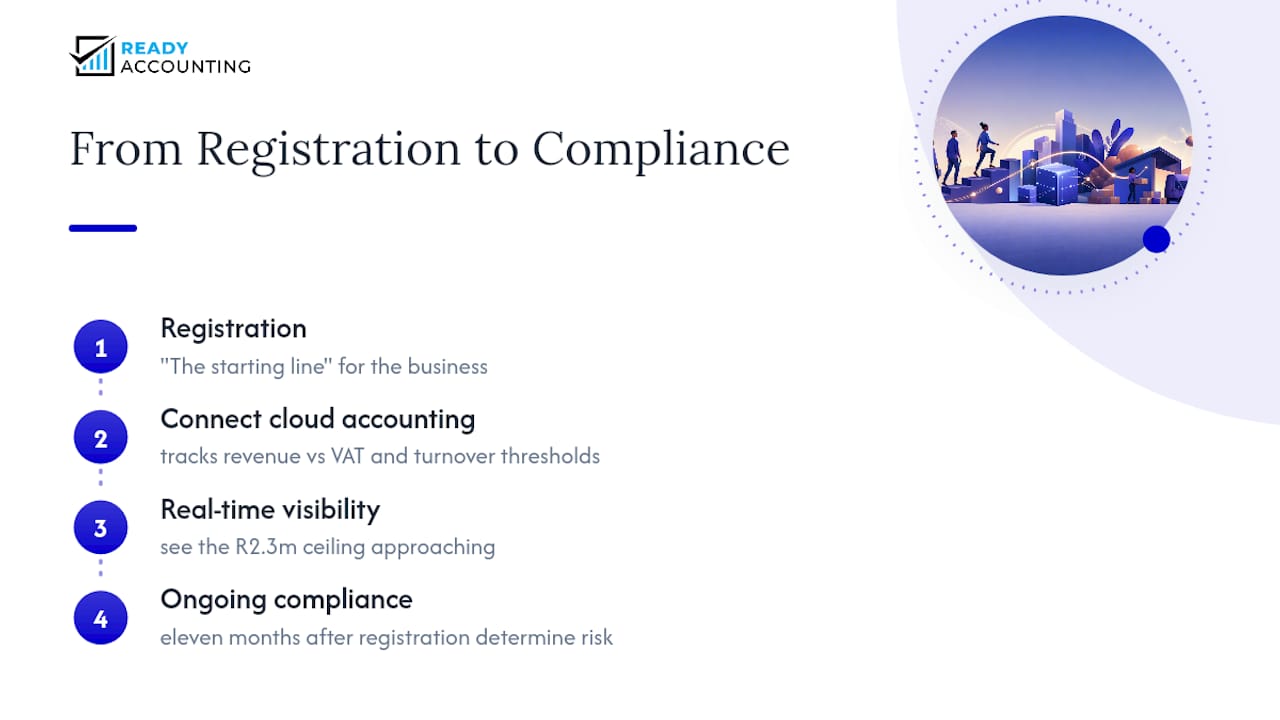
What actually prevents this isn’t more paperwork. It’s linking registration to a system that watches the moving parts automatically. When a business connects cloud accounting from the start, tracking revenue against the VAT and turnover tax thresholds becomes a background process instead of a year end scramble. You see the R2.3 million ceiling approaching in real time, not in an annual review after you’ve already crossed it.
That’s the gap Ready Accounting exists to close for South African SMEs: pairing the compliance side, VAT, PAYE, annual financial statements, with real time visibility into where a business actually stands. Registration is the starting line. What happens in the eleven months after it is what determines whether a business stays compliant or accumulates the kind of quiet administrative debt that turns into a real problem later.
— Johan
If you want a hand connecting registration to a system built for ongoing compliance rather than year end panic, a guide on how automation improves cash flow is a solid next read, and professional help is available to talk through your specific structure and tax position whenever you’re ready to move past the paperwork stage.