

Payroll taxes in South Africa: What Corporate Assets need to know
Executive Summary
- Payroll taxes in South Africa include PAYE, UIF, and SDL, with responsibilities triggered by employment.
- Compliance involves timely registration, accurate calculations, and regular submissions to avoid penalties.
- Using digital tools and expert support simplifies payroll management and enhances employee trust.
Many profitable small businesses in South Africa lose thousands of rands each year not because they are dishonest, but because payroll taxes are genuinely confusing. One missed deadline or a miscalculated UIF contribution can trigger SARS penalties that far outweigh the original amount owed. The good news is that once you understand exactly what payroll taxes are, who is responsible, and how to calculate them correctly, compliance becomes far less stressful. This guide breaks down every key payroll tax in plain language, with practical examples and actionable steps tailored specifically for South African SMB owners.
Table of Contents
- What are payroll taxes and who pays them?
- The main payroll taxes: PAYE, UIF, and SDL explained
- How South African payroll taxes affect your business
- Steps to calculate and pay South African payroll taxes
- What most business owners overlook about payroll taxes
- Get expert help with your payroll taxes
- Frequently asked questions
Key Takeaways
| Point | Details |
|---|---|
| Payroll taxes overview | Payroll taxes include PAYE, UIF, and SDL, and they fund essential government programs. |
| Obligations for businesses | Employers are legally required to manage and pay payroll taxes for their employees. |
| Exemptions and thresholds | SDL applies only if your payroll exceeds R500,000 per year; Turnover Tax is an option for very small businesses. |
| Compliance tips | Keeping good records and scheduling regular reviews can help you avoid costly payroll tax mistakes. |
| Professional support | Using tools and expert advice makes payroll tax compliance much easier for South African SMBs. |
What are payroll taxes and who pays them?
Payroll taxes are amounts withheld from employee salaries or contributed by employers to fund government programmes. In South Africa, these programmes include welfare, healthcare support, and unemployment cover. Think of payroll taxes as the financial glue between your business, your employees, and the state systems that protect them.
The three main payroll taxes you need to know are:
- PAYE (Pay-As-You-Earn): Income tax withheld from employee salaries and paid to SARS on their behalf
- UIF (Unemployment Insurance Fund): A mandatory contribution split between employer and employee, providing short-term relief if a worker loses their job
- SDL (Skills Development Levy): A levy paid by employers to fund workplace training and skills development nationally
The employer is legally responsible for withholding PAYE and UIF from employee pay and remitting all three taxes to SARS on time. This is not optional. Even if your business is not yet profitable, you still owe these contributions the moment you employ staff.
A very common misconception among small business owners is that low profits mean no payroll tax obligation. That is simply not true. Profitability has nothing to do with it. The trigger is employment, not earnings. If you pay someone a salary, you have payroll tax responsibilities.
For a deeper look at how these obligations are structured, the payroll tax guide from Ready Accounting covers the full picture. You can also explore the small business tax guide for broader context on your tax obligations.
One important relief for smaller employers: SMBs are exempt from SDL if their annual payroll is R500,000 or less, but they must still handle PAYE and UIF if they employ staff. This is a meaningful saving for micro-businesses, but it does not remove all payroll tax duties.
Getting payroll taxes wrong is not just a financial risk. It damages employee trust and your business reputation at the same time.
Pro Tip: Register as an employer with SARS as soon as you hire your first employee. Do not wait until your first payroll run. Late registration can attract penalties even before your first payment is due.
The main payroll taxes: PAYE, UIF, and SDL explained
Understanding who pays is one thing, but knowing the specifics for each type of payroll tax is just as important. Here is a clear breakdown of how each one works in practice.
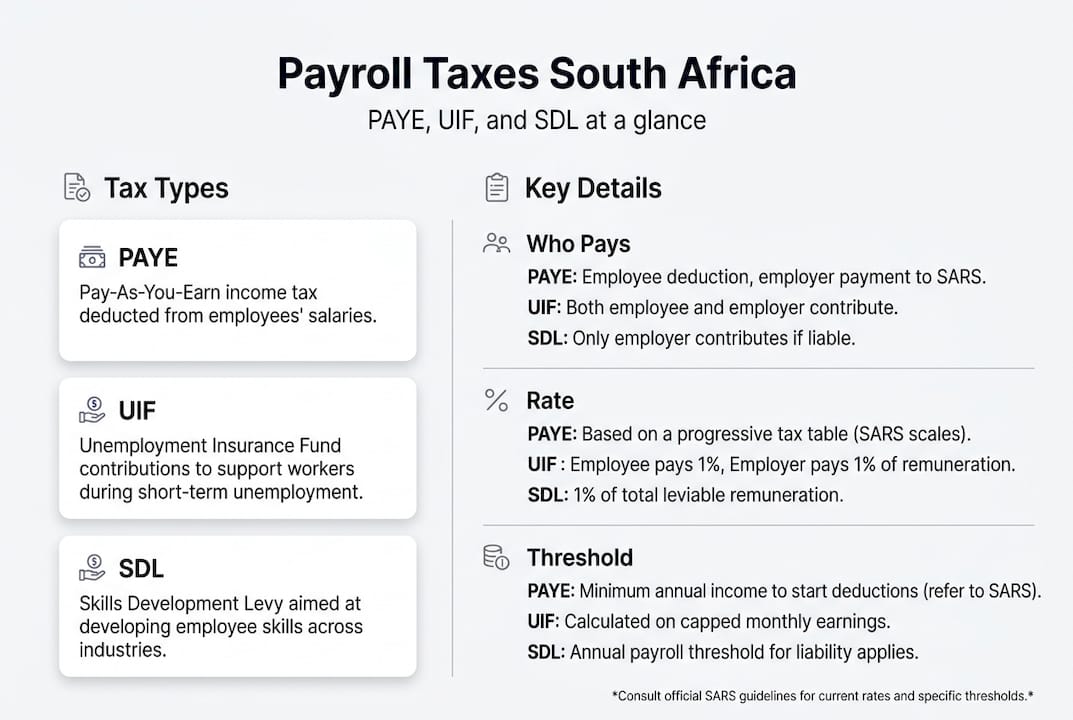
PAYE applies when an employee earns above the annual tax threshold, which for the 2026 tax year is R95,750 for individuals under 65. You calculate PAYE using the SARS tax tables, deduct it from the employee’s gross salary each month, and pay it over to SARS by the 7th of the following month.
UIF is simpler. Both employer and employee each contribute 1% of the employee’s gross monthly remuneration, capped at a monthly salary of R17,712. So the maximum combined contribution per employee per month is R354.24. It applies to almost all employment relationships, including part-time workers.
SDL is a 1% levy on your total monthly payroll. However, as noted above, it only applies if your annual payroll exceeds R500,000. Check the SDL exemption thresholds on the SARS website to confirm your current status each year.
| Tax | Rate | Who pays | Threshold |
|---|---|---|---|
| PAYE | Based on tax tables | Employer withholds from employee | Earnings above R95,750/year |
| UIF | 1% each (employer + employee) | Both employer and employee | All employees (capped at R17,712/month) |
| SDL | 1% of total payroll | Employer only | Annual payroll above R500,000 |
For very small businesses, Turnover Tax is an alternative if your annual turnover is under R1 million. It replaces several other taxes with a single simplified calculation. The tradeoff is that it may not always result in a lower tax bill, so it is worth comparing both options before committing. The payroll tax explained article and the guide on tax-efficient structures can help you decide what works best for your situation.
Pro Tip: Review your annual payroll total every February before the new tax year begins. If you are approaching the R500,000 SDL threshold, you need to plan for that additional 1% levy in your budget.
How South African payroll taxes affect your business
After outlining the technical details, let’s look at what payroll taxes really mean for your bottom line and company operations.
Payroll taxes are a fixed cost of employing people. They affect your cash flow every single month. A business with five employees on modest salaries could easily owe SARS R8,000 to R15,000 per month in combined PAYE, UIF, and SDL. That is money you must budget for before you even think about profit distributions.

Many small businesses can avoid SDL but must still handle PAYE and UIF if they have employees. Ignoring even these two obligations is where serious trouble starts.
The risks of non-compliance are steep:
- Penalties and interest: SARS charges 10% penalties on late payments plus interest, which compounds quickly
- SARS audits: Inconsistent payroll records flag your business for closer scrutiny
- Employee dissatisfaction: Workers who discover their UIF was not paid cannot claim benefits when they need them most
- Reputational damage: Suppliers, banks, and potential partners check compliance status
Here is a direct comparison of what compliance versus non-compliance looks like over 12 months for a typical SMB:
| Scenario | Annual cost | Risk level | Admin burden |
|---|---|---|---|
| Fully compliant | Predictable, budgeted | Low | Moderate, manageable |
| Partially compliant | Unpredictable + penalties | High | High (fixing errors) |
| Non-compliant | Penalties + legal exposure | Very high | Extreme (audits, disputes) |
For answers to the questions SMB owners ask most often, the common tax questions resource is a useful reference. If you want a full operational view, the payroll management guide walks you through the entire process step by step.
Building a reputation for paying employees correctly and on time also matters when you want to attract skilled workers. People talk. A business known for payroll reliability has a genuine competitive edge.
Steps to calculate and pay South African payroll taxes
To move from theory to action, here is how you can stay on top of your payroll tax duties with clear, repeatable steps.
- Register as an employer with SARS via eFiling as soon as you take on your first employee. You will receive an employer tax reference number.
- Gather employee information including ID numbers, banking details, and signed employment contracts before running your first payroll.
- Calculate gross remuneration for each employee, then apply the SARS tax tables to determine PAYE. Deduct 1% UIF from the employee’s salary and add your own 1% employer UIF contribution.
- Add SDL if applicable. If your annual payroll exceeds R500k, calculate 1% of total monthly remuneration and include it in your submission.
- Submit your EMP201 return on SARS eFiling by the 7th of each month. This is your monthly payroll tax declaration.
- Pay the total amount due via eFiling or your bank’s SARS payment portal on the same deadline.
- Reconcile bi-annually using the EMP501 return, submitted in October and April each year.
Digital tools make this far less painful. Platforms like SimplePay integrate directly with SARS eFiling and automate most of the calculations. If you want a practical setup guide, the article on how to register with SimplePay walks you through the process. For broader process improvements, the guide on how to streamline payroll is worth bookmarking.
Set calendar reminders for the 7th of each month and the EMP501 deadlines. Missing these dates is the single most common and most avoidable payroll mistake.
Pro Tip: Run a mini payroll audit every quarter. Compare your payroll records to your bank statements and SARS submissions. Catching a R200 error early is far better than discovering a R24,000 annual discrepancy during a SARS audit.
What most business owners overlook about payroll taxes
We have worked with many South African SMBs, and a pattern emerges consistently. Business owners who struggle most with payroll taxes are not the ones who lack intelligence. They are the ones who treat payroll compliance as something to deal with later, once the business is bigger or more stable.
The problem is that SARS does not wait for your business to stabilise. Penalties accumulate regardless of your growth stage.
What we have also seen is that accurate payroll processing builds something money cannot easily buy: employee trust. When your team knows their UIF is being paid and their tax certificates are correct, they feel secure. That security translates into loyalty and productivity.
The businesses that treat payroll compliance as part of their growth strategy, rather than just an admin burden, almost always find it simpler and cheaper than those who scramble to fix problems after the fact. Reviewing common payroll mistakes before they happen is the smartest investment of an hour you will make this month.
Compliance is not the ceiling. It is the foundation.
Get expert help with your payroll taxes
If you want to spend less time on admin and more time growing your business, expert help is a click away. At Ready Accounting, we support South African SMBs with end-to-end payroll management, from employer registration and monthly submissions to annual reconciliations and SARS queries. Our cloud-based approach means your payroll data is accurate, accessible, and audit-ready at all times. Explore how to manage payroll efficiently or discover the cloud accounting benefits that make compliance easier for growing businesses. For a broader view of how digital tools can transform your financial operations, the cloud accounting guide is a great starting point. Book a consultation with our team today.
Frequently asked questions
What are the main types of payroll taxes in South Africa?
The main payroll taxes are PAYE (Pay-As-You-Earn), UIF (Unemployment Insurance Fund), and SDL (Skills Development Levy). Each serves a different purpose and has its own calculation method and threshold.
Does my business have to pay SDL if my payroll is under R500,000?
No, SDL is only payable if your annual payroll exceeds R500,000. Businesses below this threshold are exempt, though PAYE and UIF remain mandatory.
What is Turnover Tax and who qualifies for it?
Turnover Tax is a simplified tax option for very small businesses with annual turnover under R1 million. It replaces several standard taxes with a single, easier calculation.
How can I avoid payroll tax mistakes in my business?
Keep accurate monthly records, meet SARS deadlines, and review your payroll requirements every year. Using a digital payroll tool significantly reduces the risk of calculation errors.
Where can I get help with payroll taxes?
The SARS official guidance for small businesses is a reliable starting point, and consulting an experienced accounting professional ensures your specific situation is handled correctly.
Recommended
- What is payroll tax? Essential guide for South African SMBs – Ready Accounting
- Payroll Tax Explained 2025: Guide for South African Businesses – Ready Accounting
- How to Streamline Payroll Management: 5 Essential Steps – Ready Accounting
- How to avoid tax penalties: protect your South African SMB – Ready Accounting