

5 Step Payroll Practices to Avoid EMP201 Penalties for SA SMEs
5 Step Payroll Practices to Avoid EMP201 Penalties for SA SMEs

Payroll practices are the routine processes and controls that make sure people are paid correctly, statutory deductions are applied, and SARS returns are filed on time. Get them right and payroll runs quietly in the background. Get them wrong and you’re staring down administrative penalties, unhappy staff, and a reconciliation nightmare come tax season. The goal is simple: accurate pay, on-time EMP201 submissions, and records that reconcile cleanly at EMP501 time.
Executive Summary
- Accurate registration and timely submission of EMP201 and EMP501 are critical to avoid penalties and reconciliation issues.
- Monthly reconciliation of payroll reports with declarations and bank payments should be standard practice to prevent mismatches and errors.
- Maintaining detailed, current master data and properly documenting all payroll adjustments ensures records stay compliant for years.
- Automation of repetitive tasks helps uphold accuracy, but strict controls like role-based access and audit trails remain essential for security and compliance.
- Year-end processes require early preparation of employee certificates and full reconciliation to prevent discrepancies and filing delays.
Table of Contents
- What comprehensive payroll practices actually cover
- Monthly submissions and statutory timelines you can’t miss
- Employer reconciliations: what EMP501 actually demands
- How to run payroll month by month, step by step
- Common payroll mistakes and the controls that stop them
- Automating payroll without losing control of it
- Your payroll compliance checklist and calendar
- Handling payroll adjustments and corrections
- Getting benefits and allowances right in payroll
- Data privacy and security in payroll processing
- Year-end payroll and issuing tax certificates
- A practitioner’s take on what actually keeps payroll clean
- Let Ready Accounting handle the payroll compliance grind
- Sources
- FAQ
What comprehensive payroll practices actually cover
Payroll is not just “pay the staff on the 25th.” It’s a chain of linked obligations, and missing one link breaks the whole thing. Solid payroll practices span registration through to record retention, and every business owner running payroll in South Africa needs to own each piece.
Here’s what the full scope looks like:
- Employer registration: you must register as an employer with SARS within 21 business days of taking on your first employee, and register for PAYE, UIF and SDL where applicable.
- Running pay: calculating gross pay, applying allowances, commission, and overtime correctly each cycle.
- Statutory deductions: PAYE, UIF, and SDL, calculated against current tax tables.
- Payslips: issuing compliant payslips with the required fields every pay period.
- EMP201 submissions: monthly declarations of PAYE, UIF, and SDL liability.
- EMP501 reconciliations: interim and annual reconciliations tying together what you declared, what you paid, and what certificates you issued.
- IRP5/IT3(a) certificates: annual tax certificates every employee needs to file their own return.
- Record retention: keeping payroll records for five years, as small-business payroll guidance confirms.
Each of these pieces feeds the next. Get the registration wrong and your EMP201s bounce. Get the monthly deductions wrong and your EMP501 reconciliation turns into a forensic exercise. Treat payroll as one continuous system rather than a monthly chore, and the individual pieces stop being a burden.
Monthly submissions and statutory timelines you can’t miss
The EMP201 is due by the 7th of the following month (or the preceding business day if the 7th falls on a weekend or public holiday). This single date drives more payroll stress than anything else in the South African compliance calendar, and it’s worth burning into your operations calendar permanently.
By the numbers: the EMP201 return covering PAYE, UIF and SDL must reach SARS via eFiling or e@syFile by the 7th of the following month. If the 7th falls on a weekend or public holiday, payment must be made not later than the last business day prior to such day. Late or missing submission triggers automatic administrative penalties with no grace period.
What makes this trickier than it looks is how SARS allocates your money once it arrives. If your payment doesn’t cover the full liability, or you don’t reference it correctly, SARS applies payments received in the following order: penalty, then interest, then employees’ tax or additional penalty, according to their guide. That means a partial payment can leave your actual PAYE liability technically unpaid, even though money left your account, and the interest clock keeps running on top.
A few checks that catch problems before SARS does:
- Confirm your Payment Reference Number (PRN) matches the specific tax period, not a generic reference.
- Bank early. EFT payments can take a day or two to clear, and “I paid on the 7th” doesn’t help if SARS receives it on the 9th.
- Reconcile your bank statement against your EMP201 submission confirmation within 48 hours, not at month end.
- Flag any payment that doesn’t match your declared liability exactly. Rounding errors compound over twelve months.
Employers are personally liable for any shortfall in employees’ tax deducted and payable to SARS.
Employer reconciliations: what EMP501 actually demands
The EMP501 is where every small inconsistency from the past six or twelve months surfaces, whether you’re ready for it or not. There are two windows to know:
- Interim reconciliation covers 1 March to 31 August and must be submitted between September and October.
- Annual reconciliation covers the full tax year and must be submitted between April and May.
Both reconciliations pull together the same three elements: your EMP201 declarations for the period, the actual payments SARS received, and the IRP5/IT3(a) certificates you issued to employees. SARS’s own reconciliation guide is explicit that these three must match exactly, and mismatches trigger administrative penalties, with wilful non-compliance carrying the risk of far heavier sanctions.
The most common reconciliation errors are painfully avoidable:
- EMP201 totals don’t match payroll system reports because a mid-month salary adjustment never made it into the declaration.
- Payments received by SARS don’t match what you think you paid, usually because of an incorrect PRN or a payment allocated to the wrong period.
- IRP5 values don’t match cumulative EMP201 declarations, often because a bonus run or backpay correction wasn’t captured consistently.
The fix in each case is the same discipline applied earlier rather than later: reconcile monthly, not annually. Match your payroll system’s monthly totals against your EMP201 submission the same week you file. Keep a running log of every manual adjustment with a reason attached. If you’re relying on outsourced payroll, ask for a monthly reconciliation report as a standing deliverable, not something you request only when SARS flags an issue. A step-by-step compliance playbook built around this cadence turns a stressful biannual scramble into routine admin.
How to run payroll month by month, step by step
Running payroll doesn’t need to feel like solving a puzzle every 25th of the month. Break it into five repeatable steps and it becomes routine.
- Prepare your master data. Confirm every employee’s tax number, banking details, and employment status are current before the pay run starts. Outdated bank details cause more payment delays than anything else in payroll.
- Collect and validate variable inputs. Pull in timesheets, overtime, commission, and any mid-month adjustments like leave without pay or bonus payments. Validate these against source documents, not memory.
- Calculate gross pay and statutory deductions. Apply PAYE using current tax tables, deduct UIF at 1% from the employee (matched by an employer contribution), and apply SDL where your payroll exceeds the threshold. Watch for annualisation rules on irregular income and confirm any SARS tax directives are applied correctly.
- Pay employees and issue payslips. Process payments, generate compliant payslips with all required fields, and capture the SARS payment PRN immediately, not after the fact.
- Submit EMP201 and retain evidence. File by the 7th, then store the submission confirmation, bank proof of payment, and payroll report together as one reconciliation packet.
Pro Tip: Create a single folder per pay period containing the EMP201 confirmation, bank proof of payment, and payroll summary report before you move on to the next month. When EMP501 season arrives, you’ll be assembling twelve folders instead of reconstructing twelve months from scratch.
This five-step rhythm is also where Employment Tax Incentive (ETI) qualification checks belong, run at step three, not bolted on afterward. Missing an eligible employee costs you real money every single month you don’t claim it.
Common payroll mistakes and the controls that stop them
Most payroll disasters trace back to a small handful of repeat offenders. Knowing them in advance is half the battle.
- Misclassifying workers. Treating an employee as an independent contractor to dodge PAYE and UIF is one of the fastest ways to attract a SARS audit, and the tax consequences apply retroactively once reclassified.
- Running outdated tax tables. Tax tables change, and a payroll system still calculating against last year’s brackets underdeducts every single payslip until someone notices.
- Forgetting employer UIF. Employees see their 1% deducted and assume the job is done, but employers owe a matching contribution that’s easy to overlook in manual spreadsheets.
- Filing EMP201 late. Usually not from ignorance, but from nobody owning the deadline once the person who “always handled it” goes on leave.
- Missing IRP5 issuance. Employees can’t file their own tax returns without it, and the fallout lands on your HR inbox every February.
- Misallocated payments. A wrong PRN sends money to the wrong tax period, creating a shortfall that looks like non-payment even though funds left your account.
The controls that actually catch these before they become penalties are straightforward: require a second sign-off on any payroll run above a set variance threshold, generate an exception report flagging any negative net pay or unusually large deduction, and keep a permanent audit log of every manual override with who made it and why.
Legitimate bonuses and overtime will trigger it too, but so will the data entry errors that actually cost you money.*
Automating payroll without losing control of it
Automation earns its keep on the repetitive, rule-based parts of payroll, not on judgment calls. The tasks worth automating first: tax-table updates so your system always calculates against current brackets, payslip generation, EMP201 and EMP501 data exports pulled straight from payroll records instead of retyped, and ETI qualification checks run automatically against each payslip.
What automation should never remove is oversight. Any system you adopt, whether built in house or outsourced, needs a few non-negotiable controls:
- Role-based access so payroll changes require the right authorisation level, not whoever happens to be logged in.
- An immutable audit trail that logs every change, including who made it and when, and can’t be edited after the fact.
- A test sandbox for running new tax tables or payroll rule changes before they touch live payslips.
- Exception workflows that route unusual transactions (large adjustments, new bank details, terminated employees still on payroll) to a human for review before processing.
Commentary on turning payroll processing into genuine payroll compliance makes a fair point: automated tax-table updates and audit trails address the most common small-business compliance failures directly, because they remove the manual step where errors creep in.
Outsourcing wins when your internal team lacks the bandwidth to own reconciliation discipline month after month, not just when payroll feels tedious. If you’re weighing that move, a short migration checklist helps: confirm your provider’s reconciliation reporting cadence, verify they issue IRP5s on your behalf with your sign-off, and get written clarity on who carries liability for a missed deadline. Streamlining payroll management in five essential steps is worth reading before you sign anything.
Employer liability doesn’t disappear just because a task is automated or outsourced, which is also why some SME owners look at employer liability coverage as a backstop against the human errors that even good systems occasionally miss.
Your payroll compliance checklist and calendar
Print this, pin it above your desk, and check it monthly.
Monthly tasks:
- Set a data freeze date a few days before your pay run so late changes don’t sneak through unvalidated.
- Run payroll and issue payslips with all required fields.
- Submit EMP201 by the 7th and capture the PRN immediately.
- Reconcile the bank payment against the EMP201 confirmation within 48 hours.
Periodic tasks:
- Prepare interim EMP501 documentation across March to August, ready for the September to October submission window.
- Prepare annual EMP501 documentation for the full tax year, submitted April to May.
- Issue IRP5/IT3(a) certificates accurately and on time.
- Confirm payroll records are archived and retrievable for five years.
| Task | Frequency | Deadline |
|---|---|---|
| EMP201 submission and payment | Monthly | 7th of following month |
| Bank reconciliation against EMP201 | Monthly | Within 48 hours of filing |
| Interim EMP501 reconciliation | Biannual | September to October |
| Annual EMP501 reconciliation | Annual | April to May |
| IRP5/IT3(a) issuance | Annual | With annual reconciliation |
| Record retention review | Annual | Ongoing, five year minimum |
If any item on this list is currently a “we’ll get to it” task rather than a scheduled one, that’s your remediation priority for this quarter.
Handling payroll adjustments and corrections
Payroll never runs perfectly clean for twelve straight months. Someone gets underpaid overtime, a bonus posts to the wrong period, or a resignation date changes retroactively. What separates a minor correction from a compliance headache is how quickly and visibly you handle it.
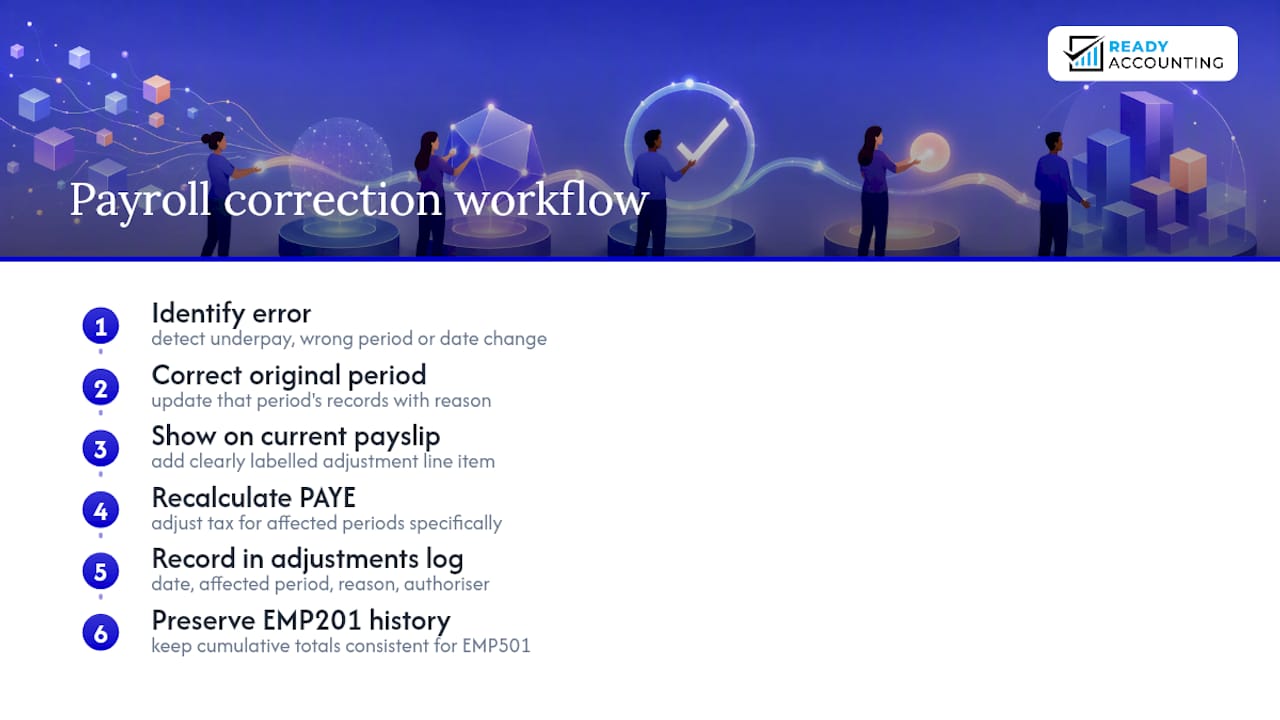
The rule that matters most: never quietly overwrite a previous pay period’s figures. If March’s numbers were wrong, correct them in March’s records with a documented reason, and reflect the adjustment in the current period’s payslip as a clearly labeled line item, not a silent balance change. This keeps your EMP201 history internally consistent, which matters enormously when EMP501 reconciliation time arrives and SARS expects your cumulative totals to add up cleanly.
For adjustments that affect tax already withheld, such as a backdated salary increase, recalculate the PAYE owed for the affected periods specifically rather than dumping the correction into the current month’s calculation. Lumping it into one period distorts that month’s tax table application and can trigger an incorrect annualisation result for the employee.
Keep a standing adjustments log separate from your regular payroll report: date of correction, affected pay period, reason, and who authorised it. This single document turns a “why doesn’t this number match” conversation with SARS or an auditor into a five-minute lookup instead of a week of digging through old spreadsheets. Corrections handled transparently rarely cause problems. Corrections buried inside a normal pay run almost always do.
Getting benefits and allowances right in payroll
Benefits and allowances are where payroll quietly gets complicated, because each one carries its own tax treatment, and treating them all the same is a fast route to an incorrect PAYE calculation.
Medical aid contributions, for instance, typically qualify for a tax credit rather than a straight deduction, and that credit needs to be applied correctly against the employee’s PAYE, not simply subtracted from gross pay. Travel allowances have their own partial inclusion rules depending on how much of the allowance relates to actual business travel versus personal use. Cellphone or data allowances, subsistence allowances for business travel, and company car fringe benefits each have distinct valuation methods that feed differently into taxable income.
The practical fix is to build your payroll master data with a specific field for each benefit or allowance type, rather than lumping “extras” into one generic line. This lets your payroll system, or your provider, apply the correct tax treatment automatically instead of relying on someone remembering the rule for cellphone allowances every single month.
Review your benefit structure annually, not just when a new employee joins. Allowance thresholds and treatment rules do shift, and a company car policy set up three years ago may no longer reflect current guidance. If your business offers a broad benefits package, this is one area where a documented policy, reviewed alongside your accountant, saves far more time than it costs.
Data privacy and security in payroll processing
Payroll data is some of the most sensitive information your business holds. Bank details, ID numbers, salary history, medical aid information, and tax numbers all sit in one system, which makes payroll a genuine security priority, not just an HR administrative function.
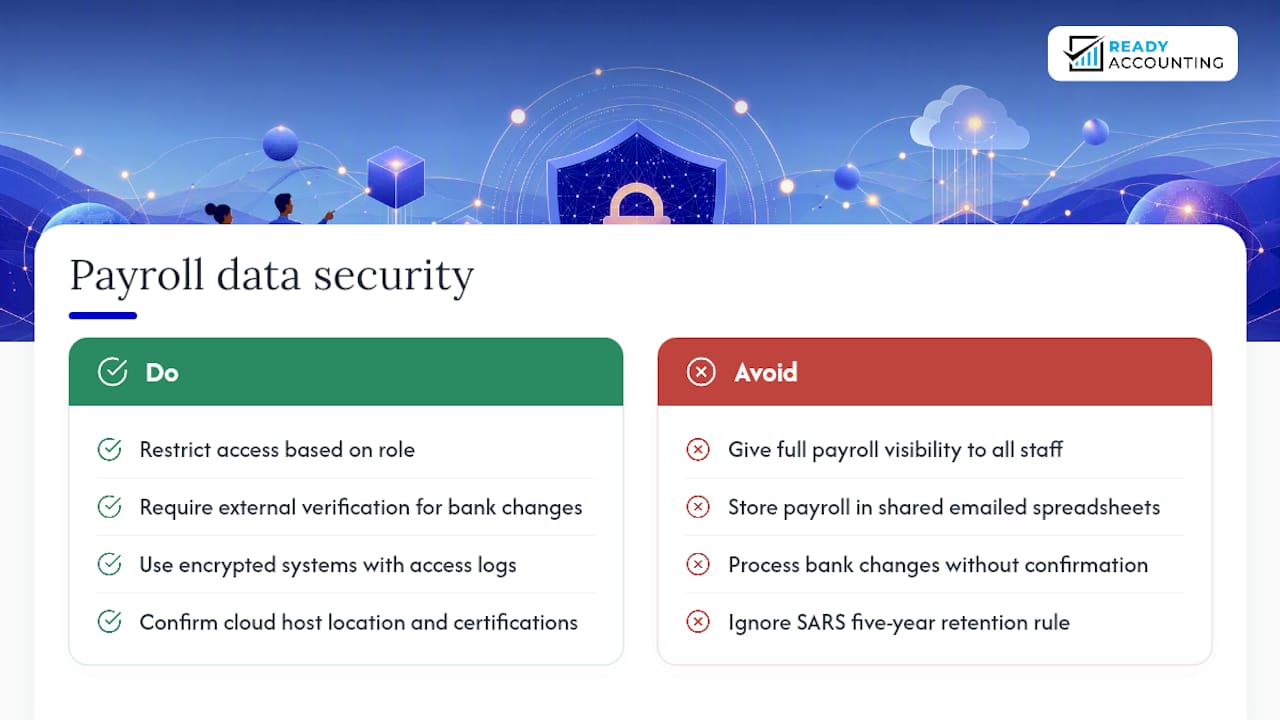
Access control is the starting point. Not everyone in finance or HR needs full visibility into every employee’s payroll record. Restrict access based on role, so a junior HR administrator can process leave requests without seeing the CEO’s salary, and limit who can edit banking details specifically, since that’s the field fraudsters target most often in payroll scams.
Any change to an employee’s bank account should trigger a verification step outside the payroll system itself, a phone call or a separate confirmation email, before the next pay run processes. This single control blocks the most common payroll fraud pattern: a fraudulent email requesting a “banking update” that redirects an employee’s salary without their knowledge.
Store payroll records, including the five years of retained history required by SARS, in a system with proper encryption and access logging, not in shared spreadsheets emailed between departments. If you use a cloud payroll platform, confirm where your data is hosted and what the provider’s own security certifications look like before you commit. Data breaches involving payroll information carry both compliance exposure and a genuine trust cost with your own staff, who trusted you with their banking and identity details in the first place.
Year-end payroll and issuing tax certificates
Year-end payroll carries its own distinct workload on top of your usual monthly cycle, centered almost entirely on getting IRP5/IT3(a) certificates right before the annual EMP501 window opens in April.
Start the certificate preparation process well before the deadline, not the week reconciliation opens. Pull a full year’s cumulative payroll totals per employee and cross-check them against every EMP201 you filed across the tax year. Any discrepancy needs resolving now, not during the reconciliation submission itself, because certificates that don’t match your declared totals get flagged and prevent affected employees from filing their own returns cleanly.
Confirm every employee who left during the year still receives an accurate IRP5 reflecting their actual employment period, not a blanket full-year figure. Terminated employees are the group most likely to have incomplete or incorrect certificates, simply because they’re no longer visible on your active payroll list when certificate season arrives.
Once certificates are validated, submit the annual EMP501 reconciliation between April and May, then distribute IRP5s to employees promptly so they have time to file their own returns. Treat this whole process as the final proof point for everything you did right, or wrong, across the previous twelve months of payroll. A year of clean monthly reconciliation makes year-end almost mechanical. A year of deferred corrections turns it into weeks of detective work.
A practitioner’s take on what actually keeps payroll clean
Most payroll failures aren’t calculation errors. They’re timing failures, someone reconciling six months late instead of monthly, or discovering a misclassified worker only when SARS asks questions. At Ready Accounting, the operational framework that holds up under pressure rests on four habits: master data hygiene kept current every pay cycle, automation applied to the repetitive statutory work, a reconciliation cadence that never waits for EMP501 season to check numbers, and a defense-minded posture that assumes SARS will eventually ask for evidence, so that evidence already exists.
The businesses that struggle aren’t the ones with complicated payroll. They’re the ones treating each monthly EMP201 as an isolated event instead of one data point in a running twelve-month reconciliation. Fix the cadence, and most of the “mistakes” in this article stop happening on their own. Our SME-focused payroll guide walks through how we build that cadence for growing businesses that can’t afford a full-time payroll specialist yet.
— Johan
Let Ready Accounting handle the payroll compliance grind
Reading a checklist is one thing. Running twelve consistent months of EMP201 filings, PRN tracking, and reconciliation prep while also running your business is another. Ready Accounting’s Automated Payroll Services replace the manual spreadsheet chase with cloud-based payroll infrastructure that applies current tax tables automatically, generates compliant payslips, and keeps a clean audit trail ready for SARS before reconciliation season ever arrives. If your payroll history is already messy, our Accounting Cleanup & Reconstruction service rebuilds it into something reconciliation-ready rather than a permanent liability. Request a compliance health check to find out exactly where your current payroll practices are exposed, before SARS finds it for you.
Sources
- Pay As You Earn | South African Revenue Service
- How to do payroll in South Africa: a small business guide | Govchain
FAQ
What are the five basic steps of payroll?
Prepare accurate master data, collect and validate variable inputs like overtime and allowances, calculate gross pay and statutory deductions, pay employees and issue payslips, then submit the EMP201 and retain your records.
What is a best practice for payroll accountants?
Reconcile EMP201 declarations against payroll reports and bank payments monthly rather than waiting for the EMP501 window, since SARS’s reconciliation guide emphasizes that mismatches between EMP201 declarations and payroll reports constitute a compliance failure.
What are the top skills for a payroll position?
Attention to detail on statutory calculations, working knowledge of SARS deadlines and forms like EMP201 and EMP501, and comfort with payroll software or automated systems that reduce manual error.
What are payroll principles?
Payroll should be accurate, timely, and auditable: pay is calculated correctly, statutory returns are filed on schedule, and every figure can be traced back to a source document if SARS or an auditor asks.
Does Ready Accounting handle full payroll compliance, not just processing?
Yes. Ready Accounting’s Automated Payroll Services cover the full cycle, from calculations and payslips through to EMP201 submissions and reconciliation support, so compliance isn’t a separate task bolted onto processing.