

Payroll Management Made Simple: A Complete Protocol for South African Employers
Running payroll in South Africa looks simple on the surface. Just pay your staff and send the right figures to SARS, right? Not so fast. Payroll mistakes can trigger fines of up to 10 percent of your annual turnover and even lead to legal prosecution. South African employers are realising that manual pay slips and outdated spreadsheets are not just risky—they are also wasting huge amounts of time.
Table of Contents
- Understanding Payroll Basics In South Africa
- Steps To Simplify Payroll Processes
- Tax Compliance And Regulatory Requirements
- Choosing The Right Payroll Solution For Your Business
Quick Summary
| Takeaway | Explanation |
|---|---|
| Understand statutory deductions | Mandatory deductions such as PAYE, UIF, and SDL must be accurately calculated and submitted. |
| Automate payroll processes | Implement cloud-based payroll solutions to reduce errors and improve efficiency in tax calculations and compliance. |
| Standardize payroll procedures | Develop clear, repeatable processes for payroll tasks to ensure accuracy and consistency in operations. |
| Invest in ongoing training | Regular training for payroll teams is essential to keep abreast of regulatory changes and technology updates. |
| Evaluate payroll solutions carefully | Choose solutions that fit business needs, considering features, scalability, and ongoing support for effective operations. |
Understanding Payroll Basics in South Africa
Payroll management represents a critical function for South African businesses, involving complex legal requirements and precise financial calculations. Employers must navigate a sophisticated landscape of tax regulations, employee compensation, and statutory reporting to ensure compliance and maintain smooth operational processes.
Key Components of South African Payroll Systems
Understanding payroll in South Africa requires comprehensive knowledge of multiple interconnected elements. The primary components include calculating gross wages, applying mandatory deductions, and ensuring compliance with national tax regulations set by the South African Revenue Service (SARS).
Employers must account for several mandatory contributions that directly impact payroll calculations. These include:
To help employers understand their main payroll obligations, here’s a summary table of the key statutory contributions and their purposes as discussed above:
| Statutory Contribution | Purpose |
|---|---|
| Pay As You Earn (PAYE) | Income tax deducted from employee salaries by employer |
| Unemployment Insurance Fund (UIF) | Provides short-term financial protection for workers |
| Skills Development Levy (SDL) | Funds training and workforce skills development |
| Compensation for Occupational Injuries (COIDA) | Provides insurance for workplace injuries/diseases |
- Pay As You Earn (PAYE): A critical tax withholding mechanism where employers deduct income tax from employee salaries before payment
- Unemployment Insurance Fund (UIF): Compulsory contributions that provide short-term financial protection for workers who become unemployed
- Skills Development Levy (SDL): A workforce development tax supporting training and skills enhancement programs
According to SARS Tax Compliance Guide, these statutory deductions are non-negotiable and require precise calculation and timely submission.
Regulatory Compliance and Reporting Requirements
Navigating South African payroll regulations demands meticulous attention to detail. Employers must maintain accurate records, submit monthly Employer Reconciliation Declarations (EMP201), and prepare annual tax certificates for each employee.
The legal framework surrounding payroll is complex. South African Labour Guide highlights that non-compliance can result in significant financial penalties, including fines up to 10% of the company’s annual turnover and potential legal prosecution.
Key reporting deadlines include monthly PAYE submissions, quarterly UIF payments, and annual income tax reconciliations. Missing these deadlines can trigger automatic penalties and create substantial administrative challenges for businesses.
Technology and Payroll Management
Modern payroll management in South Africa increasingly relies on sophisticated cloud-based software solutions that automate complex calculations and ensure real-time compliance. These technological tools help businesses streamline payroll processes, reduce human error, and maintain accurate financial records.
Businesses can learn more about optimising payroll processes by implementing integrated accounting and payroll systems that offer comprehensive tracking and reporting capabilities.
Successful payroll management requires a strategic approach that combines technological innovation, deep understanding of local regulations, and a commitment to precise financial administration. By staying informed and leveraging modern tools, South African employers can transform payroll from a complex administrative burden into a streamlined, efficient business function.
Steps to Simplify Payroll Processes
Payroll management can quickly become a complex and time-consuming task for South African businesses. Developing a systematic approach to streamline processes is essential for reducing administrative burden, minimizing errors, and ensuring consistent compliance with regulatory requirements.
Implementing Automated Payroll Systems
Technology plays a crucial role in simplifying payroll processes. Modern cloud-based payroll solutions offer significant advantages for businesses seeking efficiency and accuracy. By exploring automated payroll strategies, companies can dramatically reduce manual data entry and potential calculation errors.
Key benefits of automated payroll systems include:
- Instant Calculations: Automatic tax and contribution computations
- Compliance Tracking: Real-time updates on regulatory changes
- Secure Record Keeping: Digital storage of critical financial documents
According to Deloitte South Africa’s Payroll Insights, businesses that adopt comprehensive digital payroll solutions can reduce administrative time by up to 40% and significantly minimize compliance risks.
Standardizing Payroll Procedures
Consistent procedures are fundamental to effective payroll management. Businesses must develop clear, repeatable processes that can be easily followed by payroll personnel. This approach involves creating detailed documentation, establishing standard operating procedures, and implementing robust verification mechanisms.
Critical steps in standardization include:
To simplify the steps involved in standardising payroll procedures, here’s a process table outlining essential actions South African businesses should follow:
| Step | Description |
|---|---|
| Develop checklists | Create detailed payroll processing checklists |
| Set data guidelines | Establish guidelines for data collection & checks |
| Standardise pay schedules | Use consistent employee payment dates |
| Multi-level reviews | Implement multiple review & verification stages |
- Developing comprehensive payroll processing checklists
- Creating clear guidelines for data collection and verification
- Establishing consistent payment schedules
- Implementing multi-level review processes
The South African Institute of Professional Accountants (SAIPA) recommends developing a structured approach that ensures accuracy, transparency, and compliance in payroll management.
Regular Training and Continuous Improvement
Payroll regulations and technologies evolve continuously. Businesses must invest in ongoing training and skill development for their payroll teams. This approach ensures that staff remain updated on the latest legislative requirements, technological tools, and best practices in payroll management.
Effective training strategies include:
- Regular workshops on tax law updates
- Technical training on payroll software
- Compliance seminars hosted by professional accounting bodies
- Internal knowledge-sharing sessions
By adopting a proactive approach to payroll management, South African businesses can transform a potentially complex administrative task into a streamlined, efficient process. The key lies in leveraging technology, establishing clear procedures, and maintaining a commitment to continuous learning and improvement.
Tax Compliance and Regulatory Requirements
Tax compliance represents a critical aspect of payroll management for South African businesses, requiring meticulous attention to detail and comprehensive understanding of complex regulatory frameworks. Employers must navigate a sophisticated landscape of statutory obligations to ensure accurate reporting and timely submissions.
SARS Reporting and Documentation Requirements
The South African Revenue Service (SARS) mandates strict reporting protocols that businesses must follow precisely. Employers are required to submit detailed monthly and annual tax declarations, maintaining comprehensive documentation that demonstrates complete transparency in employee compensation and tax calculations.
Key documentation requirements include:
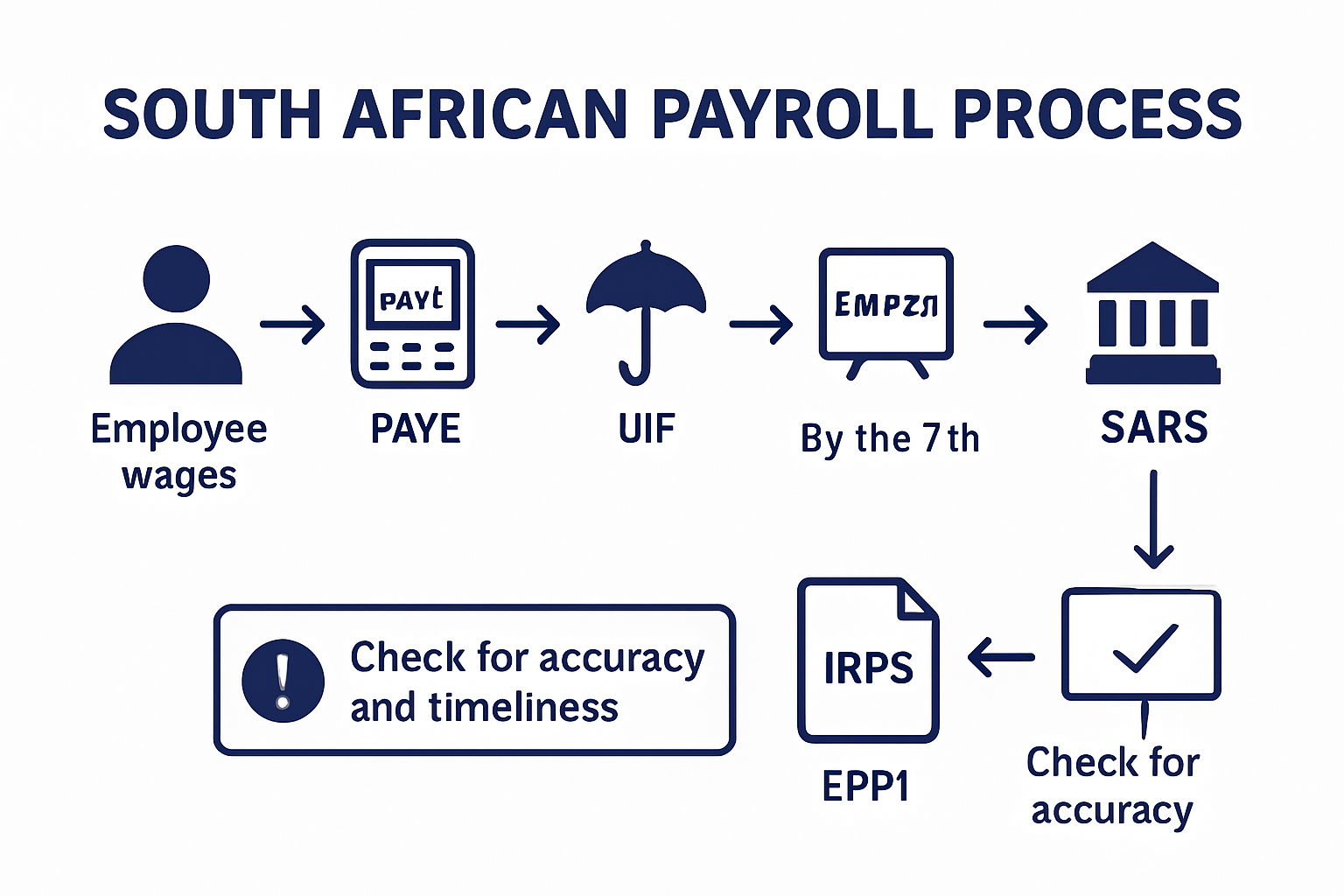
- Monthly EMP201 Declarations: Detailed reporting of employee tax withholdings
- Annual IRP5 Certificates: Comprehensive income tax certificates for each employee
- Employer Reconciliation Submissions: Detailed annual reconciliation of all tax-related payments
The Ultimate VAT Compliance Guide highlights that precise record-keeping is not just a legal requirement but a critical strategy for avoiding potential penalties and audits.
Statutory Contributions and Mandatory Deductions
South African payroll regulations require employers to manage multiple statutory contributions beyond standard income tax. These mandatory deductions play a crucial role in supporting national social security and workforce development programs.
Critical statutory contributions include:
- Unemployment Insurance Fund (UIF): Compulsory contributions protecting workers during unemployment
- Skills Development Levy (SDL): Funding national skills development and training initiatives
- Compensation for Occupational Injuries and Diseases (COIDA): Workplace injury insurance contributions
According to SARS Compliance Guidelines, these contributions are calculated as a percentage of total employee remuneration and must be precisely calculated and timeously submitted.
Penalty Management and Compliance Strategies
Non-compliance with tax regulations can result in significant financial consequences for businesses. SARS implements a structured penalty system for late submissions, incorrect calculations, and failure to meet reporting deadlines.
Potential penalties can include:
- Financial fines up to 10% of annual payroll
- Mandatory interest charges on outstanding amounts
- Potential legal prosecution for repeated non-compliance
- Temporary suspension of tax clearance certificates
Businesses can mitigate these risks by implementing robust compliance strategies, including:
- Regular staff training on tax regulations
- Investing in advanced payroll management software
- Conducting periodic internal audits
- Maintaining open communication with SARS
Successful tax compliance requires a proactive approach that combines technological solutions, continuous learning, and meticulous attention to regulatory details. By developing a comprehensive understanding of tax requirements and implementing systematic processes, South African businesses can transform tax compliance from a potential challenge into a streamlined operational function.
Choosing the Right Payroll Solution for Your Business
Selecting an appropriate payroll solution is a critical decision for South African businesses that can significantly impact operational efficiency, compliance, and financial management. The right technology can transform payroll from a complex administrative task into a streamlined, strategic business function.
Evaluating Key Features and Functionality
When assessing payroll solutions, businesses must consider a comprehensive range of features that go beyond basic salary calculations. Critical evaluation criteria include:
- Automated Tax Calculations: Integrated SARS compliance features
- Scalability: Ability to grow with your business
- Integration Capabilities: Seamless connection with accounting and HR systems
- Reporting and Analytics: Detailed financial insights and tracking
Learn how to streamline your payroll management by understanding the essential technological requirements for modern businesses.
According to Deloitte’s Digital Payroll Transformation Report, businesses that implement comprehensive digital payroll solutions can reduce administrative overhead by up to 40% and minimize compliance risks significantly.
Considering Business-Specific Requirements
Payroll solutions are not one-size-fits-all. Different businesses have unique requirements based on factors such as:
- Company size
- Industry complexity
- Number of employees
- Specific regulatory environments
- Budget constraints
Small businesses might prioritize cost-effectiveness and ease of use, while larger enterprises require more robust, customizable solutions with advanced reporting capabilities. Cloud-based platforms offer flexibility, allowing businesses to scale their payroll management as they grow.
The National Academies of Sciences emphasize the importance of selecting a solution that not only meets current needs but can adapt to future technological and regulatory changes.
Implementation and Support Considerations
Beyond features, businesses must evaluate the implementation process and ongoing support. Key factors include:
- Vendor reputation and track record
- Quality of customer support
- Training and onboarding processes
- Data migration capabilities
- Ongoing software updates
Businesses should conduct thorough due diligence, including:
- Requesting detailed demonstrations
- Checking client testimonials
- Comparing multiple solutions
- Understanding total cost of ownership
By approaching payroll solution selection as a strategic investment, South African businesses can leverage technology to simplify complex administrative tasks, ensure regulatory compliance, and create more efficient financial management processes. The right payroll solution becomes a powerful tool for business growth and operational excellence.

Frequently Asked Questions
What are the key components of payroll management in South Africa?
The key components include calculating gross wages, applying mandatory deductions such as PAYE, UIF, and SDL, and ensuring compliance with tax regulations set by the South African Revenue Service (SARS).
How can employers ensure compliance with South African payroll regulations?
Employers can ensure compliance by maintaining accurate records, submitting monthly EMP201 and annual tax certificates, and staying updated with regulatory deadlines to avoid penalties.
What are the benefits of implementing automated payroll systems?
Automated payroll systems provide instant calculations, compliance tracking, secure record-keeping, and significantly reduce administrative time and potential errors associated with manual processes.
Why is it important to standardize payroll procedures?
Standardizing payroll procedures ensures consistency, accuracy, and transparency in operations. It helps establish clear protocols, reduces errors, and facilitates compliance with regulatory requirements.
Make Payroll Stress-Free With Expert Support
If the idea of penalties, missed SARS deadlines, and endless spreadsheets keeps you up at night, you are not alone. Many South African employers feel overwhelmed by the demands of payroll compliance, tax reporting, and ever-changing legislative requirements. That is why simple automation, accurate deductions, and clear payroll procedures are not just nice to have—they are essential for peace of mind and business success.

Your next payroll cycle does not need to be another headache. At Ready Accounting, our team specialises in helping growing businesses turn complex payroll management into a streamlined, reliable process. We provide personalised support, cloud-based automation, and hands-on guidance with everything from PAYE calculations to EMP201 submissions. Discover how our payroll management solutions can save you time, reduce risk, and keep you compliant. Book your consultation with our experts now and find out how easy payroll can be when you have the right partner.