

Outsourced bookkeeping rates Cape Town: 2026 guide
Executive Summary
- Outsourced bookkeeping in Cape Town ranges from R995 monthly for basic packages to over R7,500 for comprehensive services, with hourly rates from R130 to R400 based on experience. Transaction volume, qualifications, software platforms, and scope significantly influence costs, and transparency in fees is essential to avoid hidden charges. Choosing a cloud-native provider with proper qualifications and clear scope ensures long-term value and SARS compliance for small and medium businesses.
Outsourced bookkeeping is the practice of hiring an external provider to manage your financial records, VAT submissions, and SARS compliance instead of employing an in-house bookkeeper. In Cape Town, outsourced bookkeeping rates typically start at R995 per month for basic fixed packages and reach R400 or more per hour for experienced practitioners. Providers like Bright Bookkeeping Services and SureBooks offer tiered monthly packages, while platforms like Xero and Sage Business Cloud underpin most modern service offerings. For small to medium business owners comparing bookkeeping services pricing in Cape Town, understanding what drives these numbers is the difference between overpaying and finding a genuinely strategic financial partner.
What factors influence outsourced bookkeeping rates in Cape Town?
The single biggest driver of bookkeeping cost is transaction volume. A retail business processing 500 invoices a month requires far more time than a consulting firm with 30 transactions. Providers price accordingly, and most will ask for a transaction estimate before quoting.
Qualifications matter just as much as volume. Hourly rates by experience range from R130 to R180 for entry-level bookkeepers, R180 to R250 for mid-career practitioners, and R400 or more for experienced professionals. Hiring a SAICA-qualified accountant to do basic data entry is expensive and unnecessary. Matching the qualification level to the complexity of your books is where most SMBs save money without sacrificing quality.
The scope of services included in your package also shifts the price significantly. Basic bookkeeping covers transaction capturing and bank reconciliations. Full accounting support adds management accounts, VAT submissions to SARS, payroll processing, and Annual Financial Statement preparation. Each addition carries a cost, so knowing exactly what you need before requesting quotes prevents scope creep from inflating your bill.
Software choice affects pricing too. Providers using cloud platforms like Xero or Sage Business Cloud can work more efficiently than those relying on desktop software or spreadsheets. That efficiency often translates into lower fees for clients, and it gives you real-time access to your own financial data without waiting for monthly reports.
- Transaction volume: Higher volumes mean more processing time and higher fees.
- Bookkeeper qualifications: Entry-level to SAICA-qualified practitioners command very different rates.
- Service scope: Basic capturing versus full compliance support are priced very differently.
- Software platform: Cloud-based tools reduce manual effort and can lower your monthly cost.
- Contract type: Hourly, fixed monthly, and retainer arrangements each suit different business profiles.
Pro Tip: Before requesting quotes, prepare a one-page summary of your monthly transaction volume, current software, and the specific services you need. Providers will give you sharper, more comparable quotes with this information in hand.
How do pricing models compare for Cape Town bookkeeping services?
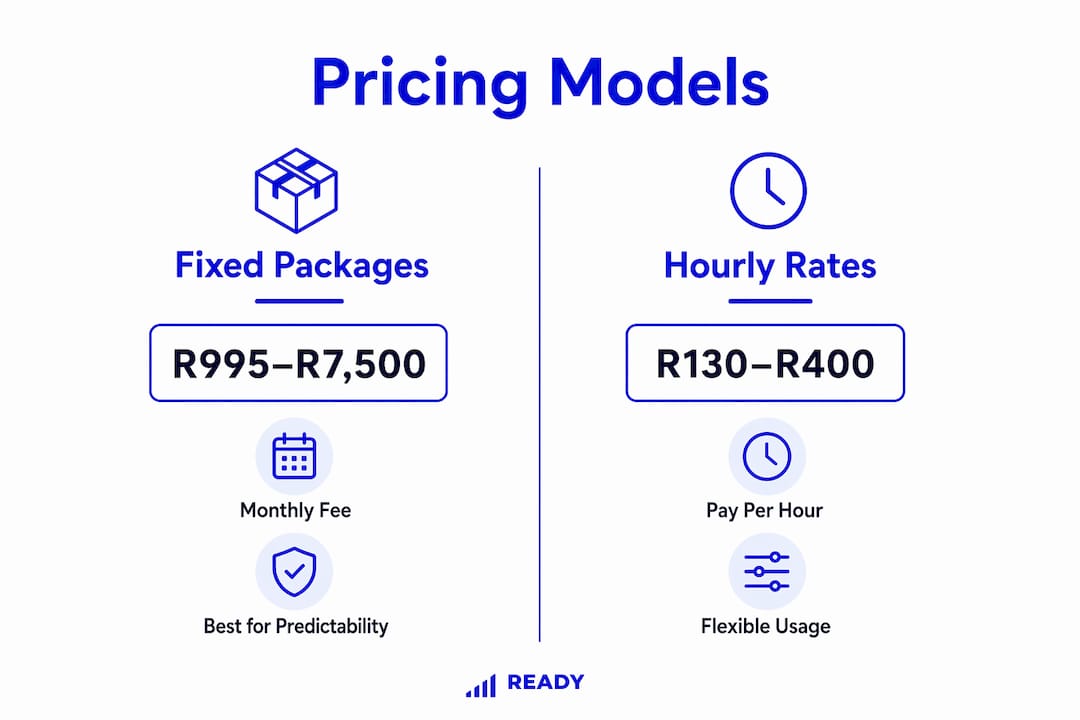
Three pricing models dominate the Cape Town market: hourly rates, fixed monthly packages, and retainer arrangements. Each suits a different type of business, and choosing the wrong model can cost you more than the bookkeeping itself.

Monthly fixed packages start as low as R995 and extend to R7,500 or more depending on scope and transaction volume. This model suits businesses with predictable, consistent financial activity. You know your cost upfront, budgeting is simple, and there are no surprises at month end.
Basic bookkeeping in South Africa typically costs R3,000 to R7,500 per month, with full accounting and compliance packages reaching up to R35,000 monthly for larger operations. That upper range includes management accounts, SARS submissions, payroll, and financial statement preparation. Most Cape Town SMBs sit comfortably in the R2,000 to R7,500 range depending on complexity.
SureBooks offers bundled packages combining payroll, monthly financial checks, VAT submissions, and digital automation from around R2,200 per month. This kind of all-in pricing removes the guesswork and is worth comparing against building a custom scope from scratch.
| Pricing model | Typical rate range | Best suited for | Key advantage | Key disadvantage |
|---|---|---|---|---|
| Hourly rate | R130 to R400+ per hour | Irregular or seasonal businesses | Pay only for time used | Unpredictable monthly cost |
| Fixed monthly package | R995 to R7,500+ per month | Consistent transaction volumes | Predictable budgeting | May include services you don’t need |
| Retainer arrangement | Negotiated monthly fee | Growing businesses needing flexibility | Scalable and relationship-based | Requires clear contract terms |
| Bundled service package | From R2,200 per month | SMBs needing payroll, VAT, and bookkeeping | All-in pricing, less admin | Less customisable |
Pro Tip: If your business has seasonal peaks, negotiate a hybrid model: a lower fixed base fee with an agreed hourly rate for months where transaction volume spikes. Most providers will accommodate this if you ask.
How to evaluate affordable outsourced bookkeeping services in Cape Town
Price is the starting point, not the finish line. A provider charging R1,200 per month who misses VAT deadlines or produces inaccurate reconciliations will cost you far more in SARS penalties than a R3,500 provider who gets it right every time.
Use this process to evaluate providers beyond the quote:
- Verify qualifications and registrations. Ask whether the bookkeeper or firm is registered with SAIPA, SAICA, or the Institute of Certified Bookkeepers (ICB). Registration signals accountability and ongoing professional development.
- Confirm software compatibility. If you already use Xero or Sage Business Cloud, your provider must be proficient on the same platform. Switching software mid-engagement creates data migration risk and additional cost.
- Request a sample report. Ask for a redacted management account or reconciliation from a current client. This tells you more about quality than any sales conversation.
- Assess transparency in pricing. A reputable provider will give you a written quote that itemises every service included. Vague quotes that bundle everything into one line are a warning sign.
- Test responsiveness before signing. Send an email with a specific question before engaging. Response time and quality of the answer reveal how the relationship will feel once you are a paying client.
- Check for scalability. Your bookkeeping needs will grow as your business grows. Confirm that the provider can handle increased transaction volumes, payroll additions, or CIPC annual return filings without referring you elsewhere.
Cloud collaboration is now the standard expectation from Chartered Accountants in Cape Town. A provider who cannot give you real-time access to your own financial data through a cloud platform is not positioned to be a strategic partner. They are a data entry service, and you should price them accordingly.
What hidden fees should you watch for in outsourced bookkeeping?
The quoted monthly rate is rarely the total cost. Common additional charges from local providers include setup and onboarding fees, extra reconciliations for accounts not included in the base package, VAT processing and SARS submission fees, payroll administration charges, and financial statement preparation costs.
Setup fees are the most common surprise. Some providers charge R500 to R2,000 to migrate your existing data onto their platform, configure chart of accounts, and onboard your business. This is a legitimate cost, but it should be disclosed upfront and not appear as a line item on your first invoice.
VAT submissions to SARS are often excluded from entry-level packages. If your business is VAT-registered, confirm whether bi-monthly VAT201 submissions are included or billed separately. The same applies to payroll: processing salaries, submitting EMP201 returns, and issuing IRP5 certificates are specialist tasks that carry their own fees.
- Onboarding and setup: R500 to R2,000 is common for new client configuration.
- Additional reconciliations: Extra bank accounts or credit cards beyond the base scope are often billed per account.
- VAT processing: Bi-monthly VAT201 submissions may be excluded from basic packages.
- Payroll services: EMP201 returns, payslips, and IRP5 preparation are typically priced separately.
- Financial statement preparation: Annual Financial Statements for CIPC or bank submissions are rarely included in standard monthly fees.
- Correction fees: If your records arrive in poor condition, some providers charge for clean-up work before regular bookkeeping begins.
The solution is straightforward: request a full written scope of work before signing anything. Every service should be listed, with a clear statement of what triggers additional charges. Any provider unwilling to provide this level of transparency is not worth engaging.
Key takeaways
Outsourced bookkeeping rates in Cape Town range from R995 to R7,500 per month for fixed packages, with hourly rates between R130 and R400 depending on experience and complexity.
| Point | Details |
|---|---|
| Rate ranges vary widely | Fixed monthly packages start at R995; full accounting support can reach R7,500 or more per month. |
| Experience drives hourly cost | Entry-level bookkeepers charge R130 to R180 per hour; experienced practitioners charge R400 or more. |
| Hidden fees are common | Setup, VAT submissions, payroll, and correction charges are frequently excluded from base quotes. |
| Cloud software reduces cost | Providers using Xero or Sage Business Cloud work more efficiently, which often lowers your monthly fee. |
| Evaluate beyond price | Qualifications, software compatibility, and contract transparency matter more than the cheapest quote. |
Why the cheapest quote is usually the most expensive decision
I have worked with enough Cape Town SMBs to say this with confidence: the businesses that chase the lowest bookkeeping rate almost always spend more in the long run. SARS penalties for late VAT submissions, incorrect EMP201 returns, or poorly prepared Annual Financial Statements dwarf the monthly saving from hiring an underqualified provider.
The Cape Town market has a wide spread of quality. You will find freelance bookkeepers at R995 per month who are genuinely excellent, and you will find firms charging R5,000 per month who produce mediocre work. The rate tells you almost nothing on its own. What tells you everything is the combination of qualifications, software proficiency, and the quality of their reporting.
Cloud accounting has changed the game here. When a provider uses real-time cloud platforms properly, you can see your financial position at any point during the month. You are not waiting for a report that is already three weeks old. That visibility is worth paying for, and it is the clearest signal that a provider is operating as a strategic partner rather than a historical record-keeper.
My advice to any Cape Town SMB owner evaluating outsourced bookkeeping: spend 20% more than the cheapest quote you receive, and use that budget to get a provider who is cloud-native, SAIPA or ICB registered, and willing to give you a fully itemised scope of work. The benefits of outsourcing accounting only materialise when the provider you choose is genuinely capable of delivering them.
— Johan
How Readyaccounting approaches outsourced bookkeeping for Cape Town SMBs
Readyaccounting works with scaling Cape Town SMBs that need more than a bookkeeper recording transactions. The firm replaces manual processes with cloud infrastructure built on Xero and Sage Business Cloud, giving clients real-time financial visibility and SARS-compliant records without the overhead of an in-house finance team. Packages are structured around your actual transaction volume and service scope, with no hidden onboarding fees. If you want to understand how automating your bookkeeping directly improves cash flow, Readyaccounting’s resource library is a practical starting point. Contact the team at readyaccounting.co.za to request a scoped quote for your business.
FAQ
What is the average cost of outsourced bookkeeping in Cape Town?
Fixed monthly packages in Cape Town typically range from R995 to R7,500 per month depending on transaction volume and service scope. Full accounting and compliance packages can reach R35,000 monthly for larger operations.
How much do bookkeepers charge per hour in South Africa?
Hourly rates range from R130 to R180 for entry-level bookkeepers, R180 to R250 for mid-career practitioners, and R400 or more for experienced professionals. The rate reflects qualifications, complexity, and the provider’s track record.
What services are typically included in a monthly bookkeeping package?
Most packages cover transaction capturing, bank reconciliations, and basic financial reporting. VAT submissions, payroll processing, and Annual Financial Statement preparation are commonly priced as add-ons.
Is outsourced bookkeeping worth it for a small Cape Town business?
Outsourcing removes the fixed cost of an in-house employee and gives you access to qualified professionals and cloud accounting platforms. For most SMBs, the combination of cost savings and SARS compliance protection makes it the more practical choice.
What software do Cape Town bookkeeping providers typically use?
The majority of reputable Cape Town providers work on Xero or Sage Business Cloud. Both platforms offer real-time access, user permissions for client collaboration, and direct integration with SARS e-filing processes.