

Measuring return on investment: a practical guide for South African businesses
Measuring return on investment: a practical guide for South African businesses
Executive Summary
- Most South African businesses overstate ROI by 30 to 60 percent because they exclude hidden internal costs. Accurate measurement requires including all expenses, using appropriate attribution windows, and reviewing results regularly. Building a culture of measurement helps businesses make better budget decisions and achieve higher returns.
Measuring return on investment (ROI) is the process of calculating how much financial return a business generates relative to what an initiative costs. For South African business owners and financial managers, getting this right is not optional. South African SMEs targeting process automation and B2B marketing aim for a 5:1 baseline (400% ROI), with high-performing firms reaching 8:1 to 12:1 after 12 months of compounding. Yet most businesses never reach those numbers, not because their investments fail, but because they measure incorrectly. The most common error is excluding hidden internal costs, which causes firms to overstate returns by 30–60% before they even notice.
What is the standard formula for measuring return on investment?
The core ROI formula is: (Revenue – Cost) ÷ Cost × 100 = ROI%. Simple in theory, but the “Cost” component is where most South African businesses go wrong.
A complete cost calculation must include every rand spent to generate the result. That means program spend, tool subscriptions, sales close labor, internal team time, and change management overhead. For recurring revenue businesses, use a 24-month customer lifetime value (LTV) as your revenue figure rather than the first deal value. For transactional businesses, use the closed deal revenue directly.
Here is a sample calculation for a South African B2B SME running a lead generation campaign:
| Component | Amount (ZAR) |
|---|---|
| Closed deal revenue (24-month LTV) | R240,000 |
| Campaign spend | R18,000 |
| Sales team close labor (20 hrs × R350/hr) | R7,000 |
| Tool and platform costs | R3,500 |
| Internal marketing time (15 hrs × R300/hr) | R4,500 |
| Total cost | R33,000 |
| ROI | (R240,000 – R33,000) ÷ R33,000 × 100 = 627% |
That result looks strong. But if you had only counted the R18,000 campaign spend, your ROI would have appeared at 1,233%. That inflated number leads to bad budget decisions.
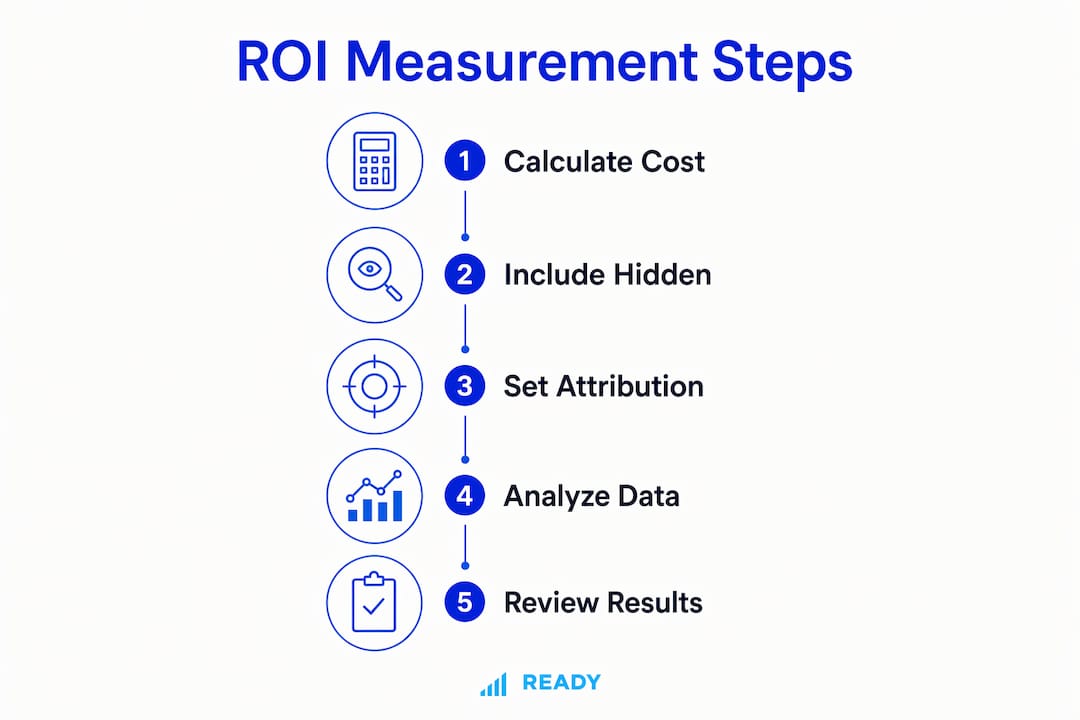
South African sales cycles often run 90 days or longer for B2B deals. Use an attribution window of at least 90 days when calculating ROI, or you will miss revenue that the investment actually generated.
Pro Tip: Apply a fully loaded hourly rate for every internal team member involved in an initiative. Include employer contributions, benefits, and overhead. This single step closes most of the 30–60% overstatement gap.
How do you measure ROI for digital marketing, automation, and AI?
ROI analysis techniques differ by initiative type. Each category has its own benchmarks, timelines, and measurement traps.
Digital marketing ROI
Digital marketing ROI measures revenue generated per rand spent across channels. For South African e-commerce businesses, break-even ROAS at a 30% gross margin requires a minimum 3.3:1 return on ad spend, with 4:1 to 5:1 needed for net profit. Google Ads and paid social typically show results within 30–60 days. SEO compounds over 6–12 months and should never be judged on a monthly basis.

Google Analytics 4 configured for conversion tracking with data-driven attribution is the minimum standard for reliable cross-channel ROI comparison. Without it, you are guessing. South African SMEs need a digital marketing service-level agreement of R5,000 to R10,000 per month to build the tracking architecture that makes every rand traceable to a commercial outcome.
Pro Tip: Never rely on last-click attribution alone. It over-credits the final touchpoint and starves your top-of-funnel channels of budget. Use data-driven attribution in Google Analytics 4 to distribute credit fairly across the customer journey.
Process automation ROI
Automation ROI calculation focuses on four components:
- Labor savings: Hours eliminated per month multiplied by fully loaded hourly rate
- Error reduction: Cost of rework, penalties, or SARS compliance corrections avoided
- Opportunity cost recovery: Time freed for revenue-generating activities
- Ongoing costs: Maintenance runs 15–25% of initial implementation cost, plus exchange rate impact, data cleanup, and compliance oversight
Most businesses budget for the software and forget the rest. That gap is why automation projects appear to underperform. The accounting automation guide from Readyaccounting covers realistic timelines and cost structures for South African financial services firms.
AI investment ROI
AI investments in South African SMEs fail most often because businesses budget for tools rather than outcomes. The right approach measures hours saved, cycle time reduction, error rates, and revenue impact after implementation. Baseline measurement before deployment is non-negotiable. Without it, you cannot prove what the AI actually changed.
South African organisations achieving real AI ROI secure their data governance models before rollout, invest in user adoption training, and track business outcomes rather than usage metrics like logins or queries processed.
What are the common ROI measurement pitfalls for South African businesses?
Most ROI measurement errors fall into predictable patterns. Knowing them in advance saves months of misdirected budget.
- Excluding hidden internal costs. Founder time, sales team effort, and change management labor are real costs. Leaving them out inflates ROI by 30–60%.
- Using too short an attribution window. Judging a 12-month initiative after 60 days produces a false negative. Use a rolling 6–12 month window for long-term channels.
- Last-click attribution. Last-click models over-credit bottom-funnel channels and under-credit the channels that started the customer relationship. This leads to cutting SEO and content while overspending on retargeting.
- No baseline before deployment. Especially critical for AI and automation. If you do not measure the current state, you cannot calculate what changed.
- Budgeting for tools, not outcomes. A R15,000 per month SaaS subscription is not an investment plan. Define the business outcome first, then select the tool.
- Underestimating operational friction costs. Exchange rate volatility on USD-priced software, SARS compliance oversight, and retraining costs are real line items. Missing them causes projects to run over budget and blame the technology.
Pro Tip: Implement time tracking for every team member involved in a new initiative for the first 90 days. Use those hours multiplied by a fully loaded cost rate to build an accurate internal cost figure. Most businesses are shocked by the result.
Governance and data security deserve a specific mention. South African businesses deploying cloud-based tools must account for POPIA compliance costs, data migration, and security audits. These are not optional extras. They belong in your ROI cost column from day one.
How do you use ROI data to make better budget decisions?
ROI measurement only creates value when it feeds directly into budget decisions. Tracking numbers in a spreadsheet that nobody reviews is not a system. It is a habit that wastes time.
The most effective approach connects ROI data to your financial KPIs and reviews it on a structured schedule. Post-implementation reviews at 3, 6, and 12 months give you the data to make confident decisions rather than reactive ones.
A practical framework for budget allocation based on ROI:
- Set a baseline target. The 5:1 ROI baseline (400%) is the South African SME standard for process automation and B2B marketing. Anything below this benchmark warrants review.
- Compare channels on equal terms. Account for timeline differences. SEO at month 3 cannot be compared to Google Ads at month 3. Use the same measurement window for a fair comparison.
- Adopt a rolling 6–12 month window. Long-term initiatives like content marketing and automation compound over time. Cutting them early based on 60-day data destroys future returns.
- Build ROI review into your budgeting cycle. Every budget line item should have a defined ROI target and a review date. This is the foundation of disciplined financial planning for South African SMEs.
- Target 8:1 ROI as your growth benchmark. High-performing South African firms reach 8:1 to 12:1 ROI after content and automation investments compound past the 12-month mark. Use this as your aspirational target, not your minimum.
- Integrate ROI into your annual financial statements. SAICA and SAIPA reporting standards require accurate cost allocation. Proper ROI tracking makes your Annual Financial Statements more reliable and your SARS submissions cleaner.
The budgeting framework from Readyaccounting provides a step-by-step structure for South African scaling companies to align budget allocation with measurable returns.
Key takeaways
Accurate ROI measurement requires including all hidden costs, using appropriate attribution windows, and reviewing results at structured intervals to drive reliable budget decisions.
| Point | Details |
|---|---|
| Use the full cost formula | Include internal labor, tool costs, and change management, not just third-party invoices. |
| Apply a 90-day minimum attribution window | South African B2B sales cycles demand longer measurement periods to capture true returns. |
| Avoid last-click attribution | Data-driven attribution in Google Analytics 4 distributes credit fairly across all channels. |
| Set a 5:1 ROI baseline | South African SMEs targeting automation and B2B marketing should aim for 400% as a minimum. |
| Review at 3, 6, and 12 months | Structured post-implementation reviews prevent premature cuts and reveal compounding returns. |
Why most South African businesses are measuring ROI wrong
I have worked with enough South African SMEs to see the same pattern repeat. A business invests in a new tool or campaign, calculates a strong ROI by looking only at the invoice, and then wonders six months later why the growth has not materialized. The answer is almost always the same: the cost side of the equation was incomplete.
The businesses I see getting ROI right share one habit. They measure the current state before they spend anything. They know their baseline hours, their error rates, their cost per lead. When the investment lands, they have something real to compare against. That discipline is rare, and it is the single biggest differentiator between firms that compound their returns and firms that chase the next tool.
The South African market is adapting fast. More businesses are asking harder questions about AI ROI for SMEs before signing contracts. That is a healthy shift. The firms that build a culture of measurement now will have a compounding advantage over the next three to five years. Patience and discipline beat enthusiasm every time.
— Johan
How Readyaccounting helps South African businesses measure and improve ROI
Readyaccounting works with scaling South African SMEs and VC-backed startups to replace manual financial processes with cloud infrastructure that produces real-time data. When your books are accurate and your costs are fully loaded, ROI calculations stop being guesswork and start being decisions. The team acts as your Fractional CFO, building the financial visibility that connects every rand spent to a measurable outcome. If you want to see how automation improves cash flow and reduces the hidden costs that inflate your ROI figures, Readyaccounting has the tools and the experience to get you there.
FAQ
What is the basic ROI formula?
ROI equals (Revenue minus Cost) divided by Cost, multiplied by 100. Always include fully loaded internal costs, not just third-party invoices, for an accurate result.
What is a good ROI benchmark for South African SMEs?
A 5:1 ROI (400%) is the standard baseline for process automation and B2B marketing in South Africa. High-performing firms reach 8:1 to 12:1 after 12 months of compounding.
How long should I measure ROI before making a decision?
Use a minimum 90-day attribution window for B2B initiatives and a rolling 6–12 month window for long-term channels like SEO and automation. Judging results too early produces false negatives.
Why do South African businesses overstate their ROI?
Most firms exclude hidden internal costs such as founder time, sales labor, and change management. This omission causes ROI overstatement of 30–60% on average.
What tools do I need for accurate digital marketing ROI?
Google Analytics 4 configured with conversion tracking and data-driven attribution is the minimum standard. Without proper setup, cross-channel ROI comparison is unreliable.