

Master employee expense management for South African SMEs
Executive Summary
- South African SMEs must carefully manage employee expenses to remain SARS-compliant and avoid penalties. Implementing a clear workflow, utilizing digital tools, and educating staff ensure accurate record-keeping and proper categorization of allowances and reimbursements. Automating processes and fostering a compliance culture transforms expense management into a strategic business advantage.
Every South African SME owner has felt it: an employee submits a crumpled stack of receipts three weeks late, half of them for expenses that aren’t clearly business-related, and SARS requires a full audit trail. One missed logbook entry or a travel allowance that exceeds the prescribed limit can transform a routine reimbursement into a taxable benefit, triggering penalties you never saw coming. This guide cuts through the confusion, showing you exactly how to structure a compliant, efficient employee expense workflow that satisfies SARS requirements and saves your team hours of administrative pain every single month.
Table of Contents
- What is employee expense management and why does it matter?
- SARS compliance essentials: Know the rules on allowances and reimbursements
- Step-by-step workflow for efficient expense management in your SME
- Common mistakes and how to avoid them
- A fresh perspective: Why automation and culture matter most for lasting success
- Take the next step: Smarter expense management with trusted partners
- Frequently asked questions
Key Takeaways
| Point | Details |
|---|---|
| Understand SARS compliance | Proper handling of allowances and reimbursements reduces risk and ensures tax compliance. |
| Prioritize substantiation | Always require receipts, invoices, and logbooks for employee claims to avoid penalties. |
| Streamline with workflow | Structure your expense process to align with SARS documentation rules for effortless audits. |
| Avoid common mistakes | Regularly update policies and train staff to prevent costly errors. |
| Embrace automation | Digital tools and clear culture boost efficiency and cut admin burdens for small businesses. |
What is employee expense management and why does it matter?
Employee expense management is the end-to-end system your business uses to capture, verify, approve, and reimburse costs that employees incur while doing their jobs. It sounds straightforward, but in practice it covers everything from petrol claims and client entertainment to subsistence allowances for overnight travel. For South African SMEs, this process sits at the intersection of daily operations and SARS compliance, making it far more consequential than most owners initially realise.
The typical pain points are painfully familiar:
- Lost or illegible receipts submitted weeks after the fact
- Employees uncertain about what qualifies as a reimbursable business expense
- Managers approving claims without checking SARS substantiation rules
- Payroll teams unsure whether a payment is taxable income or a clean reimbursement
- No central record system, so audit preparation becomes a fire drill
These aren’t just administrative inconveniences. Mishandled expenses become a direct SARS risk. If your business pays out allowances or reimbursements that aren’t correctly categorised or documented, those amounts can be reclassified as taxable income for the employee. That triggers PAYE (Pay As You Earn, the tax withheld from employee salaries) obligations, potential penalties, and interest charges for your business.
“Subsistence and travel expense handling is tightly linked to SARS rules; correct treatment is essential for compliance.” SARS Guide for Employers in Respect of Allowances
SARS regulations around allowances and reimbursements aren’t just compliance hurdles. They’re actually a blueprint for building a cleaner system. When you design your expense process around what SARS requires, you naturally eliminate ambiguity, reduce disputes between staff and management, and create an audit-ready paper trail as a byproduct of normal operations. A solid payroll compliance checklist is a practical starting point, and addressing common payroll errors early prevents cascading issues down the line.
SARS compliance essentials: Know the rules on allowances and reimbursements
This is where many SMEs get caught out. The distinction between an allowance and a reimbursement isn’t just accounting jargon. It determines whether a payment is taxable, what proof is required, and how it must appear on an employee’s IRP5 (the South African annual tax certificate issued by employers).
Allowances are upfront payments made to an employee to cover anticipated costs. A monthly car allowance or a daily subsistence allowance for travel are classic examples. The catch is that allowances above SARS-deemed thresholds, or not supported by adequate proof, become taxable income for the employee and create PAYE liability for you.
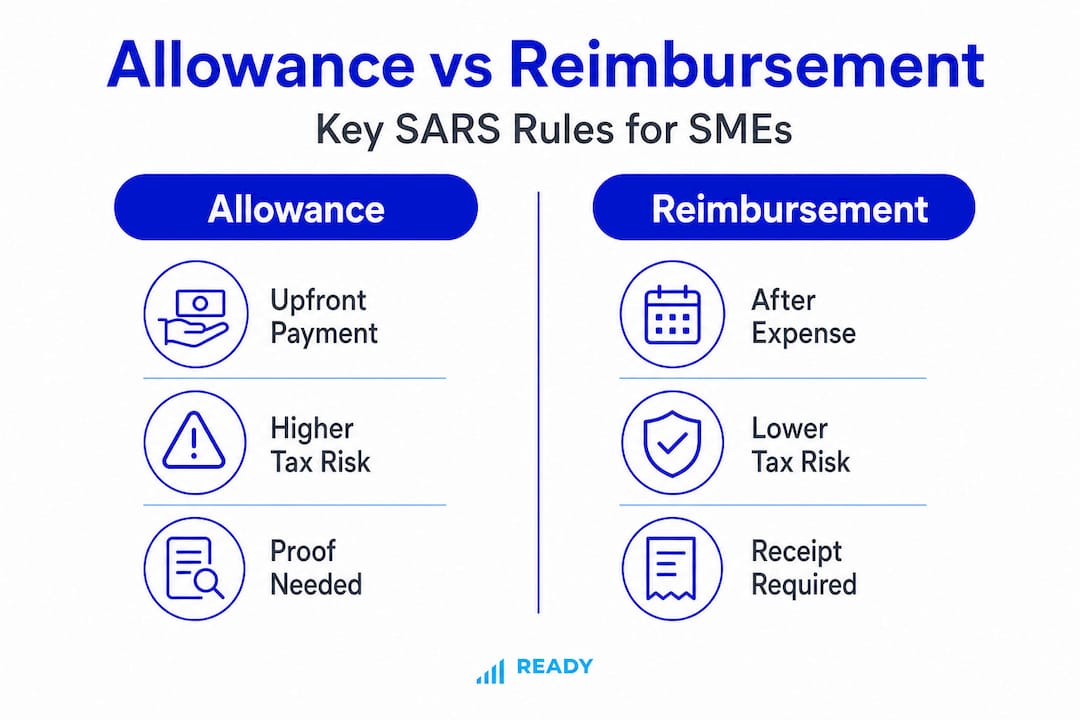
Reimbursements, by contrast, are payments made after an employee has already incurred and proven a business expense. When correctly documented, reimbursements are generally non-taxable. The key word is “correctly.” Without receipts, mileage logs, or other substantiation, a reimbursement looks no different from a cash payment to SARS.
| Category | Definition | Tax risk | Proof required | Typical examples |
|---|---|---|---|---|
| Allowance | Upfront payment to cover expected costs | Taxable if exceeds limits or lacks proof | Logbook, receipts, business purpose | Car allowance, subsistence, cell phone allowance |
| Reimbursement | Repayment of actual, proven business spend | Non-taxable if correctly documented | Original receipts, invoices, purpose statement | Petrol receipts, parking, client meals |
| Subsistence allowance | Fixed daily amount for overnight travel | Deemed amount set by SARS; excess is taxable | Proof of travel, overnight stay confirmation | Hotel meals, incidentals away from home |
SARS requires logbooks and proof for all travel claims. Without them, the entire claim can be disallowed. This is a critical detail that catches even diligent businesses off guard during tax season.
Pro Tip: Set up a digital logbook template for any employee who receives a travel allowance. Make it a condition of reimbursement, not an afterthought. Apps that automatically track GPS routes and allow employees to tag trips as business or personal solve this problem with almost no extra effort.
Key record-keeping requirements include:
- Original receipts for all expense claims above a de minimis (minor) threshold
- A logbook recording the date, starting point, destination, distance, and business purpose of every work-related trip
- Proof of overnight stays for subsistence claims
- Written confirmation of business purpose for entertainment or client-related expenses
Understanding what qualifies as a deductible business expense also helps you and your employees make smarter decisions at the point of spending, not just at claim time.
Step-by-step workflow for efficient expense management in your SME
Knowing the rules is only half the battle. The other half is building a process that makes compliance the path of least resistance for your team. Here is a practical, five-step workflow you can implement immediately.
-
Create and communicate a clear expense policy. Document exactly what is reimbursable, what proof is required, submission deadlines, and the approval chain. Employees shouldn’t need to guess. Include the SARS-prescribed subsistence deemed amounts and your company’s travel rate per kilometre so staff can self-check before submitting.
-
Collect and document claims at the point of spend. Require employees to capture receipts digitally at the time of purchase using a mobile app or cloud-based expense tool. The longer the gap between spending and submission, the higher the chance of missing documentation.
-
Review every claim against SARS proof requirements. Your approver, whether that’s a manager or your finance team, must check that the expense category is correct, the receipt is valid, and the claim falls within SARS-allowable limits. A simple checklist embedded in your approval workflow takes less than two minutes per claim.
-
Approve with clear taxable and tax-free limits in mind. Before processing payment, confirm whether the reimbursement or allowance exceeds any SARS threshold. If it does, flag it for PAYE treatment. This step prevents nasty surprises at year-end when IRP5 certificates are issued.
-
Maintain records for the SARS-required five-year period. Store all approved claims, receipts, logbooks, and policy documents in a secure, searchable digital archive. Cloud storage with version control is ideal. If SARS audits you, you want to retrieve any record within minutes, not days.
To reduce administrative complexity, align your approval workflow directly with SARS substantiation rules and build taxable thresholds into your system as automated checkpoints.
| Feature | Manual tracking | Automated tracking |
|---|---|---|
| Receipt collection | Paper or email, easy to lose | Digital capture at point of spend |
| SARS threshold checks | Manual, error-prone | Automatic flags when limits are breached |
| Approval speed | Days to weeks | Same-day with automated routing |
| Audit readiness | Scramble to compile records | Instant export of categorised records |
| Employee experience | Frustrating, slow reimbursements | Fast, transparent, predictable |
| Risk of misclassification | High | Low, with enforced categories |
Pro Tip: Use a digital expense platform that integrates with your payroll and accounting software. When a travel claim is flagged as exceeding the SARS threshold, it should automatically route to your payroll provider for PAYE treatment without requiring a manual handoff. This single integration eliminates one of the most common and costly year-end errors in SME payroll. Following payroll best practices aligned with your expense workflow creates a seamless, audit-proof system.
Common mistakes and how to avoid them
Even well-intentioned businesses make the same errors repeatedly. Recognising these patterns is the fastest way to close the gaps in your current process.
“Missing receipts, faulty logbooks, or misunderstanding allowance limits create tax risks for the business and employees alike.” SARS Travel allowance leaflet 2025
Here are the most common mistakes and their practical fixes:
-
Not collecting receipts at the time of purchase. The fix is simple: make digital receipt capture mandatory before an expense can be submitted. If there’s no photo or scan, the claim doesn’t exist. Build this into your expense policy and enforce it consistently from day one.
-
Paying allowances above SARS limits without PAYE treatment. Many employers pay a generous travel or subsistence allowance and simply forget that the excess is taxable. Review your allowance rates against the current SARS prescribed amounts at the start of each tax year, every March. Adjust, or withhold PAYE on the excess.
-
Confusing travel, subsistence, and other expense categories. A claim for meals during a day trip is treated differently from an overnight subsistence allowance. Getting these categories wrong distorts your payroll records and creates mismatches on IRP5 certificates. Train your approvers to distinguish between these categories and document the business purpose clearly.
-
Outdated policies not aligned with current SARS requirements. SARS updates its prescribed rates and requirements periodically. An expense policy written in 2021 may no longer reflect current deemed amounts for subsistence or the kilometre rate for travel. Schedule an annual policy review every April, after the new tax year begins.
-
Treating personal expenses as business costs. Whether accidental or deliberate, claiming personal expenditure as business expense exposes both the employee and the employer to serious SARS scrutiny. A clear written policy, combined with manager review, is your primary defence.
Addressing common bookkeeping mistakes before they compound is far less costly than unravelling errors during an audit. The pattern is consistent: small lapses in documentation create large problems when SARS comes knocking.

A fresh perspective: Why automation and culture matter most for lasting success
Here is the uncomfortable truth that most compliance guides won’t tell you. You can implement a perfect expense policy, buy the best software, and train every manager on SARS rules, and still have a broken system six months later. The reason is almost never technical. It’s cultural.
Many South African SMEs approach employee expense management as a SARS box-ticking exercise. They focus on avoiding penalties, which is entirely valid, but they miss the far bigger opportunity. A well-designed expense system is actually a real-time window into how your business spends money at the ground level. That’s valuable intelligence for a growing business, not just a compliance obligation.
Automation raises the floor. When your system automatically flags allowances that exceed SARS thresholds, enforces receipt uploads before submission, and routes taxable amounts to payroll without human intervention, you eliminate the most common failure points. The rules get enforced consistently, regardless of which manager is approving claims or how busy month-end is. Our accounting automation guide explores exactly how to build this kind of infrastructure for a scaling SME.
But automation only works if your employees actually use it. And employees use systems they understand and trust. When staff genuinely understand why a logbook matters, why receipts must be captured immediately, and how their claims connect to the company’s tax position, they become active participants in compliance rather than passive resistors. That shift in mindset is worth more than any software subscription.
The businesses we see get this consistently right do three things differently. They explain the “why” to employees at onboarding, not just the “what.” They make the process genuinely easy, with mobile-first tools and same-week reimbursements as a reward for compliance. And they review the data regularly, treating expense reports as business intelligence rather than administrative noise. That combination of clear culture, smart tools, and regular feedback loops is what separates businesses that own their expense management from those that are owned by it.
Take the next step: Smarter expense management with trusted partners
Building a compliant, efficient expense management system is absolutely achievable for any South African SME. But at a certain point, patching together policies, spreadsheets, and manual approvals stops scaling. If your team is growing, your expense volume is increasing, or you’ve had a close call with SARS, it’s time to upgrade your infrastructure. Ready Accounting helps scaling SMEs and startups replace manual finance processes with automated accounting systems that enforce compliance automatically, surface real-time financial insights, and protect your business from audit risk. From cash flow automation to fully outsourced accounting support, we build finance operations that work as hard as you do. Book a session with our team and let’s engineer a system that turns your expense management from a headache into a competitive edge.
Frequently asked questions
What documentation does SARS require for employee expense reimbursement?
SARS requires original receipts for most expense claims and a detailed logbook for all travel reimbursements to avoid disallowed claims and tax penalties. Missing or incomplete records can result in the entire claim being reclassified as taxable income.
Are business travel allowances always non-taxable?
No. Travel allowances exceeding SARS limits or not supported by adequate proof are taxable and must be declared for PAYE purposes. Always check the current prescribed rates each tax year.
How can a small business automate employee expense management?
Adopt a digital expense platform that integrates receipt capture at point of spend, automated SARS threshold alerts, and direct payroll integration so taxable amounts are flagged and processed without manual intervention.
What is the difference between an allowance and a reimbursement in SARS terms?
An allowance is an upfront payment that becomes taxable if it exceeds deemed amounts or lacks proof, while a reimbursement is repayment for actual, proven business costs and is non-taxable when correctly documented. The distinction drives your PAYE obligations entirely.
Recommended
- Eliminate common payroll errors for South African SMEs | Ready Accounting
- Payroll best practices for South African SMEs in 2026 | Ready Accounting
- Boost retention with employee benefits for south african enterprises | Ready Accounting
- Why budgeting matters for South African SME growth | Ready Accounting