

Market research basics for South African SMEs

Start this week: check Stats SA for your sector’s demand data, run a WhatsApp poll with 20 contacts, scan HelloPeter for competitor complaints, and book a 30-minute call with Readyaccounting to map findings to your VAT and cashflow model. That four-step sprint covers the market research basics every South African SME needs before making a pricing or product decision.
- Pull one Stats SA dataset for your industry (free at statssa.gov.za)
- Post a 3-question WhatsApp poll to an existing customer or community group
- Read the 10 most recent HelloPeter reviews for your top competitor
- Note your assumed monthly customer volume and average ticket size
- Share those numbers with your accountant before the next VAT period
Pro Tip: WhatsApp groups convert faster than email surveys in South Africa. A 3-question voice note or text poll sent to a community group at 7 PM on a weekday typically gets replies within two hours.
Table of Contents
- What are market research basics and why does the primary/secondary split matter?
- Which business questions must your research actually answer?
- Low-cost methods, timelines and realistic costs for South African SMEs
- How do you tailor research for South Africa’s diverse market?
- How do research findings feed financial automation and SARS compliance?
- A 5-step plan to run research and hand off to your finance team
- Templates, sample questions and key South African data sources
- Key takeaways
- A fractional CFO’s view on research and tax risk
- How Readyaccounting turns your research into financial automation
- Useful South African sources and further reading
What are market research basics and why does the primary/secondary split matter?
Market research in South Africa splits into two types, and knowing which to use first saves you weeks. Primary research means you collect new data directly: surveys, phone interviews, WhatsApp polls, focus groups, or street intercepts. Secondary research means you use data someone else already collected: Stats SA reports, SEDA guidance, Standard Bank’s business planner, or industry publications.
Standard Bank’s guidance makes the case plainly: effective market research lets any SME owner answer 12 critical business questions without a large corporate budget. Those questions cover demand, pricing, customer profile, objections, channels, and competitor strengths.
- Primary research: surveys (Google Forms), WhatsApp polls, phone interviews, micro-focus groups
- Secondary research: Stats SA datasets, SEDA sector guides, Standard Bank business planner, HelloPeter review scans, CIPC company searches, SARS VAT threshold guidance
Use secondary sources first. They cost nothing and take a day. Primary research fills the gaps secondary data cannot answer, especially local pricing sensitivity and specific customer objections.
Which business questions must your research actually answer?
Standard Bank lists 12 questions every SME’s market research must resolve. Here they are mapped to the decisions they drive:
- What is the demand for my product/service? Feeds your revenue forecast and VAT registration timing with SARS
- Is my pricing competitive? Determines gross margin assumptions and CIPC business plan credibility
- Who are my target customers? Shapes your customer acquisition cost and payroll planning
- What will make them purchase? Informs your USP and marketing channel spend
- What objections could they have? Reduces churn assumptions in your cashflow model
- How do I get them to hear about me? Drives channel cost estimates for your budget
- What will make them choose me over competitors? Feeds your differentiation and pricing ceiling
- What changes must I make to my product/service? Affects product development costs and timelines
- Who are my competitors and who buys from them? Informs market share assumptions
- What are their strengths and weaknesses? Identifies your entry strategy
- How can I be better? Shapes your USP and long-term pricing power
- What is my quality control standard? Affects operational cost and customer retention rate
Questions 1, 2, and 5 need primary data. Questions 9, 10, and 11 can be answered with secondary sources like HelloPeter and CIPC searches. For basic pricing sensitivity, 50–200 survey responses are usually enough for a niche city market.
Low-cost methods, timelines and realistic costs for South African SMEs
WhatsApp polls and groups are the most underused primary research tool in South Africa. They are free, fast, and reach people who will not open an email survey.
Primary methods and when to use them:
- WhatsApp poll (3–5 questions): Best for quick pricing or feature preference tests. Cost: R0. Timeline: 1–3 days.
- Google Forms survey (10–15 questions): Best for demand validation with 50–100 responses. Cost: R0–R500 for small incentives. Timeline: 1–2 weeks.
- Phone interviews (10–15 minutes each): Best for understanding objections in depth. Cost: R0–R1,000 airtime. Timeline: 1–2 weeks for 10 interviews.
- Micro-focus group (4–6 people): Best for product concept testing. Cost: R500–R2,000 for venue and refreshments. Timeline: 1 week to organize.
- Street intercepts: Best for retail or township markets. Cost: R0–R500. Timeline: 1–2 days.
Secondary methods (all free):
- Search Stats SA (statssa.gov.za) for your sector’s latest output and consumer expenditure data
- Check SEDA (seda.org.za) for SME sector guides relevant to your industry
- Use Standard Bank’s online business planner for structured question prompts
- Scan HelloPeter and Google Reviews for your top three competitors
- Search CIPC (cipc.co.za) to check competitor registration dates and director details
A focused sprint of a few weeks gives most SMEs enough confidence to make a go/no-go call. A WhatsApp poll plus 50–200 survey responses costs R0–R3,000 and takes 1–2 weeks. A wider survey with small incentives runs R3,000–R10,000 over 2–4 weeks.
Pro Tip: Ask a local community WhatsApp admin to share your poll. One message to a 200-member group beats cold outreach to strangers and gives you a more representative local sample.

For writing surveys that actually get useful answers, this guide on effective surveys covers question phrasing and response design in practical detail.
How do you tailor research for South Africa’s diverse market?
South Africa has 11 official languages and sharp urban/rural divides. A survey written in formal English and tested only in Sandton will mislead you badly if your actual market is in Soweto, Durban North, or a small Limpopo town.
- Translate key questions into isiZulu, Afrikaans, or Sesotho where your target community uses those languages daily
- Use local price anchors (e.g., “Would you pay more or less than R150 for this?”) rather than abstract scales
- Distinguish urban and peri-urban samples explicitly; do not pool them as one “South African” market
- State your sample limitations clearly in your business plan: “50 respondents, Johannesburg CBD, ages 25–45”
- Get informed consent: tell respondents the purpose, confirm participation is voluntary, and anonymise responses before sharing with any third party
Pro Tip: Naledi Mokoena’s guidance on cultural authenticity in survey design is worth following: use examples from the respondent’s daily life, not generic Western consumer scenarios. A question about “monthly subscriptions” lands differently in a township than in a suburban office park.
How do research findings feed financial automation and SARS compliance?
This is where market research basics pay off in rand terms. Raw survey data sitting in a Google Sheet does nothing for your business until it connects to a financial model.
Translate your findings into three forecast inputs: expected monthly customers, average revenue per customer, and estimated churn rate. Those three numbers update your cashflow projections, inform your accounting automation setup, and flag whether you are approaching the VAT registration threshold with SARS.
Reliable market research reduces the blind spots that trigger algorithmic tax risk. SARS combines internal and external data when assessing compliance risk — which means your own demand and revenue assumptions should be defensible, documented, and consistent with what your sector data shows.
Tax compliance is a survival factor for South African SMEs, not just a government revenue concern. A pricing test that reveals your average ticket is R8,500 per month per client changes your VAT exposure calculation immediately. A competitor analysis showing three rivals have recently registered for VAT signals your market is scaling and you may need to act sooner than planned.
Share this checklist with your accountant or Readyaccounting when handing over research findings:
- Expected monthly new customers (from survey demand signals)
- Average transaction value (from pricing sensitivity test)
- Estimated monthly churn or repeat purchase rate
- Channel mix (online vs. in-person, affects VAT treatment in some cases)
- Competitor VAT and CIPC registration status (from secondary research)
A 5-step plan to run research and hand off to your finance team
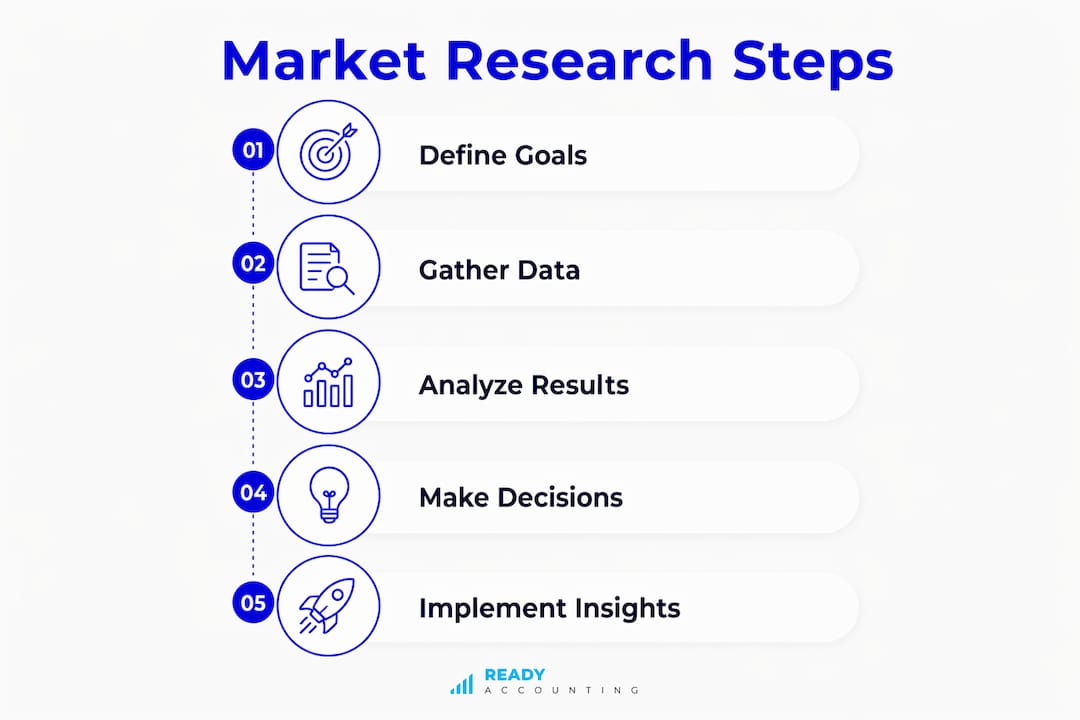
- Define your questions (Day 1–2, Founder): Pick 5–8 questions from the Standard Bank checklist. Write them in plain language. Tool: pen and paper or Google Docs.
- Run secondary research (Day 2–3, Founder): Check Stats SA, SEDA, HelloPeter, and CIPC. Document sources. Tool: browser, Google Sheets.
- Launch primary research (Week 1–2, Founder or marketing hire): Post WhatsApp poll, send Google Forms link, conduct 5–10 phone interviews. Target 50+ responses. Tool: WhatsApp, Google Forms.
- Analyse and summarise (Week 2–3, Founder): Clean data in Google Sheets or Excel. Calculate average responses per pricing question. Flag outliers. Produce a one-page summary with three forecast inputs. Tool: Google Sheets or Excel.
- Hand off to accountant (Week 3–4, Founder + Readyaccounting): Share the survey CSV, one-page summary, and forecast assumptions. Ask your accountant to map findings to VAT exposure, payroll projections, and cashflow runway. Tool: email or shared cloud folder.
Before acting on findings, run this quick bias check:
- Is your sample size at least 50 responses for a local niche market?
- Did you include respondents outside your existing network?
- Do your secondary sources (Stats SA, SEDA) broadly support your primary findings?
- Have you cross-checked competitor data from at least two sources?
Templates, sample questions and key South African data sources
| Source | What it provides | Best used for |
|---|---|---|
| Stats SA (statssa.gov.za) | Sector output, consumer expenditure, population data | Demand sizing, market size estimates |
| SEDA (seda.org.za) | SME sector guides, support programmes | Industry context, competitor landscape |
| Standard Bank business planner | Structured 12-question research framework | Checklist and business plan drafting |
| HelloPeter (hellopeter.com) | Customer reviews and complaints by brand | Competitor weakness analysis |
| SARS (sars.gov.za) | VAT thresholds, tax compliance guidance | Compliance planning, registration timing |
| CIPC (cipc.co.za) | Company registration, director details | Competitor verification, market age |
Sample survey (5 questions for pricing and demand validation):
- “How often do you currently buy [product/service category]?” (Monthly / Weekly / Rarely / Never)
- “What do you currently pay for a similar product or service?” (Open or banded: Under R200 / R200–R500 / R500–R1,000 / Over R1,000)
- “What is the single biggest problem you have with current options?” (Open text)
- “How likely are you to switch to a new provider if it solved that problem?” (1–5 scale)
- “Where do you prefer to buy this type of product or service?” (Online / In-store / WhatsApp order / Other)
For analysis, Google Sheets handles 200 responses easily. Use a pivot table to cross-tab pricing willingness against purchase frequency. That one cross-tab usually tells you more than the rest of the survey combined. Customer feedback from review platforms adds qualitative texture that surveys alone miss.
Key takeaways
South African SMEs that connect market research findings directly to forecast inputs, VAT planning, and cashflow automation make faster, lower-risk decisions than those who treat research as a standalone exercise.
| Point | Details |
|---|---|
| Start with secondary sources | Stats SA, SEDA, and HelloPeter cost nothing and take one day to cover. |
| 50–200 responses is enough | That sample size detects basic pricing sensitivity for a niche city market. |
| Three forecast inputs matter most | Expected customers, average revenue per customer, and churn rate feed cashflow automation. |
| Research reduces SARS trigger risk | Documented, defensible demand assumptions protect you when SARS cross-checks your filings. |
| Readyaccounting bridges the gap | Hand your survey CSV and forecast assumptions to Readyaccounting to map findings to VAT, payroll, and cashflow steps. |
A fractional CFO’s view on research and tax risk
Most founders treat market research as a marketing task. From a finance perspective, it is a tax risk management tool. When a pricing sensitivity test shows your average monthly revenue per client will sit at R12,000, that number immediately tells me whether you cross the VAT registration threshold within six months, what your provisional tax exposure looks like, and whether your payroll model is sustainable at that margin.
The founders who hand me a clean survey summary, a competitor pricing table, and a demand estimate cut their onboarding time in half. More importantly, their first VAT return is defensible because the revenue assumptions behind it trace back to documented evidence, not a guess. SARS does not audit optimism. It audits inconsistency. Research-backed forecasts are consistent by design.
When you brief an accountant, bring the raw dataset, a short note on how you collected it, and a mapping of each key finding to the forecast cell it affects. That three-page handoff is worth more than a 30-slide pitch deck.
How Readyaccounting turns your research into financial automation
Once your market research is done, the real work is converting findings into a financial model that runs itself. Readyaccounting builds custom cloud accounting infrastructure for South African SMEs and VC-backed startups, replacing manual bookkeeping with real-time runway dashboards and API-connected cashflow models.
Bring your survey CSV, your pricing assumptions, and your most recent VAT returns. Readyaccounting maps your demand and pricing data to automated cashflow projections, flags your VAT registration timing with SARS, and sets up the accounting automation that keeps your books clean as you scale. The result is a finance function that updates itself when your market changes, not one that surprises you at year-end.
Book a short scoping call with Readyaccounting at readyaccounting.co.za and bring your research summary. The conversation takes 30 minutes and leaves you with a clear action list.
Useful South African sources and further reading
- Stats SA: Download sector-specific consumer expenditure and output data. Cite the dataset name and release date in your business plan.
- SEDA: Sector guides and SME support programme listings. Useful for industry context and competitor landscape.
- Standard Bank business planner: Free structured framework covering all 12 market research questions.
- HelloPeter: Search any registered South African brand for customer complaints and ratings. Free and immediate.
- SARS: Check current VAT registration thresholds, provisional tax deadlines, and compliance requirements.
- CIPC: Verify competitor company registration status, registration date, and director details.
- SME Advice South Africa: Practical step-by-step guide to conducting market research on a small budget.
When presenting findings to an investor or SARS advisor, keep a short bibliography listing each source, the date you accessed it, and the specific data point you used. One page of citations turns a business plan from an opinion into evidence.
This article provides general information only and does not constitute financial, tax, or legal advice. Confirm current SARS thresholds, VAT rules, and compliance requirements with a qualified tax professional for your specific situation.
Recommended
- Digital marketing basics for South African SMEs: 2026 guide | Ready Accounting
- Marketing strategies for SMEs: your 2026 South African guide | Ready Accounting
- Why budgeting matters for South African SME growth | Ready Accounting
- Financial KPI examples every South African SME needs | Ready Accounting