

Managing cash flow during rapid growth: SME guide
Executive Summary
- Managing cash flow during rapid growth involves maintaining sufficient liquidity to cover expenses and funding expansion efforts simultaneously. Proactive forecasting, working capital controls, and early financing arrangements are essential to prevent liquidity crises. Using technology to automate processes and weekly cash reviews helps SMEs stay ahead of potential shortfalls and sustain growth.
Managing cash flow during rapid growth is the process of maintaining enough liquidity to cover daily expenses while funding expansion at the same time. For South African SMEs, this balance is harder than it looks. Revenue climbs, orders multiply, and the bank account still runs dry because cash is tied up in stock, unpaid invoices, and infrastructure costs. Experts recommend holding 90–180 days of operating cash as a reserve during growth phases. That number tells you everything: growth without liquidity is just a faster path to insolvency.
What are the core cash flow strategies for managing rapid growth?
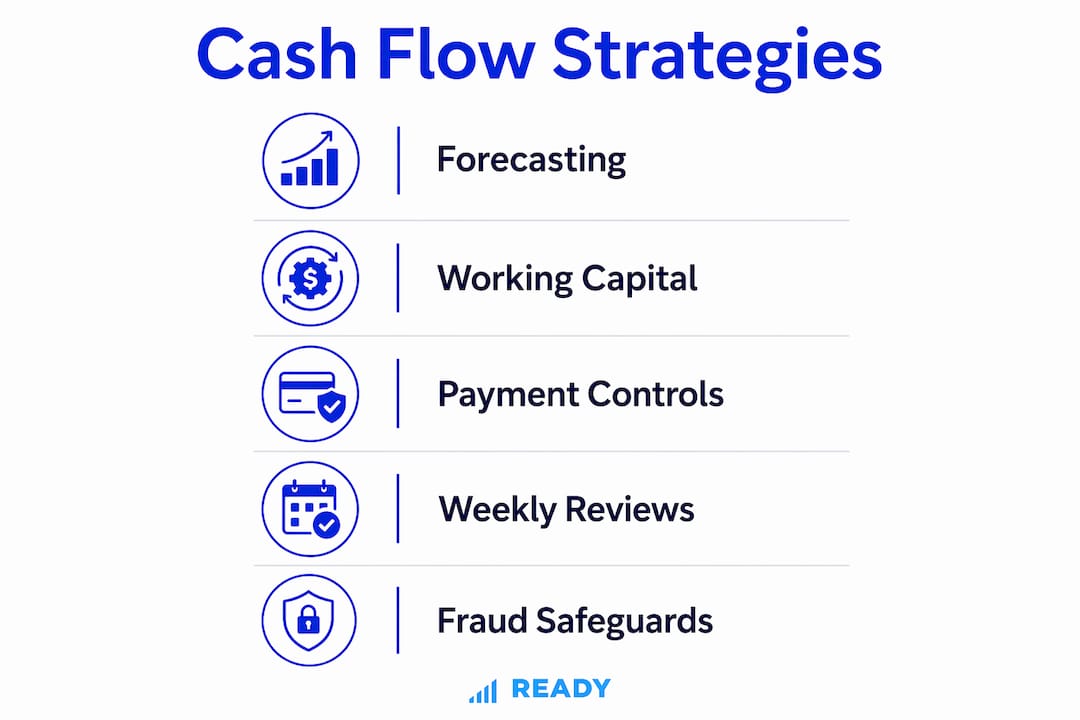
Cash flow management during rapid growth is not a passive exercise. It is an active discipline built on forecasting, working capital control, and spending structure.
The most effective tool for high-growth businesses is the rolling 13-week cash flow forecast. Weekly assessments track confirmed inflows and committed outflows, giving you three to four weeks of advance warning before a shortfall hits. Monthly reviews are too slow for a business scaling at pace. By the time a monthly report flags a problem, you have already missed the window to act.
Working capital optimization sits at the heart of rapid growth cash management. Three levers matter most:
- Receivables acceleration: Invoice on delivery, not at month end. Offer early payment discounts of 1–2% to customers who settle within 10 days. Every day you shorten your collection cycle is a day you reduce your funding gap.
- Inventory control: Carry only what you need for the next 30–45 days of sales. Overstocking ties up cash that should be funding growth.
- Payables extension: Negotiate 45 to 60-day payment terms with suppliers without damaging the relationship. This is standard practice and most suppliers expect the conversation.
A strategic cash flow approach also manages payment approvals and safeguards funds against fraud. As cash moves faster in a growing business, the risk of unauthorized payments rises. Establish dual-approval controls for any payment above a set threshold.
Pro Tip: Switch your cash flow reviews from monthly to weekly the moment your revenue growth rate exceeds 20% year on year. The extra hour per week will save you from emergency borrowing.
How can financing solutions support cash flow during rapid expansion?
Financing is not a sign of poor cash management. It is a planned tool that lets you invest in growth ahead of the revenue it generates.
CFO experts advise arranging lines of credit before you urgently need them. Banks and lenders assess your business when it is healthy. If you approach them during a cash crisis, you get worse terms, higher rates, and sometimes a flat refusal. The time to open a credit facility is when your financials look strong.
The three financing types most relevant to fast-growing South African SMEs are compared below:
| Financing type | Best use case | Key risk |
|---|---|---|
| Business line of credit | Bridging short-term cash gaps | Overuse creates dependency |
| Invoice financing | Unlocking cash from unpaid debtors | Fees reduce margin |
| Short-term working capital loan | Funding a specific growth investment | Fixed repayments strain cash |
A business line of credit works best for businesses with predictable revenue cycles. Invoice financing suits businesses with long debtor days and strong sales pipelines. Short-term loans work when you have a defined use of funds and a clear repayment source.
The worst outcome in financial planning during expansion is emergency borrowing. High-interest bridging finance or merchant cash advances can carry effective annual rates above 40%. One bad borrowing decision can wipe out months of margin.
Pro Tip: Apply for a credit facility when your last 12 months of financials are clean and your revenue trend is upward. Do not wait for the cash gap to appear.
What are the common cash flow pitfalls during rapid growth?
Growth disguises cash problems until they become crises. These are the four traps that catch South African SMEs most often.
-
Ignoring unit economics. Unit economics measure the cash tied up per sale. If you spend R800 in stock, labour, and delivery to generate a R1,000 sale, and your customer pays in 60 days, you are funding that R800 gap yourself for two months. Multiply that across hundreds of orders and the gap becomes a crisis.
-
Receivables growing faster than revenue. This is one of the clearest warning signs in scaling businesses. Delayed customer payments extend your cash conversion cycle and widen your funding gap. If your debtors book is growing faster than your income statement, you are booking sales you have not collected. That is not growth. That is deferred risk.
-
Insufficient cash reserves. Businesses should hold 3–6 months of operating expenses in reserve during growth phases. Most SMEs hold far less. When an unexpected cost hits, a large customer delays payment, or a supplier demands upfront payment, the business has no buffer.
-
Inadequate forecasting. Many owners rely on their current bank balance to make spending decisions. That number tells you where you are, not where you are going. Without a forward-looking forecast, you cannot see a shortfall coming until it has already arrived.
Pro Tip: Automate your invoicing and payment reminders using cloud accounting software like Xero or Sage. Businesses that automate collections reduce their average debtor days by a measurable margin without adding headcount.
How does technology improve cash flow visibility for growing SMEs?
Technology is the most underused tool in cash flow management for South African SMEs. Cloud accounting platforms and automation change the speed and accuracy of financial decision-making.

Automation creates bandwidth for finance staff to focus on strategic growth tasks rather than manual data entry and chasing payments. When your invoicing, payment reminders, and bank reconciliations run automatically, your finance team spends time on analysis instead of administration.
The practical benefits of cloud accounting for growing SMEs include:
- Real-time cash position: You see your actual bank balance, outstanding debtors, and upcoming creditor payments in one dashboard at any moment.
- Automated invoicing: Invoices go out the moment a job is completed or a product is shipped, not at the end of the month.
- Payment reminders: Automated reminders reduce debtor days without requiring a staff member to make awkward phone calls.
- Compliance tracking: SARS and VAT obligations are flagged in advance, so you never miss a submission deadline.
SARS compliance and VAT registration are not optional considerations for growing SMEs. Unexpected tax liabilities disrupt cash flow and can trigger penalties that compound over time. A business growing fast enough to cross the VAT registration threshold of R1 million in taxable turnover must register promptly. Missing that deadline creates backdated liability.
The table below shows how technology adoption affects key cash flow metrics:
| Metric | Manual process | Automated process |
|---|---|---|
| Average debtor days | 45–60 days | 25–35 days |
| Invoice processing time | 2–5 days | Same day |
| SARS submission errors | High | Low |
| Cash visibility | Monthly | Real-time |
Partnering with accounting professionals who understand South African SME requirements, including SAICA and SAIPA-aligned practices, gives you both the technology and the compliance expertise in one place. Financial forecasting built on accurate, real-time data is far more reliable than forecasts built on monthly spreadsheets.
Key takeaways
Managing cash flow during rapid growth requires weekly forecasting, working capital discipline, proactive financing, and technology adoption to prevent liquidity crises before they occur.
| Point | Details |
|---|---|
| Hold adequate reserves | Maintain 90–180 days of operating cash to absorb unexpected shortfalls during growth. |
| Forecast weekly, not monthly | A rolling 13-week forecast gives you 3–4 weeks of advance warning before a cash gap hits. |
| Arrange credit early | Secure a line of credit while your financials are strong, not during a cash crisis. |
| Watch your receivables | Debtors growing faster than revenue signals a collection problem that will worsen at scale. |
| Use automation for compliance | Cloud accounting reduces debtor days and keeps SARS and VAT obligations on track. |
The discipline that separates survivors from casualties
I have worked with enough fast-growing South African SMEs to say this plainly: the businesses that run into cash crises during growth phases almost never have a revenue problem. They have a discipline problem.
The pattern repeats itself. Sales are strong, the pipeline looks healthy, and the owner feels confident. So the weekly cash review gets skipped. The 13-week forecast gets replaced by a gut feel. The credit facility application gets delayed because “we don’t need it yet.” Then a large customer pays 30 days late, a VAT payment falls due, and a supplier demands upfront payment for the next order. All three happen in the same week. That is not bad luck. That is the predictable consequence of managing by optimism instead of data.
Fractional CFOs exist precisely for this stage of a business. You do not need a full-time CFO on payroll to get CFO-level financial discipline. What you need is someone who forces the weekly review, builds the forecast, and tells you the truth about your cash position before it becomes a crisis. Proactive cash flow management not only prevents insolvency but enables confident investment in talent, markets, and scaling.
My strongest advice: implement your cloud accounting infrastructure and your cash flow review cadence on the same day. Technology without process is just expensive software. Process without technology is just slow. Together, they give you the visibility and the discipline to grow without running out of road.
— Johan
How Readyaccounting helps you scale without running dry
Readyaccounting works with fast-growing South African SMEs and VC-backed startups to replace manual financial processes with cloud infrastructure that gives you real-time cash visibility. From automated invoicing and debtor management to SARS compliance and VAT registration, we remove the administrative friction that slows your finance function down. Our Fractional CFO service builds the forecasting discipline and working capital controls your business needs at this stage of growth. If you want to see exactly how automation improves cash flow for a business at your scale, start there. Then talk to us about building a system that grows with you.
FAQ
What does managing cash flow during rapid growth mean?
Managing cash flow during rapid growth means maintaining enough liquidity to cover operating expenses while funding expansion investments. It requires proactive forecasting, working capital controls, and pre-arranged financing rather than reactive responses to cash shortfalls.
How much cash reserve should a growing SME hold?
Growth-stage businesses should hold 90–180 days of operating expenses in reserve. This buffer covers unexpected shortfalls from delayed payments, tax obligations, or sudden infrastructure costs without forcing emergency borrowing.
How often should I review cash flow during rapid growth?
Weekly reviews using a rolling 13-week forecast are the standard for scaling businesses. Monthly reviews are too slow to catch problems before they become crises, particularly when debtor days and payment cycles are shifting.
What is the biggest cash flow mistake during rapid growth?
The most common mistake is letting receivables grow faster than revenue. This means you are booking sales without collecting cash, which widens your funding gap and creates a liquidity problem that worsens the faster you grow.
How does SARS compliance affect cash flow for South African SMEs?
Missed SARS deadlines and VAT registration delays create backdated tax liabilities and penalties that hit cash reserves without warning. Staying compliant through cloud accounting and professional support protects your liquidity and avoids compounding financial penalties.