

3 Platforms That Turn Local Networking into Clients for SA SMEs
3 Platforms That Turn Local Networking into Clients for SA SMEs

Your fastest local networking opportunities live on three platforms and one habit: search Meetup or Eventbrite for your industry plus your city, check your local Chamber of Commerce calendar, and RSVP to one event this week. Join a few groups and give each one some time before you judge whether it’s working.
Executive Summary
- Attending two to three well-chosen local groups for three months maximizes relationship-building without spreading yourself too thin.
- Focus on structured referral groups and industry associations for higher-value contacts, while using online communities as discovery tools.
- Follow up within two days with personalized messages and track results using a simple spreadsheet to convert contacts into meaningful outcomes.
- Prepare specific, concise answers and questions, arrive early, and respect event formats to make the most of in-person networking opportunities.
- Building lasting relationships over two to three years requires consistent engagement, not just attending events, supported by a solid financial foundation to act on referrals quickly.
Table of Contents
- Types of local networking opportunities worth your time
- How to choose the right groups without burning out
- Finding events and the hidden channels most people miss
- Turning contacts into outcomes after the event
- How solid finances help you act on the opportunities you find
- How to prepare and present yourself at a networking event
- Etiquette that separates good networkers from everyone else
- Building relationships that pay off over years, not weeks
- Overcoming shyness and inexperience at networking events
- Practitioner’s note: a checklist for predictable networking progress
- Turn your networking wins into actual business growth
- Where to go next
- Sources
Types of local networking opportunities worth your time
Not every gathering deserves a slot on your calendar. Local networking opportunities generally fall into four categories, and each one attracts a different kind of contact.
In-person meetups are informal, low-cost, and usually free or under a few hundred rand to attend. They suit founders who want breadth: a mix of freelancers, small business owners, and the occasionally random but useful contact. Expect drinks-in-hand chat rather than structured pitches.
Structured referral groups like BNI run on a set agenda, with members taking timed turns to present and exchange referrals. This format often yields higher conversion rates than open mixers, precisely because everyone shows up expecting to give and receive business, not just swap cards.
Industry associations and chambers (think your regional Chamber of Commerce or a professional body like SAICA) skew formal and are built for depth over breadth. You’ll meet fewer people per event but far more relevant ones, particularly if you’re chasing accountants, lawyers, or compliance specialists.
Online communities on LinkedIn, and local WhatsApp or Telegram groups, cost nothing but attention. They work best as a discovery layer feeding your in-person choices, not a replacement for them.
- Meetups: broad, informal, cheap, good for early-stage discovery
- Structured groups (BNI): formal agenda, referral-focused, monthly fee typical
- Chambers/associations (SAICA, SACCI): credibility-heavy, slower pace, higher-value contacts
- Online groups: free, fast-moving, best paired with in-person follow-through
How to choose the right groups without burning out
Most people fail at networking not because they attend too few events, but because they attend too many of the wrong ones. Fix that with a short filter.
- Name your goal first. Chasing clients points you toward chambers and trade shows. Chasing mentors or partners points you toward structured groups and industry associations.
- Check the fit before you commit. Look at who actually shows up, how often the group meets, whether membership is exclusive, and what it costs in time and money.
- Pick two or three groups and stick with them for three months. Effective SME owners choose a few platforms where their customers gather rather than spreading thin across every event in town.
- Define one metric before you start. Meetings booked, referrals received, or deals closed. Pick one and track it.
Walk away if a group has no clear agenda after three visits, if the same five people dominate every conversation, or if nobody ever follows up with you.
Pro Tip: If a group’s newsletter or WhatsApp thread is dead for more than two weeks between events, that’s usually a sign the organizers have already moved on. Don’t invest further.
Finding events and the hidden channels most people miss
The obvious platforms are obvious for a reason. On Meetup and Eventbrite, filter by category and distance rather than scrolling a generic feed. On LinkedIn, the Events tab under a company or industry hashtag often surfaces gatherings weeks before they hit general listings.
Chamber and association calendars rarely show up in a general search, but they’re where SACCI, NAFCOC, and SAICA post their own sessions directly.
- Set a Google Alert for “[your industry] + [your city] + networking” to catch announcements as they happen
- Monitor venue calendars directly, since co-working spaces and conference centres often list events before organizers promote them elsewhere
- Join local WhatsApp or Telegram groups for your sector, which tend to announce niche events faster than broad platforms ever do
- Search by a known speaker’s name or a specific venue instead of a generic keyword. It surfaces smaller, higher-signal gatherings that broad searches bury
Turning contacts into outcomes after the event
The event is the easy part. What happens in the following two weeks decides whether it was worth your evening.
- Follow up within 48 hours with a short, personalized message that references something specific you discussed. “Great chatting about your export challenges” beats “Nice meeting you” every time.
- Set a light cadence. A small, useful touch every two weeks, plus a slightly longer monthly check-in, keeps you present without becoming a pest.
- Track it somewhere. A spreadsheet with name, event, follow-up date, and outcome is enough for most SME owners; a basic CRM only makes sense once your contact list outgrows a scroll bar.
- Offer something concrete, like an introduction, a useful article, or an invite to a low-pressure coffee. Consistency and offering value are what turn a business card into an actual deal.
How solid finances help you act on the opportunities you find
A referral is only useful if you can act on it fast, and that means knowing your cashflow before you say yes to a new contract. A quantitative study on South African SMEs found networking directly supports sustainable business performance, but only when the business behind it can actually deliver.
Readyaccounting builds the cloud accounting infrastructure and real-time dashboards that let you check capacity before you commit. Chamber and SAICA events regularly connect SME owners with bookkeepers, auditors, and fractional CFOs. Having your own numbers straight before those conversations makes you look like the kind of business people want to refer work to.
How to prepare and present yourself at a networking event
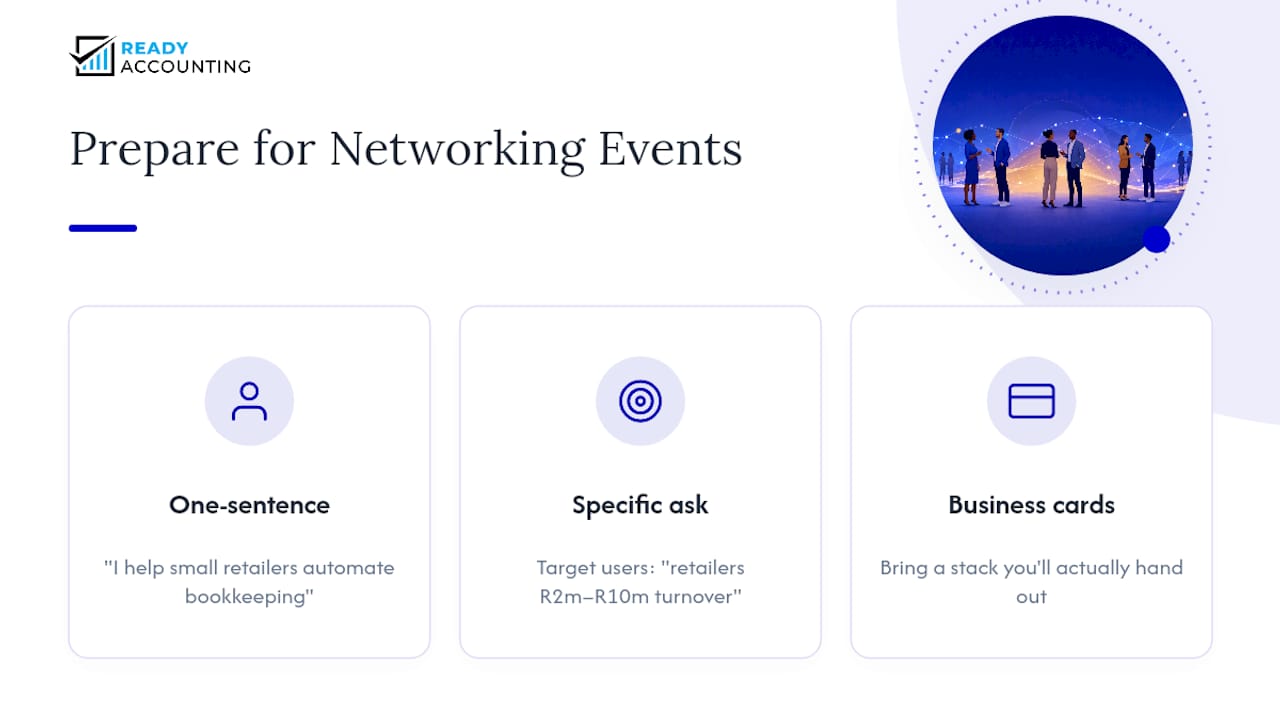
Show up with three things ready: a one-sentence answer to “what do you do,” a specific ask, and a stack of business cards you’ll actually hand out. The one-sentence answer matters more than people assume. “I help small retailers automate their bookkeeping” lands better than a three-minute explanation of your entire service catalogue, because it gives the other person something to react to immediately.
Dress for the room, not for comfort. A trade show crowd and a chamber breakfast call for different registers, and misjudging it makes you memorable for the wrong reason.
Bring a specific ask, not a vague one. “I’m looking to meet retailers doing R2 million to R10 million in turnover” gives people something to act on. “I’m just here to network” gives them nothing to work with, and most contacts will forget you within a day.
Arrive early. The first fifteen minutes of any event are quieter and easier to start real conversations in, before the room fills and everyone reverts to their existing cliques. Late arrivals spend half the evening just finding an opening.
Finally, prepare two or three open questions you can ask anyone. “What’s kept you busiest this year?” works better than “How’s business?” because it invites a real answer instead of a reflexive “fine, thanks.”
Etiquette that separates good networkers from everyone else
Listen more than you talk. The person who asks good follow-up questions is remembered far more fondly than the person who monologues about their own business for ten minutes straight.
Never pitch on first contact. Nobody wants to be sold to thirty seconds after a handshake, and it’s the single fastest way to get quietly avoided for the rest of the evening.
Respect the room’s format. If a structured group gives you sixty seconds to speak, use fifty five, not ninety. Running over doesn’t just annoy the organizer, it tells the whole room you don’t respect shared time.
Follow through on what you say you’ll do. If you promise to send an article or make an introduction, do it within a few days. This single habit, more than any pitch or business card, is what determines whether people trust you enough to refer you business later.
And exit conversations gracefully. “Great chatting, I want to say hello to a couple of other people before this wraps up” is honest, kind, and lets both of you keep circulating.
Building relationships that pay off over years, not weeks
Local networking opportunities compound. The contact who seems irrelevant today might become your best referral source in three years, but only if you kept the relationship alive in between.
The businesses that get the most out of networking treat it as ongoing maintenance, not event-by-event transactions. That means checking in without an ask attached, congratulating people on wins you notice on LinkedIn, and occasionally sending business their way with no expectation of an immediate return. Creating relationships and staying consistent is what actually converts introductions into revenue over time, and it’s a slower process than most people expect walking into their first event.

Give real relationships two to three years to mature into consistent referral sources. That timeline frustrates people who want fast results, but it’s the honest one, and it’s also why quitting after one quiet quarter is the single most common networking mistake among SME owners.
Overcoming shyness and inexperience at networking events
Almost everyone at a networking event feels some version of the same nerves you do, including the people who look confident. The most reliable fix isn’t a personality change. It’s a script.
Prepare three specific questions before you arrive, so you never have to improvise an opener under pressure. Something like “What brought you to this event tonight?” removes the blank-mind moment that trips up most first-timers.
Set a small, achievable goal instead of an overwhelming one: have three real conversations, not “work the whole room.” Three genuine conversations beats twenty rushed ones every time, and it’s a target you can actually hit even on a nervous night.
Arrive with a friend or colleague if the format allows it, but split up once you’re inside. A familiar face at the door lowers the initial anxiety spike, while splitting up forces you to actually build your own contacts instead of hiding in a two-person bubble all evening.
And treat the first few events as practice, not performance. Nobody remembers your slightly awkward opening line next week. They remember whether you followed up.
Practitioner’s note: a checklist for predictable networking progress
Prioritize quality over quantity. Two or three groups, chosen deliberately, will outperform a scattershot approach every time. Build a monthly routine: one event, four follow-ups, one piece of value shared with no ask attached. Then measure a single number, whether that’s conversations turned into meetings or meetings turned into leads. Skip the vanity metrics like attendance count. They tell you nothing about whether the room actually held your next client.
— Johan
Turn your networking wins into actual business growth
Landing a referral is the easy part. Delivering on it fast, without your books turning into a mess, is where most SME owners stumble. Readyaccounting builds the cloud accounting infrastructure and real-time cashflow dashboards that let you say yes to a new contract the moment a chamber contact sends it your way, instead of scrambling to check whether you can actually afford to take it on.
That’s the practical edge a solid finance function gives you over a business still running on spreadsheets and guesswork: you already know your numbers when the opportunity shows up, so you act on it while it’s still warm. See how automation improves your cashflow visibility and get in touch with Readyaccounting to set up a finance foundation that keeps pace with the business you’re building through your network.
Where to go next
For finding events, start with Meetup and Eventbrite, then check your local Chamber of Commerce and SAICA calendars. For converting contacts into leads, the networking-to-marketing pipeline is worth a closer look.
Sources
- Grow your business by growing your network | Business Partners
- Networking and sustainable performance of small and medium enterprises in South Africa