

Limited company tax return accountant: your next move
If your limited company owes SARS an ITR14 this year, the fastest path forward is simple: hire a qualified limited company tax return accountant to prepare and file it for you. That means finding someone who can clean up your books, compile your Annual Financial Statement, calculate what you owe, and submit through eFiling before the deadline creeps up on you. Companies registered with CIPC already have a SARS Income Tax reference number generated automatically, so the tax clock is ticking whether you’ve touched it or not. Ready Accounting handles exactly this kind of work for South African SMEs, and the process is more predictable than most directors expect.
Here’s what actually happens once you bring in a tax accountant:
- They review your bank statements, ledgers, and payroll records to confirm the numbers are clean.
- They compile or review your Annual Financial Statement (AFS) and sign off on the figures.
- They calculate your corporate tax liability and complete the ITR14 with the correct annexures for your company type.
- They submit the return via eFiling and manage any SARS follow-up queries.
Pro Tip: Before your first call with an accountant, pull together your last three months of bank statements and your prior-year ITR14 assessment. That single step often cuts the initial consultation time in half.
Key Takeaways
Hiring a qualified limited company tax return accountant to prepare your ITR14, manage your AFS, and maintain your SARS compliance status is the single most reliable way to avoid late filings and unexpected penalties.
| Point | Details |
|---|---|
| Gather documents early | Send bank statements, ledgers, payroll summaries, and your prior-year ITR14 before the first consultation. |
| Expect classification-based filing | Your ITR14 annexures depend on whether SARS classifies your company as dormant, micro, small, or medium to large. |
| Budget by book condition | Clean bookkeeping keeps fees at the entry to mid band; cleanup work or cross-border income pushes costs higher. |
| Vet credentials before signing | Confirm SAICA, SAIPA, or ACCA membership and ask for a tax practitioner PR number. |
| Work with Ready Accounting | Ready Accounting pairs cloud bookkeeping with ITR14 filing and ongoing SARS Tax Compliance Status management for South African SMEs. |
Table of Contents
- What does a limited company tax return accountant actually do?
- What documents do you need before you talk to an accountant?
- How long does filing a company tax return take?
- What does a limited company tax return accountant cost?
- How do you choose the right accountant for your company?
- How do filing rules differ by country?
- How Ready Accounting can help you file your limited company tax return
- Sources
What does a limited company tax return accountant actually do?
The job is bigger than “filling in a form.” SARS itself says as much: it recommends that companies consult a registered tax practitioner whenever supporting documents are incomplete or financial statements need interpreting, because SARS service consultants won’t do that interpretation for you. That’s the gap a tax accountant fills.
A proper engagement usually covers:
- Bookkeeping cleanup — reconciling bank feeds, fixing miscoded transactions, and closing gaps in the general ledger.
- AFS compilation — for small, medium, and large companies, a signed Annual Financial Statement is compulsory alongside the ITR14; for other categories it’s optional but still smart practice.
- Tax computation — applying the correct rate, deductions, and any allowances your company qualifies for.
- ITR14 preparation — SARS customises this return by company classification (dormant, micro, small, medium to large), and the annexures required differ by type.
- eFiling submission — the accountant, often acting as your registered representative, files the return electronically.
- Provisional tax management — where applicable, calculating and submitting IRP6 returns on schedule.
Most accountants bundle this with ongoing services: monthly bookkeeping, payroll, and maintaining your Tax Compliance Status. That last one matters more than directors realise. A company’s TCS dashboard shows registration status, outstanding returns, and debt, and a valid TCS PIN is frequently required for tenders or supplier vetting. If your accountant isn’t watching that number year round, you’ll find out the hard way, usually right when a big contract is on the table.
On turnaround: expect a signed engagement letter that spells out who prepares what, who signs the AFS, and who acts as public officer or company representative on eFiling. That clarity avoids disputes later and is a genuine sign of a well-run practice.
What documents do you need before you talk to an accountant?
Preparation saves money. An accountant who has to chase paperwork will bill for that chasing, so gather these first:
- Company registration documents and CIPC details (registration number, directors, registered address).
- Twelve months of bank statements for every business account.
- Trial balance or general ledger, if you keep one.
- Payroll summaries, including PAYE and UIF submissions.
- VAT returns, if your company is VAT-registered.
- Draft or signed AFS from the prior year.
- Prior-year ITR14 and the SARS assessment (ITA34) that followed it.
- Fixed-asset register, if the company owns equipment, vehicles, or property.
- Company resolutions and public officer appointment details.
Under the Companies Act, businesses are legally required to keep daily records of money received and paid, along with accounting records sufficient to prepare financial statements and support an audit if one’s needed. Skipping this isn’t just risky. It’s one of the most common reasons small companies land in expensive bookkeeping cleanup projects right before a filing deadline.
Missing or messy ledgers, an unsigned AFS, or a fixed-asset register that doesn’t reconcile all trigger extra hours, and extra hours mean higher fees. If your books already reflect deductible expenses correctly, your accountant spends less time untangling categories and more time on the actual return.
Pro Tip: Name your files clearly (e.g. “Bank_Statement_Jan2026.pdf”) and upload them through a secure client portal rather than emailing scattered attachments. It sounds small, but it’s the difference between a same-week quote and a two-week back-and-forth.
How long does filing a company tax return take?
For a company with clean, up-to-date books, preparation and filing can often be wrapped up within one to two weeks once all documents are in hand. A company that needs bookkeeping cleanup first, missing ledgers reconstructed, or an AFS built from scratch, is looking at four to eight weeks, sometimes longer if records span multiple years.
The deadlines that matter:
- ITR14 submission — the window depends on your financial year end; most companies must file within twelve months of that date, but check your specific notice from SARS.
- First provisional tax payment (IRP6) — due six months after your financial year starts.
- Second provisional payment — due at financial year end.
- Optional top-up payment — six months after year end, for companies wanting to true up before interest accrues.
SARS confirms that provisional tax applies to most companies at these intervals, excluding a few specific categories. Miss a provisional deadline and you’re not just late, you’re accruing interest on an estimate SARS assumes you should have gotten right.
Start the process at least six to eight weeks before your ITR14 is due, longer if your bookkeeping isn’t current. That buffer gives your accountant room to query anything unusual and still file on time, and it gives you room to respond if SARS requests supporting documents mid-review.
What does a limited company tax return accountant cost?
Fees vary by how clean your books are, not just how big your company is. A small company with a full year of reconciled bookkeeping and a straightforward structure sits at the low end. A company needing a full cleanup, multiple entities, or cross-border transactions sits much higher.
| Fee Band | What It Typically Includes | Best Fit |
|---|---|---|
| Entry | ITR14 preparation and filing, basic AFS review, clean existing books | Dormant or micro companies with minimal transaction volume |
| Mid | Full AFS compilation, tax computation, provisional tax management, TCS maintenance | Small to medium trading companies with regular monthly activity |
| Higher | Bookkeeping cleanup, complex revenue recognition, multiple bank accounts or entities, VAT reconciliation | Growing SMEs with messy records or several income streams |
| Specialist | Cross-border transactions, consolidated group accounts, capital gains calculations | Startups with foreign shareholders or holding structures |
What pushes a quote from entry to specialist level: the number of transactions per month, whether books need reconstruction, how many bank accounts feed the ledger, whether the company has foreign income or shareholders, and how tight your deadline is. A rush job costs more than one booked with a normal runway.
One overlooked option for very small businesses: turnover tax. It’s an elective simplified system replacing VAT, provisional tax, and income tax for qualifying businesses under R2.3 million in turnover. It’s not automatically cheaper or simpler for every business, and whether it saves you money depends heavily on your expense profile, so this is a decision to model with an accountant rather than assume.
How do you choose the right accountant for your company?
Not every accountant advertising “company tax returns” is equipped to handle yours well. Look for these signals before you sign anything:
- Professional body membership — SAICA, SAIPA, or ACCA registration means the accountant answers to a code of conduct, not just a business card.
- Published fee ranges — practices confident in their pricing will tell you roughly what to expect before the first invoice.
- Client testimonials or case studies — real evidence they’ve handled companies like yours.
- eFiling and CIPC experience — ask directly how many ITR14s they’ve filed this year.
- Cloud accounting fluency — if they can’t integrate with Xero, Sage, or a similar platform, your monthly bookkeeping stays manual and slow.
Questions worth asking in the first call: Who actually does the work, the person you’re speaking to or a junior you’ll never meet? What software do they use, and can you see your numbers in real time? What’s the turnaround from document submission to filed return? Is pricing fixed-fee or hourly, and what happens if SARS raises a query after filing?
Red flags to walk away from: no professional registration you can verify, no written engagement letter or deliverables list, slow or vague communication, and no secure way to send sensitive financial documents.
Ask any accountant for their tax practitioner registration and PR number before engaging them. SARS explicitly points companies toward registered practitioners when returns involve financial interpretation, and a real number is easy to verify. If they hesitate, that’s your answer.
Pro Tip: A tax practitioner number doesn’t guarantee quality, but the absence of one is a hard stop. Verify it before you send a single document.
How do filing rules differ by country?
South African company directors deal with a specific set of moving parts. CIPC registration automatically generates a SARS Income Tax reference, so there’s no separate manual step to register for company tax. The ITR14 return itself is customised by classification, dormant, micro, small, or medium to large, and each classification carries different annexure requirements. Companies also generally face provisional tax obligations on top of the annual return, and maintaining a clean Tax Compliance Status matters well beyond filing season, particularly for anyone bidding on tenders.
Other markets structure this differently, and none of it should be treated as universal:
| Jurisdiction | Company Registry | Tax Authority | Annual Return Mechanism |
|---|---|---|---|
| South Africa | CIPC | SARS | ITR14 with AFS annexures, provisional tax (IRP6) |
| United Kingdom | Companies House | HMRC | Corporation Tax return, annual accounts filed separately |
| United States | State-level registration | IRS | Form varies by entity type |
The mechanics differ enough that guidance built for one system rarely transfers cleanly to another. If your South African company has foreign shareholders, earns income offshore, or holds interests in a group structure spanning multiple countries, that’s the point to bring in a specialist rather than rely on a generalist accountant stretching outside their usual scope. And don’t assume your company automatically qualifies for Small Business Corporation tax incentives just because it feels small; SBC status has its own separate criteria distinct from your ITR14 classification.
Ready Accounting’s approach to limited company returns
I’ll be direct about how we think about this at Ready Accounting: a tax return is the output of a system, not a once-a-year scramble. Most directors we talk to have been treating bookkeeping as an afterthought, then panicking every filing season when the numbers don’t add up. Our approach starts earlier, with cloud infrastructure and forensic cleanup that means your AFS is already accurate by the time ITR14 season arrives, rather than something built under deadline pressure.

We work as a fractional CFO for scaling SMEs and venture-backed startups, which means the same team watching your monthly cash flow is the one signing off on your annual filing. That continuity matters when SARS raises a query, because whoever answers already knows your numbers instead of relearning them from a folder of PDFs. Compliance status, provisional tax, and eFiling management sit inside that same ongoing relationship, not as a separate emergency service.
How Ready Accounting can help you file your limited company tax return
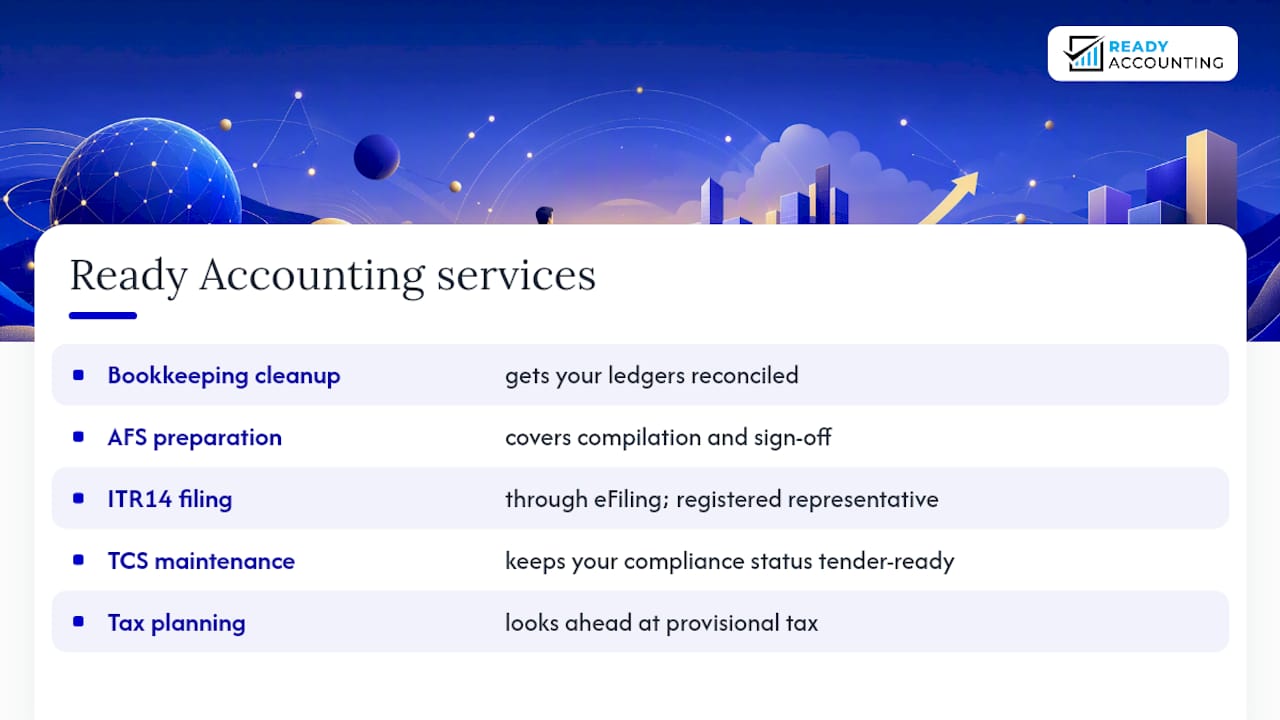
Beyond the ITR14 itself, Ready Accounting bundles the services most companies actually need across the year. Bookkeeping cleanup gets your ledgers reconciled so your AFS isn’t built on guesswork. AFS preparation covers compilation and sign-off matched to your company classification. ITR14 filing happens through eFiling with your registered representative handling submission and follow-up. TCS maintenance keeps your compliance status tender-ready, not scrambled together the week a bid closes. And tax planning looks ahead at provisional tax and structure decisions instead of reacting to them.
Readyaccounting is the practical alternative to piecing this together yourself with software and spreadsheets: automated bookkeeping feeds real-time dashboards, so your accountant isn’t reconstructing months of transactions before they can even start your return. That’s less back-and-forth, fewer surprise fees, and a filing process that starts from clean data instead of chaos. If your books need a proper diagnosis before you commit to a filing timeline, our guide on improving financial reporting walks through what “clean” actually looks like.
If your ITR14 is on the horizon or your bookkeeping has fallen behind, get in touch with Ready Accounting for a fixed-fee quote and a straight answer on timeline before you commit.
Sources
- Small Businesses - Taxpayers | South African Revenue Service
- IT-GEN-04-G01 - How to complete the Income Tax Return ITR14 for Companies - External Guide
- GEN-ELEC-08-G01 - Guide to the Tax Compliance Status functionality on eFiling - External Guide
This article is general information, not a substitute for advice from a qualified financial advisor. Consult a qualified financial professional about your own circumstances before acting on anything here.
Recommended
- Tax Services Johannesburg | Ready Accounting Tax Consulting
- Execution Framework: reduce tax liability for South African Scaling Companies | Ready Accounting
- Income tax returns for SA Scaling Companies: What owners must know | Ready Accounting
- Execution Framework: avoid tax penalties: protect your South African Corporate Asset | Ready Accounting