

Key components of a managed accounting service
Executive Summary
- Managing a business in South Africa involves handling compliance, taxes, payroll, and financial management consistently. A comprehensive managed accounting service integrates these functions using cloud technology and expert oversight to ensure accuracy, compliance, and growth readiness. This approach reduces errors, saves costs, and provides real-time visibility, giving SMEs a competitive financial advantage.
Running a business in South Africa means you are already juggling sales, staff, suppliers, and a compliance calendar that never lets up. VAT returns, SARS submissions, CIPC annual filings, payroll deadlines. Most small business owners assume they have it covered with a part-time bookkeeper or a spreadsheet, then discover a penalty notice in their inbox. Understanding what are the key components of a managed business accounting service clears up that confusion fast. This is not just bookkeeping with a fancier name. It is a complete financial management system built to keep your business accurate, compliant, and ready to grow.
Table of Contents
- Key takeaways
- Core components of a managed accounting service
- Cloud accounting and automation
- The expert human element
- Real benefits for South African SMEs
- My honest view on managed accounting
- How Readyaccounting can help your business
- FAQ
Key takeaways
| Point | Details |
|---|---|
| More than bookkeeping | Managed accounting covers payroll, tax, financial statements, and advisory under one service. |
| Compliance is built in | SARS VAT returns, CIPC filings, and payroll legislation are handled proactively, not reactively. |
| Cloud tech drives accuracy | Automated reconciliations and real-time reporting reduce errors and speed up your monthly close. |
| Expert oversight matters | A qualified tax accountant interprets your numbers and flags risks before they become problems. |
| Bundled pricing saves money | Bundled services cut costs by roughly 15% compared to hiring separate providers for each function. |
Core components of a managed accounting service
A well-structured managed accounting service is built on four pillars. Each one depends on the others, and leaving any out creates gaps that tend to surface at the worst possible time, usually right before a SARS audit or a bank loan application.
General bookkeeping and reconciliations
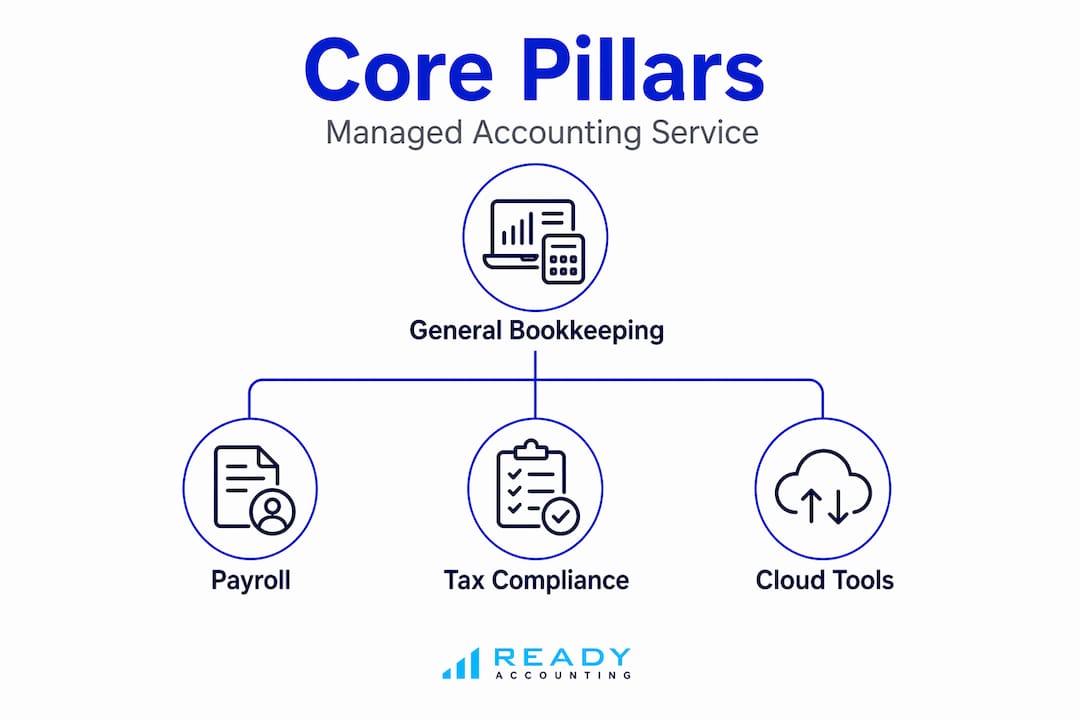
This is the foundation everything else rests on. Proper ledger management means every transaction is categorised correctly, accounts payable and receivable are tracked, and your bank accounts are reconciled monthly. End-to-end bookkeeping saves time, reduces errors, and gives you financial visibility that a shoebox of receipts simply cannot. Without clean books, everything downstream, including tax returns, financial statements, and cash flow forecasts, becomes unreliable.
Payroll processing
Managing payroll manually is where most SMEs get into trouble. A managed service integrates payroll software directly with your accounting records. SimplePay integration with your accounting platform keeps your payroll records accurate and synced with SARS requirements, covering UIF, PAYE, and SDL submissions without you having to track every deadline yourself.
Tax compliance
This is where the real value of a managed service shows up for South African business owners. Your service provider handles VAT registration, monthly or bi-monthly VAT returns, provisional tax, and income tax submissions. SARS record-keeping rules are strict, and managed accounting keeps your records audit-ready at all times. CIPC annual returns are also included in a complete service, so your company registration stays in good standing.
Financial statements and reporting
A managed service prepares your Annual Financial Statement, balance sheet, income statement, and cash flow statement on a regular schedule. Structured monthly closes with customised management reporting give you the kind of decision-making data that banks, investors, and your own planning process all depend on.
- Ledger management and bank reconciliations
- Accounts payable and accounts receivable tracking
- Monthly payroll processing and SARS statutory submissions
- VAT returns and income tax submissions
- CIPC annual filings
- Annual Financial Statement preparation
- Cash flow statements and management reports
Pro Tip: Ask any potential accounting provider whether their service includes CIPC filings as standard. Many quote low monthly fees but bill separately for annual filings, payroll add-ons, and ad hoc SARS queries.
Cloud accounting and automation
The shift to cloud-based platforms has changed what it means to work with an accountant. You no longer hand over a folder of bank statements once a year and hope for the best. Cloud accounting benefits for small businesses include real-time reporting, remote access from any device, and the kind of collaboration that lets your accountant flag a problem before it becomes expensive.
Automation handles the repetitive work that used to eat hours every month. Invoices are generated and sent automatically. Bank transactions are imported and matched against your accounting records daily. VAT calculations update as you go. Integrated software and AI-powered tools cut manual data entry and reduce the risk of the transcription errors that trigger SARS queries.
For South African SMEs specifically, the practical benefits are significant.
- Bank feeds from major South African banks connect directly to your accounting software, so reconciliations happen in real time rather than at month end.
- SARS e-filing integration means your VAT and tax data flows directly from your accounting records to your submissions, reducing the chance of figures not matching.
- Your accountant can review your books remotely and send you management reports without either of you being in the same city.
- Multiple users can access the same data simultaneously, which matters when you have a bookkeeper, an accountant, and a business owner all needing current numbers.
Pro Tip: When you explore small business accounting packages, check which cloud platform the service runs on and whether it connects to your existing tools like your POS system, e-commerce platform, or inventory software.
The expert human element
Technology does a lot, but it does not know that your biggest client just cancelled or that you are about to expand into a new province. That is where the human side of a managed service makes the difference between having numbers and understanding them.
Managed accounting services provide the financial foundation of your business, covering bookkeeping, payroll, compliance, and financial reporting. A fractional CFO adds a strategic layer on top of that foundation, guiding decisions about funding, growth, and capital allocation. Knowing the difference helps you understand exactly what you are buying and what you still need to plan for as your business scales.
Here is what expert human oversight looks like in practice within a managed accounting service:
- Scheduled advisory calls. Your accountant reviews your management reports with you monthly or quarterly, explaining what the numbers mean in plain language and flagging any trends you should act on.
- Proactive tax planning. Rather than calculating your tax bill after the year ends, a qualified tax accountant identifies deductions, timing strategies, and provisional tax estimates throughout the year.
- SARS and VAT representation. If SARS sends a query or request for supporting documents, your managed service provider handles the response, not you.
- Year-end planning. Before your financial year closes, your accountant reviews your position and advises on any decisions that affect your tax liability or your financial statements.
- Compliance monitoring. Payroll legislation, VAT thresholds, and CIPC deadlines change. A managed service tracks those changes and adjusts your processes automatically so you stay compliant without having to monitor it yourself.
Local expertise matters more than people realise. A South African tax accountant who works exclusively with SMEs understands the practical pressures of load shedding, late payments, and seasonal cash flow dips in a way that a generic offshore accounting platform simply cannot.
Real benefits for South African SMEs
The business case for a managed accounting service comes down to four things: cost, time, accuracy, and visibility.
Cost comparison
| Approach | Monthly cost estimate | Included |
|---|---|---|
| DIY with spreadsheets | Low upfront, high risk | None of the above |
| Separate providers | R3,000 to R8,000+ | Fragmented, coordination required |
| Managed accounting bundle | Fixed monthly fee | Bookkeeping, payroll, tax, reports, advisory |
Separate providers mean separate invoices, separate conversations, and no single person who sees the full picture. A bundled service gives you one point of contact and one predictable fee. Bundling accounting services saves approximately 15% compared to buying each function separately, and that excludes the hidden cost of your own time spent coordinating between providers.
Where SMEs feel the difference
- Less admin. You stop chasing down receipts, reconciling spreadsheets, and reminding yourself about VAT deadlines.
- Fewer mistakes. Automated data capture and professional review catch errors before they land in your SARS submission.
- Better cash flow visibility. Real-time dashboards show you exactly where your money is, which clients owe you, and what your obligations are next month.
- Faster decisions. When your books are current and your reports are clear, you can act on opportunities without waiting six weeks for your accountant to close last quarter.
- Audit readiness. Your records are organised, timestamped, and stored correctly at all times, which is exactly what SARS compliance requires.
The ability to focus on your core business while a professional team handles your finances is not a luxury. It is a competitive advantage that compound over time.
My honest view on managed accounting
I have worked with dozens of South African SME owners, and the story is almost always the same. They start out doing their own books, or they use a bookkeeper who does not communicate with their tax accountant, who does not talk to their payroll provider. Everyone is working from different data. Nobody owns the full picture. When a SARS query comes in, it takes three weeks to pull the information together, and by then the penalties have already started.
What I have seen work, consistently, is the combination of cloud technology and expert human oversight working as one service. The software catches what humans miss at volume. The accountant catches what software cannot interpret. Together, they create a financial operation that is accurate, current, and compliant. That peace of mind is genuinely hard to put a price on.
I am also direct with clients about what managed accounting is not. It is not a replacement for strategic thinking or fundraising advice. For those needs, you are looking at a fractional CFO. But without a clean accounting foundation under your business, no strategic advice lands correctly anyway. You have to get the foundation right first.
If you are still using disconnected tools or managing your own compliance, the question is not whether you need a managed service. The question is how long you can afford to keep operating without one. Explore how cloud accounting supports growth to see what an integrated approach actually looks like in practice.
— Johan
How Readyaccounting can help your business
Readyaccounting offers South African SMEs a fully managed accounting service that covers bookkeeping, payroll, VAT compliance, CIPC filings, and financial reporting under one fixed monthly fee. Everything runs on cloud-based platforms that give you real-time visibility into your business finances from anywhere. Your dedicated team handles SARS submissions and stays ahead of compliance deadlines so you never face a surprise penalty. Understanding how automation improves cash flow is a good starting point. Or go deeper with the 2025 accounting automation guide to see how the full system works. Contact Readyaccounting today for a consultation and find out what a managed service costs for your specific business.
FAQ
What does a managed accounting service include?
A managed accounting service typically covers bookkeeping, payroll processing, VAT returns, tax compliance, CIPC filings, and financial statement preparation. It combines cloud-based software with professional oversight under one monthly fee.
How is managed accounting different from basic bookkeeping?
Bookkeeping records transactions. Managed accounting includes bookkeeping but adds payroll, tax compliance, financial reporting, and expert advisory, giving you a complete financial management function rather than just a record of what happened.
What should I expect from accounting services in South Africa?
You should expect your provider to handle SARS VAT submissions, provisional tax, payroll statutory obligations, and CIPC annual returns, along with regular financial reports and at least quarterly advisory contact with a qualified accountant.
How do I choose an accounting service provider?
Look for a provider that offers a fixed monthly fee covering all core functions, uses cloud accounting software connected to South African banking systems, and has experience with SARS compliance for businesses in your industry and size bracket.
Can managed accounting reduce my tax liability?
Yes. A qualified tax accountant working within a managed service identifies allowable deductions, optimises provisional tax estimates, and plans year-end positions proactively, which typically results in a lower effective tax bill than a reactive, once-a-year approach.