

Independent review vs audit South Africa: what you need to know
Independent review vs audit South Africa: what you need to know
Executive Summary
- An independent review offers limited assurance through inquiry and analytical procedures, while an audit provides the highest reasonable assurance with comprehensive testing. South African law based on the Public Interest Score determines whether a business needs a review or a full audit, with thresholds specifying compliance obligations.
An independent review is defined as a limited assurance engagement where a practitioner uses inquiry and analytical procedures to assess whether financial statements are plausible. An audit, by contrast, delivers reasonable assurance, the highest level available, through comprehensive substantive testing and internal control evaluation. For South African business owners and financial managers, the choice between an independent review vs audit South Africa is not simply a preference. It is a legal obligation determined by your company’s Public Interest Score (PIS), ownership structure, and the qualifications of your accounting practitioner.
What is an independent review and what does it involve?
An independent review gives stakeholders limited assurance that nothing material appears to be wrong with the financial statements. The practitioner, typically a SAICA or SAIPA member or an accounting officer, does not verify every transaction. Instead, they ask management questions and run analytical checks to spot inconsistencies.
The procedures used in an independent review rely primarily on inquiry and analytical procedures, not the deep-dive testing you find in an audit. This makes the process faster and less disruptive to your finance team. Reviews generally take days to weeks rather than months.
Who can perform an independent review in South Africa?
- Companies with a PIS of 100 or above: a Registered Auditor (RA) or a member of SAICA or SAIPA can conduct the review.
- Companies with a PIS below 100: an accounting officer, typically a SAIPA or CIMA member, may perform the review.
- The practitioner must be independent of the company. This is a legal requirement, not a guideline.
Independent reviews are common when lenders request assurance before approving a business loan. Banks and corporate banking providers often accept a review for smaller facilities where a full audit would be disproportionate to the loan size. Voluntary reviews also appear when shareholders want comfort without the full cost of an audit.
Pro Tip: If your financial statements are compiled internally rather than by an independent accountant, your review obligations may be stricter. Get clarity on this before your financial year closes.
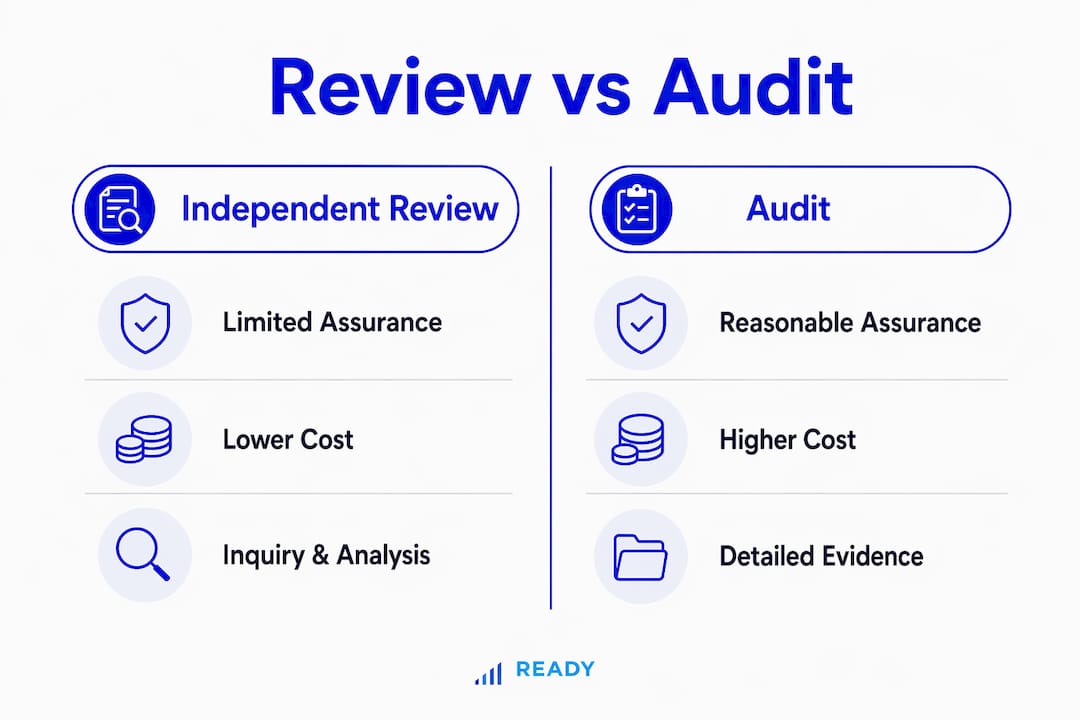
What is an audit and how does it differ in process and outcome?
An audit provides reasonable assurance, meaning the auditor has gathered sufficient evidence to form a positive opinion on whether the financial statements are free from material misstatement. This is the gold standard of financial assurance in South Africa and globally.
The audit process involves full substantive testing, evaluation of internal controls, and assertion-level risk assessment. The auditor tests samples of actual transactions, confirms balances with third parties, and checks whether your accounting policies comply with IFRS or IFRS for SMEs. The audit process South Africa businesses must follow is governed by International Standards on Auditing (ISA) and regulated by the Independent Regulatory Board for Auditors (IRBA).
Key features of a statutory audit:
- Only an IRBA registered auditor can sign off a statutory audit. No exceptions.
- The auditor issues a positive opinion report, stating the financial statements present fairly in all material respects.
- Audits are mandatory for companies with a PIS of 350 or above, listed companies, and state-owned entities.
- The process typically takes weeks to months, depending on company size and complexity.
- Audit fees cost roughly double what an independent review costs for a comparable engagement.
Pro Tip: If your company is approaching a PIS of 350, budget for an audit at least one financial year in advance. Switching from a review to an audit mid-year creates significant additional cost and delays.
How does the Public Interest Score determine your compliance obligation?
The Public Interest Score is a number calculated annually under the Companies Act, 2008. It measures your company’s impact on the public based on four factors: the number of employees, third-party liabilities, turnover, and the number of beneficial shareholders.
Each factor contributes points to your total PIS. The thresholds set by the Companies Act determine what level of financial assurance your company must obtain. Ownership structure and compilation method also affect the outcome.
| PIS range | Company type | Assurance required |
|---|---|---|
| Below 100 | Owner-managed, internally compiled statements | Compilation only (no review or audit required) |
| Below 100 | Owner-managed, independently compiled statements | Independent review required |
| 100–349 | Any company | Independent review required |
| 350 and above | Any company | Statutory audit required |
| Any PIS | Listed company or state-owned entity | Statutory audit required |
Owner-managed companies with a PIS below 100 and internally compiled statements have the lightest obligation. Once an independent accountant compiles your statements, the review requirement kicks in even at low PIS levels. Non-owner-managed companies face stricter rules at every threshold. Ignoring these thresholds exposes your business to CIPC penalties and potential SARS scrutiny during a compliance review.
Cost, timing, and practical factors when choosing between a review and an audit
Independent reviews cost roughly half of what audits do for comparable engagements. For a growing SME, that difference can be material. A review also takes days to weeks, while an audit often runs for months. Both factors matter when you are managing cash flow and finance team capacity.

| Factor | Independent review | Audit |
|---|---|---|
| Assurance level | Limited | Reasonable (highest) |
| Cost | Lower (approx. 50% of audit) | Higher |
| Time to complete | Days to weeks | Weeks to months |
| Practitioner required | SAICA/SAIPA member or accounting officer | IRBA registered auditor only |
| Typical trigger | PIS 100–349, lender request, voluntary | PIS 350+, listed company, regulatory requirement |
Stakeholder expectations also drive the decision. Investors seeking equity funding or lenders evaluating a large facility often require audit-level assurance. Loan approval odds improve when financial statements carry a clean audit opinion rather than a limited assurance review report. If you plan to raise capital or apply for significant credit in the next 12 months, factor that into your assurance planning now.
One critical risk: switching from a review to an audit mid-engagement is not permitted under professional standards. Audit evidence requirements under ISA are fundamentally different from review procedures under ISRE 2400. The auditor must start evidence gathering from scratch, which means duplicate costs and delays. Make the right call before the engagement begins.
Pro Tip: Ask your accountant to calculate your PIS at the start of each financial year. A single large contract or new hire can push you across a threshold and change your compliance obligation.
Common misconceptions about independent reviews and audits in South Africa
The most damaging misconception is that an independent review is simply a smaller, cheaper audit. It is not. Reviews and audits differ fundamentally in approach, scope, and the risk assessment framework the practitioner applies. A review practitioner does not test transactions or evaluate internal controls. An auditor does both.
Many SMEs assume that because a review costs less, it always meets stakeholder needs. That assumption creates compliance risk when audit-level assurance is legally required or when a lender specifically requests an audit opinion. The differences between audit and review extend to the professional qualifications of the practitioner, the standards applied, and the legal weight of the resulting report.
Independence is non-negotiable for both engagements. ISRE and ISA standards mandate independence for every assurance engagement, including voluntary reviews. A practitioner who prepares your management accounts and then signs off your independent review has a conflict of interest that invalidates the assurance. This is a real-world problem that Readyaccounting sees regularly with smaller firms trying to cut costs.
“Independence is not a technicality. It is the foundation of credibility. Without it, your financial statements carry no assurance value, regardless of what the report says.”
Pre-engagement planning for independent reviews is more demanding than many expect. Because the practitioner cannot rely on substantive testing, they must invest heavily in front-end risk assessment to determine whether the financial statements are plausible. Skipping this step produces a review report that would not survive scrutiny from SARS or a sophisticated lender.
Key takeaways
An independent review provides limited assurance through inquiry and analytical procedures, while a statutory audit delivers reasonable assurance through full substantive testing. South African law, specifically the Companies Act and your Public Interest Score, determines which one your business must obtain.
| Point | Details |
|---|---|
| Assurance levels differ | Reviews give limited assurance; audits give reasonable assurance, the highest level available. |
| PIS drives your obligation | A PIS of 100–349 requires a review; 350 and above requires a statutory audit. |
| Practitioner qualifications matter | Only an IRBA registered auditor can sign a statutory audit; reviews allow SAICA or SAIPA members. |
| Reviews are not mini-audits | Reviews use inquiry only; audits test transactions and evaluate internal controls. |
| Mid-engagement switches are costly | Switching from review to audit invalidates prior work and forces the auditor to restart evidence gathering. |
What I have learned helping South African SMEs choose the right assurance engagement
Most business owners I work with come to this decision too late. They wait until a lender asks for audited financials or until CIPC flags a compliance issue. By then, the cost of getting it right has doubled because the review work cannot be reused.
My strongest advice is to calculate your PIS at the start of every financial year, not at the end. One new employee, one large creditor, or one additional shareholder can shift your threshold. Catching that early costs nothing. Catching it after a review is complete costs you the full audit fee on top of what you already paid.
I also see business owners underestimate the independence requirement. They assume their bookkeeper or management accountant can sign off a review. That is only valid if the practitioner holds the right qualifications and has no conflict of interest. SAICA and SAIPA have clear rules on this. IRBA is even stricter for audits. Engaging the wrong practitioner does not save money. It produces a report that carries no legal weight.
The most useful mindset shift I can offer: treat your annual assurance engagement as a planning tool, not a compliance checkbox. A well-executed independent review or audit tells you where your financial controls are weak before SARS or a lender finds out. That intelligence is worth more than the fee.
— Johan
How Readyaccounting helps you stay compliant and financially prepared
Readyaccounting works with South African SMEs and VC-backed startups to remove the friction from financial compliance. Whether your business needs an independent review or a statutory audit, we help you calculate your PIS early, engage the right qualified practitioner, and prepare financial statements that hold up to scrutiny. Our cloud-based financial infrastructure means your records are audit-ready year-round, not just in the weeks before your engagement begins. Learn how accounting automation improves cash flow and reduces the time your team spends preparing for assurance engagements. Contact Readyaccounting to discuss your compliance obligations and get the right assurance engagement in place before your next financial year closes.
FAQ
What is the main difference between an independent review and an audit?
An independent review provides limited assurance using inquiry and analytical procedures, while an audit provides reasonable assurance through substantive testing and internal control evaluation. The audit is the higher standard and carries greater legal weight.
When is a statutory audit required in South Africa?
A statutory audit is required when a company’s Public Interest Score reaches 350 or above, or when the company is listed on a stock exchange or is a state-owned entity. Only an IRBA registered auditor can perform a statutory audit.
Can the same accountant who prepares my financial statements also do my independent review?
No. Independence is a legal requirement under ISRE standards. A practitioner who prepares your financial statements has a conflict of interest that disqualifies them from performing your independent review.
How is the Public Interest Score calculated?
The PIS is calculated annually using four factors: number of employees, third-party liabilities, annual turnover, and number of beneficial shareholders. Each factor contributes points, and the total determines your assurance obligation under the Companies Act, 2008.
Can I switch from an independent review to an audit after the review has started?
No. Switching mid-engagement is not permitted under professional standards. Audit evidence requirements under ISA differ fundamentally from review procedures under ISRE 2400, so the auditor must restart evidence gathering from the beginning, which increases cost and delays your financial reporting.
Recommended
- Auditing financial statements: protocol for South African Corporate Assets | Ready Accounting
- Understanding auditing: a guide for South African SMEs | Ready Accounting
- Key Difference Between Accountant and Auditor for SA Businesses | Ready Accounting
- Grasp the basic principles of auditing for SA SME success | Ready Accounting