

Importance of business networking for South African SMBs
Executive Summary
- South African SMBs often misunderstand networking, focusing on volume rather than mutually valuable relationships. Building genuine, capability-driven partnerships through structured, purposeful engagement enhances growth and resilience in a challenging environment. Effective networking requires ongoing relational capability, clear separation of funding and business support efforts, and leveraging structured channels to generate sustainable collaborations.
Most small business owners in South Africa treat networking like a numbers game, collect as many cards as possible, shake hands, follow up once, and wait. That misunderstanding costs real growth. The true importance of business networking lies not in volume but in the quality of mutual value exchanged. Effective networking is built on relationships where both parties gain something tangible, whether that is a referral, a partnership, access to capital, or a piece of market intelligence you could not find anywhere else. This guide shows you exactly how to build those relationships with intent.
Table of Contents
- What makes business networking essential for South African entrepreneurs
- How to structure your networking for maximum mutual value
- Choosing the right networking channels and events in South Africa
- Building and sustaining effective business partnerships through relational capability
- Navigating funding and business support networks separately for better outcomes
- Why networking success depends on building genuine, capability-driven partnerships
- How Ready Accounting can support your business networking and growth goals
- Frequently asked questions
What makes business networking essential for South African entrepreneurs
Networking is not a soft skill. For South African SMB owners, it is one of the sharpest competitive tools available, particularly in a market where formal institutional support is inconsistent and access to decision-makers is unevenly distributed.
The benefits of networking go well beyond landing a new client. A broader network gives you exposure to diverse knowledge and opportunities that fuel both innovation and business ambition. That means you hear about the tender before it is advertised. You get introduced to the investor who is quietly looking for a business in your sector. You find out which SARS audit triggers are catching similar businesses right now, because someone in your circle just went through it.
South Africa’s business environment has its own texture. Load shedding disrupts operations. Regulatory requirements from SARS and the Companies and Intellectual Property Commission create compliance pressure. Currency volatility affects importing and exporting SMBs. Within that context, the right network is often the difference between absorbing a shock and folding under it.
What strategic business networking actually does for you:
- Opens doors to joint ventures and supplier relationships you could not find through cold outreach
- Connects you to mentors and advisors who have already solved the problems you are facing
- Surfaces funding opportunities from angel investors, development finance institutions, and grant programmes
- Builds your reputation in your industry before a client ever searches for you
- Gives you early access to regulatory changes that affect your compliance obligations
The key shift in thinking is this: focus on fit rather than frequency. Ten relationships with people whose goals align with yours will always outperform a spreadsheet of 500 contacts you never engage meaningfully. Start by building strong business networks with people who are genuinely positioned to create value with you, not just people who show up at the same events.
How to structure your networking for maximum mutual value
Understanding why networking matters is the easy part. Most people get stuck on the how, specifically how to approach someone without it feeling transactional, hollow, or one-sided.

The answer is a contribution mindset. Before you ask for anything, ask yourself: what can I give this person? That could be an introduction to a procurement contact, a piece of industry data, a candid observation about a competitor’s product gap, or simply a referral to someone better suited to help them right now. Effective networking creates mutual value, not just one-sided requests that leave the other person feeling used.
Here is how to structure your outreach with that in mind:
- Identify what you genuinely have to offer. Before any event or meeting, write down three things you can share: an insight, a contact, or a solution to a problem you have seen others struggle with.
- Qualify before you invest time. Not every connection deserves deep energy. Ask: does this person’s work, client base, or expertise align with where I want to take my business in the next 12 months?
- Lead with relevance. When you reach out, reference something specific to their business or industry. Generic openers signal that you are not really paying attention.
- Create a follow-up system. A conversation at a mixer means nothing without a concrete next step. Set a date, a topic, and an action item before you walk away.
- Keep a relationship log. Track what you offered, what was discussed, and what you committed to. Treat it with the same discipline you apply to your sales pipeline.
Pro Tip: The strongest networking position is being known as someone who connects other people. When you introduce two contacts who genuinely benefit from knowing each other, both of them remember you as a resource, not a favour-seeker. That reputation compounds.
The proven networking strategies that actually convert into partnerships are built on this discipline. Consistency and contribution, repeated over time, are what separate meaningful professional growth from a pile of business cards in a drawer.
Choosing the right networking channels and events in South Africa
South Africa has a surprisingly rich landscape of structured networking opportunities, but not all of them are equal. The difference between a useful channel and a waste of an evening often comes down to whether the organiser has built in structured follow-through or simply booked a venue and a catering company.
Channels worth your time typically offer:
- Recurring mixers that let you build relationships over multiple touchpoints, not just a single encounter
- Access to advisors with specific expertise in funding, compliance, or market development
- Curated attendee lists so you are not spending 90 minutes talking to people with no relevance to your goals
- Capacity-building components like workshops or briefings that give you something to take away beyond a name badge
The Randburg Chamber of Commerce and Industry is a strong example of how structured networking should work. RCCI provides recurring mixers and advisor consultations focused on funding, compliance, and partnerships, which means each interaction has a context and a purpose. That structure dramatically improves your conversion rate from conversation to collaboration.
At the higher end, events like the SA Chamber of Commerce UK’s Ambassadors and Executives Networking Luncheon facilitate outcomes-driven engagement with senior leaders and diplomatic missions, the kind of room where a single introduction can unlock an export relationship or foreign investment conversation.
| Channel type | Best for | Networking depth |
|---|---|---|
| Chamber of commerce | SMB compliance, local partnerships, funding referrals | Medium to high, recurring access |
| Industry associations | Sector-specific knowledge, supplier relationships | High, niche and targeted |
| Curated executive events | High-value partnerships, international exposure | Very high, low volume |
| General business mixers | Brand visibility, broad introductions | Low to medium, requires active follow-up |
| Online communities | Market intelligence, lightweight warm-up | Low, supplements in-person |
Pro Tip: Separate your networking calendar by purpose. Funding conversations require a different room and a different mindset than capability or market-access discussions. Trying to combine them in a single event or relationship path creates confusion and dilutes your message to both audiences. Use your networking strategies document to plan these streams independently.
Building and sustaining effective business partnerships through relational capability
Getting into a room with the right people is one thing. Converting that introduction into a working partnership that actually delivers revenue, resources, or strategic advantage is a completely different skill set. Most SMBs underinvest in this second part.
Research on SME relational capabilities shows that businesses need to treat networking as an ongoing capability, one involving active partner qualification, structured communication, and relationship governance. That is a clinical way of saying: you need a process, not just good intentions.
Practical steps to develop your relational capability:
- Qualify partners early. Does this person or organisation have a complementary need? Are the goals shared or at least compatible? Do not invest months in a relationship that was never aligned to begin with.
- Set explicit expectations upfront. What does success look like for both parties? How often will you communicate? Who is responsible for each action item?
- Document next steps after every meaningful interaction. A short email summary after a meeting does more for partnership continuity than any amount of goodwill.
- Build in review checkpoints. Every three to six months, assess whether the partnership is delivering on its original intent. Relationships drift without deliberate attention.
- Treat governance seriously. Even informal partnerships benefit from written agreements on scope, referral terms, or confidentiality. It protects the relationship, not just your interests.
Pro Tip: One underused tool in South African SMB networking is a simple partner brief: a one-page document that explains who you are, what you are looking for, and what you bring to a collaboration. Sharing it early removes ambiguity and signals that you are serious about a structured relationship.
The investment in relational capability pays compound returns. When you learn to strengthen business relationships systematically, each new partnership becomes easier to establish because your process is already refined.
Navigating funding and business support networks separately for better outcomes
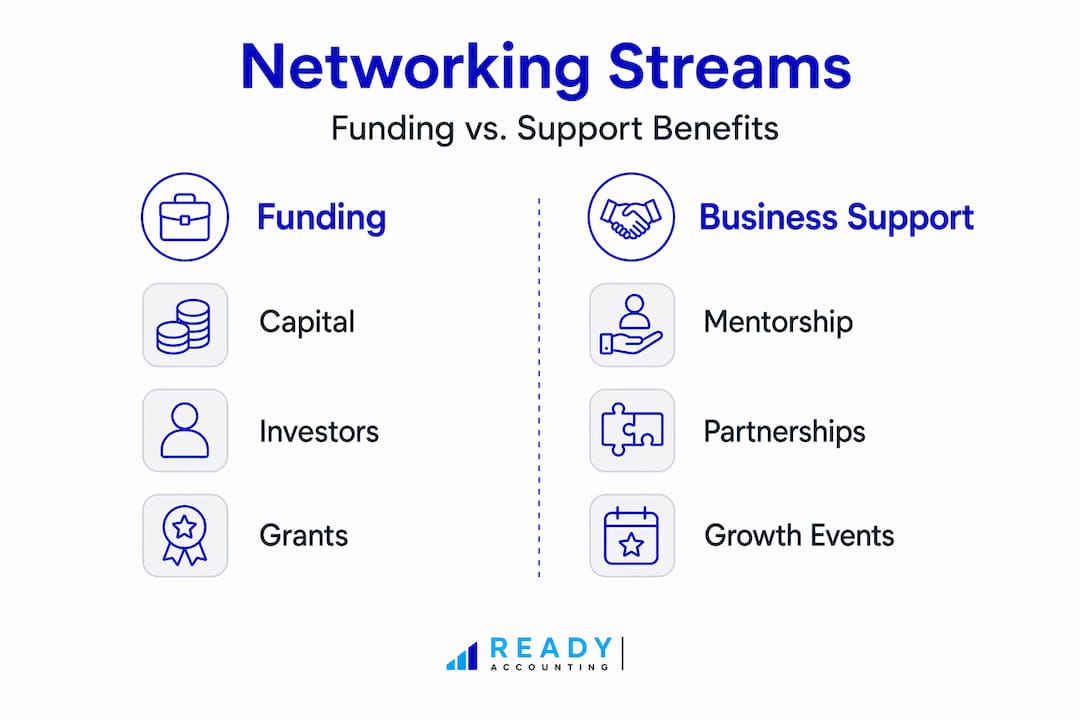
Here is a mistake that kills networking momentum: walking into every relationship with a combined ask. You want funding, you want mentorship, you want market access, and you present all of it to the same person in the same conversation. It is overwhelming for your contact and strategically unfocused for you.
Research on the South African SME entrepreneurial ecosystem confirms that finance support and business support each positively impact SMEs, but they work better when engaged separately rather than stacked into a single networking push. The interaction effect between them is not additive. It actually reduces the clarity and effectiveness of both.
Here is how to separate these streams in practice:
- Map your needs into two distinct categories. Category one: capital, credit, or investment. Category two: advisory, capability, or market access support.
- Build two separate contact lists. Funders and investors form one track. Advisors, partners, and sector specialists form another. Do not mix these in your CRM or your calendar.
- Prepare separate pitches and value propositions. What you say to a Development Finance Institution is not what you say to a potential joint venture partner.
- Set distinct success metrics for each stream. Funding networking succeeds when you have a term sheet or a qualified warm introduction to a funder. Business support networking succeeds when you have a working agreement, a referral arrangement, or a capability gap filled.
| Networking stream | Primary goal | Key contacts | Success indicator |
|---|---|---|---|
| Funding and finance | Capital access, credit, investment | DFIs, angel networks, banks | Warm intro or term sheet |
| Business advisory | Skills, market access, referrals | Chambers, industry bodies, mentors | Active collaboration or referral |
Keeping these tracks clear sharpens your messaging and protects your relationships. A funding contact who is suddenly asked for business mentorship feels miscast. A mentor who is asked for money feels put on the spot. Your networking growth strategies should reflect this separation from the start.
Why networking success depends on building genuine, capability-driven partnerships
Most networking advice focuses on tactics: what to say, where to go, how often to follow up. That is useful, but it misses the deeper reason most SMB networking fails to produce partnerships. The problem is not technique. It is substance.
When you show up without a clear sense of what you bring to a relationship, the conversation has nowhere meaningful to go. People are busy. Goodwill alone does not sustain a business relationship for long. What does sustain it is mutual value and relational capabilities, the combination of having something real to offer and knowing how to develop and maintain the relationship over time.
The uncomfortable truth about networking in South Africa’s SMB ecosystem is that most of it stays at the level of pleasant introductions. A coffee meeting happens. A follow-up email goes out. Then silence. That is not a pipeline problem. It is a capability problem.
High-leverage networking looks different. It involves entering a relationship with an explicit understanding of what each party needs and a concrete idea of how you can help the other party get there. It means building a strong business network with intentional, documented cycles of outreach, contribution, and review rather than sporadic, enthusiasm-driven bursts of contact.
The most effective SMB owners we see are not the ones attending the most events. They are the ones who have built a reputation as genuine connectors and problem-solvers within a focused network of 30 to 50 people. That network delivers consistently because it was built on capability and authenticity, not visibility and volume.
How Ready Accounting can support your business networking and growth goals
Now that you know how to network with intent, the next question is whether your financial operations can keep up with the growth those relationships generate. New partnerships mean new invoices, new contracts, and new compliance obligations. If your bookkeeping is manual and reactive, you will spend the time networking created right back on administrative catch-up.
Ready Accounting replaces that friction with cloud accounting infrastructure that gives you real-time visibility into cash flow, so you walk into every funding conversation with accurate numbers. Our automation tools improve cash flow reliability and keep your records SARS-ready without the monthly scramble. The cloud accounting benefits for growing SMBs include faster decision-making, cleaner audit trails, and more time for the relationship-building that actually drives revenue. We also help you reduce tax liability with proactive planning, so the wealth your network helps you build stays protected.
Frequently asked questions
Why is mutual value important in business networking?
Mutual value ensures both parties in a networking relationship gain something tangible, which builds trust and makes the relationship worth sustaining. Networking built on mutual value rather than one-sided requests creates the ethical foundation for long-term partnerships.
How can South African SMEs choose effective networking events?
Prioritise events that offer structured, recurring access rather than one-off socialising. RCCI’s structured networking with quarterly mixers and advisor support is a strong local example of an event format that produces measurable outcomes for SMBs.
Should funding and business support networking be combined?
No. Research shows that finance and business support each benefit South African SMEs positively but via separate relationship paths, and combining them in a single interaction dilutes the effectiveness of both.
What does building relational capability involve for SMEs?
It means developing a repeatable process for qualifying partners, setting clear communication expectations, and governing relationships over time. Relational capabilities enable SMEs to convert networking introductions into sustainable, productive business collaborations.