

Start a SARS Ready Bookkeeping Business in South Africa in 30–90 Days
Start a SARS Ready Bookkeeping Business in South Africa in 30–90 Days
Start by moving your books onto a SARS-ready cloud accounting platform, connect live bank feeds, and set up an audit-ready monthly close, before your VAT liability date catches you flat-footed. If your taxable turnover is closing in on the R2.3 million compulsory registration threshold, that record system isn’t optional. Get this foundation right in the next 30 to 90 days, and Ready Accounting’s Johan can help you migrate without disrupting operations.
Executive Summary
- Moving books to a cloud platform with live bank feeds and setting up audit-ready processes should be completed within 30 to 90 days to ensure SARS compliance.
- Choose accounting software that offers direct South African bank feeds, a genuine audit trail, VAT handling, document attachments, and API capability, then test it live before committing.
- VAT registration becomes mandatory at R2.3 million in taxable turnover within a 12-month period, with an application deadline of 21 business days after crossing the threshold.
- Record-keeping must include storing data in an acceptable electronic form in South Africa unless authorized for offshore storage, and SARS requires detailed audit logs and supporting documentation.
- Outsourced bookkeeping costs vary depending on transaction volume, payroll complexity, and service level, with tiered packages often best for VC-backed startups needing investor reports.
Table of Contents
- How to start my bookkeeping business: the 30 to 90 day setup
- What should you look for in a cloud bookkeeping platform?
- What SARS and CIPC compliance actually requires from your books
- How much does outsourced bookkeeping actually cost?
- Why bookkeeping automation is the real competitive edge for scaling businesses
- Get your books SARS-ready without the guesswork
- Forms and guides worth bookmarking
- Sources
How to start my bookkeeping business: the 30 to 90 day setup
Founders usually make one of two mistakes when they try to figure out how to start my bookkeeping business the right way: they either bolt together spreadsheets and hope, or they buy expensive software and never configure it properly. Both leave you exposed the moment SARS asks a question you can’t answer in under a minute.
Here’s the sequence that actually works, spread across three months so it doesn’t derail your operations:
- Map your compliance dates first. Find your VAT liability date if you’re near or over the R2.3 million compulsory threshold, and confirm your CIPC annual return due date, which is tied to your company’s registration anniversary.
- Trial a cloud platform for two weeks. Connect one live bank account, import your opening balances, and attach five real supporting documents to test the workflow before committing.
- Build your month-end cadence. Lock in bank reconciliation, VAT recon, payroll submission, and (if you’re VC-backed) investor reporting into a fixed monthly calendar with named owners for each task.
- Set access controls and backups. Configure user roles, turn on audit logging, and document your backup schedule, because SARS expects proof your records haven’t been tampered with.
- Run a readiness drill. Pick ten random transactions from the past quarter and time how long it takes to pull the invoice, the bank match, and the audit trail. Under 30 seconds each is the bar.
Pro Tip: Run that readiness drill before you need it for real. If it takes you ten minutes to find one invoice during a practice run, it’ll take you an hour during an actual SARS verification, and that’s when penalties start accumulating.
This isn’t busywork. A SARS compliance checklist built around these five steps is what separates a business that sails through a verification request from one that scrambles for three weeks.
What should you look for in a cloud bookkeeping platform?
Not every accounting platform marketed to South African SMEs actually holds up under a SARS review. The features that matter aren’t the flashy ones; they’re the boring ones that protect you when it counts.
Prioritise platforms that offer:
- Direct bank feeds for the major South African banks, so reconciliation happens daily instead of monthly.
- A genuine audit trail that logs who changed what and when, not just a transaction list.
- VAT handling that maps correctly to standard, zero-rated, and exempt supplies, with VAT201 export or direct eFiling integration.
- Document attachment at the transaction level, so every invoice, receipt, and contract sits next to its entry.
- Payroll integration that can generate EMP201 and EMP501 data without a manual re-entry step.
- API capability, because phased e-invoicing rules are already moving through South African regulatory channels, and a platform without an open API will struggle to adapt.
Before you sign anything, run a vendor-test script rather than trusting a sales demo. Ask them to show you a live VAT201 pull, connect a real bank feed in front of you, export an audit log for a random date range, and retrieve one attached document from six months back. If any of those steps takes longer than a minute or requires a support ticket, keep looking.
Pro Tip: Ask the vendor to run their payroll module live, generating an EMP201 for a sample employee. A platform that fumbles this in a demo will fumble it on your actual payday.
Migration works best in stages. Pull your historical data in a clean export format, migrate one bank account first, and only bring the rest of your accounts across once that first one reconciles cleanly for a full month. A cloud accounting system built for South African compliance should make this staged approach straightforward, not a fight.
What SARS and CIPC compliance actually requires from your books
South Africa’s rules on VAT and record-keeping aren’t suggestions; they carry real deadlines and real penalties for missing them.
The numbers you need memorised: compulsory VAT registration kicks in once taxable supplies cross R2.3 million over a 12-month period, and you must apply promptly within the required timeframe after crossing that threshold. Voluntary registration is available from a lower threshold, which some growing startups choose early to reclaim input VAT on infrastructure spend.
Compulsory VAT registration in South Africa applies at R2.3 million in taxable turnover, with a 21 business day window to apply once you’ve crossed it. Voluntary registration opens at R120,000.
On record-keeping, SARS is specific: your electronic records need to be in what it calls an “acceptable electronic form,” and they generally must be stored on a system physically located in South Africa unless you’ve secured written authorisation for offshore storage. If you store data offshore, SARS may require you to produce those records within a specified reasonable period following a request, so “it’s in a server somewhere overseas” is not an acceptable answer during an audit.
Your compliance checklist should cover:
- Confirm your VAT accounting basis (invoice or payment) and your tax period category, as these determine your filing cadence.
- Keep audit logs that show creation, edits, and deletions on every financial record, not just the current balance.
- Retain supporting documentation, bank statements, and payroll records for the period SARS may reasonably request them.
- File CIPC annual returns on time every year, and confirm whether your company qualifies for the Financial Accountability Supplement or requires full audited Annual Financial Statement with iXBRL formatting. Missing this filing repeatedly can lead to CIPC deregistering your company.
- Document your software setup if it’s customised or non-standard, since SARS expects a data trail showing how records are created and archived.
Our own guide on SARS record-keeping rules walks through the practical side of building this into your existing workflow rather than treating it as a once-a-year scramble before tax season.
How much does outsourced bookkeeping actually cost?
Pricing in this space varies more than most founders expect, and the variance usually comes down to complexity rather than the provider padding their fees.
Three common shapes dominate the market. A fixed monthly retainer is the most predictable, bundling reconciliation, VAT recon, and basic reporting into one number that doesn’t shift with transaction volume. Per-transaction or per-invoice pricing suits very early-stage businesses with low volume but scales awkwardly once you grow. Tiered packages, which add payroll processing, tax consulting, or fractional CFO advisory on top of core bookkeeping, tend to fit VC-backed startups best because the tier grows alongside headcount and investor reporting needs.
What actually drives the number on your invoice:
- Monthly transaction volume across all bank accounts and credit facilities.
- Number of payroll employees and the complexity of your benefits structure.
- Whether you need retroactive cleanup of prior years’ books (this is almost always priced separately and can be substantial).
- Integration requirements between your accounting platform and other systems (payment processors, e-commerce platforms, CRM).
- The service level you need: same-day query turnaround costs more than 48-hour turnaround.
When comparing quotes, ask each provider directly how fast they close your books each month, whether their dashboard shows runway and burn rate in real time, and whether they’ve prepared investor-ready financials before. A cost breakdown for bookkeeping services in the South African market gives useful benchmarks if you want to sense-check a quote against what similar businesses are actually paying.
Why bookkeeping automation is the real competitive edge for scaling businesses
Most founders treat bookkeeping as an administrative cost to minimise. That’s backwards. Readyaccounting built its fractional CFO model around the opposite premise: real-time runway dashboards and forensic tax defense aren’t overhead, they’re what lets a founder walk into an investor meeting with numbers nobody can poke holes in.
The outcomes we aim for are concrete: faster month-end close, dramatically lower friction during a SARS verification, and financials a due diligence team doesn’t flag…
The gap between businesses that treat this as infrastructure and those that treat it as an afterthought shows up exactly when it matters most, at your Series A term sheet or your first SARS audit letter.
— Johan
Get your books SARS-ready without the guesswork
If you’ve read this far, you already know the DIY spreadsheet route runs out of road the moment you cross the VAT threshold or a term sheet lands on your desk. Readyaccounting builds the cloud infrastructure directly, connecting your bank feeds, configuring audit logs, and setting up the runway dashboards your investors expect to see, without you having to learn the compliance rules yourself while running the business.
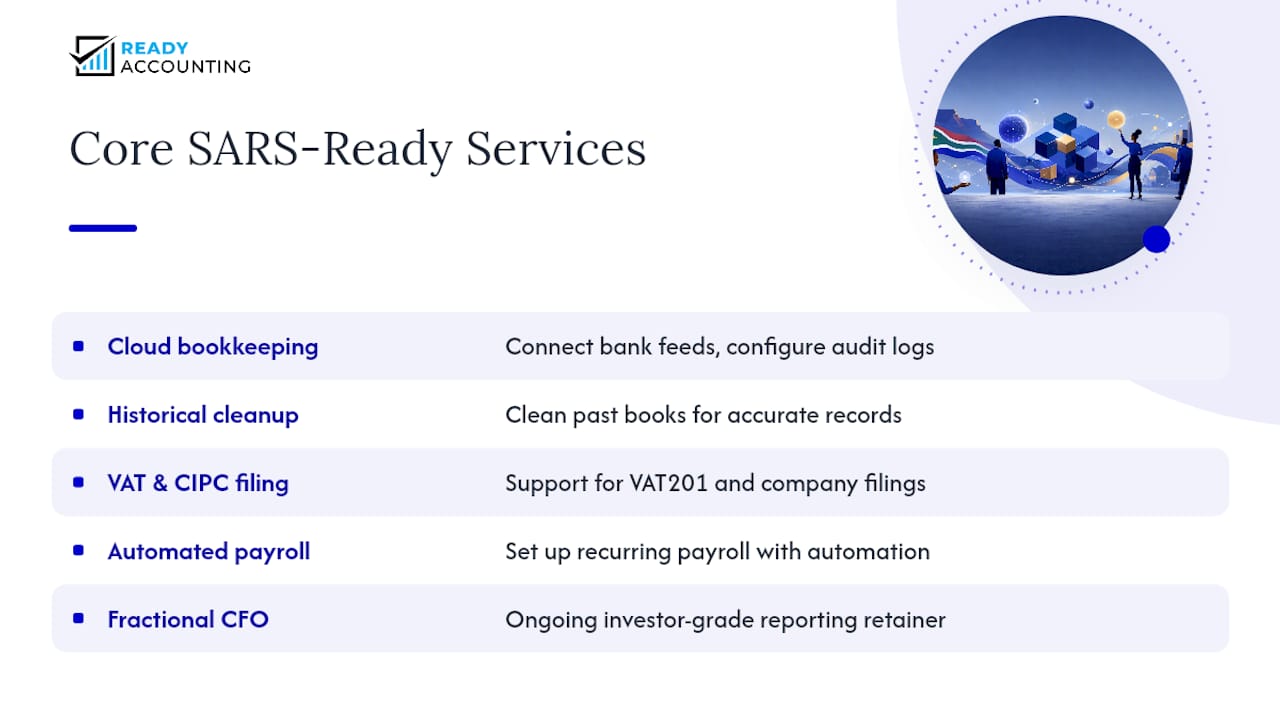
Our core services cover cloud bookkeeping implementation, historical books cleanup, VAT and CIPC filing support, automated payroll, and ongoing fractional CFO retainers for startups that need investor-grade reporting on tap. If your current setup is manual, patchy, or you’re simply unsure whether it would survive a SARS review, book a readiness call or request a scoping estimate for your migration.
See exactly how automation improves cash flow for a growing business, and get in touch with our team to schedule your VAT201 demo and migration assessment.
Forms and guides worth bookmarking
Keep these close: SARS’s VAT guidance for registration mechanics, CIPC’s annual returns guide for statutory filings, and our own VAT registration walkthrough for the practical version.
Sources
- SARS: Value-Added Tax (VAT)
- Tax Administration Act: Electronic form of record keeping (Government Gazette / SARS rules)
- CIPC: Comprehensive step-by-step guide on how to file annual returns, FAS and AFS