

4 Steps to Set Up Bookkeeping for Small Businesses in South Africa
4 Steps to Set Up Bookkeeping for Small Businesses in South Africa
The fastest way to fix messy books is to do four things in order: open a dedicated business bank account, gather every invoice, receipt, and contract you have and digitize them, decide between cash and accrual accounting, and start recording transactions weekly in simple cloud software. Get those right and everything else, from VAT registration to your first Annual Financial Statement, gets dramatically easier.
Executive Summary
- Opening a dedicated business bank account and digitizing all receipts immediately reduces errors and simplifies reconciliations, especially when claiming deductions.
- Switching to accrual accounting and double entry systems becomes essential once inventory, credit terms, or VAT registration are involved, typically after a few dozen transactions per month.
- Automating bank feeds, VAT codes, and recurring rules in cloud software improves accuracy and frees owner time, making manual spreadsheets obsolete beyond very small transactions.
- Conducting brief weekly and monthly reconciliation routines prevents errors from accumulating, which reduces surprises during tax audits or SARS reviews.
- Businesses exceeding roughly 50 transactions monthly should consider outsourcing bookkeeping or payroll services to avoid time drain and costly mistakes.
Table of Contents
- Gather your documents and open the right bank accounts
- Choose your accounting method and entry system
- Set up a chart of accounts and choose your software
- How do you record transactions, invoices and receipts correctly?
- Reconcile your bank accounts and run a proper month-end close
- Payroll essentials and employer filing obligations
- South Africa compliance essentials: SARS, CIPC, and VAT
- A monthly bookkeeping routine you can actually stick to
- When should you hire a bookkeeper or outsource entirely?
- Common bookkeeping mistakes and how to avoid them
- Why automation changes what “good bookkeeping” even means
- Get your books built properly with Ready Accounting
- Sources
Gather your documents and open the right bank accounts
Before you touch any software, you need paper trails and a clean bank account. Practitioner guidance consistently ranks a dedicated business account as the single highest-leverage step you can take, and it costs nothing to do it before your first sale.
Start by collecting:
- Sales invoices and quotes issued to customers
- Purchase invoices, supplier statements, and expense receipts
- Bank and credit card statements going back at least a year
- Payroll records, if you employ anyone
- Signed contracts, leases, and loan agreements
Open a business bank account in your registered trading name and never run business transactions through your personal account. Commingling funds is the fastest way to confuse SARS reviewers and yourself when tax season arrives. If you’re a sole proprietor without a separate legal entity, a dedicated account still matters. It keeps your bookkeeping honest even without a formal separation.
For digitizing, scan or photograph every paper receipt the day you get it, name files consistently (something like 2026-03-15_Suppliername_invoice.pdf), and store them in a cloud folder with automatic backup. Google Drive, Dropbox, or your accounting software’s built-in receipt capture all work. The point is that nothing lives only in a shoebox or a fading thermal receipt.
Choose your accounting method and entry system
Two decisions shape everything that follows: cash versus accrual, and single entry versus double entry.
Cash basis works fine when you invoice and get paid quickly, hold little or no inventory, and have few outstanding receivables. A freelance consultant or a small service business often never needs anything more complex.
Accrual accounting becomes necessary once you:
- Carry meaningful stock or work-in-progress
- Extend credit terms to customers or take credit from suppliers
- Register for VAT, since SARS expects accrual-based reporting for most VAT vendors
- Need financial statements that reflect true profitability, not just cash movement
On entry systems, single entry (a simple income and expense log) suits a very small operation with few transactions. Double entry, where every transaction hits two accounts, catches errors automatically because your books have to balance. Once your transaction volume grows, or a bank or investor wants proper financial statements, double entry stops being optional. The practical trigger point is simple: if you’re doing more than a handful of transactions a week, switch now rather than later.
Set up a chart of accounts and choose your software
Your chart of accounts is the backbone of your bookkeeping system: a structured list of every category your money moves through. Most small businesses need, at minimum:
- Assets: bank accounts, debtors (money owed to you), equipment
- Liabilities: creditors (money you owe), loans, VAT payable
- Equity: owner contributions and drawings
- Income: sales revenue, split by product or service line if useful
- Expenses: rent, salaries, subscriptions, cost of goods sold
Adapt these to your actual business. A retailer needs an inventory account and cost-of-sales tracking; a consultancy usually doesn’t.
Cloud accounting software beats spreadsheets almost immediately once you have more than a few transactions a month, because automation prevents the costly manual errors that spreadsheets invite and saves hours of owner time every week. Spreadsheets are fine for a business doing five invoices a month. They fall apart fast once bank feeds, VAT, or payroll enter the picture.
When you set up your software, enable bank feeds so transactions import automatically, configure VAT tax codes correctly from day one, and build a proper invoice template with your registration details and payment terms.
Pro Tip: Set your invoice numbering sequence before you send your first invoice. Retrofitting a numbering system after 40 invoices is a headache you can avoid entirely.
How do you record transactions, invoices and receipts correctly?
Getting this daily mechanic right is what separates clean books from a year end scramble.
- Invoice promptly. Send invoices the day you deliver a product or service, and include payment terms, your VAT number if registered, and a due date. Delayed invoicing is one of the quietest cash-flow killers in small business.
- Capture every receipt immediately. Photograph it, attach it to the matching transaction in your software, and don’t wait for month end when half of them have faded or disappeared.
- Build bank rules. Most cloud software lets you set rules so recurring transactions (rent, subscriptions, fuel) auto-categorize. This is where automation earns its keep.
- Track petty cash and owner draws separately. Money you pull out of the business for personal use is a drawing, not an expense, and reimbursements for business costs paid personally need their own clear trail so they don’t get mistaken for income.
Reconcile your bank accounts and run a proper month-end close
Reconciliation is where hidden problems surface before they become expensive ones.
- Match every bank transaction to a recorded entry in your books, line by line.
- Investigate unmatched items immediately: a bank fee you didn’t record, a payment that reversed, or a deposit you forgot to invoice for.
- Review debtors and creditors to see who owes you money and who you owe, flagging anything overdue.
- Check your VAT control account, plus any prepayments or accruals, so your numbers reflect reality, not just cash in the bank.
- Document every adjustment you make, with a short note on why, so an auditor or accountant can follow your logic later.
A monthly reconciliation habit of just 30 to 45 minutes catches unrecorded deposits and reversed payments early, before they snowball into a bigger reconciliation headache at tax time. Skipping this step is one of the most common reasons small businesses get an unpleasant surprise during a SARS review.
Payroll essentials and employer filing obligations
If you’re paying anyone a salary, including yourself through a company, you need to register as an employer with SARS and keep proper payroll records: payslips, tax certificates, and leave records.
- EMP201 is your monthly employer declaration, covering PAYE, UIF, and SDL, due by the 7th of the following month.
- EMP501 is your reconciliation, submitted twice a year, confirming that what you declared monthly matches what you actually paid.
- Payroll entries need to flow into your bookkeeping as liabilities until paid over to SARS, not as straight expenses the moment you run payroll.
The most common payroll pitfall is treating the PAYE and UIF deducted from staff wages as company cash. That money belongs to SARS from the moment it’s withheld.
South Africa compliance essentials: SARS, CIPC, and VAT
Compliance in South Africa runs on a handful of firm dates and thresholds, and missing them costs real money in penalties.
- VAT registration becomes mandatory once your taxable supplies exceed R2.3 million in any rolling 12-month period, as of 1 April 2026, with VAT201 returns filed bi-monthly, or monthly if your turnover tops R30 million. You can also register voluntarily below the threshold if it suits your business model.
- CIPC registration comes first for a company, and SARS then generates your Company Income Tax reference, with your company representative registering separately on SARS eFiling.
- You have 21 business days to register with SARS once you become liable for tax, whether that’s through trading, hiring staff, or crossing the VAT threshold.
- Record retention runs a minimum of five years from the date of your relevant ITR14 submission, though many practitioners recommend keeping seven years as a practical buffer against later queries.
- Provisional tax runs twice a year via IRP6 submissions, with companies automatically registered for provisional tax the moment they register with CIPC.
Owners remain personally accountable for accurate SARS filings even when a bookkeeper handles the paperwork, which is exactly why the CIPC registration process and your SARS compliance checklist deserve attention from day one, not after your first penalty notice.
A monthly bookkeeping routine you can actually stick to
Consistency beats intensity. A short routine repeated every week outperforms a marathon session once a quarter.
- Weekly: Capture receipts, post new invoices and bills, and clear your inbox of anything financial.
- Mid-month: Reconcile your bank account against your books and review which customers owe you money and for how long.
- End-of-month: Close the books, generate a profit-and-loss statement, and check your cash position against what’s coming due.
- Ongoing: Update a rolling 13-week cash-flow forecast every week, and set aside 15 to 25% of incoming payments as a SARS reserve so tax deadlines never catch you short of cash.
Pro Tip: Block the same 90 minutes every Friday for bookkeeping. Businesses that treat it as a scheduled appointment, not an “if I have time” task, rarely fall behind.
Ready Accounting’s monthly bookkeeping checklist walks through this same rhythm in more detail if you want a printable version to pin next to your desk.
When should you hire a bookkeeper or outsource entirely?
DIY bookkeeping has a natural ceiling, and most owners hit it faster than they expect.
- Transaction volume above roughly 50 a month starts eating hours you should spend running the business.
- VAT registration adds filing complexity most owners underestimate until their first VAT201 is due.
- Payroll introduces statutory deadlines with real penalties for lateness.
- Time spent exceeding four hours a week on bookkeeping is a signal, not a badge of honor.
Your outsourcing options range from a part-time virtual bookkeeper, to fully managed bookkeeping, to a fractional CFO for businesses that need strategic financial oversight, not just data entry. Whichever route you choose, ask for clear deliverables and a written contract before you sign anything.
Common bookkeeping mistakes and how to avoid them
A few mistakes account for most of the bookkeeping trouble small businesses run into.
- Mixing personal and business funds is the most damaging habit in small-business bookkeeping. SARS auditors typically start their review at the business bank account, so keep it transaction-only and route owner withdrawals through a separate drawings account.
- Skipping reconciliations lets small errors compound into big ones by year end.
- Losing receipts means losing legitimate deductions, full stop.
- Miscategorizing expenses quietly shrinks your allowable deductions and distorts your actual profit picture.
Pro Tip: Run a quick categorization review every quarter, not just at year end. Catching a miscoded expense in April is a five-minute fix. Catching it in December after your accountant flags it is a much longer conversation.
Why automation changes what “good bookkeeping” even means
Manual bookkeeping was never really about discipline. It was about the sheer number of repetitive touches, each one a chance for a typo, a missed receipt, or a miscoded expense. Cloud accounting and API bridges between your bank, invoicing, and payroll systems remove most of those touches entirely, which is where the real error reduction comes from, not from owners suddenly becoming more careful.
Fractional CFO oversight earns its cost once your business needs someone reading the numbers strategically: cash-flow timing, tax exposure, runway. That’s a different skill from data entry, and conflating the two is why so many SMEs either overpay for basic bookkeeping or underinvest in the strategic layer they actually need.
— Johan
Get your books built properly with Ready Accounting
Readyaccounting is the alternative to hiring a junior bookkeeper and hoping they catch everything: our clients get cloud infrastructure, API bridges between your bank and accounting software, and real-time dashboards that show your cash position without waiting for month end. If you’re a VAT vendor juggling bi-monthly filings, running payroll for the first time, or a founder who needs runway clarity before your next funding conversation, this is built for exactly that situation.
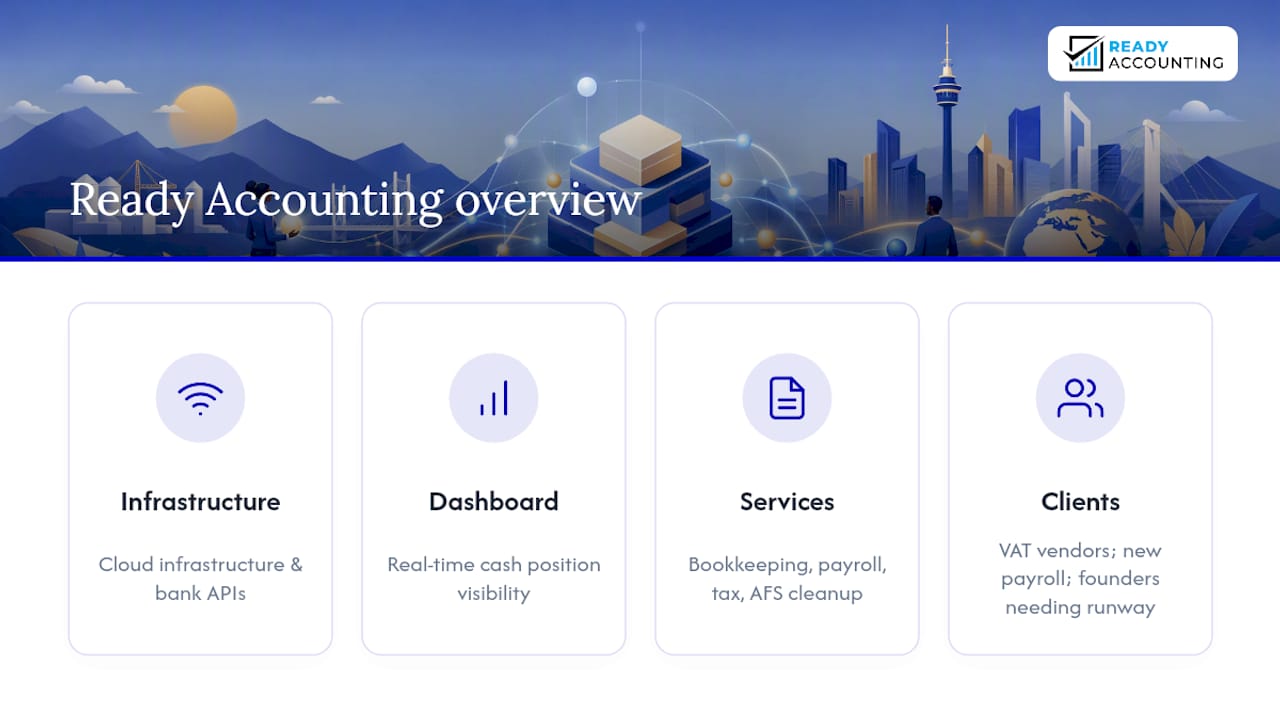
We handle managed bookkeeping, Annual Financial Statements, payroll, tax consulting, and forensic cleanups when your books have fallen behind. Explore how automation improves cash flow for businesses like yours, and get in touch with our team to talk through what your setup actually needs.
Sources
- SARS — Value-Added Tax (VAT)
- SARS — Registering (starting a business and tax)
- SARS — Small business leaflet (updated 27 Nov 2024)
- Okhantu — Bookkeeping basics for South African small businesses